
EPISODE · Sep 2, 2026 · 34 MIN
PSYCH 110: Mood Disorders - Epidemiology
from Clinical Deep Dives · host Dr Manaan Kar Ray
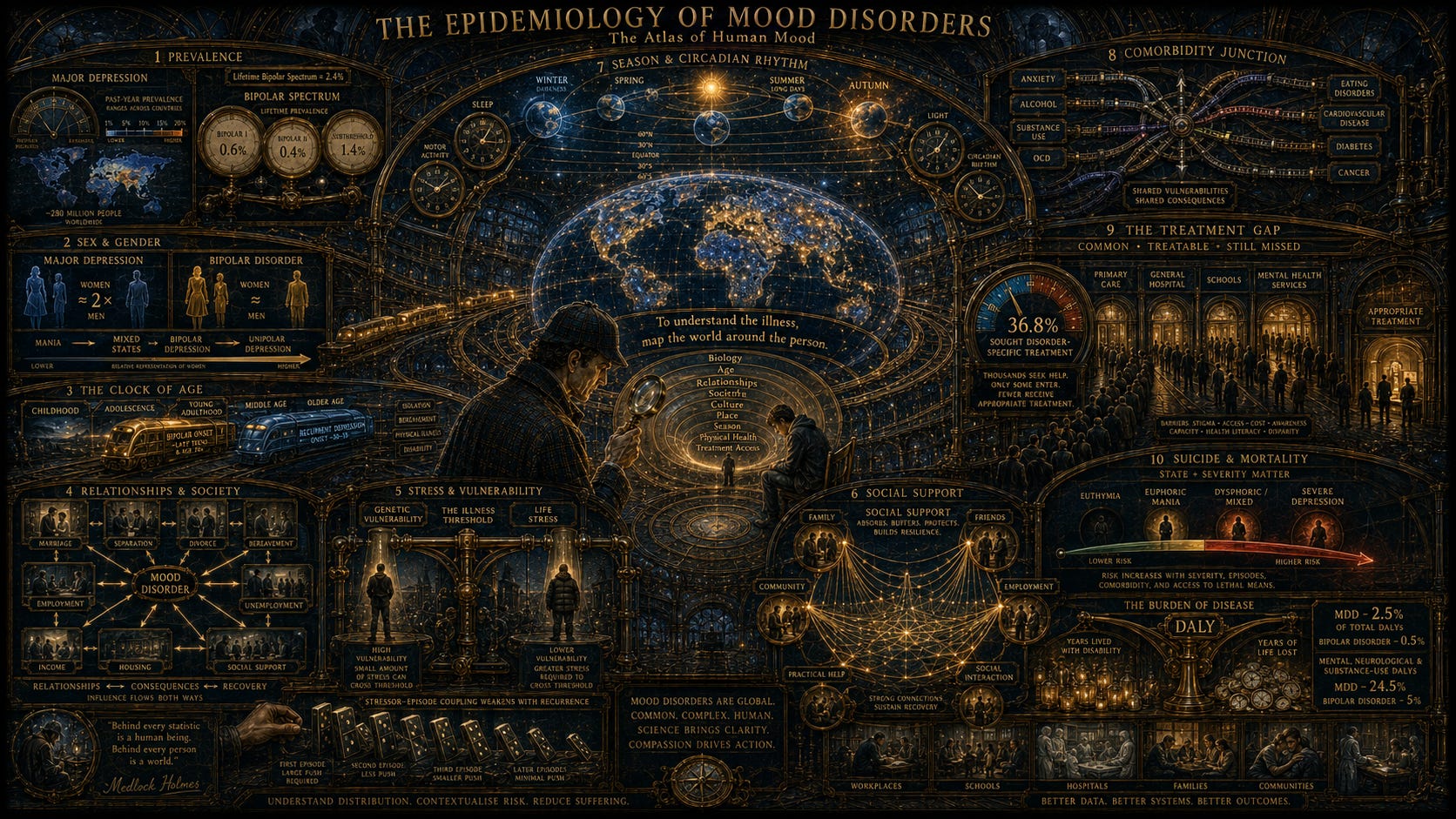
Medlock Holmes enters the Atlas of Human Mood.It is an extraordinary observatory.Suspended at its centre is an enormous illuminated globe. Across every continent, thousands of small lights pulse between blue and gold.Blue represents depression.Gold represents mania and hypomania.But the lights are not distributed randomly.Holmes notices patterns.They cluster differently according to sex.Age.Social circumstances.Relationships.Latitude.Season.Comorbidity.And access to treatment.This is the domain of epidemiology.Its task is not simply to ask:Who develops a mood disorder?It asks something more ambitious:Where does illness occur, when does it emerge, who is most vulnerable, what travels alongside it, what protects against it, and what happens when societies fail to recognise or treat it?The investigation begins with bipolar disorder.Historically, the lifetime prevalence of bipolar I disorder has generally been estimated at around 1%.But the number changes depending upon where investigators draw the diagnostic boundary.The WHO World Mental Health surveys estimated a cross-national lifetime prevalence of the broader bipolar spectrum at approximately 2.4%:0.6% bipolar I0.4% bipolar II1.4% subthreshold bipolar disorderOther studies using broader definitions have produced still higher estimates.Holmes immediately encounters one of epidemiology’s central principles:Prevalence depends partly upon where we draw the diagnostic frontier.Move the boundary outward and more human experience enters the territory called illness.The same principle applies to depression.Across the WHO World Mental Health surveys, lifetime major depressive disorder averaged approximately 11.1% in low- and middle-income countries and 14.6% in high-income countries.Twelve-month prevalence was approximately 5.9% and 5.5%, respectively.On page 5 of the source, the international bar chart makes the point visually: prevalence varies considerably between individual countries, yet major depression is clearly present across both lower/middle- and higher-income settings.But beneath the threshold of major depression lies a much larger territory.Some people experience recurrent brief depression.Others have minor depressive syndromes.Others experience subthreshold hypomania.These states may not satisfy the duration or severity requirements of formal diagnostic systems.Yet they can still produce considerable suffering and disability.When spectrum definitions are used, estimates can reach approximately 5% for bipolarity and 20% for depression.Holmes therefore draws the first epidemiological lesson into his notebook:Diagnostic thresholds create categories; human suffering remains continuous.He turns next towards sex and gender.Here one of psychiatry’s most reproducible epidemiological findings emerges.Major depressive disorder is approximately twice as common in women as in men.The difference develops around early adulthood, becomes particularly pronounced between approximately 30 and 45 years, and persists into older age.No single explanation accounts for it.Biological and hormonal factors may contribute.So may differences in stress exposure and sensitivity.Coping.Social roles.Earlier anxiety disorders.And differences in how depressive symptoms are expressed or recognised.Bipolar disorder presents a fascinating contrast.Across bipolar disorder as a whole, the sex ratio is approximately 1:1.Yet women become increasingly represented as the depressive component of the phenotype increases - including bipolar II disorder, rapid cycling, mixed or dysphoric states, atypical bipolar depression and winter depression.At the other extreme, rare forms of unipolar mania show a predominance of men.Holmes looks again at the great globe.Perhaps epidemiology is not merely counting diagnoses.It is revealing the architecture hidden beneath them.The next gallery is Age.Depression and bipolar disorder have different temporal signatures.The average onset of recurrent major depressive episodes falls around 30–35 years.Single-episode major depression often begins somewhat later.Bipolar disorder typically arrives considerably earlier.Its onset is commonly around 20 years, with more than half of cases beginning before 20, frequently during late adolescence.Men with bipolar disorder may begin approximately four to five years earlier than women.First-onset mania in later life is comparatively unusual.Family history changes the clock again.Individuals with a familial loading for mood disorder tend to develop illness earlier and may require less environmental stress to precipitate an episode.Holmes sketches a simple equation:Genetic vulnerability lowers the threshold at which experience becomes illness.But age changes the nature of vulnerability too.In younger people, social stressors may play a greater role.Later in life, isolation, loss of relationships, disability and physical illness become increasingly important.Depression is therefore not epidemiologically identical across the lifespan.The same syndrome may emerge from a changing ecology of risk.Holmes walks onwards into the Hall of Relationships.Here the statistics become entangled with causality.Mood disorders are more common among people who are divorced, separated or widowed.Recently bereaved people carry particularly high risk of major depressive episodes.But Holmes notices arrows travelling in both directions.Relationship breakdown may precipitate depression.Depression may damage relationships.Mania may generate behaviours that contribute to separation.Divorce then becomes another stressful life event.The consequence becomes another cause.This is one of epidemiology’s great difficulties:Risk factors can become outcomes, and outcomes can manufacture new risk factors.The same circularity appears in socioeconomic status.Depressive symptoms are associated with social disadvantage.Lower income, poorer housing, unemployment and homelessness cluster with mood disorder.The source reports that major depressive episodes were approximately three times more frequent among people without employment than among those with a workplace.But again the arrow is bidirectional.Unemployment can contribute to depression.Depression can contribute to unemployment.Illness can therefore create the very environment that perpetuates it.Holmes calls this the social feedback loop of illness.He enters another chamber labelled Place.Urban environments generally show higher rates of major depression than rural environments in Western studies.Yet “urban” is probably not itself the causal agent.It may instead represent density, stress, social fragmentation, socioeconomic conditions and other environmental exposures.Geography becomes more intriguing when Holmes looks upwards.Above him is an enormous model of the Earth tilted towards the Sun.Mood has a calendar.Spring and autumn are statistical peaks for depression.Summer is a peak for mania.Seasonal affective patterns occur in a substantial minority of people with recurrent mood disorders.Winter depression tends to become more common farther from the equator, although latitude explains only part of the phenomenon.Photoperiod.Climate.Genetics.Culture.Social behaviour.Circadian biology.All may contribute.Holmes realises that mood disorders exist not merely in psychological time but in astronomical time.Earth rotates.Seasons change.Light exposure changes.Sleep changes.Human biology follows.And for some vulnerable brains, mood follows too.The investigation now reaches social stress.Acute negative events can precipitate depressive or manic episodes.But chronic adversity - unemployment, difficult relationships, persistent social strain - may be even more important.Accumulation matters.Multiple adverse events create greater vulnerability than isolated events.Yet something interesting happens as episodes accumulate.The relationship between acute stress and subsequent episodes becomes progressively weaker.Early episodes may require substantial environmental provocation.Later episodes can appear increasingly autonomous.In those with strong genetic vulnerability, episodes may arise without an obvious preceding negative event.Holmes sees a row of dominoes.The first requires a firm push.Later ones fall more easily.This is one way of conceptualising the recurrent nature of mood disorders.But stress is not simply what happens.The source emphasises that subjective perception of the event may matter more than the objective event itself.Two people can inhabit the same external circumstance and experience profoundly different psychological worlds.Epidemiology therefore eventually reaches the boundary of meaning.The next chamber provides the counterweight:Social Support.Strong social networks can modify stress.Relationships can provide emotional support.Practical assistance.Information.Belonging.Perspective.And opportunities for coping.Weak social support, living alone, unemployment and socioeconomic disadvantage are associated with mood disorder.Poor support is related not only to onset but also to relapse and recurrence.Holmes writes:Risk is rarely merely inside the individual.Sometimes resilience lives between people.He now reaches the Comorbidity Junction.Railway lines converge from every direction.Major mood disorders commonly coexist with:Alcohol and other substance-use disordersPanic disorderObsessive-compulsive disorderSocial anxiety disorderEating disordersMen with mood disorders more often show substance-use comorbidity.Women more often show anxiety and eating-disorder comorbidity.Bipolar disorder generally carries greater psychiatric comorbidity than unipolar major depression, with particularly high levels described in bipolar II disorder.These additional disorders matter because they worsen prognosis.And they increase suicide risk.The relationship with alcohol is particularly tangled.The source reports that among people with alcohol-use disorders in the NESARC study, 41% had primary depression, 17% concurrent depression and 42% secondary depression.Holmes sees three arrows:Depression → AlcoholAlcohol → DepressionShared vulnerability → BothClinical assessment must determine which pathway - or combination of pathways - is operating.The railway then enters its darkest tunnel.Suicide.Untreated major mood disorders, particularly bipolar disorder, carry substantial risk of attempted and completed suicide.But the risk is not evenly distributed across mood states.Suicidal behaviour occurs predominantly during severe depressive episodes and, less frequently, mixed affective states or dysphoric mania.It is comparatively rare during euphoric mania or euthymia.Suicide risk is therefore partly state-dependent and severity-dependent.This carries an immediate clinical implication.Treating the mood disorder is itself an intervention in suicide prevention.Yet Holmes writes an important warning beneath it:Risk factors help identify danger; they do not permit perfect prediction of individual suicide.The investigation then widens beyond psychiatry.Mood disorders coexist with cardiovascular disease.Diabetes.Cancer.Other chronic medical illnesses.Several possible bridges connect them:Inflammation.Stress biology.Smoking.Alcohol.Drug use.Sedentary behaviour.Other shared risk factors.The epidemiological association is clear.The precise causal architecture is much less so.Holmes enters the Treatment Observatory.Here he discovers perhaps the most disturbing statistic in the museum.We know mood disorders are common.We know they are treatable.Yet many people never receive adequate treatment.North American and European surveys suggest that roughly half of people developing mood disorders seek treatment, while only a fraction receive appropriate care.The NESARC study found that only 36.8% of people with a current mood disorder had sought disorder-specific treatment.People experiencing mania were less likely than those experiencing major depressive episodes to seek such care.And many people with depression present not to psychiatrists but to primary care.Current major depression in primary-care populations is estimated at approximately 10–15%.In acute medical and surgical hospital settings, prevalence is also above 10%.Physical illness can obscure depression.Depression can worsen physical illness.It reduces adherence.Slows recovery.Increases morbidity.And increases mortality.The patient presenting with diabetes, cardiovascular disease or chronic pain may therefore carry another illness that remains invisible unless somebody deliberately looks for it.Holmes writes:The epidemiology of depression is partly the epidemiology of missed diagnosis.The problem is particularly stark in young people.Despite significant depression and impairment, only a minority receive specialist mental-health services.Schools often become the first point of entry.Yet movement from educational services into specialist mental-health care may be poor.A stepped-care approach - beginning with psychosocial interventions and progressing towards pharmacological treatment and combined approaches according to need - has therefore become increasingly important.Holmes finally enters the largest chamber.Above its doors are the words:BURDEN OF DISEASEAn enormous brass balance carries two weights.One represents premature death.The other represents years lived with disability.Together they form:DALYs - Disability-Adjusted Life Years.Mood disorders weigh enormously upon the scale.The source reports that 2.5% of total DALYs were attributable to major depressive disorder and 0.5% to bipolar disorder in the WHO estimates it discusses.Within mental, neurological and substance-use disorders, approximately 24.5% of DALYs were attributed to MDD and 5% to bipolar disorder.The consequences spread far beyond symptoms.Lost education.Reduced employment.Relationship breakdown.Physical illness.Reduced productivity.Healthcare utilisation.Suicide.Premature mortality.The burden belongs not simply to patients but to families, employers, health systems and societies.Holmes approaches one final exhibit.It asks:Is depression becoming more common?Popular narratives often suggest that modern society is experiencing an unprecedented epidemic of depression.The epidemiological evidence presented in the source is more cautious.Although earlier studies appeared to demonstrate strong birth-cohort effects, retrospective and prospective evidence did not demonstrate a clear marked increase in the incidence and prevalence of depression over preceding decades.Apparent increases can arise through changing awareness, diagnostic definitions, ascertainment, recall, age distribution and recognition of childhood-onset illness.Holmes closes the atlas.Epidemiology has transformed the question.Mood disorder is not merely something happening inside one person’s brain.It occurs within an ecology.A person has genes.A sex.An age.A developmental history.Relationships.Employment.Culture.Physical health.A geographical location.A season.A social network.And access - or lack of access - to treatment.Each alters the probability that vulnerability becomes illness.And illness, once established, changes the ecology around the person.The epidemiology of mood disorders is therefore not merely a map of where illness is found.It is a map of how human beings and their worlds continuously shape one another.Key Takeaways* Epidemiology has transformed understanding of the prevalence, correlates, comorbidity, course, treatment and burden of mood disorders.* WHO World Mental Health surveys provide important cross-national estimates.* Traditional lifetime prevalence estimates for bipolar I disorder have been around 1%.* Broader bipolar-spectrum definitions produce higher prevalence estimates.* WHO WMH data estimated lifetime bipolar-spectrum prevalence at approximately 2.4%: 0.6% bipolar I, 0.4% bipolar II and 1.4% subthreshold bipolar disorder.* Bipolar-spectrum prevalence in some studies reaches approximately 5%.* Bipolar disorder occurs in children and adolescents, with meta-analytic prevalence around 1.8%.* Bipolar disorder tends to be persistent and recurrent.* WHO WMH surveys estimated lifetime MDD prevalence averaging 11.1% in low/middle-income countries and 14.6% in high-income countries.* Corresponding 12-month estimates were approximately 5.9% and 5.5%.* The international prevalence chart on page 5 demonstrates substantial variation between individual countries rather than a simple high-income/low-income divide.* Subthreshold depression and bipolar symptoms can cause substantial suffering and disability despite failing to satisfy full diagnostic criteria.* Spectrum approaches can produce depression prevalence estimates approaching 20%.* Major depression is approximately twice as common among women as men.* The sex difference probably reflects interacting biological and psychosocial factors rather than a single cause.* Bipolar disorder overall has an approximately 1:1 sex ratio.* Women are relatively overrepresented in bipolar II disorder, mixed/dysphoric presentations, rapid cycling, atypical bipolar depression and winter depression.* The greater the depressive component across the depression–mania spectrum, the greater the relative representation of women described in the source.* Bipolar disorder generally begins earlier than unipolar depression.* Recurrent MDD commonly begins around 30–35 years.* Bipolar disorder commonly begins around 20 years, frequently during adolescence.* Positive family history is associated with earlier onset and potentially less environmental stress being required to precipitate illness.* Risk factors for depression change across the lifespan.* Social adversity may be particularly important in younger people, whereas isolation, interpersonal loss, physical illness and disability become increasingly important later in life.* Mood disorders are associated with divorce, separation and widowhood.* Causality is bidirectional: relationship disruption can precipitate illness, while illness can damage relationships.* Socioeconomic disadvantage is associated with mood disorders.* Major depressive episodes were approximately three times more common among people without employment in the data described.* Depression can contribute to unemployment and social decline, creating feedback loops between illness and disadvantage.* Western studies generally report higher major-depression prevalence in urban than rural environments.* Urban residence probably acts as a marker for multiple social and environmental exposures rather than a simple causal variable.* Mood disorders demonstrate seasonal patterns.* Spring and autumn are statistical peaks for depression, while summer is a peak for mania in the source.* Seasonal affective patterns occur in a substantial minority of people with recurrent mood disorders.* Winter depression tends to become more prevalent farther from the equator, although latitude explains only part of the phenomenon.* Circadian rhythms, motor activity, sleep and mood regulation are increasingly studied together.* Acute and chronic social stressors influence mood-disorder risk.* Chronic adversity and accumulation of negative life events may be particularly important.* The relationship between acute stressful events and episode onset may weaken after repeated episodes.* Highly genetically vulnerable individuals can develop episodes without an identifiable negative life event.* Subjective interpretation of life events can be more important than the objective event itself.* Even positive life events can precipitate mania or depression in vulnerable individuals.* Social support can buffer stress and its consequences.* Poor social support is associated with onset, relapse and recurrence of depression.* Mood disorders frequently coexist with anxiety, substance-use and other psychiatric disorders.* Men with mood disorders more commonly show substance-use comorbidity; women more commonly show anxiety and eating-disorder comorbidity.* Bipolar disorder generally carries greater psychiatric comorbidity than unipolar depression.* Bipolar II disorder shows particularly high anxiety and substance-use comorbidity in the evidence presented.* Comorbidity worsens prognosis and contributes to suicide risk.* Among people with alcohol-use disorders in NESARC, depression could precede, coincide with or follow the alcohol disorder, illustrating complex causal relationships.* Untreated major mood disorders carry substantial suicide risk.* Suicide risk in mood disorders is strongly related to current mood state and illness severity.* Severe depressive episodes account for much suicidal behaviour, followed by mixed and dysphoric states.* Suicidal behaviour is comparatively uncommon during euthymia and euphoric mania.* Effective recognition and acute and long-term treatment of mood disorders are therefore central components of suicide prevention.* Epidemiological risk factors improve clinical recognition of risk but cannot perfectly predict individual suicides.* Mood disorders are associated with major chronic medical illnesses.* Possible mechanisms include inflammatory and stress pathways alongside shared behavioural risk factors.* Mood disorders remain substantially underdiagnosed and undertreated.* Approximately half of affected people in North American and European surveys seek treatment.* Only 36.8% of people with current mood disorder in NESARC had sought disorder-specific treatment.* People experiencing mania may be less likely to seek disorder-specific care than people experiencing depression.* Primary care is a crucial setting for detecting mood disorders.* MDD prevalence in primary-care populations is approximately 10–15% in the source.* Depression is also common among medical and surgical hospital patients.* Comorbid depression can worsen medical morbidity, mortality, adherence and recovery.* Depression in physically ill patients is therefore both a psychiatric and general medical concern.* Mental-health service utilisation among young people remains inadequate.* Schools frequently provide the first route into services for children.* Stepped-care approaches can escalate from psychosocial interventions towards medication and combined treatment according to clinical need.* Disability, rather than symptoms alone, is essential for understanding the societal burden of mood disorders.* DALYs combine disability and premature mortality into a measure of disease burden.* The source reports MDD accounting for 2.5% of total DALYs and bipolar disorder 0.5% in the WHO estimates discussed.* Within mental, neurological and substance-use disorders, MDD accounted for approximately 24.5% of DALYs and bipolar disorder approximately 5%.* Mood disorders generate major indirect costs through impaired education, employment, relationships and productivity.* Bipolar disorder is associated with increased all-cause and suicide mortality.* Current major depression was associated with an almost threefold increase in mortality in the prospective CoLaus|PsyCoLaus study described.* Mortality risk can be particularly high soon after initial psychiatric admission.* Evidence reviewed in the source did not demonstrate a straightforward major increase in depression incidence or prevalence over preceding decades.* Apparent historical increases may partly reflect recall, awareness, diagnostic definitions and improved case identification.* Epidemiology reveals mood disorders as disorders occurring within biological, developmental, interpersonal, cultural and socioeconomic systems, rather than within isolated individuals. This is a public episode. If you'd like to discuss this with other subscribers or get access to bonus episodes, visit drmanaankarray.substack.com/subscribe
Embed this episode
Ready to play
PSYCH 110: Mood Disorders - Epidemiology
No transcript for this episode yet
Similar Episodes
No similar episodes found.
Similar Podcasts
No similar podcasts found.