
EPISODE · Sep 3, 2026 · 34 MIN
PSYCH 111: Mood Disorders - Clinical Features
from Clinical Deep Dives · host Dr Manaan Kar Ray
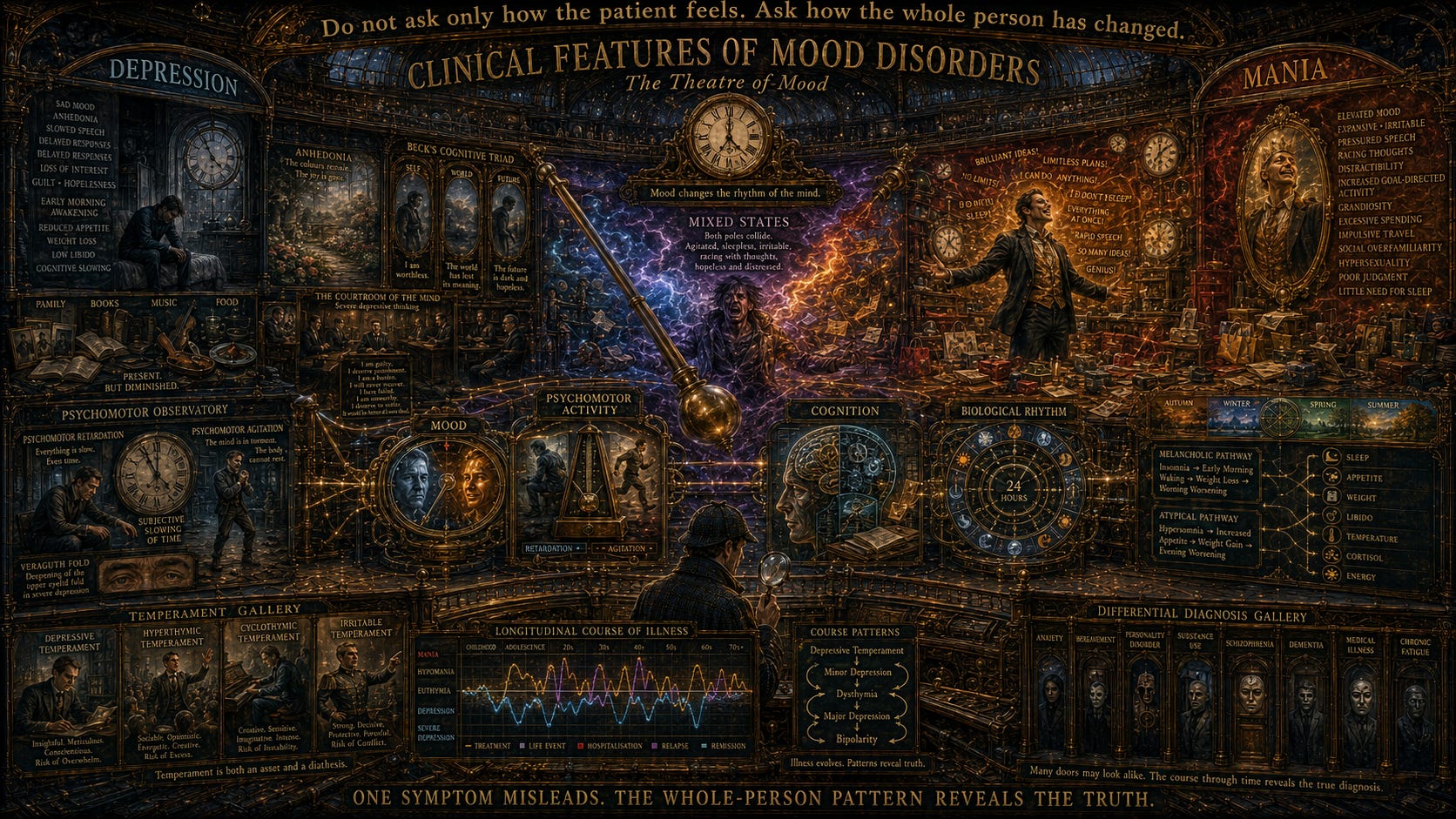
Medlock Holmes enters the Theatre of Mood.At first, the stage appears simple.One side is darkened by depression.The other glows with mania.But as the lights rise, Holmes realises that mood is only one part of the performance.Behind every emotional state lies an entire orchestra of change.Movement slows or accelerates.Sleep contracts or expands.Appetite disappears or increases.Thought becomes constricted or races.Self-esteem collapses or inflates.Time itself seems to change speed.This chapter explores the clinical phenomenology of mood disorders: how depression, mania, hypomania, mixed states, dysthymia, cyclothymia, psychosis, cognition, vegetative disturbance, and temperament appear in real patients.Holmes begins with an essential distinction.Affect is what the observer sees.Facial expression.Tone of voice.Gesture.Posture.Mood is what the person experiences within.The two may agree.Or they may not.A person may smile while profoundly depressed.Another may claim to feel fine while their behaviour communicates despair.Clinical understanding therefore begins not with a checklist, but with careful observation and empathic enquiry.Holmes moves next into the gallery of normal emotion.Sadness is universal.Grief is universal.Joy and elation are universal.These states are not illnesses simply because they are intense.The boundary is crossed when mood becomes disproportionate, autonomous, sustained, recurrent, and impairing.The source describes pathological mood states as endoreactive: they may begin in response to an event, but once released, they can continue under their own momentum even after the precipitating event has faded.This distinction matters.Normal grief remains responsive to the environment.Pathological depression becomes increasingly sealed from it.The same applies to elation.Ordinary happiness follows success.Mania does not require success to sustain itself.It creates its own internal momentum.Holmes then enters the Hall of Temperament.Before illness fully develops, many people have enduring affective styles.Depressive temperament.Hyperthymic temperament.Cyclothymic temperament.Irritable temperament.These are not diagnoses in themselves.They may carry both strengths and vulnerabilities.The depressive temperament can bring dependability, conscientiousness and sensitivity.The hyperthymic temperament may confer energy, extroversion, humour and leadership.The cyclothymic temperament may carry emotional intensity and creativity.The irritable temperament may confer assertiveness and forcefulness.But the same traits can become unstable.Temperament is therefore not simply pathology.It is the terrain upon which pathology may later emerge.Holmes now enters the depressive chamber.The first thing he notices is that depression is not synonymous with sadness.Some patients describe unbearable psychic pain.Others feel emotionally numb.Some cannot cry.Some deny feeling depressed altogether and instead present with headache, abdominal discomfort, chest pain, fatigue, or vague bodily distress.Others primarily complain that they have lost the capacity to enjoy anything.Anhedonia becomes one of the most important clues.A patient stops reading.Stops gardening.Stops listening to music.Stops enjoying food.Stops feeling warmth towards people they love.The world has not become objectively empty.The patient’s ability to resonate with it has disappeared.The depressive syndrome then reveals itself across four major domains:MoodPsychomotor activityCognitionVegetative functionA diagnosis made from mood alone is therefore incomplete.Holmes observes the body.Some depressed patients are agitated.They pace.Wring their hands.Pull at their hair.Speak anxiously.Others slow dramatically.Speech becomes sparse.Movement becomes reduced.Responses are delayed.The posture collapses.The gaze turns downward.The source even illustrates the classical Veraguth fold on page 9: a triangular fold at the nasal corner of the upper eyelid historically associated with depression, alongside the broader emphasis on altered facial musculature and psychomotor expression.Psychomotor retardation can become profound.The patient describes inertia.Thought itself feels slowed.Simple tasks feel impossible.Time seems to stop.Concentration collapses.Decision-making becomes exhausting.At its extreme lies depressive stupor.On page 10, the source contrasts the appearance of a woman during severe retarded depression with her appearance after recovery, visually demonstrating how profoundly mood illness can alter posture, facial expression, grooming and vitality.Holmes then enters the chamber of depressive cognition.The mind has become a courtroom.The patient is simultaneously defendant, prosecutor and judge.Everything is interpreted negatively.Failure becomes global.Mistakes become unforgivable.The future becomes hopeless.The self becomes worthless.Depressive thinking commonly centres on:* loss and deprivation;* low self-esteem;* guilt and self-reproach;* helplessness;* hopelessness;* death and suicide.In severe depression, these ideas may become psychotic.A patient may believe they have financially ruined the family.That they are dying from an undiagnosed illness.That their organs have disappeared.That they deserve punishment.That catastrophe is inevitable.Mood-congruent psychotic symptoms amplify the emotional logic of depression until metaphor becomes conviction.Yet mood-incongruent psychotic experiences can also occur and do not automatically imply schizophrenia.Holmes learns again that isolated symptoms mislead.The pattern matters more.Then comes the issue of suicide.Depressive despair may create the wish to die.But risk is not static.The source highlights a clinically important observation: when psychomotor activity begins to improve while mood and thinking remain profoundly dark, a patient may regain sufficient energy to act on suicidal thoughts. Hopelessness during apparent early recovery therefore demands careful attention.Holmes writes in bold:Improvement in movement is not always improvement in risk.He then examines the vegetative system.Classic melancholic depression often produces:* reduced appetite;* weight loss;* insomnia;* early morning waking;* reduced libido;* morning worsening;* loss of energy.But not every depression follows this pattern.Atypical depression may reverse the biological signs:* increased appetite;* weight gain;* hypersomnia;* leaden fatigue;* rejection sensitivity;* mood reactivity;* sometimes evening worsening.The contrast between melancholic and atypical patterns is clinically important because atypical features may raise suspicion of bipolar II disorder in some patients.Sleep becomes one of the richest clues.Depression may shorten REM latency.Slow-wave sleep may reduce.Sleep becomes fragmented.Some younger depressed patients, particularly those with bipolar tendencies, sleep excessively and struggle to get out of bed.Others wake at 4 am and cannot return to sleep.The same disorder family can disturb biological rhythm in opposite directions.Seasonality adds another temporal layer.Autumn–winter depression may bring hypersomnia, overeating, carbohydrate craving and fatigue, followed by increased energy or hypomanic activation in spring.The mind is not merely emotional.It is rhythmic.The chapter then turns to mania.The theatre lights blaze.Psychomotor activity accelerates.Speech becomes pressured.Ideas race.Sleep requirement collapses.Self-confidence expands.Social inhibition falls away.The patient becomes energetic, intrusive, distractible and impulsive.At first, this may appear joyful.But mania is not simply happiness amplified.The elevated mood is often unstable.Elation can rapidly become irritability.Humour can become hostility.Confidence can become grandiosity.Sociability can become overfamiliarity.Energy can become dangerous disorganisation.Manic cognition is expansive.The person feels unusually powerful, gifted or important.Insight falls.Judgement deteriorates.Spending may become reckless.Sexual behaviour may become impulsive.Business decisions become unrealistic.Travel becomes sudden.Relationships become destabilised.The clinical danger comes partly from the fact that the person may feel better than ever while objectively functioning far worse.The source strongly emphasises psychomotor acceleration as a hallmark of mania, with increased energy, rapid speech, impulsivity, social disinhibition and decreased need for sleep.Psychosis may accompany mania.Grandiose delusions.Persecutory ideas.Hallucinations.Even Schneiderian-like phenomena.Again, these do not automatically indicate schizophrenia.The entire affective pattern must be understood.Holmes then enters the chamber marked Mixed States.Here the lighting is neither blue nor gold.It is violet.Manic activation and depressive suffering occupy the same person.The patient is energised but hopeless.Agitated but despairing.Unable to sleep.Irritable.Racing with thoughts.Possibly suicidal.Mixed states are among the most clinically dangerous presentations because activation may coexist with depressive cognition.The old image of bipolar disorder as clean alternation between cheerful mania and sad depression is therefore inadequate.Real illness is often messier.The next distinction is between mania and hypomania.Hypomania is not merely weaker mania.It is a qualitatively different clinical state.Mood elevation or irritability is present.Energy increases.Sleep need falls.Confidence and sociability rise.But there is no marked functional impairment, psychosis or need for hospitalisation.Indeed, patients may experience hypomania as productive and desirable.That creates a diagnostic problem.People often report depression spontaneously.They rarely complain about periods when they felt unusually energetic, confident, creative and socially alive.Collateral history therefore becomes crucial.Holmes does not simply ask:“Have you ever been manic?”He asks:“Have there been periods when you needed much less sleep?”“Were you unusually driven?”“Did people tell you that you were talking more?”“Did you feel sharper, faster or more confident than usual?”“Did you become unusually sociable or impulsive?”The key diagnostic clue is often behavioural activation, not the patient’s label for mood.The chapter then moves to the enduring forms.Persistent depressive disorder is not simply a long major depressive episode.Often it begins insidiously in childhood or adolescence.The person may say:“I have always been this way.”Mood is chronically low-grade.Joy is scarce.The person may function adequately but invest most available energy into duty and work, leaving little for relationships, leisure or pleasure.When major depressive episodes occur on top of this chronic baseline, the result resembles what has historically been called double depression.The source’s course diagram on page 50 illustrates this visually: complete remission, partial remission, and major depression superimposed upon a dysthymic baseline are shown as distinct longitudinal patterns.Holmes then studies cyclothymia.Here the baseline itself oscillates.The person moves repeatedly between subthreshold depressive and hypomanic states.Neither pole reaches full syndromal severity.Yet the instability itself may damage relationships, employment and judgement.Cyclothymia can be mistaken for personality disorder because mood instability becomes woven into the individual’s biography.But Holmes learns to ask a different question:Is the instability truly characterological-or is it affective?The source’s spectrum diagram on page 56 depicts depressive temperament, minor or brief depression, dysthymic disorder, major mood episodes and interpersonal sequelae as interconnected rather than isolated boxes, reinforcing the idea that mood disorders may exist along continua rather than in perfectly discrete categories.That continuum becomes even more important when Holmes examines the border between major depressive disorder and bipolar disorder.Some people initially diagnosed with recurrent depression later develop hypomania or mania.Clues that should raise suspicion of bipolarity include:* early onset;* recurrent episodes;* psychotic depression in youth;* postpartum episodes;* abrupt onset and offset;* hypersomnia;* marked psychomotor retardation;* atypical features;* seasonality;* cyclothymic temperament;* hyperthymic temperament;* bipolar family history;* antidepressant-induced hypomania;* mixed depressive features.The diagnosis therefore lives in the longitudinal history, not simply the current episode.The chapter repeatedly returns to this principle.Mood disorders unfold over time.A single consultation gives only a snapshot.The illness is a film.This is why life-charting becomes so powerful.The source’s life-chart illustration on page 59 maps mania, depression, treatments, life events and hospitalisations across years, showing how diagnosis becomes clearer when episodes are viewed longitudinally rather than separately.Holmes next examines rapid cycling.At least four mood episodes occur within a year.The patient moves repeatedly through depression, hypomania or mania, sometimes with little stable time between them.The result can be devastating.Occupational functioning collapses.Relationships destabilise.Treatment becomes difficult.Substances, caffeine, endocrine factors and antidepressants may all complicate cycling in vulnerable individuals.Then comes the differential diagnosis.Mood disorders can masquerade as anxiety disorders.Personality disorders.Substance-related disorders.Schizophrenia.Dementia.Chronic fatigue.Neurological illness.Endocrine disease.Medication effects.Bereavement.Holmes must therefore resist diagnostic shortcuts.A depressed older person complaining of memory loss may have depression rather than dementia.A young person with rapid speech and bizarre behaviour may have mania rather than schizophrenia.A chronically unstable person may have cyclothymia rather than a primary personality disorder.A cocaine user may have an underlying bipolar disorder rather than purely substance-induced symptoms.A patient with physical complaints may have depression.And a patient with depression may still have genuine physical disease.The clinical task is to keep both possibilities alive.At the end of the theatre, Holmes discovers the master control room.It contains four interconnected systems:MoodMovementThinkingBiological RhythmEvery major mood syndrome changes all four.Depression slows or distorts them.Mania accelerates them.Mixed states pull them in opposing directions.Temperament sets the baseline.Time reveals the pattern.Holmes closes the final chart.Mood disorders are not simply diseases of sadness and happiness.They are disorders of regulation.The whole organism shifts.The whole life shifts.And the clinician’s task is not merely to ask how the patient feels-but to understand how the person’s entire internal rhythm has changed.Key Takeaways* Mood disorders involve pervasive dysregulation of mood, psychomotor activity, cognition and biological rhythms.* Affect and mood are related but distinct: affect is externally expressed, while mood is the sustained internal emotional state.* Accurate assessment requires empathic observation because outward affect and inner mood may not always match.* Sadness, grief, joy and elation are normal human experiences and should not automatically be pathologised.* Pathological mood states are distinguished by disproportion, persistence, autonomy, recurrence and functional impairment.* The source describes pathological mood states as endoreactive: once triggered, they may persist autonomously beyond the precipitating event.* Mood disorders exist on a spectrum from temperamental variation and subthreshold states to full syndromal depression and mania.* Subthreshold symptoms may persist between major episodes and remain clinically important.* Affective temperaments include depressive, hyperthymic, cyclothymic and irritable patterns.* Temperaments can represent both assets and vulnerabilities.* Depressive temperament may be associated with dependability, conscientiousness and sensitivity.* Hyperthymic temperament may be associated with energy, extroversion and leadership.* Cyclothymic temperament involves mood lability and may precede bipolar-spectrum illness.* Pathological mood disorders are characterised by recurrence or chronicity as well as severity.* Major depression should be assessed across mood, psychomotor, cognitive and vegetative domains.* Depressed mood may be experienced as profound psychic pain rather than ordinary sadness.* Some patients deny sadness and instead present with somatic symptoms.* Anhedonia is a central feature and should be assessed behaviourally by asking what activities the patient has stopped enjoying or pursuing.* Severe depression can include emotional numbing, depersonalisation and derealisation.* Psychomotor agitation and psychomotor retardation can both occur in depression.* Psychomotor retardation may include reduced movement, slowed speech, fatigue, impaired concentration, indecisiveness and altered perception of time.* Severe retardation can progress to depressive stupor.* The source illustrates classical physical signs of depression, including the Veraguth fold on page 9.* The before-and-after images on page 10 demonstrate the profound observable change in posture, expression and vitality between severe depression and recovery.* Depressive cognition commonly includes loss, low self-esteem, guilt, helplessness, hopelessness and thoughts of death.* Cognitive slowing, poor attention, memory difficulty and executive dysfunction may accompany depression.* So-called depressive “pseudodementia” represents genuine cognitive impairment rather than fabricated symptoms.* Cognitive symptoms may persist beyond improvement in mood and may influence recurrence.* Psychotic depression may include mood-congruent delusions of guilt, poverty, illness, worthlessness or nihilism.* Hallucinations may also occur in severe depression.* Mood-incongruent psychotic symptoms do not automatically imply schizophrenia.* Suicide enquiry does not provoke suicide and should form part of depressive assessment.* Suicide risk may remain high or increase when psychomotor activity improves before hopelessness and depressive cognition resolve.* Melancholic depression commonly includes reduced appetite, weight loss, insomnia, early morning waking, reduced libido, psychomotor disturbance and morning worsening.* Atypical depression may show reverse vegetative features such as hypersomnia, increased appetite, weight gain, rejection sensitivity and mood reactivity.* Atypical features may raise suspicion of bipolar-spectrum illness in some patients.* Sleep disturbance is a cardinal feature of mood disorders.* Depression may involve reduced slow-wave sleep and shortened REM latency.* Hypersomnia is particularly important in younger depressed patients with possible bipolar tendencies.* Circadian dysregulation can persist across episodes and may contribute to recurrence.* Seasonal depression may show autumn–winter worsening with spring activation.* Sexual dysfunction is common in depression, although increased sexual drive can occur in some mixed or bipolar-spectrum presentations.* Mania involves mood elevation or irritability, psychomotor acceleration, reduced need for sleep, pressured speech, racing thoughts, increased activity and poor judgement.* Lability and irritability are as important as euphoria in mania.* Pathological overfamiliarity and social disinhibition are important clinical features.* Manic impulsivity may lead to reckless spending, gambling, sexual indiscretion, travel and damaging interpersonal behaviour.* Insight is often impaired in mania.* Grandiose and persecutory delusions may occur in mania.* Psychotic symptoms in mania do not necessarily indicate schizophrenia.* Decreased need for sleep is a core manic feature and differs from insomnia because the patient remains energetic despite little sleep.* Severe mania can progress to delirious mania, a medical emergency.* Catatonic features can occur in mood disorders as well as schizophrenia and medical illness.* Mixed states combine depressive and manic features within the same episode.* Agitation, insomnia, racing thoughts, irritability and suicidality may coexist in mixed states.* Hypomania is characterised by activation without the marked impairment, psychosis or hospitalisation associated with mania.* Hypomania is often ego-syntonic and may not be spontaneously reported by patients.* Collateral history is essential when assessing possible hypomania.* Behavioural activation may be easier to elicit than asking directly about “high mood”.* Persistent depressive disorder is typically chronic, lower-grade and often begins early in life.* Patients with persistent depressive disorder may experience their low mood as part of their habitual identity.* Major depressive episodes may superimpose upon persistent depressive disorder, historically termed double depression.* The source’s page 50 diagram demonstrates complete remission, partial remission and depression superimposed upon dysthymia as distinct longitudinal courses.* Cyclothymic disorder involves recurrent subthreshold depressive and hypomanic periods over prolonged periods.* Cyclothymia can produce substantial interpersonal and occupational instability despite the absence of full syndromal episodes.* Cyclothymia may be confused with personality disorder.* The depressive spectrum diagram on page 56 illustrates continuity between temperament, minor depression, dysthymia, major episodes and interpersonal consequences.* Bipolar I disorder requires a manic episode.* Bipolar II disorder involves major depressive episodes and hypomania without a history of full mania.* Bipolar II disorder is frequently missed because patients present during depression and may not recognise hypomania as pathological.* Early age of onset, recurrent depression, atypical features, seasonality, psychomotor retardation and family history increase suspicion of bipolarity.* Postpartum and psychotic depression in younger patients should heighten vigilance for bipolar disorder.* Antidepressant-associated hypomania may indicate underlying bipolar vulnerability.* Depressive mixed states may represent part of the bipolar spectrum.* Rapid cycling is defined by at least four mood episodes in one year.* Rapid cycling is associated with severe functional impairment and treatment complexity.* Mood episodes are best understood longitudinally rather than cross-sectionally.* Life-charting can reveal relationships between depression, mania, treatments, life events and recurrence.* The page 59 life-chart illustration demonstrates how longitudinal mapping can expose patterns otherwise missed in isolated consultations.* Normal bereavement differs from major depression through greater emotional reactivity, absence of marked psychomotor retardation, limited pathological guilt and lower rates of active suicidal ideation.* Severe or prolonged grief can nevertheless progress into depressive disorder.* Depression and anxiety frequently coexist and may be difficult to differentiate.* Bipolar disorder may be mistaken for schizophrenia, personality disorder, anxiety disorder or substance-use disorder.* Mood disorders should be considered before attributing affective instability entirely to personality pathology.* Substance use may represent self-medication of an underlying mood disorder.* Affective symptoms persisting after detoxification should prompt reassessment for primary mood disorder.* Medical illnesses and medications can cause or precipitate depressive and manic syndromes.* Somatic symptoms in depression should not lead clinicians to ignore genuine physical disease.* Depressive cognitive impairment in older people may resemble dementia.* Prospective follow-up is sometimes necessary to distinguish mood disorder from neurodegenerative disease.* There is no single routinely useful biomarker, scan or laboratory test that establishes the diagnosis of a mood disorder.* Diagnosis still depends primarily on careful phenomenology, longitudinal history, family history, course and treatment response.* The most useful clinical model is to assess mood disorders as disturbances across emotion, psychomotor function, cognition and biological rhythm rather than as simple changes in happiness or sadness. This is a public episode. If you'd like to discuss this with other subscribers or get access to bonus episodes, visit drmanaankarray.substack.com/subscribe
Embed this episode
Ready to play
PSYCH 111: Mood Disorders - Clinical Features
No transcript for this episode yet
Similar Episodes
No similar episodes found.
Similar Podcasts
No similar podcasts found.