
EPISODE · Sep 4, 2026 · 41 MIN
PSYCH 112: Mood Disorders - Intrapsychic and Interpersonal Aspects
from Clinical Deep Dives · host Dr Manaan Kar Ray
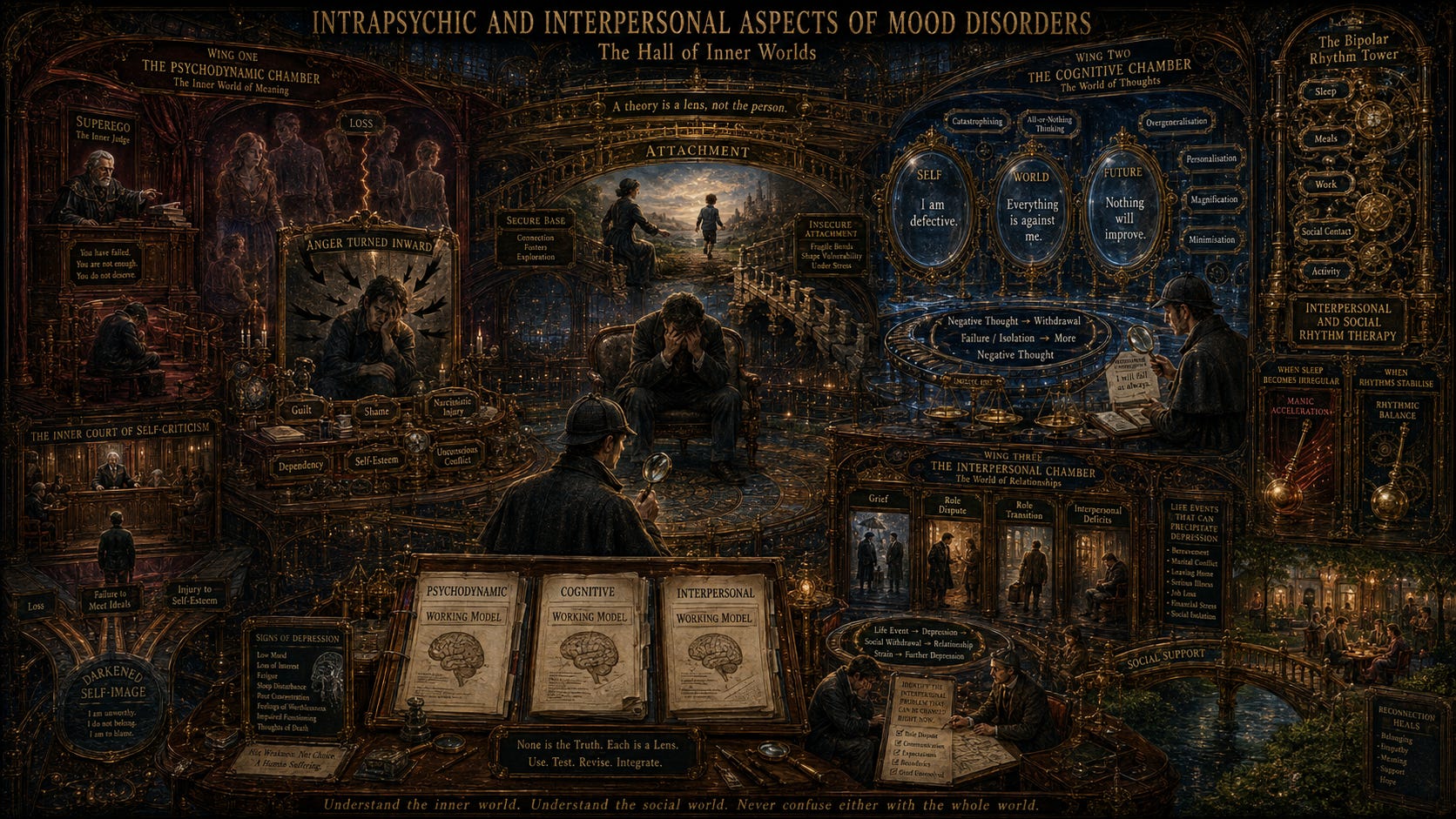
Medlock Holmes enters the Hall of Inner Worlds, where three different investigative rooms attempt to explain the same depressed patient.The first is the Psychodynamic Chamber.Here, the focus is on what lies beneath conscious experience: loss, unconscious conflict, guilt, anger turned inward, injured self-esteem, and the enduring influence of early relationships.Freud’s classic account of melancholia proposed that after a painful loss, hostility towards an ambivalently loved person may be redirected towards the self. The patient attacks themselves instead of the lost or disappointing other.Later psychoanalytic thinkers broadened this picture.Some emphasised guilt.Others narcissistic injury.Others the effects of emotionally unavailable or depressed caregivers.Across many psychodynamic formulations, one theme repeatedly appears: the depressed person experiences themselves as damaged, inadequate, unlovable, or morally deficient. Self-esteem collapses, and aggression is directed inward.Holmes then enters the second room.Three enormous mirrors are labelled:SELFWORLDFUTUREThis is Aaron Beck’s cognitive triad.The depressed patient sees themselves as defective.The world appears hostile or overwhelming.The future seems hopeless.Around the mirrors appear familiar cognitive distortions:* all-or-nothing thinking;* catastrophising;* overgeneralisation;* selective attention to failure;* minimising success;* personalisation.These automatic thoughts reinforce withdrawal and inactivity, which then generate further evidence for the patient’s negative beliefs.Cognitive therapy intervenes by making these thoughts visible, examining the evidence for them, testing them behaviourally, and replacing unquestioned assumptions with more balanced appraisals.Holmes notices that cognitive theory does not explain all of depression.Nor does psychodynamic theory.Each illuminates a different part of the same room.He now enters the third chamber.There are no mirrors.There are people.A grieving spouse.A couple locked in conflict.A student leaving home.A patient adjusting to illness.A lonely person without support.This is the Interpersonal Chamber.Interpersonal theory focuses less on the hidden inner world and more on the person’s present relationships and life events.Loss, interpersonal conflict, role transitions, social isolation, and inadequate support can precipitate or perpetuate depressive episodes in vulnerable individuals.Once depression begins, symptoms themselves damage relationships and functioning, creating a vicious cycle:Life event → Depression → Impaired relationships → More life events → Deeper depressionInterpersonal psychotherapy, or IPT, uses this model pragmatically.The therapist identifies a current interpersonal focus and helps the patient work towards change in areas such as grief, role disputes, role transitions, or interpersonal deficits.The aim is not to prove that relationships caused the illness.It is to identify a meaningful point where treatment can intervene.Holmes sees that all three theories are useful, but none is absolute truth.Psychodynamic theory asks:What unconscious meanings and conflicts are shaping this suffering?Cognitive theory asks:How is the person interpreting themselves, the world, and the future?Interpersonal theory asks:What is happening in this person’s relationships and social world?The wisest clinician does not become a prisoner of one theory.Theory should organise understanding, not replace it.The chapter’s central lesson is therefore one of disciplined pluralism.Use a coherent model.Understand its assumptions.Know its limits.And remember that the patient is always larger than the theory used to explain them.Key Takeaways* Symptom criteria define mood disorders reliably but do not fully explain how patients experience them.* Three major psychotherapeutic frameworks discussed are psychodynamic, cognitive, and interpersonal.* No single theory fully explains the aetiology of mood disorders.* Theories are best treated as working models rather than absolute truths.* A coherent theoretical framework helps organise clinical formulation and psychotherapy.* Clinicians should avoid rigid dogmatism and understand multiple theoretical perspectives.* Psychodynamic theory focuses on unconscious processes, conflict, defence, guilt, self-esteem and internalised relationships.* From a psychoanalytic perspective, mood states may reflect unconscious meaning as well as biological processes.* Freud’s Mourning and Melancholia conceptualised depression partly as hostility towards a lost or ambivalently loved object redirected towards the self.* Loss, real or imagined, is a central theme in several psychoanalytic theories of depression.* Some psychodynamic models emphasise excessive dependency and difficulty tolerating separation.* Melanie Klein highlighted guilt and fear of damaging or triumphing over loved internal objects.* Bibring emphasised helplessness, failure and collapse of self-esteem rather than aggression as the primary mechanism.* Narcissistic injury and failure to meet personal ideals can contribute to depressive states.* Early caregiver inadequacy or lack of empathy may contribute to vulnerability through disturbed self-esteem regulation.* Psychoanalytic writers distinguish between dependent or anaclitic forms of depression and self-critical or introjective forms.* Chronic depression can be mistaken for character pathology because long-standing mood symptoms become woven into identity and relationships.* Across many psychodynamic formulations, low self-regard, shame, guilt and self-directed aggression are recurring themes.* Psychoanalytic theories of mania often conceptualise mania as involving denial, regression, omnipotence and defence against painful affect.* Psychotherapy alone is not sufficient treatment for true mania; pharmacological treatment is required.* Beck’s cognitive model focuses on distorted thinking about the self, world and future.* The cognitive triad is a central feature of depressive thinking.* Common cognitive distortions include dichotomous thinking, arbitrary inference, selective abstraction, overgeneralisation, magnification, minimisation, personalisation and catastrophising.* Depressive automatic thoughts are involuntary, negative and often highly believable to the patient.* Negative cognitions can inhibit action and reinforce behavioural withdrawal.* Withdrawal then creates more opportunities for self-criticism and further strengthens the depressive cycle.* Underlying schemas or core beliefs are broader patterns of self-evaluation that shape automatic thoughts.* Cognitive therapy helps patients examine, test and modify distorted thoughts.* CBT has substantial evidence for efficacy in major depression.* Behavioural activation can also improve depression, suggesting that therapeutic benefit may extend beyond the specific mechanisms proposed by cognitive theory.* Cognitive and psychodynamic theories overlap in their interest in self-critical thinking but differ in how they understand its origins and meaning.* Interpersonal theory focuses primarily on current relationships, social roles and life events.* Important interpersonal precipitants include bereavement, relationship conflict, role transition and social isolation.* Social support can protect against depression.* Depression itself can worsen relationships and create additional negative life events.* Attachment theory provides an important bridge between early relationships and later interpersonal vulnerability.* Interpersonal psychotherapy is a structured, time-limited treatment developed specifically for depression.* IPT does not claim that interpersonal events are the sole cause of depression.* Instead, it pragmatically links depressive symptoms with a current interpersonal focus for treatment.* Core IPT problem areas include grief, role disputes, role transitions, and interpersonal deficits.* IPT seeks to improve communication, assertiveness, expression of anger, negotiation and social confidence.* Dysthymic or chronic depression may require particular emphasis on entrenched passivity, resignation and interpersonal skill deficits.* For bipolar disorder, psychotherapy is usually adjunctive to pharmacotherapy.* Interpersonal and Social Rhythm Therapy combines interpersonal work with stabilisation of daily rhythms and sleep.* Regular sleep and social rhythms are particularly important in preventing manic relapse.* Psychodynamic, cognitive and interpersonal approaches each capture different dimensions of mood disorder.* No framework should be treated as complete or infallible.* The clinician’s task is to choose a coherent model that fits the patient while remaining open to revising it when the facts no longer fit. This is a public episode. If you'd like to discuss this with other subscribers or get access to bonus episodes, visit drmanaankarray.substack.com/subscribe
Embed this episode
Ready to play
PSYCH 112: Mood Disorders - Intrapsychic and Interpersonal Aspects
No transcript for this episode yet
Similar Episodes
No similar episodes found.
Similar Podcasts
No similar podcasts found.