
EPISODE · Sep 5, 2026 · 37 MIN
PSYCH 113: Mood Disorders - Suicidal Behaviou
from Clinical Deep Dives · host Dr Manaan Kar Ray
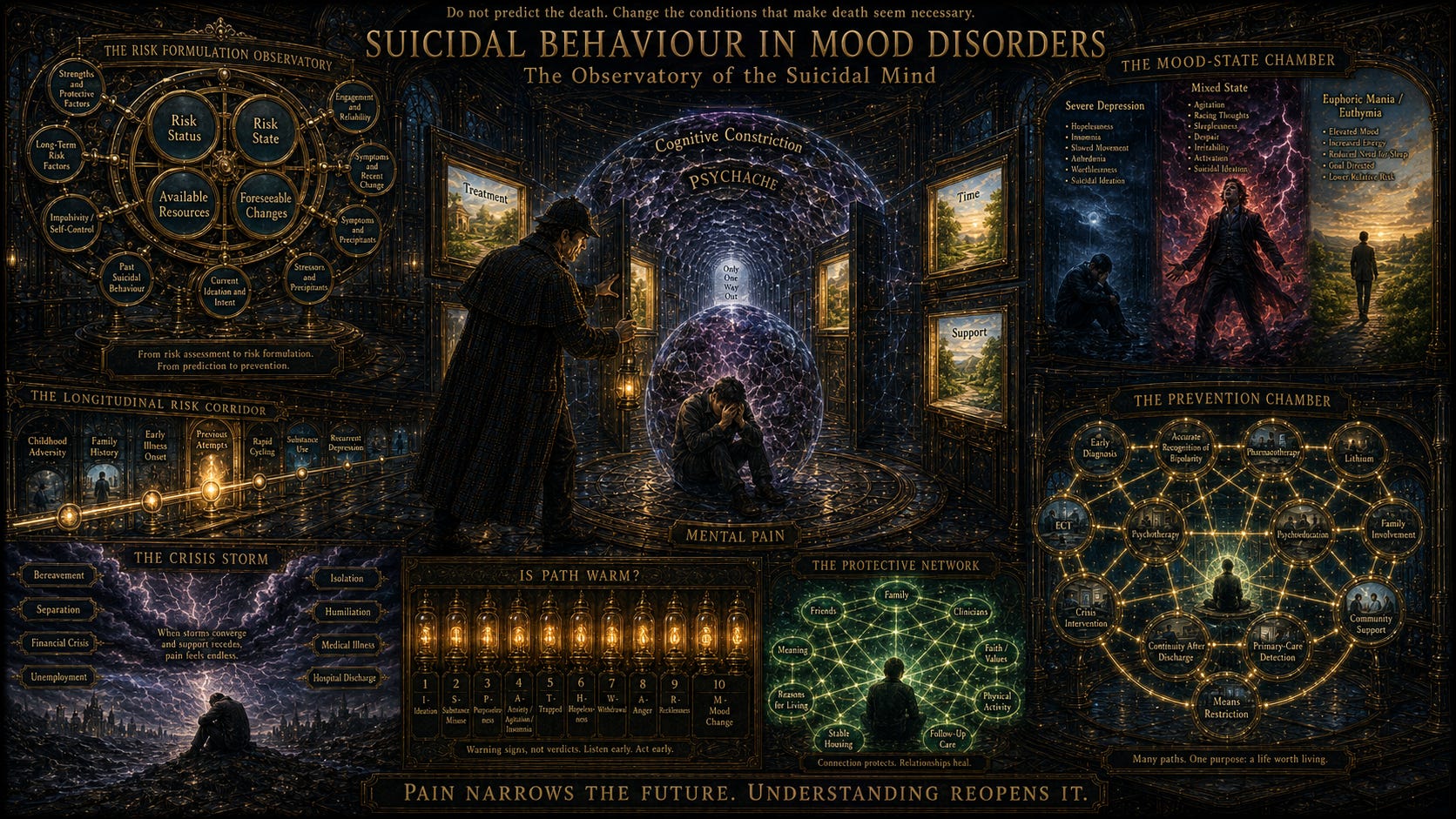
Medlock Holmes enters the Observatory of the Suicidal Mind.At first, the room appears to contain a familiar psychiatric chart:Depression → Suicide RiskHolmes immediately rejects it.The relationship is far more complex.Mood disorders are among the strongest contributors to suicidal behaviour, but most people with depression do not die by suicide, and suicidal crises can occur outside formal diagnostic thresholds. What matters is not simply the presence of depression, but the interaction between illness severity, hopelessness, agitation, mixed affective states, impulsivity, previous attempts, family history, adversity, substance use, social support, and rapidly changing life circumstances.The central concept Holmes encounters is psychache: unbearable psychological pain.For some people, suicide is not experienced primarily as a movement towards death, but as an imagined escape from intolerable consciousness. The person becomes cognitively constricted, unable to perceive alternatives, and increasingly convinced that the suffering cannot change.This is why understanding the suicidal mind requires more than counting risk factors.The clinician must ask:Where is the pain coming from?Why has it become intolerable now?What has changed?What still connects this person to life?The chapter moves from traditional risk assessment towards suicide risk formulation.Rather than assigning a simplistic label of low, medium, or high risk, formulation integrates four questions:* What is this person’s risk status relative to others in a similar population?* What is their current risk state compared with their own baseline?* What resources and protective factors are available?* What foreseeable changes could rapidly increase danger?The prevention-oriented model shown on page 3 of the source visually reinforces this shift. It brings together enduring factors such as prior suicidal behaviour and long-term vulnerability with dynamic factors such as current ideation, stressors, suffering, engagement, available resources, and foreseeable change.Holmes then examines mood states themselves.The greatest danger usually lies not in euthymia or euphoric mania, but in severe depressive episodes and mixed states.Hopelessness.Insomnia.Anxiety.Agitation.Worthlessness.Guilt.Appetite loss.Psychosis.Substance use.A person may be severely depressed yet lethargic. Another may be equally hopeless but agitated, sleepless, impulsive, and internally accelerated.The second presentation may be especially dangerous because despair has acquired energy.Mixed depressive states therefore deserve particular attention.The investigation then turns backwards in time.A previous suicide attempt is one of the strongest predictors of future suicidal behaviour.Early illness onset, rapid cycling, predominantly depressive course, prior suicidal ideation, family history of suicide, childhood adversity, cyclothymic or irritable temperament, and impulsive–aggressive traits may further increase vulnerability.But these factors are not destiny.They are the landscape upon which the current crisis unfolds.Life events frequently supply the trigger.Bereavement.Separation.Financial collapse.Unemployment.Isolation.Humiliation.Illness.Hospital discharge.Relationship breakdown.Yet even severe events rarely act alone. They become dangerous when they interact with psychiatric illness, personality, reduced support, and an individual’s sense that there is no escape.Holmes then enters the chamber of warning signs.The source highlights the mnemonic IS PATH WARM:* Ideation* Substance misuse* Purposelessness* Anxiety, agitation, insomnia* Trapped* Hopelessness* Withdrawal* Anger* Recklessness* Mood changeThese signs are not a prediction algorithm.They are prompts to investigate a rapidly changing crisis.The source is equally clear that clinicians should ask directly about suicidal thoughts and plans. Asking does not create suicidal behaviour. Avoidance protects the clinician from discomfort, not the patient from risk.The final chamber concerns prevention.Holmes finds that suicide prevention in mood disorders is built from multiple layers:Early diagnosis.Accurate recognition of bipolarity.Rapid treatment of severe depression, agitation, anxiety, and insomnia.Mood stabilisation where indicated.Long-term treatment to prevent recurrence.Psychological intervention.Family involvement.Regular follow-up.Restriction of access to lethal means.Primary-care education.Community awareness.Continuity after discharge.Lithium stands out in the source as having particularly strong evidence for reducing suicidal behaviour in recurrent mood disorders. Effective treatment of the underlying illness remains one of the most powerful modifiable protective factors.Holmes leaves the observatory with one central lesson.Suicide prevention is not the prediction of an unknowable future.It is the disciplined recognition of suffering, change, vulnerability, and opportunity for intervention in the present.The task is not to determine with certainty who will die.It is to understand what can be changed now so that dying no longer feels like the only answer.Key Takeaways* Mood disorders are major contributors to suicidal behaviour but are not sufficient explanations on their own.* Suicide is multifactorial and reflects interactions among psychiatric, genetic, personality, developmental, psychosocial, and demographic factors.* Hopelessness may be more strongly associated with suicide risk than the diagnosis of depression alone.* Distal risk factors include family history, childhood adversity, personality traits, early substance misuse, and developmental vulnerabilities.* Proximal factors include current psychopathology, suicidal ideation, hopelessness, and recent life events.* Psychache refers to unbearable mental pain and provides an important phenomenological model of the suicidal state.* Suicidal thinking may involve cognitive constriction, in which alternatives become increasingly difficult to perceive.* Suicide may be experienced as an escape from intolerable suffering rather than a simple wish for death.* Suicide risk assessment should progress towards suicide risk formulation.* Risk formulation considers risk status, risk state, available resources, and foreseeable changes.* The prevention-oriented formulation on page 3 integrates enduring and dynamic clinical data rather than relying on static categories.* Psychological autopsy studies suggest that a large majority of people who die by suicide have a diagnosable psychiatric disorder, often a mood disorder.* Previous suicide attempt is one of the strongest predictors of future attempted or completed suicide.* About half of people who die by suicide have made a previous attempt, meaning many also die during a first suicidal act.* Bipolar disorder carries particularly high levels of suicidal behaviour.* Suicide risk in bipolar disorder is often greatest early in the illness.* Delayed diagnosis of bipolar disorder may increase exposure to untreated depressive and mixed states.* Severe depressive episodes are high-risk states.* Mixed depressive and manic features further increase concern.* Dysphoria, agitation, insomnia, anxiety, hopelessness, guilt, and worthlessness are particularly important acute clinical signals.* Suicidal behaviour is comparatively uncommon during euthymia and pure euphoric mania.* Psychotic mood episodes may carry additional risk.* Substance-use disorders, including alcohol, can increase both impulsivity and lethality.* Acute alcohol use may precipitate suicidal behaviour even in people without alcohol dependence.* Cigarette smoking is also associated with suicidal behaviour beyond its relationship with psychiatric morbidity.* Painful, disabling, or life-threatening medical illness can increase suicide risk, particularly when depression coexists.* Early onset, predominantly depressive polarity, rapid cycling, and past suicidal ideation increase longitudinal vulnerability.* Cyclothymic, irritable, depressive, and anxious temperaments are associated with greater risk.* Hyperthymic temperament may be relatively protective.* Impulsivity, aggression, pessimism, cognitive rigidity, rumination, and poor decision-making may contribute to suicidal behaviour.* The stress–diathesis model conceptualises suicidal behaviour as interaction between acute stress and enduring vulnerability.* Family history of suicidal behaviour is an important risk factor.* Familial transmission of suicide risk may partly reflect impulsive–aggressive traits and shared environments as well as psychiatric illness.* Childhood abuse, neglect, and disrupted attachment may increase later vulnerability.* Recent bereavement, separation, financial crisis, isolation, unemployment, and humiliation may precipitate crises in vulnerable individuals.* Mood episodes can themselves generate adverse life events, producing vicious cycles of illness and stress.* The period immediately after psychiatric discharge is particularly important for monitoring and follow-up.* Suicide risk factors are cumulative rather than independently deterministic.* Illness-related and dynamic factors generally have more immediate clinical utility than demographic factors.* IS PATH WARM is a mnemonic for warning signs: Ideation, Substance misuse, Purposelessness, Anxiety/agitation/insomnia, Trapped, Hopelessness, Withdrawal, Anger, Recklessness, Mood change.* Direct questioning about suicide does not increase suicidal behaviour.* Withdrawal, putting affairs in order, giving away valued possessions, and sudden behavioural change may signal increased danger.* Family and collateral information may reveal warning signs not disclosed directly by the patient.* Protective factors include social support, strong relationships, reasons for living, resilience, regular physical activity, and effective treatment.* Restricting access to lethal means is an important preventive strategy.* Acute management should address severe depression, agitation, anxiety, insomnia, psychosis, and mixed features promptly.* ECT can be particularly useful in severe or psychotic suicidal depression.* Appropriate long-term pharmacotherapy substantially reduces suicidal morbidity and mortality.* Lithium has particularly strong evidence for reducing suicidal behaviour in recurrent mood disorders.* Antidepressant treatment overall is associated with lower suicide mortality than untreated depression, although close monitoring is essential in vulnerable younger patients and those with emerging mixed or activated states.* Recognition of underlying bipolarity is important when suicidality worsens during antidepressant treatment.* Esketamine may rapidly reduce depressive symptoms, although evidence for a specific independent anti-suicidal effect is less clear in the source.* Pharmacotherapy alone is insufficient; psychosocial intervention, psychoeducation, psychotherapy, family involvement, and continuity of care are also needed.* Primary care is a major setting for suicide prevention because many people who die by suicide have recently consulted healthcare services.* Training clinicians to recognise and treat depression can reduce suicide rates.* Multilevel community approaches are more effective than isolated educational interventions.* Regular planned follow-up is especially important after a suicide attempt or hospital discharge.* The source emphasises that many suicides in mood disorders are potentially preventable through earlier diagnosis, treatment, continuity, and coordinated care.* Suicide risk formulation should ultimately be prevention-oriented rather than prediction-oriented. This is a public episode. If you'd like to discuss this with other subscribers or get access to bonus episodes, visit drmanaankarray.substack.com/subscribe
Embed this episode
Ready to play
PSYCH 113: Mood Disorders - Suicidal Behaviou
No transcript for this episode yet
Similar Episodes
No similar episodes found.
Similar Podcasts
No similar podcasts found.