
EPISODE · Sep 6, 2026 · 40 MIN
PSYCH 114: Mood Disorders - Pharmacologic Treatment of Depression and Bipolar Disorders
from Clinical Deep Dives · host Dr Manaan Kar Ray
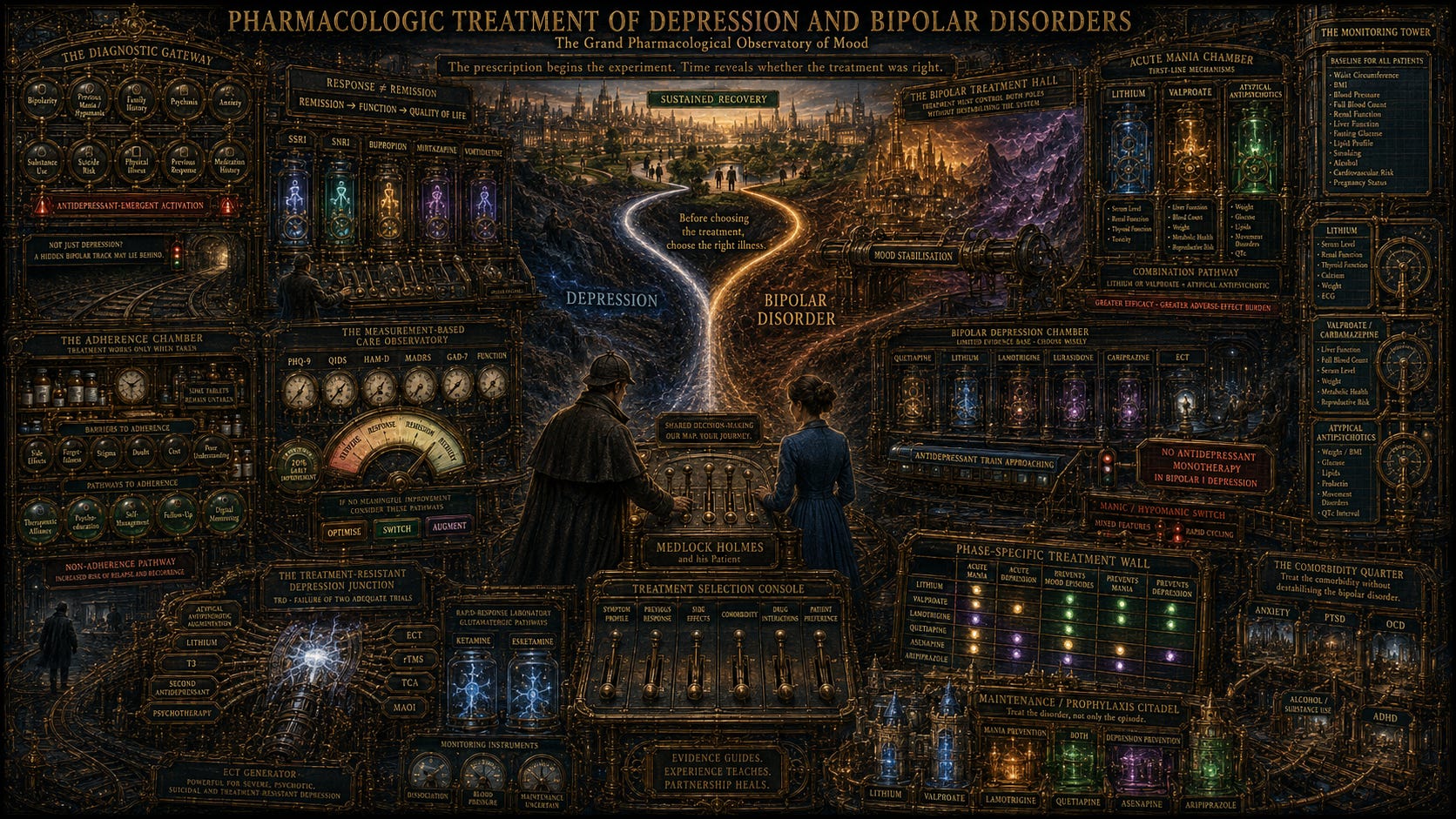
Medlock Holmes enters the Grand Pharmacological Observatory of Mood.At its centre stands an enormous control table.Two major pathways emerge from it.One is labelled:MAJOR DEPRESSIVE DISORDERThe other:BIPOLAR DISORDERAt first, the pathways appear similar.Both contain depression.Both contain impaired function.Both may involve suicidality, anxiety, sleep disturbance, and psychotic features.But Holmes quickly discovers that the treatment logic is very different.The first lesson is therefore diagnostic.Before prescribing an antidepressant, the clinician must ask whether the apparent depressive episode might actually belong to bipolar disorder.Family history.Previous hypomania.Psychotic features.Reverse vegetative symptoms.Mood lability.Antidepressant-induced activation.All may raise suspicion.The source emphasises that bipolar disorder is frequently misdiagnosed initially as major depressive disorder, partly because patients are more likely to seek help when depressed than when hypomanic or manic.Holmes moves first into the Depression Treatment Chamber.Here the immediate goal is not simply improvement.It is remission.Response means that symptoms have reduced.Remission means that the depressive syndrome has largely resolved.This distinction matters because residual symptoms are associated with a greater risk of relapse and recurrence.But Holmes notices another instrument beside the symptom scales.It measures:Function.Can the person work?Study?Care for children?Maintain relationships?Enjoy life?The chapter repeatedly emphasises that symptom reduction alone is not enough.Patients often care most about restoration of function and quality of life.The next section of the chamber contains the familiar first-line antidepressant pathways.SSRIs.SNRIs.Bupropion.Mirtazapine.Vortioxetine.Other second-generation agents.Their overall efficacy is broadly comparable.The art lies in matching treatment to the individual.An activating antidepressant may suit someone dominated by fatigue and low drive.A sedating antidepressant may help when severe insomnia accompanies depression.A patient worried about weight gain may prefer one profile.Another troubled by sexual dysfunction may prefer another.Holmes realises that pharmacology becomes useful only when translated into the language of the patient’s actual life.The source then introduces measurement-based care.Standardised measures such as the PHQ-9, QIDS, HAM-D, MADRS, GAD-7, Sheehan Disability Scale, and LEAPS can help track symptom change and function.Early improvement matters.A reduction of approximately 20% in symptom severity early in treatment predicts a greater likelihood of later response.Failure to improve should trigger a question:Is the dose adequate?Has the medication been taken?Has enough time passed?Is the diagnosis correct?Should the treatment be optimised, switched, or augmented?Holmes enters the Adherence Chamber.Here, half-empty medicine bottles sit beside treatment charts.Many apparent medication failures are not true pharmacological failures.Patients miss doses.Stop medication when they begin to feel better.Stop because of side effects.Stop because they fear dependence.Stop because they do not believe the treatment is helping.The clinician must therefore examine adherence before declaring resistance.Therapeutic alliance, psychoeducation, self-management, regular follow-up, and digital monitoring can all help.The next junction is labelled:OPTIMISE - SWITCH - AUGMENTThis is the heart of treatment sequencing.If a first-line antidepressant produces little or no improvement after an adequate trial, the clinician may increase the dose, switch to another antidepressant, or add an adjunctive treatment.STAR*D demonstrated how difficult sustained remission can be.Only around one-third of patients achieved remission after the initial antidepressant trial, and remission rates fell as successive treatment steps failed.Importantly, switching to another drug class was not clearly superior to switching within the same class, and augmentation was not universally superior to switching.Holmes sees the message clearly:There is no magical algorithm.Treatment must remain iterative.For treatment-resistant depression, the pathways broaden.Second-generation antipsychotic augmentation may be considered.Lithium.Triiodothyronine.A second antidepressant with a different mechanism.Psychotherapy.ECT.rTMS.Older antidepressants such as TCAs and MAOIs may also have a role in more difficult-to-treat illness, although their adverse-effect and toxicity profiles limit their routine use.Then Holmes encounters a newer section of the observatory.A rapid-response chamber.Here sit ketamine and esketamine.Rather than waiting weeks for improvement, these glutamatergic treatments may produce rapid antidepressant effects in treatment-resistant depression.But rapidity brings new responsibilities.Dissociation.Blood-pressure changes.Monitoring.Uncertainty about maintenance.The source also discusses emerging strategies involving inflammation, pramipexole, psychedelics, and precision approaches, although these remain less established than conventional treatments.Holmes then turns towards the second great pathway:BIPOLAR DISORDERThe architecture changes immediately.This is not merely depression plus episodes of mania.It is a recurrent illness requiring treatment across several phases:Acute ManiaAcute Bipolar DepressionMaintenance / ProphylaxisThe first principle is to treat the disorder, not simply the current episode.A medication that improves today’s mania but increases tomorrow’s depression may not be the best long-term strategy.A treatment that improves depression but destabilises mood may create a larger problem than the one it solves.The source emphasises that bipolar disorder is highly recurrent and that prevention of future episodes should be considered from the beginning of treatment.The source’s monitoring diagram on page 23 makes this longitudinal approach especially clear. It places baseline physical-health parameters at the top - including waist circumference, BMI, blood pressure, full blood count, renal function, liver function, fasting glucose, fasting lipids, smoking status, alcohol use, cardiovascular risk factors, and pregnancy status - before branching into treatment-specific monitoring for lithium, valproate, carbamazepine, and atypical antipsychotics.Holmes enters the Acute Mania Chamber.First-line treatments include lithium, valproate, and several atypical antipsychotics.Combination treatment may be more effective than monotherapy in more severe mania, although this comes at the cost of more adverse effects.Lithium is particularly associated with classical euphoric, grandiose mania.Valproate may be preferred when mania is dysphoric, irritable, mixed, associated with substance use, or occurs following brain injury.Atypical antipsychotics are especially useful when rapid behavioural control is required.Treatment choice therefore depends not simply on diagnosis, but on phenotype.Lithium requires serum-level monitoring and attention to renal, thyroid, and toxicity risks.Valproate requires hepatic, haematological, metabolic, and reproductive consideration.Carbamazepine introduces enzyme induction and interaction problems.Antipsychotics carry varying metabolic, neurological, and cardiovascular burdens.There is no treatment without trade-offs.The source’s table on page 34 visually reinforces this by comparing atypical antipsychotics across acute mania, acute depression, prevention of mood episodes, prevention of mania, and prevention of depression. The important message is that efficacy is phase-specific: a drug effective for mania may not necessarily treat bipolar depression or prevent depressive recurrence.Holmes moves into the Bipolar Depression Chamber.Here the therapeutic challenge becomes harder.Only a limited number of treatments have robust efficacy.Quetiapine.Lithium.Lamotrigine.Lurasidone.Cariprazine.Some combinations.ECT.The source is particularly cautious about antidepressants.Antidepressant monotherapy is not recommended for bipolar I depression because of the risk of manic or hypomanic switch and possible illness destabilisation.Adjunctive antidepressants may sometimes be used, but especially cautiously in those with rapid cycling or mixed features.This is one of the most important pharmacological distinctions in psychiatry:A treatment that is ordinary in unipolar depression can become destabilising in bipolar disorder.The next chamber is the largest.It is labelled:MAINTENANCEHolmes finds that the true treatment of bipolar disorder happens here.The acute episode may last weeks.The illness lasts years.Lithium remains central.Valproate.Lamotrigine.Quetiapine.Asenapine.Aripiprazole.Selected combinations.Each has a different prophylactic profile.Some prevent mania better.Some prevent depression better.Some do both.Lamotrigine, for example, is particularly useful in preventing depressive recurrence but has much less antimanic strength.Lithium remains one of the most broadly effective long-term agents and may also carry anti-suicidal benefit.The source emphasises that maintenance treatment should generally begin early because recurrence is so common.Residual symptoms matter.Poor adherence matters.Comorbid anxiety and substance use matter.Cognition matters.Physical health matters.Suicide risk remains relevant even during maintenance.The aim is no longer simply:“Stop the episode.”It becomes:“Protect the life between episodes.”The final section of the observatory contains multiple smaller chambers.Bipolar II disorder.Anxiety.PTSD.OCD.Substance use.ADHD.Each introduces another pharmacological tension.Treat the comorbidity too aggressively and bipolar disorder may destabilise.Ignore the comorbidity and overall outcome worsens.The solution is careful sequencing and choosing treatments that improve one problem without worsening another.Holmes steps back from the enormous control table.He finally understands the central principle.Psychopharmacology is not the pursuit of the most powerful drug.It is the pursuit of the most appropriate treatment for this person, in this phase of illness, with this pattern of risk, at this point in time.A medicine can only be judged by what happens next.Does the episode remit?Does function return?Do side effects remain tolerable?Does the person stay well?Does treatment preserve autonomy and quality of life?Does it prevent the next episode?The prescription is therefore not the end of clinical reasoning.It is the beginning of a longitudinal experiment conducted collaboratively with the patient.Key Takeaways* Pharmacological treatment of mood disorders begins with accurate diagnosis and careful differentiation between major depressive disorder and bipolar disorder.* Bipolar disorder is commonly misdiagnosed initially as major depressive disorder because patients often present during depressive rather than hypomanic or manic episodes.* Family history, psychotic features, reverse vegetative symptoms, mood lability, and antidepressant-emergent hypomania or mania should raise suspicion of bipolar disorder.* A thorough biopsychosocial assessment should include safety, comorbidity, substance use, physical health, medication history, family history, and functional impairment.* Treatment planning should be collaborative and should incorporate patient preferences, expectations, concerns, and previous treatment experience.* The acute goal of antidepressant treatment is remission, not merely partial response.* Response is typically defined as a 50% or greater reduction in symptom severity.* Remission represents near-resolution of the depressive syndrome.* Failure to achieve remission is associated with greater risk of recurrence.* Functional recovery and quality of life are important treatment outcomes alongside symptom improvement.* The source divides antidepressant treatment into acute/continuation and maintenance phases.* Acute and continuation treatment typically lasts around 8–12 weeks.* Maintenance treatment may continue for 6–24 months or longer depending on recurrence risk.* Measurement-based care can improve longitudinal monitoring of symptoms and function.* Common instruments include PHQ-9, QIDS, HAM-D, MADRS, GAD-7, Sheehan Disability Scale, and LEAPS.* Early symptom improvement of approximately 20% predicts a greater likelihood of later response.* Failure to show early improvement should prompt reconsideration of dose, adherence, diagnosis, switching, or augmentation.* Adherence should be assessed before declaring a treatment ineffective.* Approximately half of patients report reduced adherence by three months.* Therapeutic alliance, psychoeducation, self-management, follow-up contact, and digital tools may improve adherence.* Common first-line antidepressants include SSRIs, SNRIs, bupropion, mirtazapine, vortioxetine, and other second-generation agents.* First-line antidepressants generally have comparable efficacy, so tolerability and patient-specific factors are important determinants of choice.* Bupropion is relatively activating and may be useful where low energy and fatigue predominate.* Mirtazapine is sedating and may be useful where severe insomnia accompanies depression.* Mirtazapine is associated with increased appetite and weight gain.* SSRIs commonly produce gastrointestinal, CNS, and sexual adverse effects.* SNRIs may increase blood pressure, particularly venlafaxine.* Citalopram and some other antidepressants may prolong QTc at higher doses.* Important antidepressant adverse effects include serotonin syndrome, hyponatraemia, gastrointestinal bleeding, seizure-threshold reduction, and treatment-emergent mood elevation.* Antidepressant-induced hypomanic or manic symptoms require careful reassessment for bipolar disorder.* Course specifiers can influence treatment selection.* Seasonal depression may benefit from light therapy.* Psychotic depression may require antidepressant plus antipsychotic treatment or ECT.* Mixed features require particular caution because of possible bipolarity and risk of antidepressant-induced activation.* Approximately half of patients with MDD do not respond adequately to the first prescribed antidepressant.* Approximately 20–30% remain unresponsive after at least two adequate antidepressant trials.* Treatment-resistant depression is commonly defined as failure to respond to at least two adequate antidepressant trials.* STAR*D demonstrated remission of roughly one-third of patients after initial citalopram treatment.* Remission rates fall substantially after repeated treatment failures.* STAR*D did not show that switching antidepressant class was clearly superior to switching within the same class.* STAR*D also did not demonstrate universal superiority of augmentation over switching.* After inadequate response, clinicians should consider optimisation, switching, or augmentation.* Optimisation is generally appropriate when a medication is well tolerated but has not yet been adequately dosed.* Slow but progressive improvement may justify extending a treatment trial.* Switching can reduce polypharmacy and may improve adherence.* Cross-tapering can reduce discontinuation symptoms when pharmacologically appropriate.* Hazardous drug interactions must be considered when switching, especially with MAOIs.* Second-generation antipsychotics can be effective augmentation treatments in treatment-resistant depression.* Aripiprazole, brexpiprazole, quetiapine, and olanzapine–fluoxetine have evidence in selected contexts.* Adjunctive antipsychotics can produce weight gain, dyslipidaemia, hyperglycaemia, akathisia, extrapyramidal symptoms, and QTc prolongation.* Lithium remains an evidence-based augmentation strategy for resistant depression.* Triiodothyronine is another possible augmentation strategy.* ECT is highly effective in treatment-resistant depression, with response rates approaching 70% in some groups.* ECT is particularly important in severe suicidal or psychotic depression.* rTMS is an established neurostimulation option in resistant depression.* TCAs and MAOIs remain effective but are usually reserved for more difficult-to-treat depression because of tolerability, toxicity, and interaction concerns.* Irreversible MAOIs require dietary precautions because tyramine interactions can precipitate hypertensive crisis.* Ketamine and esketamine have rapid antidepressant effects in treatment-resistant depression.* Ketamine and esketamine require monitoring for dissociation and physiological adverse effects such as hypertension.* Maintenance strategies after ketamine and esketamine remain incompletely defined.* Psychedelic therapies, anti-inflammatory treatments, pramipexole, and precision approaches are emerging areas of research rather than established universal treatments.* Recurrent MDD and persistent depressive disorder may require prolonged maintenance treatment.* Patients with multiple episodes, residual symptoms, psychotic episodes, strong family history, or recurrent relapse after discontinuation may require longer-term therapy.* Discontinuation of long-term treatment should generally be gradual and followed by careful monitoring.* Bipolar disorder should be treated as a recurrent longitudinal illness rather than as isolated episodes.* Patients with bipolar I disorder spend considerably more time depressed than manic.* Bipolar II disorder is even more dominated by depressive symptoms.* Early recognition of bipolarity may reduce inappropriate antidepressant exposure and improve long-term outcomes.* The monitoring diagram on page 23 emphasises baseline assessment of weight, waist circumference, blood pressure, full blood count, renal function, liver function, glucose, lipids, smoking, alcohol use, cardiovascular risk, and pregnancy status before bipolar pharmacotherapy.* Lithium, valproate, carbamazepine, and atypical antipsychotics require treatment-specific safety monitoring.* The source stresses that the disorder should be treated, not merely the current episode.* Prevention of recurrence should influence treatment selection from the beginning.* Residual subsyndromal symptoms strongly predict earlier relapse.* Psychiatric comorbidity is extremely common in bipolar disorder.* Anxiety disorders and substance-use disorders are particularly frequent and worsen prognosis.* Cognitive impairment can persist during euthymia and contribute to functional disability.* Treatment non-adherence in bipolar disorder is common and contributes to relapse, hospitalisation, suicide risk, and disability.* Psychoeducation improves treatment adherence.* Suicide risk should be monitored during both acute and maintenance treatment.* Acute mania may require hospitalisation when severe agitation, aggression, psychosis, or lack of insight compromises safety.* Verbal de-escalation and a low-stimulation environment should be used where possible.* Antidepressants and other activating medications should generally be stopped during acute mania.* Lithium, valproate, and several atypical antipsychotics are first-line treatments for acute mania.* Combination treatment with lithium or valproate plus an atypical antipsychotic may produce higher response rates than monotherapy.* Combination treatment also produces more adverse effects.* Lithium is particularly associated with good response in classical euphoric, grandiose mania.* Valproate may be particularly useful in dysphoric or irritable mania, mixed features, substance-use comorbidity, or brain injury.* Lithium requires serum-level monitoring and vigilance for toxicity.* Lithium toxicity is a medical emergency.* Carbamazepine is effective in acute mania but has important tolerability and drug-interaction disadvantages.* Carbamazepine induces hepatic microsomal enzymes and can reduce concentrations of other medications.* Valproate has demonstrated efficacy in acute mania and can have a relatively rapid onset when appropriately loaded.* Lamotrigine, gabapentin, and topiramate are not effective treatments for acute mania.* First-generation antipsychotics such as haloperidol are effective in mania but carry greater extrapyramidal and depressive-switch concerns.* Atypical antipsychotics including risperidone, olanzapine, quetiapine, aripiprazole, asenapine, paliperidone, and cariprazine have evidence for acute mania.* The efficacy table on page 34 demonstrates that antipsychotic efficacy differs across acute mania, acute depression, and prevention of manic and depressive episodes.* Acute bipolar depression has fewer well-established pharmacological treatments than acute mania.* Quetiapine has strong evidence for bipolar I and bipolar II depression.* Lurasidone is effective both as monotherapy and adjunctive treatment in acute bipolar depression.* Cariprazine has demonstrated efficacy in bipolar I depression.* Lamotrigine has limited acute antidepressant efficacy but is valuable in longer-term prevention of depressive recurrence.* Lithium remains important in bipolar depression partly because of its broad longitudinal efficacy and potential anti-suicidal effect.* Antidepressant monotherapy is not recommended for bipolar I depression.* Antidepressants can precipitate manic or hypomanic switch and may destabilise illness course.* Switch risk is higher with TCAs, older MAOIs, and possibly SNRIs such as venlafaxine.* Adjunctive antidepressants may have a limited role in selected bipolar depression patients.* Antidepressants should generally be avoided in rapid cycling and mixed features.* ECT is one of the most effective treatments for severe or treatment-resistant bipolar depression.* ECT may be considered earlier when suicidality, psychosis, catatonia, poor oral intake, or severe deterioration is present.* rTMS and tDCS have emerging evidence in bipolar depression.* The aim of bipolar depression treatment is full remission without destabilising the illness.* Psychological treatments such as CBT, IPSRT, and family-focused therapy are important adjuncts.* Lithium remains a major long-term maintenance treatment for bipolar disorder.* Lithium is effective in preventing both mania and depression.* Abrupt lithium discontinuation substantially increases recurrence risk compared with gradual tapering.* Valproate is widely used for maintenance treatment, particularly in patients who previously responded to it.* Lamotrigine is particularly effective in preventing depressive recurrence but is less effective in preventing mania.* Quetiapine has evidence for prevention of both manic and depressive episodes.* Aripiprazole is stronger in prevention of mania than depression.* Olanzapine is effective in maintenance but limited by metabolic burden.* Maintenance treatment should generally begin after the first manic episode because recurrence is common.* The goals of maintenance include preventing recurrence, reducing subthreshold symptoms, reducing suicidal behaviour, improving adherence, and restoring cognitive, social, and occupational function.* Psychoeducation can reduce relapse rates in bipolar disorder.* Treatment selection in maintenance should consider predominant polarity, previous treatment response, tolerability, comorbidity, and patient preference.* Bipolar II disorder remains comparatively under-researched.* Quetiapine has the strongest evidence among pharmacological treatments for acute bipolar II depression.* Modern antidepressants may sometimes be used more cautiously in bipolar II than bipolar I, but monotherapy remains controversial.* Comorbid anxiety, PTSD, OCD, substance-use disorder, and ADHD complicate bipolar treatment.* Psychological approaches are often preferred initially for anxiety comorbidity because they do not destabilise mood.* When antidepressants are used to treat anxiety or OCD in bipolar disorder, adequate mood stabilisation is important.* Around half of people with bipolar disorder may have alcohol or substance-use comorbidity.* Valproate may be useful in bipolar disorder with alcohol-use comorbidity.* ADHD should be considered when attentional and impulsive symptoms persist during euthymia.* Stimulant treatment in bipolar disorder requires prior mood stabilisation and careful monitoring for emerging mania.* Future treatment aims increasingly towards personalised, stratified, faster-acting, and function-focused care.* No validated biomarker currently determines routine medication choice in mood disorders.* Pharmacological treatment remains fundamentally a process of repeated clinical assessment, individualisation, monitoring, collaboration, and longitudinal adjustment. This is a public episode. If you'd like to discuss this with other subscribers or get access to bonus episodes, visit drmanaankarray.substack.com/subscribe
Embed this episode
Ready to play
PSYCH 114: Mood Disorders - Pharmacologic Treatment of Depression and Bipolar Disorders
No transcript for this episode yet
Similar Episodes
No similar episodes found.
Similar Podcasts
No similar podcasts found.