
EPISODE · Sep 7, 2026 · 38 MIN
PSYCH 115: Mood Disorders - Psychotherapy
from Clinical Deep Dives · host Dr Manaan Kar Ray
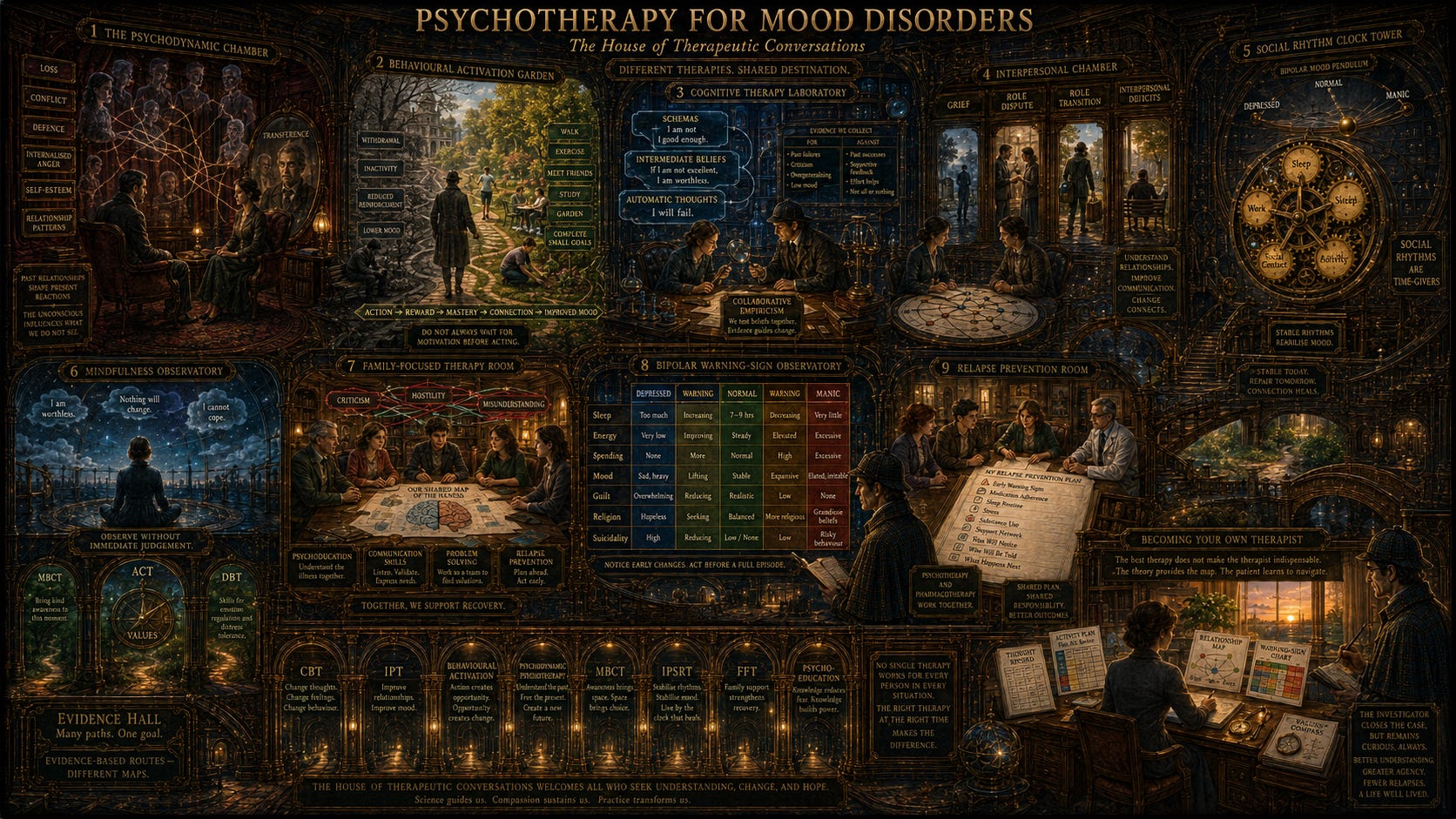
Medlock Holmes enters the House of Therapeutic Conversations.Unlike the pharmacological observatory, there are no bottles, serum levels, or receptor maps here.Instead, there are rooms.Each room represents a different way of understanding and changing mood disorder.One contains memories, conflicts, and unresolved relationships.Another contains automatic thoughts and deeply held beliefs.Another contains grief, role transitions, and interpersonal disputes.A fourth is filled with routines, clocks, families, values, mindfulness, and behavioural experiments.Holmes quickly realises that psychotherapy is not one treatment.It is a family of treatments built upon different theories of how suffering is maintained and how change occurs.The historical journey begins with psychoanalytic and psychodynamic therapy.Early models conceptualised depression as arising from unconscious conflict, internalised anger, loss, and disturbed object relationships. Therapy was long term and aimed at insight through free association, interpretation, and examination of transference.Modern psychodynamic treatments are often much more focused and time limited, but retain the central idea that current symptoms may be shaped by patterns of relationship, defence, and meaning that are not fully conscious.The next chamber belongs to behavioural therapy.Here the model becomes concrete.Depression is associated with withdrawal.Withdrawal reduces access to pleasure, achievement, social contact, and reinforcement.Reduced reinforcement worsens mood.Worsened mood drives further withdrawal.The treatment therefore aims to interrupt the cycle.Get up.Re-engage.Schedule meaningful activity.Reconnect with people.Test whether action can precede motivation rather than waiting for motivation to appear first.From behavioural therapy emerges one of the most influential approaches in psychiatry:Cognitive Behavioural Therapy.Holmes stands before three levels of cognition.At the surface are automatic thoughts.Beneath them lie intermediate beliefs.At the deepest level are schemas.A student receives a poor mark and thinks:“I will never succeed.”Behind the thought may lie a rule:“If I am not excellent, I am a failure.”And beneath that:“I am not good enough.”CBT teaches the patient to observe these thoughts, examine their accuracy, test them against evidence, and develop more balanced alternatives.The therapist does not simply tell the patient they are wrong.Instead, therapist and patient become joint investigators.Beck called this collaborative empiricism.The patient learns to conduct experiments in everyday life.The thought record shown on page 18 of the source captures this process clearly: a situation, emotion, automatic thought, rational response, and resulting emotional shift are tracked systematically so that assumptions can be tested rather than merely believed.Holmes then enters the Interpersonal Chamber.Here depression is viewed within relationships.Unresolved grief.Role disputes.Role transitions.Interpersonal deficits.Interpersonal psychotherapy, or IPT, is time limited and focuses on one or more of these current relational problem areas.The aim is not to prove that relationships caused the depression.It is to identify a tractable interpersonal problem through which recovery can begin.Another doorway leads to Interpersonal and Social Rhythm Therapy.Here the interpersonal world is connected to biological rhythm.Sleep.Meals.Activity.Work.Social contact.Regularity matters particularly in bipolar disorder, where disruption of daily rhythms may destabilise mood.IPSRT therefore combines interpersonal work with deliberate stabilisation of social rhythms.A further chamber is quieter.Holmes encounters mindfulness.Thoughts are still present.Sadness remains.But the patient learns to observe internal experience without immediately reacting to it.Mindfulness-based cognitive therapy helps patients relate differently to negative thoughts rather than becoming absorbed by them.Acceptance and commitment therapy adds another element:values.Instead of making symptom elimination the only goal, ACT asks what kind of life the patient wishes to move towards even while distress is present.Dialectical behaviour therapy similarly combines behavioural change with acceptance and mindfulness, particularly where emotional dysregulation and suicidal behaviour complicate treatment.Holmes then enters the Family Room.Here the patient is no longer treated as an isolated individual.Family-focused therapy recognises that criticism, hostility, misunderstanding, and high emotional expression can increase relapse risk, particularly in bipolar disorder.The family is educated about the illness.Warning signs are identified.Communication is practised.A relapse-prevention plan is agreed.The family becomes part of the therapeutic system.The source emphasises that psychotherapy has strong evidence in major depressive disorder.CBT, IPT, behavioural activation, and time-limited psychodynamic psychotherapy can all be effective.Across many studies, differences between validated psychotherapies are often modest.This leads Holmes to an important insight.Perhaps specific techniques matter.But so do common therapeutic ingredients:A positive therapeutic relationship.Shared goals.A coherent treatment rationale.Repeated practice.Behavioural change.Hope.Attention.Accountability.The evidence also suggests that psychotherapy can have enduring effects after treatment ends, particularly because patients acquire skills they can continue to use themselves.In depression, combined psychotherapy and pharmacotherapy may be particularly valuable in chronic, severe, recurrent, or treatment-resistant illness.In bipolar disorder, however, the role is different.Psychotherapy is adjunctive.It does not replace mood-stabilising pharmacotherapy for mania or mixed states.Instead, therapies such as CBT, IPSRT, FFT, and psychoeducation improve adherence, identify warning signs, stabilise routines, improve relationships, and reduce relapse risk.The warning-sign table on page 27 illustrates this beautifully. It compares depressed, normal, warning, and manic states across sleep, energy, spending, mood, guilt, religion, and suicidality, demonstrating how relapse prevention depends upon recognising a person’s movement away from baseline before a full episode emerges.Holmes reaches the final room.There is no label on the door.Inside sits a therapist with a formulation.The therapist understands the model they are using.But they also understand the patient.That distinction matters.The source ends with a central principle:Excellent psychotherapy requires both a conceptual framework and the capacity to adapt that framework to the unique person in front of the clinician.The theory provides the map.The relationship makes the journey possible.The skills change the path.And successful psychotherapy eventually helps the patient become their own therapist.Key Takeaways* Psychotherapy has been a cornerstone of treatment for mood disorders for decades.* Modern psychotherapy increasingly emphasises structured, time-limited, manualised, and empirically tested approaches.* Major evidence-based approaches include behavioural therapy, CBT, IPT, psychodynamic psychotherapy, mindfulness-based approaches, ACT, DBT, IPSRT, and FFT.* Early psychodynamic models conceptualised depression in terms of unconscious conflict, internalised anger, loss, and object relationships.* Traditional psychoanalytic treatment emphasised free association, interpretation, insight, and transference.* Contemporary psychodynamic psychotherapy can be time limited and focused while retaining attention to unconscious processes and relationship patterns.* Behavioural theories emphasise reduced access to rewarding activity and positive reinforcement.* Behavioural activation aims to reverse withdrawal by increasing meaningful and rewarding activity.* Behavioural activation may be particularly effective in more severe depression.* CBT integrates behavioural strategies with systematic examination of cognition.* Beck’s cognitive therapy focuses on automatic negative thoughts, intermediate beliefs, and deeper schemas.* Depressive automatic thoughts frequently concern failure, worthlessness, rejection, hopelessness, and incompetence.* Intermediate beliefs often take the form of assumptions or rules such as “If I fail, I am worthless.”* Schemas are deeper organising cognitive structures that influence attention, memory, interpretation, and behaviour.* Depression-related schemas may remain relatively silent until activated by relevant stressors.* Beck’s model contains a stress–diathesis formulation in which life events activate underlying cognitive vulnerabilities.* Collaborative empiricism describes therapist and patient working together to test beliefs rather than the therapist simply correcting the patient.* Socratic questioning is used to help patients examine evidence and generate alternative perspectives.* Homework is a central component of CBT because skills must generalise into everyday life.* Activity scheduling, graded tasks, thought monitoring, behavioural experiments, and cognitive restructuring are common CBT techniques.* The thought record on page 18 demonstrates how a situation, emotion, automatic thought, rational response, and new emotional state can be systematically examined.* Behavioural experiments can produce stronger evidence against dysfunctional beliefs than discussion alone.* A major long-term aim of CBT is for patients to become capable of applying therapeutic skills independently.* Case formulation is central to CBT because interventions should be matched to the individual’s underlying beliefs and patterns.* Assessment should include symptoms as well as interpersonal, occupational, health, recreational, and functional domains.* Standardised measures may include diagnostic interviews and depression rating scales.* CBT sessions are typically structured and include collaborative agenda setting.* Initial CBT sessions aim to establish rapport, orient the patient to the model, identify problems, assess severity, provide early symptom relief, and introduce homework.* Treatment gradually moves from surface automatic thoughts towards deeper core beliefs.* Termination includes relapse-prevention planning and ensuring that the patient can use skills without the therapist.* IPT emerged as a major evidence-based alternative to CBT.* IPT draws from interpersonal theory, attachment theory, and pragmatic case-management principles.* Core IPT problem areas include unresolved grief, role disputes, role transitions, and interpersonal deficits.* IPT may use psychoeducation, empathic support, role play, communication analysis, and interpersonal problem solving.* IPT and CBT appear broadly comparable in efficacy for many outpatients with depression.* IPT has particularly strong evidence in depression during and after pregnancy.* IPSRT adapts IPT for recurrent mood disorders and bipolar disorder.* IPSRT combines interpersonal treatment with stabilisation of daily social rhythms.* Sleep, meal times, activity, work, and social contact function as important social zeitgebers.* Rhythm disruption can contribute to mood instability in bipolar disorder.* Mindfulness emphasises observing and accepting internal experiences nonjudgmentally.* Mindfulness can help patients experience negative thoughts as transient mental events rather than unquestioned truths.* Mindfulness-based cognitive therapy was developed particularly to reduce relapse in recurrent depression.* Acceptance and commitment therapy emphasises values-guided action rather than making symptom elimination the sole goal.* ACT may be particularly relevant to chronic depression.* DBT combines behavioural methods, mindfulness, acceptance, and emotion-regulation strategies.* DBT has evidence for reducing suicidal ideation and behaviour.* Family support is generally a favourable prognostic factor in mood disorders.* High levels of family criticism and emotional expression are associated with increased relapse risk.* Family-focused therapy was developed particularly for bipolar disorder.* FFT includes psychoeducation, relapse-prevention planning, communication training, and problem-solving work.* Family members can assist with early identification of symptom exacerbation.* Validated psychotherapy is effective in outpatient major depressive disorder across a range of settings.* Evidence suggests that CBT can produce response and remission rates comparable with antidepressant treatment across approximately 8–16 weeks.* Time-limited psychodynamic psychotherapy is also efficacious for depression.* Differences in efficacy between validated psychotherapies are often modest.* No reliable markers consistently identify which patient will respond preferentially to one psychotherapy over another.* Psychotherapy may produce benefits that persist after formal treatment ends.* Continuation CBT can reduce relapse in incompletely remitted patients at high risk of recurrence.* MBCT and CBT may improve residual symptoms and reduce relapse risk after antidepressant discontinuation.* Group CBT and behavioural therapies can be effective and may offer cost advantages.* Group therapy may be particularly useful for subsyndromal depressive symptoms.* Behavioural marital therapy can improve depressive symptoms and marital functioning in depressed patients with relationship distress.* Combined psychotherapy and pharmacotherapy may offer additional benefit in severe, chronic, recurrent, or treatment-resistant depression.* The advantage of combined treatment may be greater as illness severity and chronicity increase.* Focused psychotherapy can also improve outcomes when added to inpatient treatment.* Sequential treatment with pharmacotherapy followed by psychotherapy may help sustain recovery.* No psychotherapy has been established as an effective monotherapy for acute mania or mixed states.* Psychotherapy in bipolar disorder should generally be viewed as adjunctive to pharmacotherapy.* Evidence-based adjunctive bipolar interventions include psychoeducation, CBT, IPSRT, and FFT.* Adjunctive psychotherapy can increase time well and reduce relapse and recurrence.* Group psychoeducation is a cost-effective adjunctive intervention in bipolar disorder.* Psychoeducation improves treatment adherence and relapse prevention.* CBT for bipolar disorder targets beliefs that worsen symptoms or reduce adherence.* CBT and IPSRT both emphasise routine stability and reduction of triggers for mania.* FFT brings the family system directly into relapse prevention.* Acute bipolar depression may also benefit from adjunctive focused psychotherapy.* STEP-BD demonstrated benefits of adjunctive FFT, IPSRT, and CBT for depressive symptoms and social functioning.* Psychotherapy should be guided by an explicit case formulation.* Theoretical models are useful, but they extend beyond what empirical data alone can prove about the causes of depression.* Shared therapeutic factors may account for part of the effectiveness across different models.* Important common factors include therapeutic alliance, shared goals, coherent rationale, and facilitated behavioural change.* The therapist’s ability to apply a conceptual model flexibly to the individual patient may be as important as allegiance to a specific school.* Psychotherapy for bipolar disorder should include assessment of routines, activity level, social supports, and beliefs about medication.* Beliefs that mania is beneficial or that medication destroys identity may undermine adherence.* Psychotherapy can help patients identify early warning signs of relapse.* Supportive family members or trusted others may detect changes that the patient does not recognise.* The warning-sign table on page 27 maps movement from depression through normality and warning signs to mania across sleep, energy, spending, mood, guilt, religion, and suicidality.* Relapse-prevention plans should specify how warning signs will be communicated and what actions will follow.* Coordination between psychotherapist and prescribing clinician is essential when different professionals provide psychotherapy and pharmacotherapy.* Later therapy can address core beliefs about identity, stigma, rejection, and the possibility of living a meaningful life with bipolar disorder.* By the end of therapy, patients should ideally be able to monitor symptoms, recognise warning signs, use therapeutic skills independently, communicate effectively with clinicians, and participate actively in relapse prevention.* Psychotherapy is most effective when the therapist holds a clear model while remaining responsive to the individuality of the patient.* The ultimate aim is not permanent dependence on the therapist, but increasing the patient’s capacity for self-observation, self-correction, and self-directed recovery. This is a public episode. If you'd like to discuss this with other subscribers or get access to bonus episodes, visit drmanaankarray.substack.com/subscribe
Embed this episode
Ready to play
PSYCH 115: Mood Disorders - Psychotherapy
No transcript for this episode yet
Similar Episodes
No similar episodes found.
Similar Podcasts
No similar podcasts found.