
EPISODE · Sep 8, 2026 · 25 MIN
PSYCH 116: Mood Disorders - Neurobiology
from Clinical Deep Dives · host Dr Manaan Kar Ray
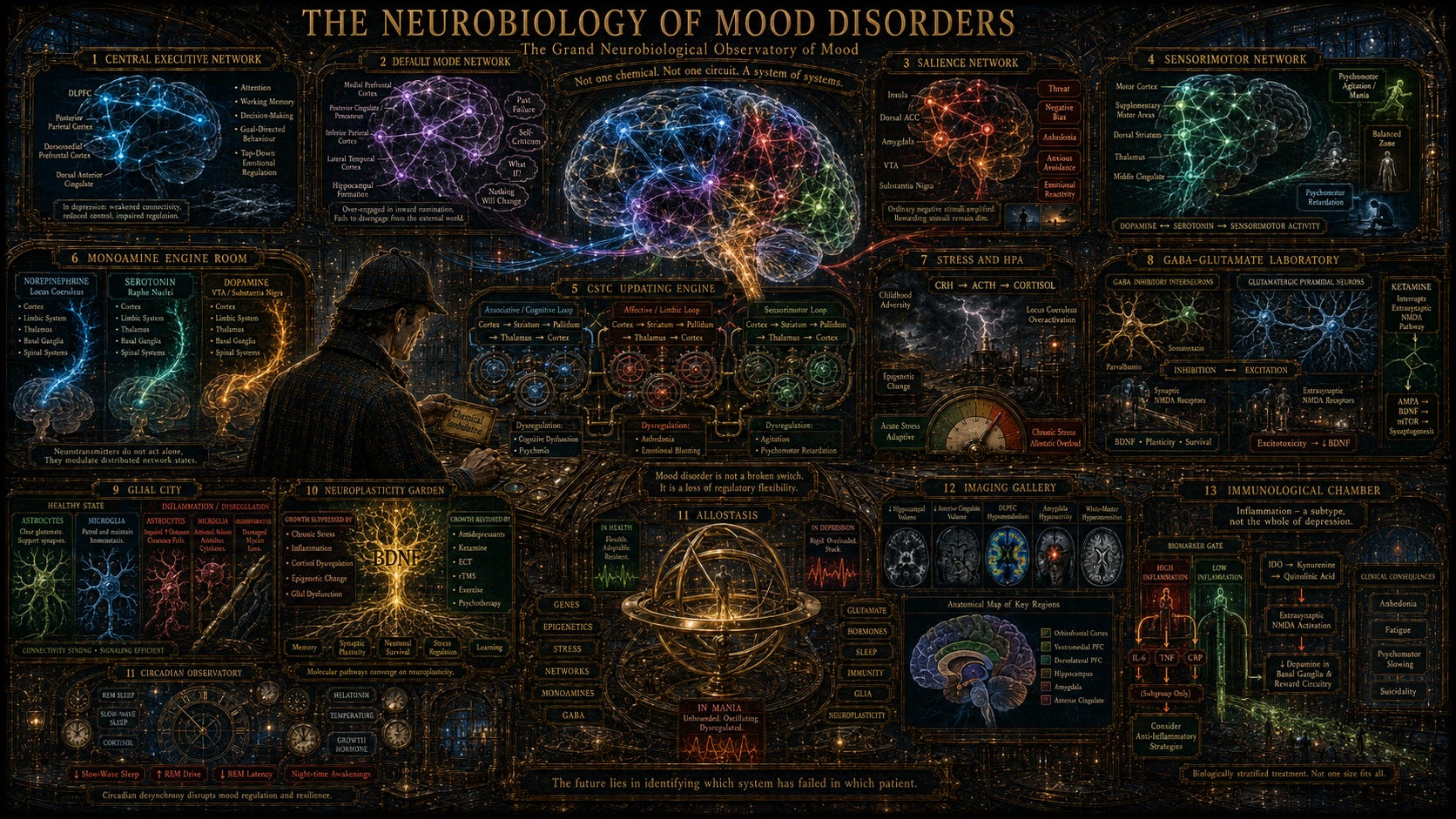
Medlock Holmes enters the Grand Neurobiological Observatory of Mood.At its centre is not one brain map, but an enormous interconnected city of systems.One district controls attention and executive function.Another processes salience and threat.Another turns inward towards memory, self-reflection, and rumination.Another regulates movement.Another tracks reward and motivation.Above them all, stress hormones, immune signals, monoamines, glutamate, GABA, and neurotrophic factors move like weather systems across the city.Holmes quickly realises that the old search for a single biological cause of depression is inadequate.The modern question is different:How do multiple systems lose their ability to regulate one another?The investigation begins with clinical phenomenology.Depression alters cognition, reward, movement, sleep, appetite, libido, energy, and biological rhythms.Negative cognitive bias implicates prefrontal, hippocampal, amygdala, and limbic circuitry.Anhedonia points towards reward circuits involving the ventral tegmental area, nucleus accumbens, anterior cingulate, thalamus, hypothalamus, and prefrontal cortex.Psychomotor slowing and agitation implicate subcortical and sensorimotor systems.Sleep and circadian disturbance draw attention towards hypothalamic, thalamic, and brainstem regulation.The symptoms themselves therefore offer clues to the underlying neural architecture.Holmes then enters the Network Chamber.The first structure is the Central Executive Network, centred on the dorsolateral prefrontal and posterior parietal cortices.It supports working memory, attention, decision-making, goal-directed behaviour, and top-down regulation of emotion.The diagram on page 8 maps this network across the dlPFC, posterior parietal cortex, dorsomedial prefrontal cortex, dorsal anterior cingulate, and inferior temporal regions. When this system underfunctions, indecisiveness, poor working memory, impaired attention, and weak emotional control can emerge.The next chamber is the Default Mode Network.Its hubs include the medial prefrontal cortex, posterior cingulate/precuneus, inferior parietal regions, lateral temporal cortex, and hippocampal formation.The figure on page 10 shows the network underlying self-reflection, autobiographical memory, future planning, social cognition, and internally directed thought.In depression, abnormal DMN connectivity may promote rumination, negative self-focus, and difficulty disengaging from internal thought to solve external problems.Holmes then examines the Salience Network.The insula, dorsal anterior cingulate, amygdala, ventral tegmental area, and substantia nigra help determine what deserves attention and emotional significance.The page 12 diagram links dysfunction here with anhedonia, anxious avoidance, negative emotional bias, inattention, and impaired emotional control.A fourth system is the Sensorimotor Network.Its disturbances may help explain why depression can physically slow a person while mania can accelerate them.The source proposes that mania may involve elevated salience and sensorimotor activity with reduced default-mode self-monitoring, whereas depression may involve reduced sensorimotor activity alongside greater internally focused processing.The psychomotor balance diagram on page 29 captures this beautifully: changes in sensorimotor activity and the balance between dopamine and serotonin are shown along a continuum from severe psychomotor retardation to agitation.Holmes reaches a key conclusion.Mood disorders may involve less a failure of individual brain regions than a failure of dynamic coupling between networks.The brain loses flexibility.It becomes trapped in particular patterns.Rumination persists.Reward circuits fail to engage.Movement slows.Or, in mania, activation overwhelms reflection and self-monitoring.The investigation then descends into the Monoamine Engine Room.Serotonin.Norepinephrine.Dopamine.These neurotransmitters remain important, but the chapter explicitly rejects the old idea that depression is simply a deficiency of one monoamine.Recent studies show that many depressed patients do not demonstrate clear monoamine abnormalities.Monoamines are better understood as neuromodulators that fine-tune the activity and connectivity of large functional networks.Norepinephrine from the locus coeruleus regulates arousal, attention, stress responsivity, and externally directed coping.Serotonin from the raphe nuclei influences sleep, appetite, anxiety, aggression, pain, circadian rhythm, reward, and network regulation.Dopamine regulates motivation, reward, motor activity, concentration, and goal-directed behaviour.Too little or too much activity can be maladaptive.Dopamine in particular shows an inverted-U relationship with executive function: both deficient and excessive signalling can impair working memory, attention, and decision-making.The source’s dopaminergic pathway diagram on page 31 maps the nigrostriatal and mesocorticolimbic systems, linking the substantia nigra and ventral tegmental area with striatum, limbic structures, and prefrontal cortex.Holmes then enters the Stress Laboratory.The hypothalamic–pituitary–adrenal axis activates.CRH rises.ACTH stimulates cortisol.The locus coeruleus increases noradrenergic arousal.Glutamate amplifies excitation.The acute stress response is adaptive.But persistent stress changes the system.Feedback becomes less effective.Monoamines may decline.Neurogenesis may be suppressed.Epigenetic changes can stabilise maladaptive responses.The chapter describes early maltreatment as particularly important.Childhood abuse and neglect increase later depression risk approximately two- to threefold and may leave enduring changes in HPA responsivity, hippocampal structure, and gene expression.Stress therefore becomes biologically embedded.Holmes moves next into the Glutamate and GABA Chamber.Here the old monoamine story becomes even more incomplete.GABA interneurons help regulate cortical signal-to-noise and the output of glutamatergic pyramidal neurons.Depression has been associated with reductions in GABA activity, particularly involving somatostatin-expressing interneurons.Glutamate, meanwhile, is the brain’s major excitatory neurotransmitter.Too much extrasynaptic NMDA activity may suppress BDNF, promote excitotoxicity, and contribute to structural and functional impairment.This is one reason ketamine and esketamine became so important.By antagonising NMDA receptors, they may trigger glutamatergic bursts through AMPA pathways, increase BDNF signalling, activate mTOR pathways, and promote synaptogenesis.The mechanism diagram on page 43 illustrates this shift from NMDA modulation towards BDNF synthesis and synaptic growth.The next chamber belongs not to neurons, but to glia.Astrocytes.Microglia.Oligodendrocytes.These cells regulate glutamate, GABA, inflammation, myelination, neurotrophic support, and connectivity.The glia–synaptic diagram on page 44 shows how inflammation, cytokines, oxidative stress, glutamate, kynurenine metabolites, and neurotrophic factors interact at the synapse.The old image of the brain as neurons communicating while glia merely support them has become obsolete.Mood disorders may involve pathology of the entire cellular ecosystem.Holmes enters the Neuroplasticity Chamber.At its centre is BDNF.Brain-derived neurotrophic factor supports neuronal survival, differentiation, synaptic plasticity, memory, HPA regulation, and neurotransmitter function.Stress, inflammation, epigenetic changes, cortisol dysregulation, and glial dysfunction can all reduce BDNF signalling.Many successful treatments - antidepressants, ketamine, ECT, rTMS, exercise, and psychotherapy - can increase BDNF-related activity.This creates a powerful unifying idea:Perhaps effective treatment works partly by restoring the brain’s capacity to change.The investigation then reaches the Hormonal Observatory.Hypercortisolism is one of the most reproducible biological findings in severe depression, particularly melancholic and psychotic depression.But it is not diagnostically specific.Thyroid abnormalities are also important.A clinically relevant proportion of depressed patients have previously unrecognised hypothyroidism, and thyroid dysfunction can impair treatment response.Growth hormone, prolactin, and other endocrine systems also show abnormalities in subgroups.No single hormonal test diagnoses depression.Instead, endocrine findings reveal how deeply mood disorders are embedded in whole-body physiology.Holmes then enters the Sleep Laboratory.The architecture of sleep has changed.Slow-wave sleep is reduced.Nocturnal awakenings increase.REM sleep becomes more intense.REM latency shortens.These abnormalities may persist beyond symptomatic recovery and can function more like vulnerability markers than simple state effects.The chapter emphasises that biological rhythm is not merely an accompaniment to depression.It is part of its neurobiology.Finally, Holmes reaches the Immunological Chamber.Inflammatory markers such as IL-6, TNF, and CRP are elevated in a subgroup of people with depression.But the source is careful:Depression is not simply an inflammatory disease.Only a subgroup - approximately 30–45% depending on the population and threshold - shows elevated peripheral inflammation.This distinction matters because anti-inflammatory strategies appear most promising in those with demonstrably increased inflammation rather than across all patients with depression.Inflammation particularly appears to influence:Anhedonia.Psychomotor slowing.Fatigue.Suicidal behaviour.It may do so by reducing dopamine synthesis and release, activating the kynurenine pathway, increasing glutamatergic excitotoxicity, altering glial function, and disrupting reward circuitry.Holmes sees the future of biological psychiatry emerging.Not one biomarker for depression.Not one neurotransmitter.Not one circuit.Instead:biotypes.Different combinations of genetics, inflammation, stress responsivity, network connectivity, neurotransmission, neuroplasticity, sleep, and clinical phenotype may eventually identify biologically meaningful subgroups.At the centre of the observatory, Holmes finds no broken switch.He finds a network struggling to maintain allostasis - dynamic stability through constant adaptation.Mood disorder occurs when adaptation becomes overload.The system no longer flexes.Stress responses remain active.Reward circuits disengage.Rumination persists.Sleep loses rhythm.Movement slows or accelerates.Inflammation amplifies vulnerability.Neuroplasticity narrows.Holmes closes the casebook.The neurobiology of mood disorders is not the story of a single chemical deficiency.It is the story of a living system that has lost its capacity to regulate itself.Key Takeaways* Mood disorders are associated with disturbances across multiple neurobiological systems rather than a single lesion or neurotransmitter abnormality.* Neurobiology should be linked to clinical phenomenology, illness course, and treatment response.* Depressive cognition implicates the prefrontal cortex, hippocampus, amygdala, and other limbic structures.* Anhedonia implicates reward circuitry involving the VTA, nucleus accumbens, anterior cingulate, hypothalamus, thalamus, and prefrontal cortex.* Psychomotor retardation and agitation implicate subcortical and sensorimotor circuits.* Sleep, appetite, libido, energy, and circadian symptoms indicate dysfunction in hypothalamic, thalamic, and brainstem regulatory systems.* Melancholia historically refers to depression characterised by anhedonia, loss of mood reactivity, psychomotor disturbance, weight loss, terminal insomnia, and diurnal mood variation.* Melancholic depression is often recurrent and relatively responsive to ECT.* Atypical depression includes reverse vegetative symptoms such as hypersomnia, increased appetite, and weight gain.* Atypical depression is associated in some studies with immune-metabolic features including obesity, insulin resistance, elevated CRP, leptin abnormalities, and altered insula responses to appetitive stimuli.* Bipolar disorder is more heritable than unipolar depression.* Early-onset mood disorder is generally associated with greater heritable loading.* Identical twins show greater shared risk than fraternal twins, but concordance is not 100%, demonstrating the importance of non-genetic influences.* Genetic susceptibility to mood disorder is polygenic.* More than 100 genes have been associated with risk, but each contributes only a small effect.* Some genes may influence resilience rather than vulnerability.* Genes affecting cytochrome P450 enzymes can influence antidepressant metabolism without necessarily affecting depression risk.* Temperamental traits such as neuroticism, harm avoidance, behavioural inhibition, and introversion are partly heritable and can increase vulnerability.* Epigenetic mechanisms allow environmental experience to alter gene expression without changing DNA sequence.* Chronic stress and early adversity can induce lasting epigenetic changes.* Childhood maltreatment increases later depression risk approximately two- to threefold.* Early adversity can produce enduring alterations in HPA-axis responsivity, hippocampal function, and gene expression.* The neurobiology of emotion involves several major large-scale brain networks.* The Central Executive Network supports working memory, attention, decision-making, goal-directed behaviour, and top-down emotional control.* The figure on page 8 places the CEN around the dlPFC, posterior parietal cortex, dorsomedial PFC, dorsal ACC, and inferior temporal gyrus.* CEN dysfunction may contribute to indecisiveness, impaired attention, poor working memory, disorganisation, and reduced emotional regulation.* The Default Mode Network supports self-referential thinking, autobiographical memory, future planning, social cognition, and internal mentation.* The page 10 figure shows the DMN centred on medial prefrontal and posterior cingulate/precuneus regions with temporal and hippocampal components.* DMN dysfunction is associated with rumination, inward orientation, mind wandering, impaired goal-directed behaviour, and disturbed self-processing.* MDD may involve both hyperconnectivity and hypoconnectivity within different DMN components.* DMN-core hypoconnectivity has been described as a moderate risk marker for MDD.* Increased internal DMN activity can contribute to persistent rumination.* The Salience Network helps assign emotional significance and coordinate switching between internal and external cognitive states.* Key salience-network regions include the insula, dorsal ACC, amygdala, VTA, and substantia nigra.* The page 12 diagram links salience-network dysfunction to low motivation, anhedonia, negative emotionality, anxious avoidance, inattention, and impaired emotional control.* The Sensorimotor Network supports sensory processing and motor planning and execution.* Reduced SMN activity may contribute to psychomotor retardation.* Increased SMN activity may contribute to psychomotor agitation and mania.* Internal hypoconnectivity within the SMN has emerged as a relatively stable imaging finding in MDD.* The balance between DMN and SMN activity correlates with depression severity.* The source increasingly frames mood disorders as disorders of dynamic network coupling rather than static regional abnormalities.* The cortico-striatal-thalamo-cortical loop provides a major updating system linking cognitive, affective, and sensorimotor networks.* Its associative, affective, and sensorimotor divisions may contribute respectively to cognitive dysfunction, anhedonia, and psychomotor abnormalities.* Elevated dopaminergic transmission in associative striatum may contribute to psychotic symptoms during bipolar mania.* Reduced ventral limbic CSTC activity may contribute to anhedonia and emotional blunting.* Acute stress activates both the HPA axis and sympathomedullary systems.* CRH stimulates ACTH and subsequent cortisol release.* Acute stress also activates locus coeruleus noradrenergic systems.* Glutamate can amplify arousal during stress.* Prolonged uncontrollable stress can lead to adaptive changes including reduced monoamine and GABA signalling.* Learned helplessness models illustrate how chronic stress can produce persistent behavioural withdrawal.* Antidepressants can attenuate or reverse learned helplessness in animal models.* Social status alters serotonergic and HPA function in primates, illustrating the biological embedding of social experience.* Monoamine hypotheses played a major historical role in mood-disorder neurobiology.* Simple “low serotonin” or “low norepinephrine” explanations of depression are no longer adequate.* Modern evidence suggests many depressed patients do not have clear primary monoamine abnormalities.* Monoamines are better understood as large-scale neuromodulatory systems that regulate network activity and coupling.* The locus coeruleus is the principal source of cerebral norepinephrine.* Norepinephrine contributes to arousal, cognition, sensory processing, stress response, emotional memory, and externally directed coping.* Some depressed patients may demonstrate increased rather than decreased norepinephrine activity.* Excessive locus-coeruleus activity may impair prefrontal top-down regulation despite increasing overall arousal.* Depression may therefore include both hyperaroused and hypoaroused noradrenergic phenotypes.* Elevated norepinephrine is also associated with mania and dysphoric manic symptoms.* Serotonergic neurons project from brainstem raphe nuclei throughout cortex, thalamus, basal ganglia, hippocampus, hypothalamus, and other regions.* Serotonin regulates sleep, appetite, temperature, metabolism, anxiety, aggression, pain, cognition, reward, libido, and circadian rhythms.* The page 25 diagram illustrates widespread serotonergic projections from rostral and caudal raphe nuclei.* Serotonin helps regulate the balance between excitation and inhibition through interactions with GABA and glutamate.* Acute stress may transiently increase 5-HT release, while chronic stress can eventually reduce serotonin activity.* Serotonin plays an important role in neurodevelopment and network connectivity.* Increased serotonin tends to suppress sensorimotor-network activity.* This may partly explain fatigue and sensory blunting associated with SSRIs.* SNRIs and bupropion may improve psychomotor symptoms more strongly than SSRIs in some patients.* SSRIs may normalise amygdala activity and alter abnormal network connectivity.* The dopaminergic system includes tuberoinfundibular, nigrostriatal, mesolimbic, and mesocortical pathways.* Dopamine regulates reward, motivation, motor behaviour, cognition, reinforcement, and goal-directed activity.* The page 31 figure demonstrates projections from substantia nigra and ventral tegmental area to striatum, limbic regions, and prefrontal cortex.* Reduced mesocortical and mesolimbic dopamine may contribute to anhedonia, low motivation, cognitive impairment, and psychomotor slowing.* Increased striatal dopamine may contribute to agitation, psychosis, and mania.* Dopamine follows an inverted-U relationship with executive performance: both deficient and excessive signalling can impair attention and working memory.* Depression may contain distinct psychomotor biotypes, including agitated depression and depression with retardation.* Monoamines influence large-scale networks indirectly through glutamate and GABA regulation.* The chapter presents monoaminergic signalling as part of a broader allostatic regulatory system.* Acetylcholine interacts with monoaminergic systems and may influence sleep, HPA activity, psychomotor slowing, and mania.* A high cholinergic-to-adrenergic ratio has historically been associated with depression, whereas a lower ratio has been associated with mania.* GABA is the major inhibitory neurotransmitter in much of the brain.* Reduced GABA has been reported in plasma, CSF, and brain tissue in depression.* Somatostatin-expressing GABA interneurons appear particularly relevant to MDD.* These interneurons help regulate signal-to-noise and pyramidal-neuron output.* Large ENIGMA-type analyses have linked depression with altered astrocytes and SST GABA interneurons.* Reduced GABA activity may impair emotional regulation, endocrine control, arousal modulation, and network switching.* Allopregnanolone is a neurosteroid that modulates GABA-A receptors.* Brexanolone is approved for major depressive episodes with peripartum onset.* Glutamate is the principal excitatory neurotransmitter.* NMDA and AMPA receptor activity are central to synaptic plasticity.* Synaptic NMDA activity can support BDNF synthesis and neuroprotection.* Extrasynaptic NMDA activation can suppress BDNF, promote mitochondrial dysfunction, and contribute to excitotoxicity.* Glutamate abnormalities have been reported in hippocampus, vmPFC, ACC, and basal ganglia in mood disorders.* Elevated basal-ganglia glutamate has been associated with anhedonia and psychomotor retardation.* Ketamine and esketamine produce rapid antidepressant effects through NMDA modulation.* The page 43 diagram illustrates the proposed pathway from NMDA antagonism through glutamate burst, AMPA activation, BDNF, mTOR, and synaptogenesis.* Ketamine may increase CEN activity and reduce dysfunctional DMN and salience-network activity.* Lateral habenula burst firing has been associated with negative affect and suppression of monoamine release.* Glial cells play central roles in mood-disorder pathophysiology.* Astrocytes regulate glutamate, GABA, inflammation, and neurotrophic support.* Oligodendrocytes regulate myelination and long-range connectivity.* Microglia regulate immune signalling within the CNS.* Postmortem studies show reductions in glial density in several prefrontal and limbic regions in MDD and bipolar disorder.* Oligodendrocyte reductions may contribute to impaired white-matter connectivity.* Microglial activation has been described particularly in some individuals dying by suicide.* The page 44 glia–synaptic figure illustrates interactions among astrocytes, microglia, inflammatory cytokines, glutamate, GABA, BDNF, kynurenine metabolites, and NMDA receptors.* Inflammation can activate the kynurenine pathway through IDO.* This diverts tryptophan away from serotonin synthesis towards kynurenine metabolites.* Quinolinic acid acts as an NMDA agonist and may contribute to excitotoxicity.* Inflammation can increase monoamine reuptake and impair dopaminergic signalling.* BDNF is a major neurotrophic factor involved in neuronal survival, differentiation, memory, plasticity, HPA regulation, and neurotransmitter function.* BDNF levels are often reduced in MDD and bipolar mood episodes.* Lower BDNF has been associated with persistent illness, suicidality, and greater symptom severity in some studies.* Many successful treatments can increase BDNF-related signalling.* These include antidepressants, ketamine, ECT, rTMS, exercise, and psychotherapy.* Neuroplasticity provides a possible common downstream mechanism across otherwise very different treatments.* Second-messenger systems translate receptor activation into intracellular change.* G proteins, adenylate cyclase, phospholipase C, cAMP, calcium signalling, and protein kinases influence receptor function and gene transcription.* Antidepressants and mood stabilisers may exert delayed therapeutic effects partly through intracellular and gene-expression changes.* HPA-axis hyperactivity is one of the most replicated biological findings in severe depression.* Approximately 20–40% of depressed outpatients and 40–60% of depressed inpatients show evidence of elevated HPA activity.* HPA abnormalities are more common in older patients and severe, recurrent, melancholic, or psychotic depression.* Hypercortisolism is not specific enough to serve as a diagnostic test.* Persistent HPA dysregulation after symptomatic recovery is associated with increased relapse risk.* Approximately 5–10% of people assessed for depression may have previously unrecognised hypothyroidism.* Thyroid abnormalities can compromise antidepressant response.* Blunted TSH response to TRH is found in a larger subgroup of depressed patients but is not diagnostically specific.* Thyroid augmentation may be clinically useful in selected treatment-resistant cases.* Growth-hormone responses are frequently blunted in depression.* Somatostatin levels may be reduced in depression and increased in mania.* Prolactin abnormalities are less consistent.* Sleep disturbance is deeply integrated with mood-disorder neurobiology.* Depression is associated with reduced slow-wave sleep, increased nocturnal arousal, increased REM activity, and shortened REM latency.* Reduced REM latency and slow-wave deficits may persist after recovery and function as vulnerability markers.* EEG sleep abnormalities are more common in severe and recurrent depression.* Abnormal sleep profiles may predict poorer response to psychotherapy and greater relapse risk.* Structural imaging studies describe reduced hippocampal, medial orbital, and anterior cingulate volumes in some patients.* Hippocampal volume reduction is associated with illness chronicity in some studies.* Subcortical hyperintensities are particularly common in older adults and bipolar I disorder.* Some late-onset depression may reflect interaction between vascular disease and mood regulation.* Functional imaging commonly shows reduced anterior and prefrontal metabolism in depression.* Reduced dorsolateral PFC function correlates with impaired executive control and difficulty regulating negative emotion.* Amygdala and paralimbic hyperactivity may act as an “emotional amplifier” in severe depression.* Imaging abnormalities can partially normalise with successful treatment.* The figure on page 53 highlights the orbital and ventromedial PFC, dorsolateral PFC, hippocampus, amygdala, and anterior cingulate as key regions in affective regulation.* Depression is associated with elevated inflammatory mediators in a subgroup of patients.* The most consistently elevated peripheral markers include IL-6, TNF, and CRP.* Inflammation can prospectively increase risk of later depression.* Chronic interferon-alpha treatment produces major depressive syndromes in approximately 30–50% of exposed individuals.* This supports a causal role for inflammation in at least some depressive states.* MDD is not best understood as a universally inflammatory disorder.* Approximately 30–45% of depressed individuals demonstrate elevated peripheral inflammation depending on the sample and threshold.* Elevated inflammation is more common with obesity, childhood adversity, socioeconomic disadvantage, and treatment resistance.* Inflammation disproportionately promotes anhedonia, psychomotor slowing, fatigue, and suicidal behaviour.* Inflammatory effects on reward and movement may be mediated particularly through impaired dopamine signalling in basal ganglia.* Inflammation may impair effort-based motivation and reward anticipation more than consummatory pleasure.* Suicidal ideation and behaviour have repeatedly been associated with increased inflammatory signalling.* Peripheral inflammation can influence the brain through circumventricular organs, transporters, sensory afferent nerves, immune-cell trafficking, and disruption of the blood–brain barrier.* Inflammation reduces dopamine synthesis, release, and receptor function.* It activates the kynurenine pathway and alters glutamatergic transmission.* It can impair astrocytic glutamate clearance and promote extrasynaptic NMDA activation.* Increased inflammation is associated with reduced ventral-striatal and prefrontal connectivity and greater anhedonia.* Anti-inflammatory treatments do not show uniform antidepressant effects across all patients with MDD.* Cytokine antagonists appear most promising in patients with clearly elevated inflammatory biomarkers.* Infliximab and other cytokine antagonists have shown little benefit in depressed patients with low baseline inflammation.* Some evidence suggests patients with increased inflammation may respond relatively poorly to purely serotonergic antidepressants and better to agents with catecholaminergic or dopaminergic activity.* Inflammation may therefore represent one route towards biologically stratified treatment.* Future neurobiology will increasingly seek biotypes rather than one universal mechanism of depression.* Biotypes may integrate genetics, epigenetics, inflammation, network function, neurotransmission, neuroplasticity, endocrine regulation, sleep, and clinical phenotype.* Some neurobiological abnormalities are state-dependent and resolve with treatment.* Others are trait-like and persist during remission.* Still others may accumulate over time as consequences of chronic illness, stress, ageing, or vascular disease.* The most useful overarching model is one of disrupted allostasis: the brain and body lose the flexibility required to maintain stability through changing circumstances.* Mood disorders are therefore best understood neurobiologically as failures of dynamic regulation across interconnected systems rather than as simple chemical imbalances. This is a public episode. If you'd like to discuss this with other subscribers or get access to bonus episodes, visit drmanaankarray.substack.com/subscribe
Embed this episode
Ready to play
PSYCH 116: Mood Disorders - Neurobiology
No transcript for this episode yet
Similar Episodes
No similar episodes found.
Similar Podcasts
No similar podcasts found.