
EPISODE · Sep 9, 2026 · 40 MIN
PSYCH 117: Anxiety Disorders - Introduction and Overview
from Clinical Deep Dives · host Dr Manaan Kar Ray
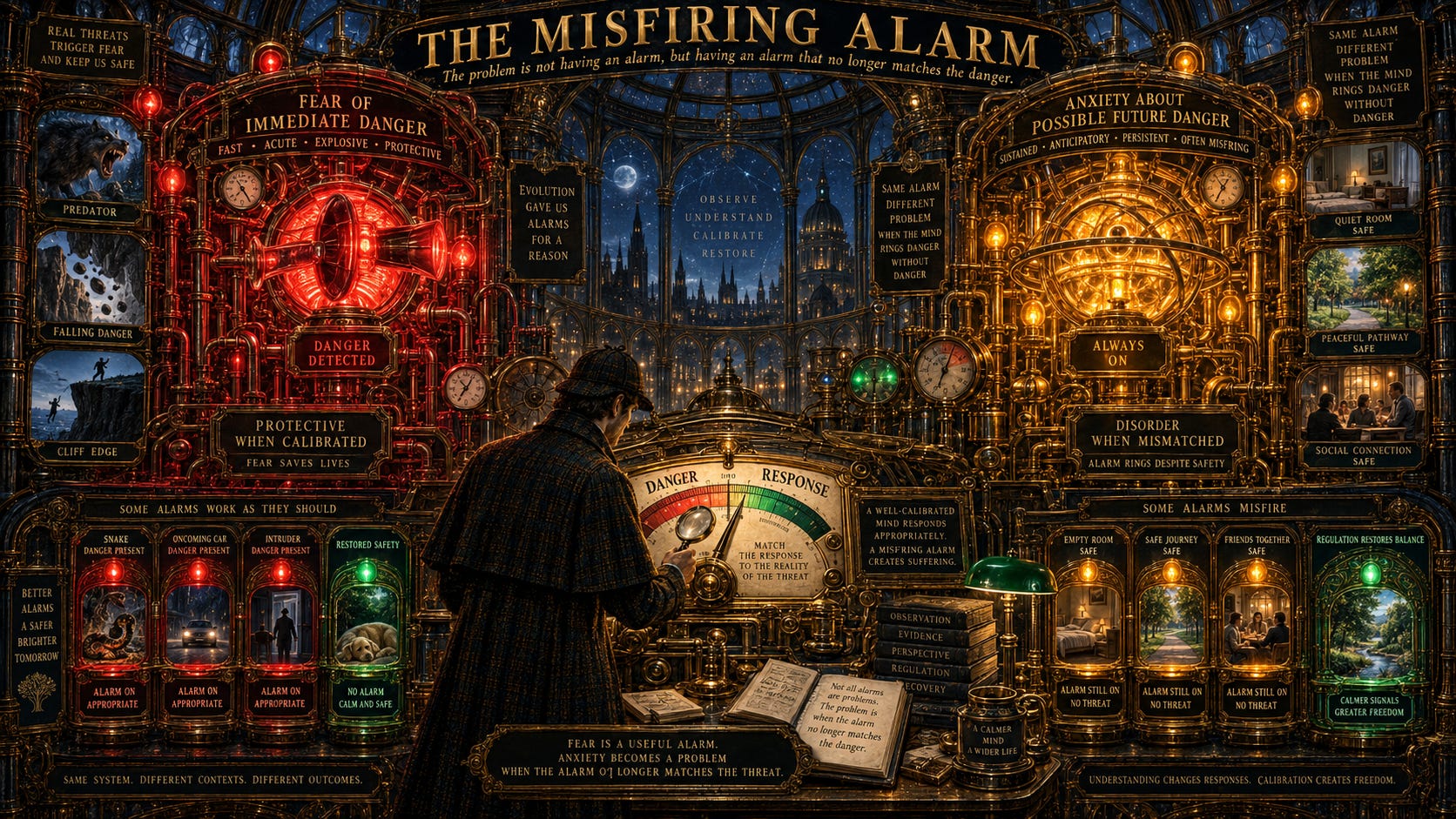
Medlock Holmes enters the Grand Observatory of Fear and Anxiety.At the centre stand two enormous warning systems.One is labelled:FEARThe other:ANXIETYAt first they appear identical.Both activate the body.Both sharpen attention.Both pull behaviour towards avoidance.Both exist to protect the organism from harm.But Holmes quickly sees the difference.Fear is immediate.A threat is here.A predator appears.A car swerves towards the pedestrian.A dangerous person approaches.The brain mobilises rapidly.Anxiety is different.The threat is not yet present.It may be distant.Ambiguous.Possible.The organism prepares for what might happen.The chapter distinguishes them across both time and space.Fear is the acute response to proximal, overt danger.Anxiety is the sustained response to distal, anticipated, or uncertain threat.Holmes walks into a laboratory where a simple conditioning experiment is underway.A tone predicts an aversive event.When the tone appears, the animal freezes.That is the analogue of fear.But later, when the animal is returned to the same environment without the tone, its body remains vigilant.Nothing dangerous is currently happening.Yet the context itself has become threatening.That is closer to anxiety.The distinction is not perfect.When an immediate threat becomes especially intense, the acute state may be better understood as panic.Holmes therefore draws three circles:Anxiety → Fear → PanicNot as separate diseases, but as increasingly immediate forms of defensive response.The chapter then asks a more difficult question:When does normal anxiety become abnormal?The answer cannot come from intensity alone.Humans are supposed to feel anxious.A student before an examination.A parent waiting for medical results.Someone walking alone through an unsafe environment.Anxiety becomes clinically significant when it produces substantial distress or interferes with normal functioning.But Holmes notices a complication.Impairment depends partly upon environment.Two people could have similar internal fear responses, yet one has greater resources, social support, financial security, or environmental flexibility.The same neural response may therefore create very different levels of disability.Clinical definitions and neuroscience do not always draw their boundaries in exactly the same place.This becomes one of the chapter’s central ideas:Anxiety exists at the intersection of brain, behaviour, and context.Holmes then enters the Hall of Classification.The DSM-5 anxiety-disorder family includes:* Panic disorder* Agoraphobia* Specific phobia* Social anxiety disorder* Generalized anxiety disorder* Separation anxiety disorderBut two familiar conditions have moved elsewhere.Obsessive-compulsive disorder is now classified among obsessive-compulsive and related disorders.Post-traumatic stress disorder belongs among trauma- and stressor-related disorders.Agoraphobia has become independently diagnosable rather than being defined only through panic disorder.Social phobia has become social anxiety disorder.And separation anxiety disorder is no longer restricted conceptually to childhood.Holmes recognises what classification is trying to achieve.Not perfect biological truth.A practical structure for identifying recurring clinical patterns.The next chamber is devoted to assessment.Anxiety can be measured at several levels.Symptoms.Traits.Disorders.Behaviour.Physiology.Adults may be assessed using structured or semistructured interviews such as the CIDI, DIS, SCID, or ADIS.Children often require information from several observers.The child.Parents.Teachers.Clinicians.This matters because anxiety is context dependent.A child who appears calm at home may be incapacitated at school.Another may conceal anxiety from parents but show avoidance to teachers.No single informant sees the entire picture.Holmes then enters the Physiology Laboratory.Here anxiety becomes visible through the body.Heart rate rises.Pulse changes.Skin conductance increases.Temperature regulation shifts.Blushing appears.Facial expression changes.The chapter notes that experimental tasks such as public speaking or threat-of-shock paradigms can be used to induce and measure anxiety.These measures remind Holmes that anxiety is not merely a thought.It is a coordinated state involving cognition, physiology, emotion, and behaviour.The investigation then widens towards public health.Anxiety disorders are among the most prevalent psychiatric syndromes.The source reports that approximately 17% of adults have a lifetime history of a major anxiety disorder, while around 1 in 10 experience a current anxiety disorder.Their burden begins early.Many anxiety disorders emerge in childhood or adolescence.That means they can interfere with education.Friendships.Development of independence.Employment.Relationships.And the gradual accumulation of confidence that comes from successfully approaching the world.The consequences can therefore stretch across decades.At a global level, anxiety disorders account for approximately 10% of disability-adjusted life years among mental, neurological, and substance-use disorders, second only to major depression in the burden estimate described by the source.Yet Holmes discovers a paradox.Despite being common.Despite being disabling.Despite having effective treatments.Anxiety disorders have among the lowest rates of professional treatment across major classes of mental disorder.Some people interpret anxiety as personality.Others avoid treatment because avoidance itself is part of the disorder.Some never realise that what they experience is treatable.Others reach primary care repeatedly through bodily symptoms but remain undiagnosed.The treatment gap becomes part of the burden.The final chamber is not dedicated to one diagnosis.It is an enormous map of the entire anxiety-disorder field.Clinical phenomenology.Epidemiology.Genetics.Neuroimaging.Neurochemistry.Cognitive behavioural therapy.Somatic treatment.Every pathway returns to the same fundamental defensive system.The fear system evolved because danger is real.The anxiety system evolved because anticipating danger can improve survival.The problem begins when prediction loses proportionality.When safe situations become threatening.When uncertainty becomes intolerable.When avoidance prevents corrective learning.When physiological defence activates without sufficient danger.Holmes closes the casebook.The central mystery of anxiety is therefore not why humans possess fear.Without fear, humans would not survive.The mystery is how an adaptive alarm system becomes calibrated to signal danger when danger is absent, distant, exaggerated, or no longer relevant.Key Takeaways* Anxiety disorders are among the most prevalent psychiatric syndromes.* The source reports that approximately 17% of adults have a lifetime history of a major anxiety disorder.* Approximately 1 in 10 adults experience a current anxiety disorder.* Anxiety disorders are associated with substantial subjective distress and social impairment.* Their frequent onset in childhood and adolescence can interfere with educational, occupational, social, and developmental functioning.* Anxiety disorders account for approximately 10% of disability-adjusted life years among mental, neurological, and substance-use disorders in the burden estimate cited by the source.* In that estimate, anxiety disorders rank second only to major depression in disability burden.* Despite their prevalence and treatability, anxiety disorders have among the lowest proportions of professional treatment among major psychiatric disorder classes.* Fear and anxiety are both core negative emotions.* Emotions can be conceptualised as brain states generated by motivationally salient stimuli that require action.* Motivational stimuli can broadly be divided into rewards and punishments.* Rewards promote approach behaviour.* Punishments promote avoidance behaviour.* Danger refers to stimuli or situations capable of producing harm.* A threat is an encountered or anticipated dangerous stimulus or situation.* Fear is not necessarily one unitary state; different forms of danger may elicit distinguishable fear responses.* Innately dangerous stimuli, social threats, and learned threats can activate partly different defensive responses.* Fear generally refers to an acute response to overt, immediate danger.* Anxiety generally refers to sustained responding to anticipated, uncertain, or more distant danger.* Fear can therefore be understood as relatively proximal and anxiety as relatively distal.* Fear is also more immediate temporally, whereas anxiety may persist before the threat actually appears.* Panic can be conceptualised as an especially intense acute response to an immediate threat.* Fear-conditioning paradigms help model defensive responses experimentally.* In classical conditioning, a neutral cue becomes a conditioned stimulus when it predicts an aversive unconditioned stimulus.* The immediate response to the conditioned cue provides an experimental analogue of fear.* Anxiety can be modelled as sustained defensive responding to the broader context in which danger was previously encountered.* Fear and anxiety therefore differ both temporally and spatially.* Animal models help clarify basic defensive circuitry but do not map perfectly onto clinical human anxiety.* Clinical definitions of abnormal anxiety depend heavily on distress and functional impairment.* Anxiety can be intense without necessarily being pathological.* Normal anxiety is an adaptive response to genuine risk, uncertainty, challenge, or anticipated difficulty.* Pathological anxiety involves disproportionate, persistent, distressing, or impairing responses.* Functional impairment is strongly influenced by environmental context.* Two people with similar neural anxiety responses may experience very different levels of disability depending on available resources and environmental demands.* This creates an important distinction between neuroscience-based and clinically based definitions of abnormal anxiety.* Future understanding of anxiety disorders will depend on integrating brain function with environmental context.* DSM-5 reorganised the anxiety-disorder category.* Major DSM-5 anxiety disorders include panic disorder, agoraphobia, specific phobia, social anxiety disorder, generalized anxiety disorder, and separation anxiety disorder.* Obsessive-compulsive disorder was removed from the anxiety-disorders chapter and placed within obsessive-compulsive and related disorders.* Post-traumatic stress disorder was moved into trauma- and stressor-related disorders.* Agoraphobia became an independently codable disorder rather than being diagnosed only in relation to panic disorder.* Social phobia was renamed social anxiety disorder.* Separation anxiety disorder was moved from the childhood-only grouping into the broader anxiety-disorders category.* Diagnostic wording was revised to improve consistency, clarity, and objectivity.* Anxiety can be assessed at both symptom and disorder levels.* Adult anxiety assessment can include state and trait anxiety scales, fear and avoidance measures, and clinician-administered symptom scales.* Structured diagnostic interviews include the CIDI and DIS.* Clinician-administered structured or semistructured interviews include the SCID and ADIS.* The ADIS-R is described as a particularly comprehensive interview for anxiety and affective disorders.* Assessment of anxiety in children should often include information from multiple informants.* Parents, caregivers, teachers, clinicians, and the child may each observe different manifestations of anxiety.* Structured child assessments include the DISC, adolescent CIDI, K-SADS, and child versions of the ADIS.* Anxiety can also be studied using psychophysiological measures.* Experimental anxiety tasks include public speaking and threat-of-shock paradigms.* Physiological indicators include pulse, heart rate, skin conductance, temperature regulation, blushing, facial expression, and other autonomic changes.* Physiological measures can complement self-report because subjective recall may incompletely capture actual defensive responding.* Anxiety disorders are heterogeneous in presentation and underlying mechanisms.* The broader anxiety-disorders section examines phenomenology, epidemiology, genetics, neurobiology, imaging, CBT, and somatic treatments.* Panic disorder, GAD, phobic disorders, and social anxiety disorder remain linked by shared fear/anxiety processes despite their distinct clinical presentations.* Epidemiological evidence shows that anxiety disorders are common worldwide.* A major public-health problem is the mismatch between high prevalence and low treatment uptake.* Neurobiological models increasingly emphasise interactions between cortical and subcortical fear circuits.* Neurochemical systems implicated in anxiety include serotonin and norepinephrine, but also neurosteroids, opioid peptides, neuropeptide Y, and other modulators.* Neuroimaging studies increasingly focus on interactions among the amygdala, hippocampus, and medial and orbital prefrontal cortex.* Neurodevelopmental processes are especially important because many anxiety disorders begin early in life.* Cognitive behavioural therapy is effective across multiple anxiety disorders and across age groups.* Exposure to feared but safe stimuli is a central component of many effective CBT programmes.* Imaginal exposure can be used for distressing thoughts or feared scenarios.* Reduction of safety behaviours and subtle avoidance is essential because avoidance prevents corrective learning.* Interoceptive exposure is particularly relevant to panic disorder.* Cognitive interventions help patients attend to evidence that feared outcomes do not occur as expected.* Behavioural experiments combine cognitive testing with real-world exposure.* Anxiety-management training and cognitive therapy are useful particularly in GAD.* Somatic treatment should follow comprehensive diagnostic assessment rather than symptom prescribing alone.* Physical examination, laboratory investigation, comorbidity, and contextual factors may influence treatment choice.* Treatment adherence, adverse effects, and medication discontinuation should be actively managed.* Primary care plays an important role in detection and management because many patients with anxiety disorders first present outside specialist psychiatry.* The anxiety-disorder field still faces major challenges involving phenotypic heterogeneity and uncertain diagnostic boundaries.* The boundary between normal fear and pathological anxiety cannot be established purely from biological response.* Anxiety disorders are best understood as disorders in which an evolutionarily adaptive defensive system becomes disproportionate, persistent, maladaptive, or functionally impairing.* The central clinical question is therefore not whether fear exists, but whether the alarm system remains appropriately calibrated to the actual level of danger. This is a public episode. If you'd like to discuss this with other subscribers or get access to bonus episodes, visit drmanaankarray.substack.com/subscribe
Embed this episode
Ready to play
PSYCH 117: Anxiety Disorders - Introduction and Overview
No transcript for this episode yet
Similar Episodes
No similar episodes found.
Similar Podcasts
No similar podcasts found.