
EPISODE · Sep 12, 2026 · 1H 21M
PSYCH 120: Anxiety Disorders - Neurobiology and Neuroscience
from Clinical Deep Dives · host Dr Manaan Kar Ray
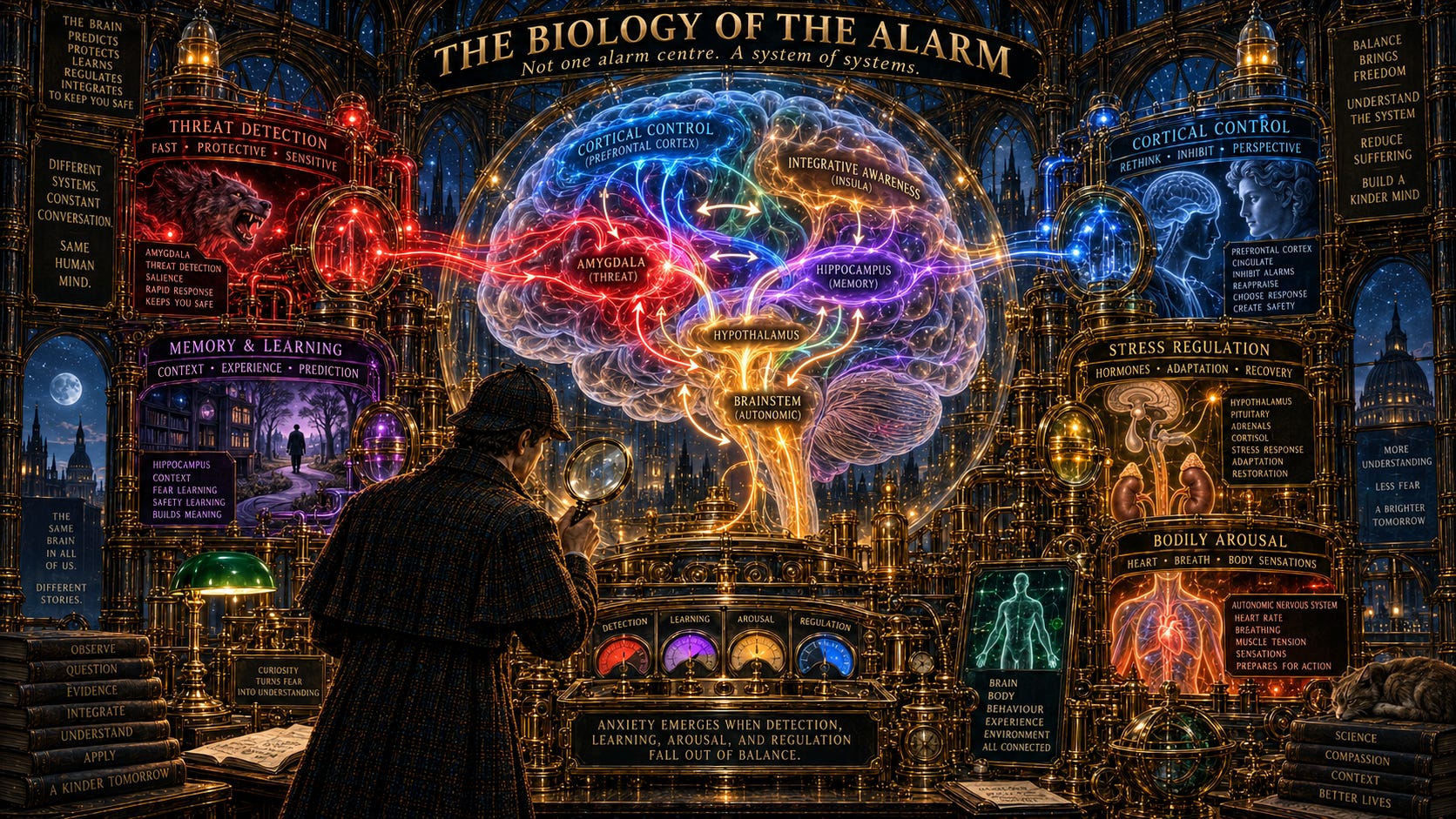
Medlock Holmes enters the Neurobiological Citadel of Fear.At its centre stands an enormous transparent brain.It is not silent.Signals move constantly between the amygdala, hippocampus, prefrontal cortex, thalamus, hypothalamus, locus coeruleus, and brainstem.Some pathways detect threat.Others generate autonomic responses.Others encode memories.Others decide whether a stimulus is dangerous.Others determine whether the alarm can finally be switched off.Holmes immediately sees the problem.Anxiety is not produced by a single fear centre.It is produced by a network.The central diagram on page 4 captures this clearly. The thalamus contributes to autonomic and endocrine regulation. The hippocampus and amygdala participate in salience detection and associative learning. The locus coeruleus projects widely to cortex and helps regulate attention, arousal, and pain evaluation. The prefrontal cortex helps coordinate higher-order regulation of these responses.The first chamber belongs to norepinephrine.The locus coeruleus sits in the pons like an emergency broadcasting tower.When danger appears, norepinephrine surges.Heart rate increases.Pupils dilate.Breathing accelerates.Attention narrows.Vigilance rises.The organism becomes ready to fight or flee.In the short term, this is adaptive.But when the noradrenergic system becomes excessively active, the same protective response can become pathological.The person remains hyperaroused when danger has passed.Startle becomes excessive.Attention remains locked onto threat.Autonomic symptoms themselves become frightening.This is particularly relevant to panic disorder and phobic states.Holmes sees the paradox.Drugs that increase norepinephrine acutely may provoke anxiety.Yet SNRIs and tricyclic antidepressants can treat anxiety disorders over time.The explanation lies in adaptation.Their therapeutic effects emerge not from the immediate increase in monoamine signalling, but from longer-term receptor and network changes.The next chamber is the HPA Axis Observatory.Stress activates the hypothalamus.CRH rises.ACTH follows.The adrenal glands release cortisol.Again, the system is protective.Cortisol mobilises energy.Sharpens vigilance.Modifies memory.Suppresses nonessential processes.Helps the organism survive an acute threat.But Holmes watches what happens when the system stays active for too long.Persistently elevated glucocorticoids affect the hippocampus.Cell survival changes.Morphology changes.Memory becomes impaired.Metabolic and cardiovascular effects accumulate.The source describes hypertension, osteoporosis, immunosuppression, insulin resistance, dyslipidaemia, coagulation abnormalities, and cardiovascular disease among the possible consequences of prolonged glucocorticoid exposure.Yet when Holmes compares patients with different anxiety disorders, he does not find one uniform HPA abnormality.Panic disorder shows mixed findings.GAD may show increased, decreased, or dysregulated cortisol activity.Some studies of long-term hair cortisol in GAD even suggest lower concentrations, raising the possibility that chronic anxiety can eventually downregulate the stress axis.Social anxiety also shows inconsistent findings influenced by age and sex.Specific phobias, however, can produce clear cortisol increases during exposure to the feared stimulus.The lesson is important:The stress system is dysregulated in anxiety, but not in one identical direction across all disorders.Holmes then enters the chamber of corticotropin-releasing hormone.CRH does more than activate cortisol.It operates throughout the brain.Amygdala.Prefrontal cortex.Cingulate cortex.Bed nucleus of the stria terminalis.Nucleus accumbens.Periaqueductal grey.Locus coeruleus.Raphe nuclei.CRH therefore coordinates behavioural as well as endocrine responses to stress.Early-life stress may alter CRH signalling for years.High CRH exposure can contribute to allostatic load.CRH-1 and CRH-2 receptors appear to have partly opposing functions.CRH-1 activation tends to increase anxiety-like behaviour in animal models.CRH-2 may contribute to more adaptive or anxiolytic responses.It appears biologically compelling.But clinical translation has been disappointing.CRH-1 antagonists have not yet produced reliable therapeutic success in anxiety disorders.Holmes writes another principle in his notebook:Biological plausibility does not guarantee clinical efficacy.The next chamber belongs to dopamine.Dopamine is usually associated with reward and motivation.But during stress it also changes.The medial prefrontal cortex is particularly sensitive.Moderate stress increases prefrontal dopamine.This can improve adaptive responding.Too much dopamine impairs cognition.Too little may delay extinction of conditioned fear.Holmes sees an inverted-U-shaped control system.Optimal dopamine allows flexible learning.Excessive dopamine destabilises cognition.Insufficient dopamine makes the brain slow to update when danger is no longer present.This becomes especially important in fear extinction.The person may know intellectually that the situation is now safe, but the defensive system fails to learn it.The next chamber is serotonin.Here the biology becomes even more complex.Serotonin can both promote and reduce anxiety depending on where in the brain it acts.In the prefrontal cortex and amygdala, serotonin can enhance awareness of threat.In the dorsal periaqueductal grey, it can suppress fight-or-flight behaviour.This dual role helps explain why serotonin can participate in panic, anticipatory anxiety, and generalized worry.The 5-HT1A and 5-HT2 receptor families are particularly important.Imaging studies show reduced 5-HT1A receptor binding in several regions in panic disorder and social anxiety.Early-life changes in serotonergic systems may have persistent effects on anxious behaviour.SSRIs eventually alter these circuits and remain among the most effective treatments for panic disorder, social anxiety disorder, and GAD.But again, the effect is delayed.The immediate neurochemical change is not the same as the final therapeutic change.Holmes then enters the GABA Chamber.Here everything becomes quieter.GABA is the major inhibitory neurotransmitter in the brain.It reduces neuronal excitability.It restrains the alarm.The GABA-A receptor sits at the centre of the chamber.Benzodiazepines bind allosterically to this receptor complex and amplify inhibition.Anxiety falls quickly.The person relaxes.Panic diminishes.But the chamber contains a warning.Tolerance.Dependence.Sedation.Memory effects.Abuse potential.This explains why benzodiazepines, despite their clear anxiolytic efficacy, are no longer considered first-line treatment for panic disorder, social anxiety disorder, or GAD.Holmes also notices something interesting.Flumazenil - a benzodiazepine antagonist - can provoke panic in people with panic disorder but not reliably in healthy controls.This suggests that the GABA system is not merely a target for treatment.It may already be altered within the disorder itself.The next chamber belongs to glutamate.The excitatory counterpart to GABA.Holmes watches the balance shift:GABA inhibition ↓Glutamate excitation ↑The alarm system becomes easier to trigger.Glutamate also interacts with norepinephrine and serotonin.NMDA receptors become particularly important because they are involved in both fear acquisition and fear extinction.Block NMDA receptors and fear learning can be impaired.But extinction can also be impaired.That produces a therapeutic puzzle.How do we reduce pathological fear without preventing the brain from learning safety?One answer emerged through D-cycloserine.Rather than acting as a traditional anxiolytic, it partially stimulates the glycine site of the NMDA receptor.The hope was that it could enhance the learning that occurs during exposure therapy.Early trials were promising.Acrophobia.Social anxiety.Panic disorder.But larger studies produced inconsistent findings.Again, Holmes sees the translational challenge:A molecule may enhance learning.But the quality and timing of the learning experience still matter.If exposure goes badly, enhancing learning could theoretically reinforce the wrong memory.Ketamine enters the story from another direction.Small preliminary studies suggest rapid reductions in refractory social anxiety and generalized anxiety symptoms.But this evidence remains limited.Other glutamatergic drugs have produced similarly mixed or preliminary results.The source repeatedly reminds Holmes not to confuse promising mechanism with established treatment.The next room is filled with hormones derived from cholesterol.These are neurosteroids.Allopregnanolone.Pregnanolone.Other progesterone metabolites.They modulate GABA-A receptors and may provide endogenous anxiolytic effects.The biology becomes particularly striking during pregnancy and the postpartum period.Progesterone and allopregnanolone rise during pregnancy.Some women with panic disorder experience improvement.Hormone concentrations fall rapidly after delivery.Anxiety may rebound.The source explores this as one example of how endogenous neurosteroid systems may influence fear and anxiety.Holmes moves onward.The next chambers contain an expanding collection of neuropeptides.Vasopressin.Oxytocin.Neuropeptide Y.Galanin.Cholecystokinin.Each modifies the stress system differently.Oxytocin is particularly associated with social behaviour, social cognition, and attenuation of stress responses.Intranasal oxytocin has reduced amygdala responses to fearful faces and altered social-anxiety circuitry in experimental studies.It may facilitate extinction of social fear.But clinical implementation remains uncertain.Neuropeptide Y appears to play a different role.Resilience.Stress buffering.Fear-memory modulation.Higher NPY activity can reduce anxiety-like behaviour in animal models.Early human work suggests potential anxiolytic effects, but clinical evidence remains preliminary.Galanin interacts closely with the noradrenergic system of the locus coeruleus and may become especially important under high stress.Again, human treatment studies are sparse.Cholecystokinin presents the opposite picture.CCK-4 can provoke panic.In both healthy people and those with panic disorder, administration can generate intense panic-like responses.This made CCK an attractive drug target.But CCK antagonists repeatedly failed to become effective anxiolytic treatments.Another compelling biological mechanism had failed the clinical test.Holmes reaches the Endocannabinoid Chamber.CB1 receptors are distributed through the prefrontal cortex, amygdala, hippocampus, and periaqueductal grey.Endocannabinoid activity increases during threat and may counteract fear responses.But dose matters.Low CB1 activation may reduce anxiety.High activation may worsen it.THC can therefore be anxiolytic at low doses and panicogenic at higher doses.CBD has shown anxiolytic effects in experimental public-speaking paradigms and in some studies of social anxiety.But the chapter treats this as an evolving research area rather than established standard treatment.The final biological chamber is labelled:INFLAMMATIONStress activates the sympathetic nervous system and HPA axis.Catecholamines influence immune cells.Cytokines may change.But unlike in some models of depression, the evidence in anxiety disorders is inconsistent.Some panic studies show higher inflammatory markers.Others show lower concentrations.Some GAD studies show elevated CRP.Social anxiety may show lower CRP in some groups.Age.Sex.BMI.Medication.Stress.All can confound the findings.Holmes refuses to create certainty where the evidence does not support it.The final chamber contains no neurotransmitter.It contains learning.A harmless stimulus was once associated with danger.Fear developed.Then the fear spread.A sound.A place.A bodily sensation.A facial expression.Eventually the alarm generalised far beyond the original threat.Anxiety disorders may therefore involve not only excessive fear acquisition, but also fear generalisation and impaired fear extinction.This insight connects neuroscience directly to psychotherapy.Exposure therapy is not merely making someone tolerate discomfort.It is a biological learning process.The patient discovers:“The feared outcome did not occur.”“The bodily sensation is survivable.”“The context is safe.”“I can remain here without escaping.”New learning competes with old fear memory.The chapter’s future direction therefore becomes clear.The goal is not simply to discover another sedative.It is to understand the precise circuits responsible for fear acquisition, generalisation, extinction, resilience, and recovery.Optogenetics.Chemogenetics.Genomics.Neuroimaging.Circuit-specific interventions.Drugs designed to enhance psychotherapy.The future lies in identifying the biological mechanism operating in the particular patient.Holmes returns to the enormous brain at the centre of the citadel.He finally understands the deeper principle.Anxiety is not an alarm that should never sound.The alarm evolved for survival.The disorder emerges when threat detection becomes exaggerated, fear spreads beyond the original danger, inhibition weakens, stress systems remain activated, or the brain fails to learn that the world has become safe again.Key Takeaways* Anxiety disorders arise from interacting neurochemical, neuroendocrine, neural-circuit, genetic, developmental, and environmental processes.* No single neurotransmitter or brain region explains all anxiety disorders.* Animal studies provide important information about defensive responses but cannot fully model the subjective human experience of fear and anxiety.* Translational work requires close collaboration between basic and clinical neuroscience.* Neuroimaging has improved understanding of human fear and anxiety circuitry.* Genetic research increasingly examines vulnerability to anxiety disorders and treatment response.* Overgeneralisation of learned fear to harmless stimuli is an important model of pathological anxiety.* Severe or prolonged stress can produce chronic alterations across multiple biological systems.* Early-life stress or trauma may increase later anxiety vulnerability through neuroendocrine, neural, epigenetic, or neurotoxic mechanisms.* Individual differences in susceptibility and resilience remain central areas of investigation.* The major fear-and-anxiety circuitry illustrated on page 4 involves the prefrontal cortex, thalamus, hypothalamus, amygdala, hippocampus, and locus coeruleus.* The thalamus contributes to autonomic and endocrine regulation.* The hippocampus and amygdala contribute to salience detection and associative learning.* The hippocampus also contributes to learning, memory, and plasticity.* Locus-coeruleus projections to cortex contribute to attention, arousal, and pain evaluation.* Norepinephrine is released centrally primarily from the locus coeruleus.* Acute threat activates the noradrenergic system as part of the fight-or-flight response.* Norepinephrine increases vigilance, arousal, autonomic activation, and readiness to respond.* Acute noradrenergic activation is adaptive when danger is real.* Excessive or sustained noradrenergic output may contribute to pathological anxiety.* The locus coeruleus projects extensively to cortical and limbic structures.* Norepinephrine modulates dopamine, serotonin, glutamate, and GABA systems.* Sympathetic norepinephrine also contributes to peripheral physiological responses.* α1 adrenergic receptors are principally postsynaptic.* α2 adrenergic receptors are principally presynaptic and contribute to negative feedback regulation.* α2 agonists such as clonidine and guanfacine reduce noradrenergic activity.* α2 antagonists such as yohimbine and idazoxan increase norepinephrine release.* Yohimbine can provoke panic in patients with panic disorder.* Idazoxan can also provoke panic responses.* Panic disorder shows evidence of altered noradrenergic responsivity.* Phobic individuals may show elevated catecholamine release in response to feared stimuli.* GAD has been associated with increased plasma norepinephrine and MHPG in some studies.* Beta-blockers reduce peripheral autonomic symptoms such as tremor and tachycardia.* Propranolol can therefore be helpful in performance anxiety.* Beta-blockers do not directly remove anticipatory social anxiety.* Alcohol, opioids, and benzodiazepines reduce noradrenergic activation and may be used maladaptively as self-medication.* Drugs such as SNRIs and tricyclic antidepressants initially increase norepinephrine but treat anxiety through delayed adaptive receptor and circuit changes.* The HPA axis is a central stress-response system.* CRH stimulates ACTH.* ACTH stimulates adrenal cortisol release.* Cortisol increases arousal, vigilance, attention, memory formation, and energy mobilisation during acute stress.* Cortisol also inhibits growth, reproductive, and immune processes during stress.* Cortisol regulates hippocampal, amygdala, and prefrontal function.* Glucocorticoids can enhance emotional-memory encoding.* Noradrenergic activation within the amygdala interacts with cortisol in memory formation.* Cortisol has biphasic effects on cognition and memory.* Moderate cortisol activity can be adaptive.* Persistent excessive glucocorticoid exposure can be harmful.* Chronic glucocorticoid exposure is associated with hypertension, osteoporosis, immunosuppression, insulin resistance, dyslipidaemia, coagulation abnormalities, and cardiovascular disease.* The hippocampus contains high concentrations of glucocorticoid and mineralocorticoid receptors.* The hippocampus plays an important role in negative feedback regulation of the HPA axis.* High glucocorticoid levels can impair hippocampal cell survival and alter cell morphology.* Stress-related hippocampal damage may contribute to cognitive and memory problems.* HPA findings in panic disorder are inconsistent.* Some studies show elevated cortisol or ACTH, while others show normal values.* Naturally occurring panic attacks may produce modest cortisol increases.* Pharmacologically provoked panic does not always activate the HPA axis in the same way.* Yohimbine-induced panic is more consistently associated with cortisol elevation than lactate-induced panic.* HPA activation may depend partly on environmental novelty and context.* GAD also shows HPA-axis abnormalities, but findings are heterogeneous.* Some studies show increased cortisol, others reduced cortisol, and others normal levels.* Reduced HPA negative-feedback sensitivity has been reported in GAD.* Long-term hair cortisol studies have found concentrations approximately 50–60% lower in some GAD samples than controls.* This may indicate downregulation of the HPA axis during chronic anxiety.* Successful GAD treatment has been associated with reduced cortisol alongside reduced anxiety symptoms.* Social anxiety disorder does not show one consistent basal cortisol abnormality.* Age and sex may influence HPA findings in social anxiety.* Specific-phobia exposure can increase cortisol.* Successful psychotherapy for specific phobia has been associated with reduced cortisol responses to the feared stimulus.* Glucocorticoids may interfere with retrieval of fear memories.* Experimental cortisol administration has reduced social fear and specific-phobia responses in some studies.* Cortisol has also been studied as an adjunct to exposure therapy.* CRH coordinates behavioural and physiological responses to stress.* CRH acts both through the HPA axis and through widespread extrahypothalamic pathways.* CRH neurons are found in the prefrontal cortex, cingulate cortex, amygdala, BNST, nucleus accumbens, PAG, locus coeruleus, and raphe nuclei.* Amygdala CRH activation can produce fear-related behaviour.* Cortical CRH activity may reduce reward expectation.* Early-life stress may produce lasting changes in CRH concentrations.* Persistent CRH activation contributes to allostatic load.* CRH-1 and CRH-2 receptors appear to have different functions.* CRH-1 activation tends to promote anxiety-like behaviour in animal models.* CRH-2 signalling may contribute to anxiolytic or adaptive stress responses.* CRH-1 knockout animals show less anxiety-like behaviour.* CRH-2 knockout animals show greater anxiety-like behaviour.* Genetic variation in CRH systems has been associated with behavioural inhibition and panic disorder.* Despite promising preclinical rationale, CRH-1 antagonists have not demonstrated convincing clinical efficacy in anxiety disorders.* Pexacerfont failed to outperform placebo in GAD.* This illustrates the difficulty of translating compelling animal mechanisms into effective psychiatric treatments.* Dopamine contributes to reward, motivation, goal-directed behaviour, and stress responses.* Stress increases dopamine release in the medial prefrontal cortex.* The mPFC dopaminergic system is especially sensitive to relatively low-intensity stress.* Greater-intensity stress recruits mesolimbic and striatal dopamine systems.* Amygdala activity influences stress-induced prefrontal dopamine release.* Prefrontal dopamine contributes to fear extinction.* Too little prefrontal dopamine may delay extinction.* Excessive stress-related prefrontal dopamine can impair cognition.* Optimal dopamine activity therefore appears to follow an inverted-U relationship.* Extreme mesocortical dopamine activity may inhibit subcortical reward processes and contribute to helpless responses.* Reduced dopamine-transporter and D2-receptor density has been reported in social anxiety disorder.* Dopamine-agonist withdrawal can produce anxiety.* Dopamine abnormalities in panic disorder remain inconsistent.* Serotonin is released primarily from the dorsal raphe system and participates extensively in stress and anxiety.* Serotonin has a dual role in defensive behaviour.* Serotonergic activity in the prefrontal cortex and amygdala can increase threat awareness.* Serotonergic activity in the dorsal periaqueductal grey can inhibit fight-or-flight responses.* This model may help explain both anticipatory anxiety and panic.* 5-HT1A and 5-HT2A receptors are particularly relevant to anxiety.* 5-HT1A receptors are distributed in cortex, hippocampus, amygdala, PAG, and raphe nuclei.* Reduced 5-HT1A binding has been reported in panic disorder.* Reduced 5-HT1A receptor binding has also been reported in social anxiety disorder.* Early-life serotonergic disruption may produce long-lasting anxious phenotypes.* Early stress may reduce 5-HT1A receptor expression through CRH and cortisol mechanisms.* SSRIs may affect different serotonergic circuits depending on the anxiety disorder.* In panic disorder, SSRIs may eventually enhance serotonergic modulation of the dorsal PAG.* In GAD, SSRIs may act partly through 5-HT2C desensitisation and 5-HT1A stimulation.* Peripheral serotonin findings in anxiety disorders are inconsistent.* Tryptophan-depletion studies have produced mixed results.* Reduced serotonin can increase sensitivity to panic provocation in some patients.* Serotonergic medications remain among the most effective pharmacological treatments for panic disorder, social anxiety disorder, and GAD.* SSRIs and SNRIs have the strongest established roles among these agents.* Buspirone acts partly through 5-HT1A mechanisms.* Newer 5-HT1A agents have shown inconsistent results.* GABA is the principal inhibitory neurotransmitter in the brain.* GABA-A receptors are fast ligand-gated ion channels.* GABA-B receptors operate more slowly.* Benzodiazepines, barbiturates, alcohol, anaesthetics, neurosteroids, and some anticonvulsants enhance GABA-A function.* Benzodiazepines bind to an allosteric site associated with the GABA-A receptor complex.* Benzodiazepines produce rapid anxiolytic effects.* GABA inverse agonists can produce anxiety.* Flumazenil can provoke panic in patients with panic disorder.* Imaging studies have reported reduced GABA-A or benzodiazepine-receptor binding in panic disorder.* Reduced GABA has been reported in anterior cingulate and basal-ganglia regions in panic disorder.* Benzodiazepines remain effective anxiolytic drugs.* They are no longer considered first-line treatment for panic disorder, social anxiety disorder, or GAD.* Concerns include tolerance, dependence, misuse, sedation, and possible cognitive and memory effects.* Appropriate prescribing can nevertheless provide safe and effective symptom relief in selected patients.* Newer GABA-A subtype-selective compounds aim to retain anxiolysis while reducing sedation and dependence.* Neurosteroids are also being investigated as GABA-A modulators.* Gabapentin and pregabalin are structurally related to GABA but act primarily through voltage-sensitive calcium channels rather than GABA receptors.* Glutamate is the principal excitatory neurotransmitter in the CNS.* Panic may partly reflect imbalance between glutamatergic excitation and GABAergic inhibition.* Glutamate also regulates serotonergic and noradrenergic systems.* Major ionotropic glutamate receptors include NMDA, AMPA, and kainate receptors.* NMDA receptors participate in fear conditioning.* NMDA-receptor blockade can impair acquisition of fear.* NMDA receptors are also important for fear extinction.* Fear extinction therefore requires intact excitatory plasticity rather than simple suppression of all glutamate.* D-cycloserine is a partial agonist at the glycine modulatory site of the NMDA receptor.* D-cycloserine was investigated as a pharmacological enhancer of exposure-based learning.* Early studies suggested benefit when augmenting exposure therapy in acrophobia, social anxiety, and panic disorder.* Later trials were inconsistent.* Larger studies have not consistently replicated initial D-cycloserine findings.* The efficacy of learning-enhancing drugs may depend critically on the quality of the exposure session.* Glycine-transporter inhibition has also been investigated as an exposure-augmentation strategy without convincing clinical benefit.* Metabotropic glutamate receptor modulators show anxiolytic effects in animal models.* Translation into human treatment has been limited.* Some compounds demonstrated safety concerns or failed to outperform placebo.* Ketamine has shown preliminary rapid anxiolytic effects in small studies of treatment-refractory social anxiety and GAD.* These findings remain early and are not equivalent to an established first-line treatment.* Pregabalin has demonstrated efficacy in multiple GAD trials.* Pregabalin is recommended as a first-line option for GAD when comorbid epilepsy is present in the source.* Riluzole has shown preliminary benefit in GAD.* Its analogue troriluzole failed to distinguish itself from placebo in a large Phase III GAD trial.* Neurosteroids are steroids synthesised within the CNS that regulate neuronal excitability.* Allopregnanolone and pregnanolone positively modulate GABA-A receptors.* Neurosteroids may have endogenous anxiolytic properties.* Progesterone can increase allopregnanolone.* Animal studies suggest increased progesterone during pregnancy may contribute to reduced anxiety-like behaviour.* Some women with panic disorder show improvement during pregnancy and worsening postpartum.* Rapid postpartum reductions in progesterone and allopregnanolone provide one possible biological explanation.* Altered neurosteroid concentrations have been reported in panic disorder.* Neurosteroid findings in GAD and social anxiety remain inconsistent.* Arginine vasopressin contributes to stress regulation through V1a and V1b receptors.* Vasopressin interacts with CRH in ACTH release.* Animal work suggests increased vasopressin signalling can promote anxiety-like behaviour.* Genetic variation in vasopressin receptors has been associated with panic disorder.* Clinical trials of vasopressin antagonists in GAD have not demonstrated clear efficacy.* Oxytocin is produced in hypothalamic nuclei and released centrally and through the posterior pituitary.* Oxytocin modulates social-emotional processing, reward, and stress responses.* It can attenuate HPA-axis activity.* Lower CSF oxytocin has been associated with greater anxiety in some studies.* Oxytocin-receptor polymorphisms may interact with early-life stress.* Intranasal oxytocin can reduce amygdala responses to fearful faces.* Oxytocin may improve aspects of emotion recognition and social cognition.* Intranasal oxytocin has reduced anxiety during experimental social-stress tasks.* Preliminary studies suggest possible benefit in GAD and social anxiety.* Oxytocin may facilitate extinction of social fear.* Oxytocin has altered amygdala-frontal and amygdala-insula connectivity in social anxiety studies.* Sex differences may influence oxytocin effects.* Evidence is not yet sufficient for routine clinical use in anxiety disorders.* Neuropeptide Y is widely distributed in the locus coeruleus, hypothalamus, septum, PAG, hippocampus, amygdala, and brainstem.* NPY has strong anxiolytic effects in animal models.* NPY appears involved in stress resilience.* NPY may impair retention of traumatic memories.* NPY can reduce anxiety during stressful tasks.* Reduced NPY expression is associated with increased anxiety-like behaviour in some animal models.* Intranasal NPY has shown preliminary anxiolytic effects in small human studies outside the currently defined anxiety disorders.* Further clinical trials are needed.* Galanin is coexpressed with norepinephrine neurons in the locus coeruleus.* Galanin projects to amygdala, hippocampus, and prefrontal cortex.* It can reduce locus-coeruleus firing.* Galanin may have anxiolytic effects particularly during states of high noradrenergic activation.* Human evidence remains very limited.* Cholecystokinin, particularly CCK-4, can provoke panic.* CCK receptors are densely distributed in cortex, hypothalamus, substantia nigra, PAG, amygdala, and hippocampus.* CCK-4 and pentagastrin can produce panic attacks experimentally.* Panic disorder may involve heightened sensitivity to CCK challenge.* Despite strong panicogenic effects, CCK-2 antagonists have repeatedly failed to demonstrate clear clinical anxiolytic efficacy.* This again illustrates the gap between mechanistic models and successful treatment.* The endocannabinoid system contributes to sleep, appetite, pain, emotional memory, fear, and anxiety.* Major endogenous ligands include anandamide and 2-AG.* CB1 receptors are widely distributed throughout prefrontal, limbic, and subcortical fear circuitry.* Endocannabinoid activity increases during threat and may counteract fear responses.* CB1 activation has dose-dependent effects.* Low levels of cannabinoid activation may be anxiolytic.* Higher levels can be anxiogenic and panicogenic.* THC can therefore reduce anxiety at low doses and worsen anxiety at higher doses.* CBD has reduced anxiety during simulated public-speaking paradigms.* Small studies suggest possible benefit for social anxiety.* FAAH inhibition may enhance endogenous anandamide signalling and facilitate fear extinction.* Reduced FAAH expression has been associated with stronger fronto-amygdala connectivity and improved extinction learning.* Cannabinoid modulation of fear-memory consolidation and reconsolidation is complex.* Endocannabinoid treatments remain experimental for anxiety disorders.* Inflammation may contribute to anxiety biology, but evidence remains inconsistent.* Stress activates HPA and sympathetic systems that can influence immune signalling.* Some panic studies show elevated cytokines, while others show reduced concentrations.* CRP may be elevated in some GAD samples.* CRP may be lower in some social-anxiety groups.* Age, sex, BMI, medication, and other confounders complicate interpretation.* There is not yet sufficient evidence to define anxiety disorders broadly as inflammatory illnesses.* Fear conditioning remains one of the most important experimental models in anxiety neuroscience.* Fear acquisition, fear generalisation, and fear extinction represent distinct but interacting processes.* Pathological anxiety may involve excessive generalisation of fear to safe stimuli.* It may also involve impaired extinction of previously learned fear.* Exposure therapy can be understood as a form of new inhibitory or safety learning.* Successful exposure does not necessarily erase the original fear memory.* It teaches a competing prediction that the feared outcome does not occur.* Pharmacological augmentation of psychotherapy aims to strengthen this corrective learning.* Optogenetics and chemogenetics increasingly allow researchers to study highly specific anxiety circuits in animal models.* Work in the central amygdala has identified somatostatin-expressing neurons and dynorphin-related mechanisms as possible contributors to anxiety.* Future research may identify increasingly precise circuit-based targets.* Biomarker development remains a major goal.* Future work is likely to combine neural circuitry, genomics, intermediate phenotypes, and treatment-response data.* The eventual goal is more individually tailored treatment.* Anxiety disorders are therefore best understood not as the product of one abnormal chemical, but as disorders of threat detection, stress regulation, inhibitory control, learning, generalisation, and extinction across interacting biological systems. This is a public episode. If you'd like to discuss this with other subscribers or get access to bonus episodes, visit drmanaankarray.substack.com/subscribe
Embed this episode
Ready to play
PSYCH 120: Anxiety Disorders - Neurobiology and Neuroscience
No transcript for this episode yet
Similar Episodes
No similar episodes found.
Similar Podcasts
No similar podcasts found.