
EPISODE · Sep 14, 2026 · 50 MIN
PSYCH 122: Anxiety Disorders - Cognitive-Behavioural Therapy
from Clinical Deep Dives · host Dr Manaan Kar Ray
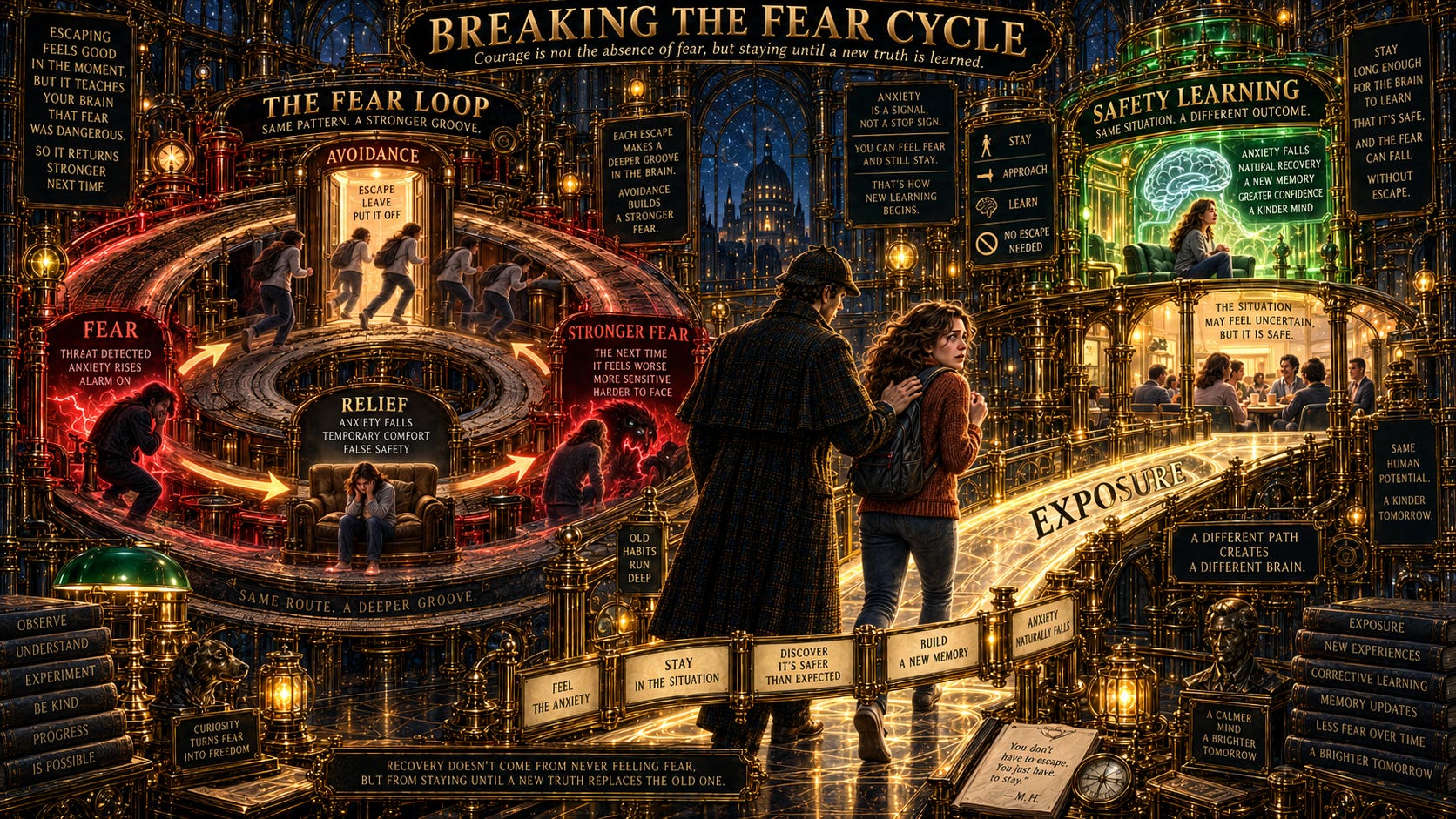
Medlock Holmes enters an immense Victorian experimental laboratory called The Institute of Fear and Learning.Around him, patients are trapped within apparently different mysteries.One avoids dogs. Another fears crowded trains because a panic attack might occur. Another rehearses every sentence before speaking, terrified of humiliation. Another spends hours worrying about disasters that may never happen.Yet Holmes notices the same mechanism running beneath them all.Threat → Anxiety → Escape or Safety Behaviour → Relief → Stronger Future Fear.Avoidance works remarkably well in the short term. That is precisely why it becomes such a problem.Each escape produces relief. Relief negatively reinforces avoidance. And every avoided encounter prevents the person from discovering something potentially transformative:Perhaps the predicted catastrophe would not have happened.Cognitive-behavioural therapy breaks this cycle.At its centre lies the concept of the fear structure: interconnected representations of stimuli, responses, and meanings. A dog becomes associated with danger. Palpitations become associated with heart attack. Social attention becomes associated with humiliation. Uncertainty becomes associated with intolerable catastrophe.The fear itself is not necessarily pathological. The problem is that the structure inaccurately represents reality.For therapeutic change to occur, two things are required. The fear structure must first be activated. Then the patient must encounter information incompatible with its pathological predictions. Modern formulations describe this in terms of prediction error: the brain predicts catastrophe, encounters a different outcome, and is given an opportunity to update its model.This explains why exposure sits at the heart of CBT for anxiety disorders.Exposure may be in vivo - entering the avoided lift, touching the feared animal, speaking in front of others.It may be imaginal - deliberately approaching distressing memories, images, thoughts, or feared future scenarios.Or it may be interoceptive - deliberately producing the bodily sensations that have themselves become feared, such as dizziness, breathlessness or a racing heart.But exposure is not simply a test of endurance.Its purpose is learning.The patient predicts:“If my heart races, something terrible will happen.”The experiment produces a racing heart.The catastrophe does not occur.Or perhaps something uncomfortable does happen - embarrassment, anxiety, uncertainty - and the patient discovers that even this is tolerable.The prediction begins to change.Holmes therefore realises that falling anxiety during a single exposure is not the ultimate objective. Someone may feel better because they distracted themselves, escaped psychologically, performed a ritual, sought reassurance, or relied upon another safety behaviour.The more important question is:What did they learn?That distinction also explains why safety behaviours matter. The patient who survives a feared situation while gripping a bottle of water, checking their pulse, rehearsing every sentence or staying beside a trusted companion may conclude:“I survived because my protection worked.”The old fear remains intact.CBT therefore combines exposure with cognitive work: identifying catastrophic predictions, examining evidence, using Socratic questioning, uncovering deeper meanings, and designing behavioural experiments that allow beliefs to collide with reality.Different anxiety disorders require different experiments.In panic disorder, treatment targets the fear of fear itself. Interoceptive exposure deliberately produces feared sensations so that palpitations, dizziness or breathlessness can be experienced without catastrophe.In specific phobia, the person progressively approaches the feared object or situation.In social anxiety disorder, exposure targets feared scrutiny and rejection while attention is shifted outward and safety behaviours are dropped.In generalized anxiety disorder, where there may be no single feared object, treatment focuses more heavily upon worry, intolerance of uncertainty, cognitive work, problem-solving and sometimes imaginal exposure to uncertain future outcomes.Acceptance and mindfulness can also be incorporated - not as methods of making anxiety disappear, but as ways of reducing the struggle against internal experience.By the end of the investigation, Holmes understands the paradox.The anxious person has often spent years becoming exceptionally skilled at preventing feared outcomes.CBT asks them to relinquish enough protection to discover whether that protection was ever necessary.The therapeutic question therefore changes from:“How can I make sure I never feel afraid?”to:“What happens when I approach what matters, allow anxiety to be present, and discover for myself what is actually dangerous?”That is the central experiment of cognitive-behavioural therapy.Key Takeaways1. Anxiety disorders share a common CBT architectureDespite different symptom presentations, anxiety disorders commonly involve three interacting elements:Threat cognition → anxiety response → avoidance or defensive behaviour.The feared outcome differs by disorder:* Panic disorder: catastrophic consequences of anxiety or bodily sensations - the “fear of fear”.* Social anxiety disorder: embarrassment, negative evaluation and rejection.* Specific phobia: harm associated with a circumscribed object or situation.* GAD: uncertainty regarding future negative outcomes.* Similar CBT principles also extend to OCD and PTSD despite their classification outside the DSM-5 anxiety-disorders grouping.2. The fear structureEmotional processing theory conceptualises fear as an interconnected structure containing:STIMULUS + RESPONSE + MEANINGFor example:Dog → tachycardia/urge to flee → “Dogs are dangerous and uncontrollable.”The structure is adaptive when it accurately identifies danger and generates effective protective behaviour.It becomes pathological when safe or relatively harmless stimuli, responses or situations acquire unrealistic meanings.3. Emotional processing requires activation plus corrective informationTwo conditions are central:1. Activate the fear structure.The patient must encounter or meaningfully represent what they fear.2. Introduce incompatible information.Experience must provide evidence inconsistent with the pathological associations.Thus:Prediction → Experience → Prediction Error → UpdatingExposure provides an especially powerful environment for this process.4. Exposure is not simply about “getting used to anxiety”Exposure deliberately confronts feared but objectively safe:* objects* situations* activities* thoughts* memories* images* physiological sensations.Its therapeutic purpose is to alter the meaning attached to these experiences.The patient can learn:“Anxiety is uncomfortable, but tolerable.”“My prediction was exaggerated.”“The catastrophe did not occur.”“Even when something unpleasant happened, I could cope.”5. Between-session learning matters more than simply feeling calmer during one exposureEarlier models emphasised within-session habituation - anxiety progressively declining during an exposure.The chapter cautions that this is neither necessary nor sufficient for successful treatment.Anxiety may decline because the patient:* distracts themselves* performs a compulsion* uses reassurance* engages in a safety behaviour* mentally disengages.The more meaningful evidence of emotional processing is enduring change that transfers beyond the immediate exercise, particularly between-session reductions in fear and pathological cognitions.6. Avoidance is maintained by negative reinforcementThe mechanism is simple:Fear → Escape → ReliefRelief rewards escape.Therefore:Fear → Escape → Relief → More Escape Next TimeAvoidance also prevents exposure to corrective information.The person concludes:“Nothing bad happened because I avoided it.”rather than discovering:“Perhaps it was safe.”This makes avoidance one of the central maintaining mechanisms of anxiety disorders.7. Safety behaviours can preserve fearSafety behaviours are actions intended to prevent catastrophe during feared situations.Examples include:* reassurance seeking* checking* carrying “protective” objects* remaining near exits* rehearsing speech* monitoring bodily sensations* relying excessively on another person.The difficulty is misattribution.Instead of learning:“The feared situation was safe,”the patient learns:“I survived because I protected myself.”CBT therefore frequently requires dropping subtle safety behaviours during exposure.8. Benzodiazepines can interfere with exposure learningThe chapter describes research in fear of flying in which benzodiazepine use reduced anxiety during the initial exposure but impaired later learning when the medication was absent.The broader principle is important:Immediate reduction in distress is not synonymous with therapeutic learning.If medication, distraction or another safety strategy becomes the explanation for survival, the underlying fear prediction may remain unchanged.9. Distraction is more nuancedDistraction does not invariably undermine exposure.Its effects depend upon factors such as:* intensity of distraction* divided versus complete attention* interpersonal involvement* severity of anxiety* number and duration of exposures.When emotion is overwhelming, some distraction may make engagement possible.The clinically important question remains whether sufficient processing and corrective learning occur.Three complementary models of exposureEmotional Processing TheoryPathological fear structures must be activated and modified through incompatible corrective information.Belief DisconfirmationMaladaptive beliefs generate emotional and behavioural responses.Treatment tests those beliefs against evidence.Inhibitory LearningExposure creates inhibitory learning that competes with the original fear association rather than necessarily deleting it.This explains why fear can return.Modern exposure therefore attempts to maximise:expectancy violation, prediction error, removal of safety signals, variability of exposure and learning across contexts.These models use different terminology but substantially overlap in clinical practice.The four major procedural families of CBTThe chapter describes four broad components:* Exposure* Anxiety/stress-management strategies* Cognitive therapy* Specific skills trainingTreatment usually begins with:Assessment → Psychoeducation → Individual formulation → Treatment targets → Collaborative plan → Homework and monitoringCBT is therefore structured without being mechanically standardised.The Three Forms of Exposure1. In Vivo ExposureDirect confrontation with feared real-world situations.Examples:Spider phobia: photograph → spider behind glass → approaching spider → touching spider.Social anxiety: initiating conversations, speaking publicly, allowing visible anxiety.Panic/agoraphobia: queues, lifts, public transport, crowded environments.Exposure can be graduated, but contemporary approaches do not require rigid progression from the easiest item to the hardest.2. Imaginal ExposureThe patient vividly approaches feared:* thoughts* images* memories* scenarios* consequences.It is particularly useful when the feared event cannot safely or practically be reproduced.Imaginal exposure can also help distinguish:Remembering danger ≠ being in danger now.It may also reveal that an imagined catastrophe is less probable, less severe or more manageable than assumed.3. Interoceptive ExposureThe feared stimulus is generated inside the body.Exercises deliberately reproduce sensations such as:* dizziness* tachycardia* breathlessness* tingling* nausea* derealisation-like sensations.Examples include spinning, aerobic exercise or controlled hyperventilation.The purpose is not simply symptom provocation.It is learning:Sensation ≠ catastrophe.This is particularly important in panic disorder.Imagery RescriptingImagery rescripting extends imaginal approaches.A distressing memory is revisited while new perspectives or responses are incorporated into the representation of the event.The person may imagine their current self entering the old memory and providing protection, understanding or unmet needs.The purpose is not to pretend the historical event changed.It is to alter its current emotional meaning.Cognitive TherapyCognitive therapy begins from the proposition that emotional reactions depend substantially upon how events are interpreted.Important distortions include:* probability overestimation* catastrophising* all-or-nothing thinking* overgeneralisation* selective attention to confirming evidence.Three traditional techniques highlighted are:Socratic dialogueQuestions help the patient examine assumptions rather than simply being told that they are wrong.Downward arrowRepeated questioning uncovers the deeper meaning beneath an automatic thought.Thought recordsThe patient records beliefs, evidence for and against them, cognitive distortions and more realistic alternatives.Behavioural Experiments: where cognition meets exposureBehavioural experiments integrate cognitive and behavioural approaches.The patient makes a specific prediction:“If I become very dizzy, I will lose control.”The experiment intentionally creates dizziness.The actual outcome is observed.The discrepancy becomes evidence.This can be conceptualised as:Prediction → Test → Observation → ReappraisalThe goal is not therapist reassurance.It is patient-generated evidence.Acceptance and MindfulnessAcceptance-based approaches challenge another form of avoidance:avoidance of internal experience itself.Trying desperately to suppress anxiety can paradoxically strengthen the struggle with it.Acceptance involves acknowledging anxiety and observing it without automatically attempting to eliminate it.The principle fits naturally with exposure:“I can experience this feeling without escaping from it.”ACT, mindfulness-based approaches and related methods can therefore be integrated with conventional CBT.Anxiety Management and Stress InoculationAnxiety can be understood through interacting:CognitivePhysiologicalandBehaviouralchannels.Management strategies may include:* coping self-statements* diaphragmatic breathing* progressive muscle relaxation* behavioural rehearsal* role-play* problem-solving.These approaches can improve perceived competence, although strategies intended purely to suppress anxiety should not become safety behaviours that undermine exposure learning.Interpersonal SkillsSome people with social anxiety have genuine interpersonal skill deficits in addition to fear.Treatment may therefore include:* assertiveness* initiating conversations* maintaining conversations* ending conversations* interpersonal practice.Importantly, social interaction should not become another performance test.A more adaptive goal may be:connection rather than perfect performance.CBT for Specific PhobiasExposure is the core intervention and is strongly supported.Historically, treatment evolved from:Systematic desensitisationtowards more direct:In vivo exposureand guided mastery/participant modelling.In vivo exposure is generally more effective than imaginal exposure when safe direct exposure is feasible.Virtual-reality exposure also has evidence of effectiveness.CBT for Panic DisorderThe core vicious cycle is:Bodily sensation → Catastrophic interpretation → Anxiety → More bodily sensation → PanicTreatment commonly includes:* psychoeducation* cognitive restructuring* interoceptive exposure* in vivo exposure where avoidance/agoraphobia exists.Interoceptive exposure is particularly important because panic disorder involves fear of the anxiety response itself.The chapter reports substantial evidence supporting CBT, including durable outcomes after treatment cessation.Relaxation and breathing retraining were historically prominent but are not necessary components and may sometimes interfere when used defensively.CBT for Social Anxiety DisorderThe central fear involves:scrutiny → perceived poor performance → humiliation/rejectionEffective contemporary treatment emphasises:* exposure to social situations* cognitive restructuring* specific predictions before exposure* dropping safety behaviours* shifting attention away from excessive self-monitoring* external attention* feedback after exposure* video feedback where useful.Individual CBT has particularly strong evidence.Internet-based CBT has also produced promising outcomes.CBT for Generalized Anxiety DisorderGAD differs because the feared stimulus is diffuse.The central problem is:excessive and difficult-to-control worry about uncertain future outcomes.Treatment has traditionally included:* cognitive therapy* relaxation* worry-focused exposure* problem-solving.More recent formulations increasingly target:intolerance of uncertaintyand:meta-worry - worrying about worry itself.A useful distinction is between:Current solvable problem → Problem-solvingversusUnknown future possibility → Learning to tolerate uncertaintyImaginal exposure can be used for feared uncertain outcomes.CBT is effective for GAD, although treatment effects have historically been less robust than for some more circumscribed anxiety disorders.Treatment Delivery MattersKnowing the name of a technique is not equivalent to delivering it competently.Effective CBT requires the therapist to identify:* the patient’s actual core fear* overt avoidance* covert avoidance* safety behaviours* the appropriate exposure target* the prediction being tested* the corrective information available.Therapeutic warmth, empathy and alliance remain important because they facilitate engagement and adherence.But nonspecific therapeutic qualities alone do not substitute for technical competence.Internet-Based CBTTherapist-supported internet interventions have increasingly demonstrated efficacy across disorders including:* panic disorder* social anxiety disorder* GAD.This is particularly important because one of CBT’s limitations is access to clinicians with adequate specialist expertise.Digital delivery may therefore substantially expand treatment availability.CBT and MedicationCombining medication with CBT does not automatically produce superior outcomes.The chapter’s overall interpretation is that adding medication to effective CBT generally produces either a small additional advantage or none, whereas adding CBT to medication can improve medication outcomes.Sequential augmentation may sometimes be more informative than beginning both simultaneously.Treatment should therefore be strategically combined rather than assuming:more treatment = better treatment.The enduring lessonThe aim of CBT is not to convince the patient intellectually that nothing bad will ever happen.Nor is it to guarantee permanent calm.The deeper objective is to change the relationship between:PredictionFearAvoidanceExperienceandLearning.The therapist does not simply tell the patient:“You are safe.”Instead, treatment creates conditions in which the patient can discover:“I predicted catastrophe. I approached rather than escaped. I relinquished the behaviours I believed were protecting me. I experienced what actually happened. And now I have new evidence.”That is the engine of cognitive-behavioural therapy for anxiety disorders. This is a public episode. If you'd like to discuss this with other subscribers or get access to bonus episodes, visit drmanaankarray.substack.com/subscribe
Embed this episode
Ready to play
PSYCH 122: Anxiety Disorders - Cognitive-Behavioural Therapy
No transcript for this episode yet
Similar Episodes
No similar episodes found.
Similar Podcasts
No similar podcasts found.