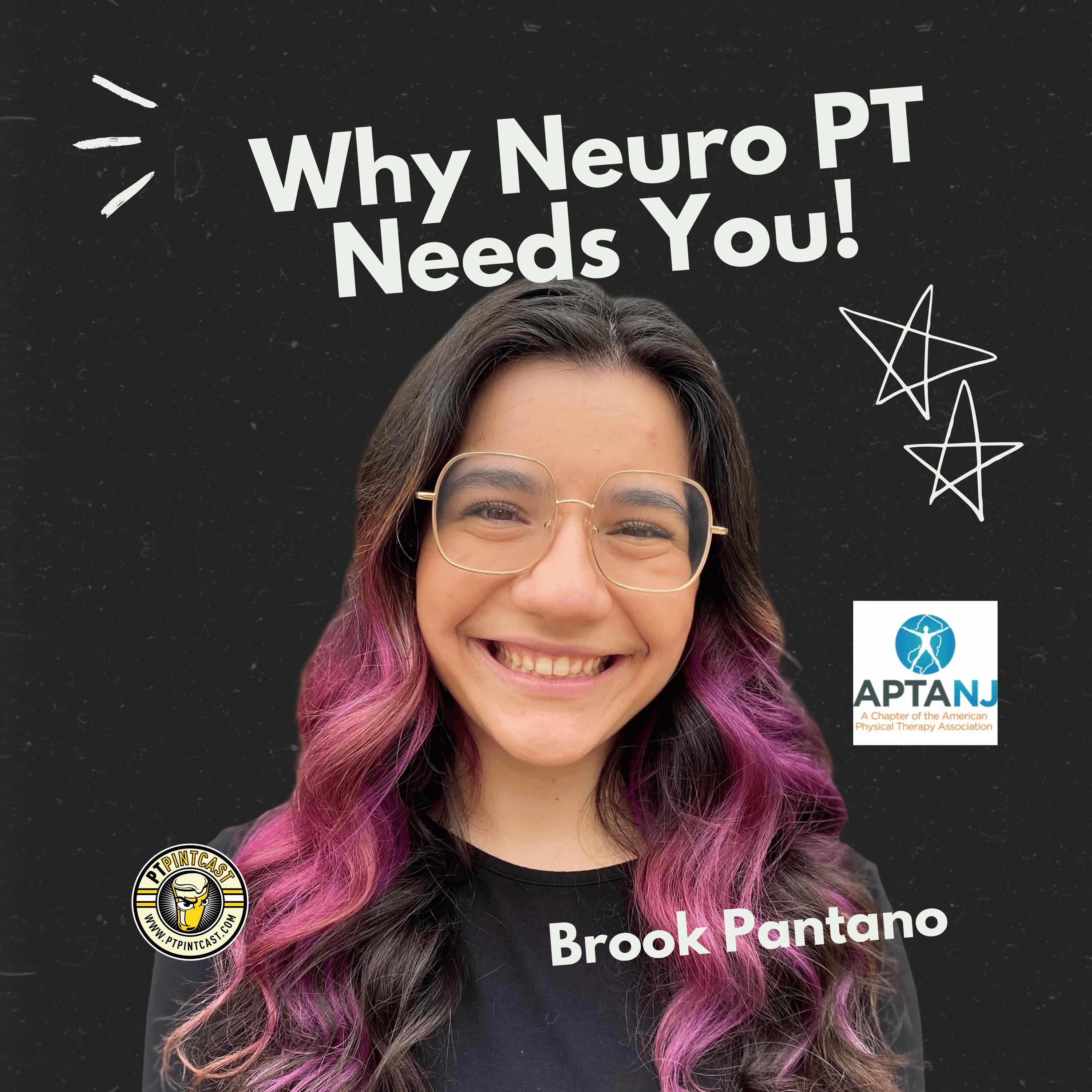
your passion is not too big. And when you're a new grad, you go into a place, right? Maybe you're unfamiliar and suddenly you feel a little bit small and you're like, I don't know if I can really kind of lay down what my ideas are, right? But the more people you're around, the more people talk to you, you can lay those ideas down, right? Just because you've been practicing for 20 years and I've been practicing for almost three doesn't mean that my opinions don't matter. So I've carved myself out in my workplace and you will do the same. From neuro residency to educator, advocate, and bodybuilder. Let me get a flex. There we go. She's on fire for elevating neuro rehab and giving students the truth about what really awaits after graduation. She's a fierce believer in evidence advocacy and give it a damn. Please welcome Brooke Panteno.
Welcome to the show. It's great to be here. Why is neuro misunderstood by students and follow up? How do we fix that? Well, I would say one thing is unfortunately we're a little bit behind on the curriculum in school. So I think sometimes we learn things and we're like, oh, well, you know what? We need to sit before we can stand before we can walk and then you meet people and then you're like, oh, I don't think you can stand on their own. And before you know, you're walking a hundred feet down the hall. Yeah. So I think right now we're just lagging a little bit behind. So I think what we need to do and what I'm trying to do is we advocate once we do graduate. But hey, this is our current evidence. We get people that are currently practicing in.
your courses, and teaching your courses, because sometimes it's been 20 years and you haven't practiced, then you forget what's happening right now. But I would say those are the biggest things. Yeah, shake it up a little bit. What's one thing you learned in residency that PT school didn't prepare you for? The one thing you were like, this was not in the brochure. I would say, you know, having to, okay, toileting four times in one 90-minute session. Oh. But you do it really quickly. Oh. And then you get your gait training in. Got it. Yeah. So I got really good at that. I was in pediatrics and learned that bathroom breaks don't care if it's in the middle of a PT session is going to happen. Yeah, and then sometimes your patient is really agitated, you know? So then you're also fighting that, but then you build such a good rapport with them, then you're like, you know what?
Maybe you're a little bit mad, but, you know, I know you so well. I'm going to get you in the bed. We're going to clean you up real quick. We're getting right back up, and then we're walking. Yeah. How do you balance clinical work now, clinical work, education, and advocacy? Because none of these things, you know, in terms of time commitment, are small. I would say I'm still figuring that out. Good. But I think I am someone that has a lot of big ideas, and sometimes I've been told, Brooke, like, you're really, as you might be able to tell, I'm very passionate about a lot of things, and I could probably talk your ear off for about network. Keep going. About every little thing I love. But I would say the biggest thing is you find what...
you do care about. You don't take on those extraneous opportunities that are just there to take. So that way you can actually carve out the time about what you do care about. So I would say right now, it's me figuring out within all those things I love, where can I make the biggest impact? And how can I do that tangibly right now? And then maybe I add those other things in. And I know the idea is like say yes to like a lot of things and try all the things, but like sometimes I imagine you got to say no, because saying no, saying yes to this is saying no to something else that you might want to do later. Yeah. And I think if you know your niche and your brand, which takes time to kind of cultivate, then you're able to say yes and say no. I would say, you want to say yes to the things that scare you. Because I remember when I was a student, I was on the board of directors for APT National, and that was so terrifying.
because I was like, if I run and I do this whole thing and I don't get it, I'm going to feel really bad. And you know what? Maybe I wouldn't have. I did get it. But it's those little opportunities that really make your heart race, that then make you realize, you know what? I tried. And even putting myself out there took me about 10 steps farther than someone who was a little bit too afraid to do that. Yeah, that's a pretty cool experience, right? What's something memorable about being involved in something like that? Maybe give context to you. What does that mean? What is that association in that position? Yeah, so it's changed now. So now there isn't just like a student board of directors in that way. We have the student council representatives.
Toby, hello. In each state? Yes, each state. And then within those, they create a larger governing board. And it used to be there was just this one larger governing board of students. But they kind of changed that. I think now this allows us to be more well-represented on a state level, with beforehand maybe some states were not well-represented, who didn't have as much of a well-fleshed-out student organization. But I did get to meet Matt when we work together. Who will be out soon? Talk to Matt soon. But what I would say is that that is the networking, right? And I think, right, when you think networking, sometimes you're like, ugh, I have to network with people I don't like. Which is true. You know, sometimes you do. But then within that, you have the opportunity to meet so many people that are very like-minded to you, that care about the things that you care about, that are now
doing those things that you can't even imagine yourself doing right now. And the more people that you talk to who have done those things that you want to do, the closer that you get getting there. Just curious, it's not an inexpensive thing to go to a national conference. I was taught, when I was in PT school, go to a local, a state, a regional, or a national event in somewhere in your three years. Anybody going to LA in a couple of weeks to CSM? You are going. Good for you guys.
It's like, here's what I can tip you off. It is a giant circus with 18 circuses going on at the exact same time. Simple, simple, but not easy to sort of, but here's what I'll tell you. If I were going to write, if I were going to write copy for APTA, I wouldn't say, you know, 18 different components and state chapters. I would say something like, you see future versions of yourself everywhere. Wouldn't that make you want to show up? Like, I wonder what I could be. And here's the cool part. You can remix pretty much anything. You could be like, oh, I want to do this and that. Is that allowed? Yeah. See, also my birthday cake analogy. You can just do stuff.
You can't. Just know your state practice act. There's an answer. Know your practice act because that's when you can get in trouble. If it's not, if you can't do it, you know, ask a lawyer. I don't know. If you can't do it, the only limitation, you and your beliefs. Absolutely. And I will say too that as a student, right, it's so hard to financially kind of squeeze all of these conferences. It's not easy. But if you get involved in the APTA and do those things you're a little scared to do, that's a nice highway to conferences, to all these really big names that otherwise you might not have the opportunity to kind of interact with. Yeah. I mean, you get in there early and I mean, I mean, life hack.
Have any of you guys looked into taking a CEU course as just a student? Okay, great. Do you want to know how to get it for free? Email them and tell them you'll show up early and you'll clean everything and you'll stay late and you'll clean everything and you said all you want is a free seat. If your batting average isn't better than 900 on that, you don't want to go to the event anyway because someone's like, God, they're a student. Here's the one universal fact. If you're talking to a PT or a PTA, they've all been students. They see their past version of themselves in you and wouldn't they like to, hopefully, not pull the ladder up and lift you up? Cheat.
Gee, play the student card now. That's where you're allowed to say just. I'm just a student. You know what it's like. No money. Could I do your thing? Absolutely. And I'm willing to work a little bit for it. If your batting average isn't better than 900, you're asking for the wrong CEU people. I'm just telling you. Most of them, I play that left and right. Bodybuilding and neuro. Yeah. What's the crossover? Well, so when I first was getting into PT, I was really big into fitness. When I was in high school and then going into college, I found myself in a group of bodybuilders and powerlifters. So naturally did that, competed in a couple shows. Oh, yeah. Oh, yeah. Like I like competed.
Like all my coworkers. Like Tanner. No, yes. Yes. It's a little scary to look at. I haven't gotten there yet. All my coworkers have seen the pictures now. And so every so often they'll be like, oh, well, that's my patient. Like, did you know that Brooke was a bodybuilder? I was like, stop.
But yeah, I don't, and I also power lift it for a bit. I don't necessarily do either of those things anymore, but I will say that I lift and I cross train and I work really hard and I equally work my patients on them. If we worked together, I would have it on, I would be like, oh, here's the button and a screen would drop down. I'd be like, oh, I'm sorry, did Brooke show you the picture? But what, is there anything you've been able to sort of life hack? Like have you been able to like steal neuro principles in improving bodybuilding? Of course you have, right? You know, I would say yes, because I like strength training. I used to be a certified strength and conditioning coach and I loved strength training and I definitely brought that into my neuro realm. And we do a lot of high intensity training where I'm at. We do a lot of just high intensity stuff. So I would say I use those principles every day at work.
with a little neuro twist. Because all power lifters have a brain and a nervous system. Yes, and here's my thing, right? Is that every rehab is kind of neuro rehab because everyone has a nervous system, right? So so many of those things connect and we don't really see that right away. But I find having all those things married together makes me a better therapist. Yeah, I always love like the authority of the neuroPTs who say that. They're like, well, everybody has brain and nervous systems. They're all neuroPTs. Any cardiopalm PTs in here? No? I'll speak for them. They'll be like, yeah, well, they all have at least one lung and a heart too. So they're all cardiopalm PTs as well. What's one thing about neuroPT you wish everyone knew? Everyone? Ooh, let's see. Is that, okay, I guess I'll put it this way. Is that...
In neuro PT, you have to be very aware of your own limitations, but also make sure that you're not using that as a way to kind of, how do I put this? Not challenging patients enough. So I have to be very aware of what I can and what I can't improve, right? I work with folks with neurodegenerative diseases, right? Who will get worse over time, but benefit from intensive balance of therapy. So I think something that I am, everyone who knows me at work knows I'm very blunt, but I'm very confident when I speak. Yeah, I'm very confident when I speak. So something I think is really important is everyone I talk to, I'm like, hey, I'll be very honest with you. But if you work hard, I work hard, we're a team. We can make this work and this is what we can do. So I think I am in the world of very honest and blunt conversations and also just troubleshooting everything. But that's, I think, skills that transfer everywhere, but especially in neuro. Yeah, we want to get behind that.
Brooke, you ready for your parting shots? Absolutely. All right. What do you got for us? All right. I'm just going to say your passion is not too big. And when you're a new grad, you go into a place, right? Maybe you're unfamiliar and suddenly you feel a little bit small and you're like, I don't know if I can really kind of lay down what my ideas are. Right. But the more people you're around, the more people to talk to you, you can lay those ideas down. Right. Just because you've been practicing for 20 years and I've been practicing for almost three doesn't mean that my opinions don't matter. Yeah. So I've carved myself out in my workplace and you will do the same. Lovely. Let's hear it for Brooke.