
EPISODE · Oct 14, 2024 · 10 MIN
Pulsar Timing Arrays and Gravitational Waves
from Multi-messenger astrophysics · host Astro-COLIBRI
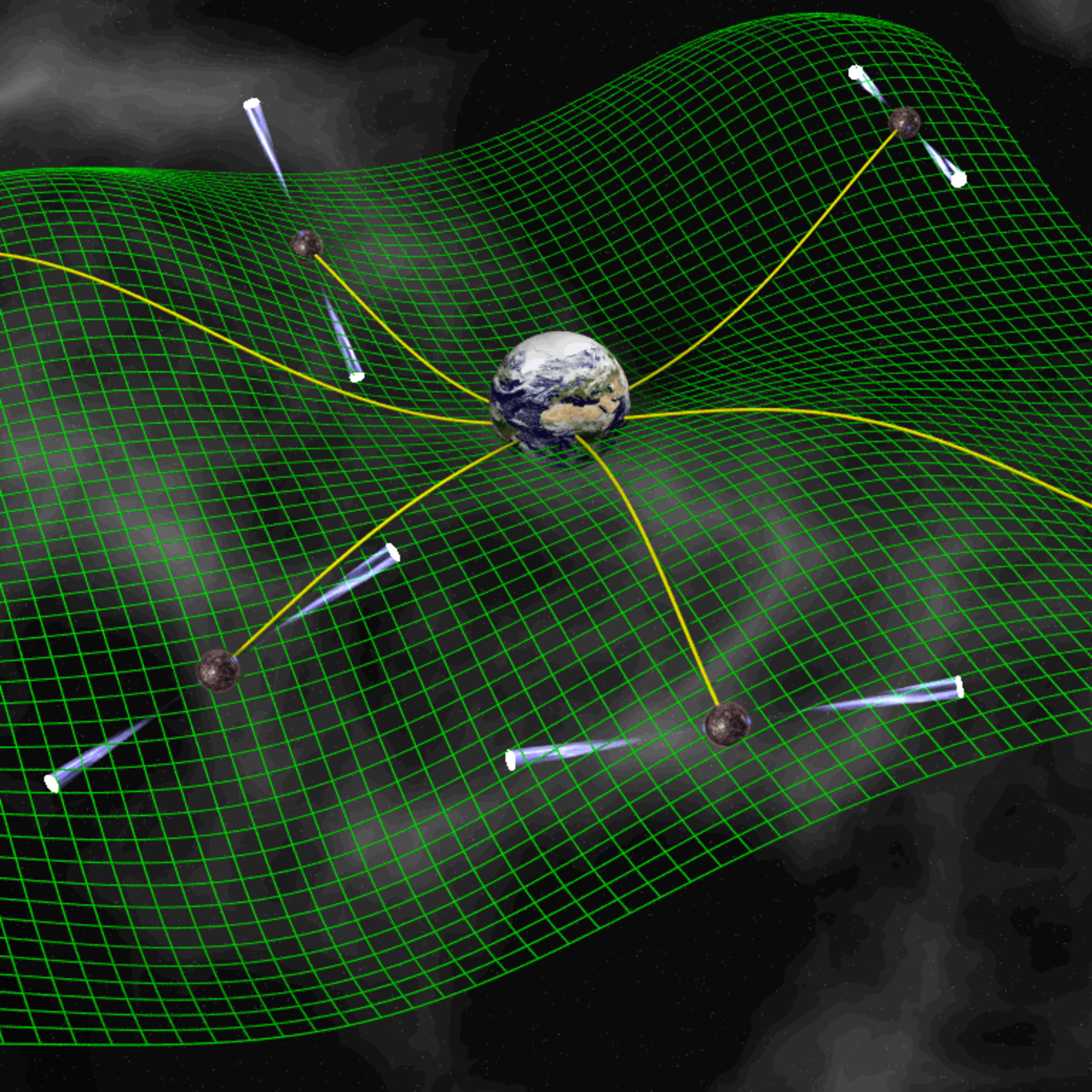
Millisecond pulsars (MSPs) are incredibly stable rotators and can be used as extremely precise clocks. Pulsar Timing Arrays (PTAs) monitor a collection of these pulsars to detect gravitational waves (GWs). GWs affect the arrival times of pulses from these pulsars, causing tiny, correlated fluctuations. There are four main PTAs: The European Pulsar Timing Array (EPTA) combines data from five major European radio telescopes and the synthesized Large European Array for Pulsars (LEAP). The Indian Pulsar Timing Array (InPTA), focusing on low-frequency observations, uses data from the upgraded Giant Metrewave Radio Telescope (GMRT). The North American Nanohertz Observatory for Gravitational Waves (NANOGrav) utilizes data from the Arecibo Observatory, Green Bank Telescope, Very Large Array, and the Canadian Hydrogen Intensity Mapping Experiment (CHIME). The Parkes Pulsar Timing Array (PPTA) in Australia employs the Parkes radio telescope The most recent PTA data sets have yielded promising results. They have all detected CRN and the PPTA, NANOGrav, EPTA, and InPTA have found evidence of quadrupolar correlations in this noise, suggesting the presence of a GW background. This is a major step towards a definitive GW detection and opens up exciting possibilities for understanding the universe through GWs in the nanohertz frequency range. Publication: J. Verbiest et al., "Status Report on Global Pulsar-Timing-Array Efforts to Detect Gravitational Waves", arXiv:2404.19529 Acknowledgements: Image credit: David J. Champion. Podcast created by Google/NotebookLM
Embed this episode
Ready to play
Pulsar Timing Arrays and Gravitational Waves
No transcript for this episode yet
Similar Episodes
No similar episodes found.
Similar Podcasts
No similar podcasts found.