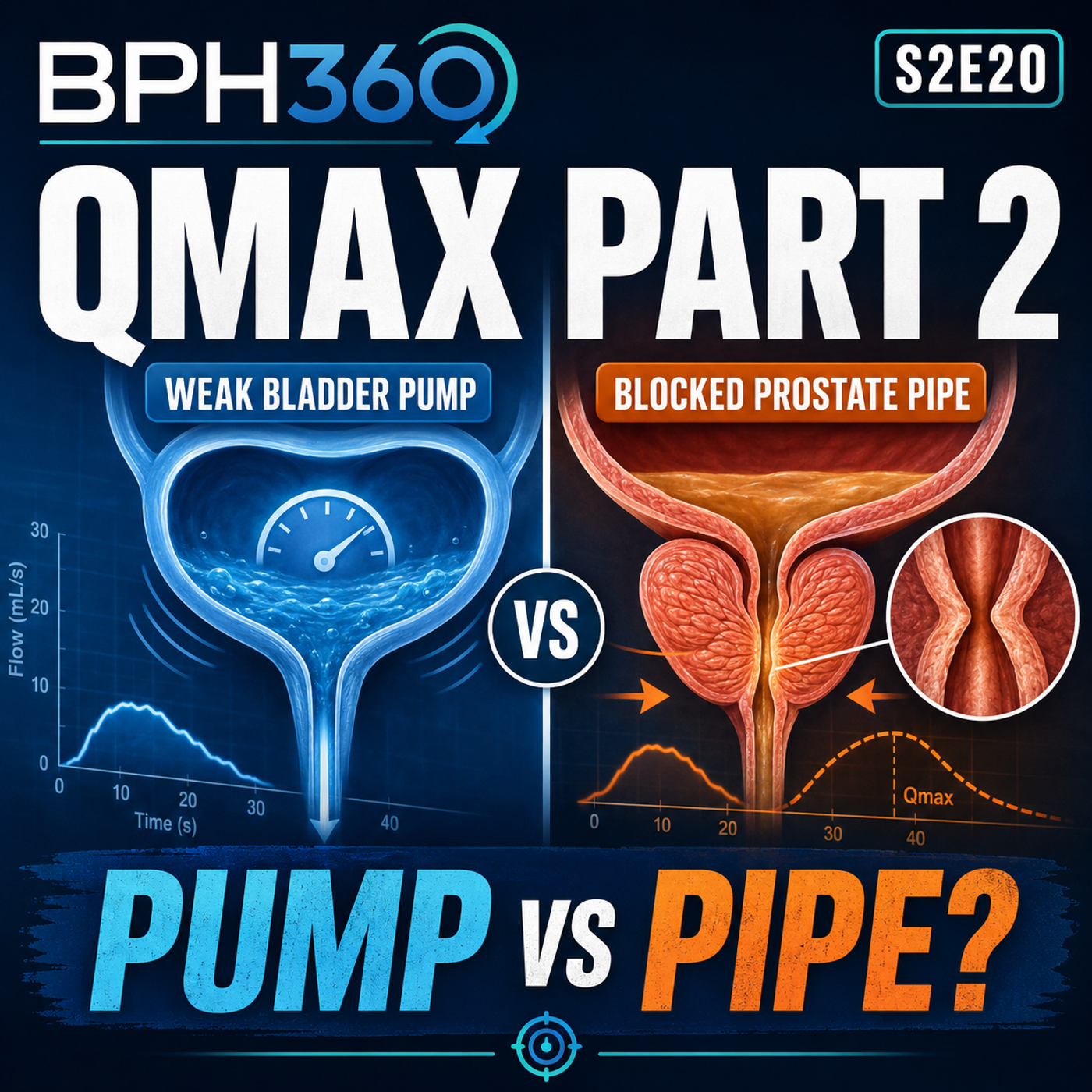
Pump vs Pipe: The Bladder-Prostate Question Men Miss S2E20
from BPH360 Hosted by Man vs Prostate
In this episode of BPH360, Dr. Wayne Kuang continues the Qmax conversation by asking the key question every man with slow urine flow needs to understand: Measure Your Urine Flow Rate Qmax: https://proudp-soundable.app.link/w5rhpKoU7Wb 00:00 Opener: Understanding Q Max: The Next Vital Sign for Men 01:03 Measuring Q Max: Techniques and Technologies 06:30 The Shift from Office to Home Testing 08:43 MidRoll 08:45 Qmax Baseline 10:00 Diagnosing Flow Problems: Pump vs. Pipe 15:03 Mid Roll 16:20 Need More Diagnostics? 20:29 Q Max as a Vital Sign: Trends and Patterns 23:37 What to Ask Your Doctor? 24:53 Questions to Ask Your Doctor About Bladder Health 27:24 Wrapping Up Is it a weak bladder pump, a blocked prostate pipe, or both? Qmax is your maximum urinary flow rate — the strongest part of your urine stream. In Part 1, we explained why Qmax may become the next vital sign for men’s bladder health. In Part 2, we go deeper into what a low Qmax actually means, why it does not automatically diagnose prostate blockage, and why better testing may be needed to protect your bladder before damage becomes permanent. A low Qmax tells you there is a flow problem. But it does not always tell you why. Some men have obstruction from the prostate or urethra — the “pipe” problem. Other men have a bladder muscle that is no longer strong enough — the “pump” problem. Some men have both. That uncertainty is exactly why Qmax should trigger a better bladder health conversation, not just another pill or a higher dose. This episode also covers how urine flow testing is changing. Office uroflowmetry remains important, but newer home-based hardware, smartphone apps, and remote monitoring tools are making it easier to measure Qmax repeatedly over time. One office test on one random day may not tell the full story. Tracking your Qmax at home may help show patterns, trends, and changes after medications, procedures, or worsening symptoms. Dr. Kuang also explains how Qmax fits into the Man vs Prostate Triangle of Triage: Symptoms Qmax Post-void residual, or PVR Together, these can help decide whether you need a higher level of diagnostic testing, such as ultrasound, MRI, cystoscopy, or other bladder-prostate evaluation. The goal is not to guess. The goal is to match the right level of testing to the right level of bladder risk. Key questions to ask your doctor: What is my Qmax? How much did I urinate? How much urine did I leave behind? Is my Qmax under 15 mL/sec? Could this be a weak bladder pump, a blocked prostate pipe, or both? Do I need a bladder health baseline? Do I need higher-level testing such as cystoscopy? For Man vs Prostate, a Qmax under 15 mL/sec is a bladder conversation trigger. A Qmax under 10 mL/sec is an academic concern cutoff. But the real message is this: do not ignore slow flow. Measure it. Track it. Understand it. Use it to ask better questions. Your bladder is not transplantable. Your prostate may be the obstruction, but your bladder is the organ we are trying to save. Better data drives better decisions. #BPH360 #ManVsProstate #Qmax #BPH #BladderHealth #MensHealth #ProstateHealth #Urology #SlowUrineFlow #WhatAboutMyBladder Educational only, not medical advice. Please consult your physician or licensed healthcare provider for your individual care. This video is not sponsored. Some links may be affiliate links, which may provide a small commission at no additional cost to you.
Embed this episode
No transcript yet.