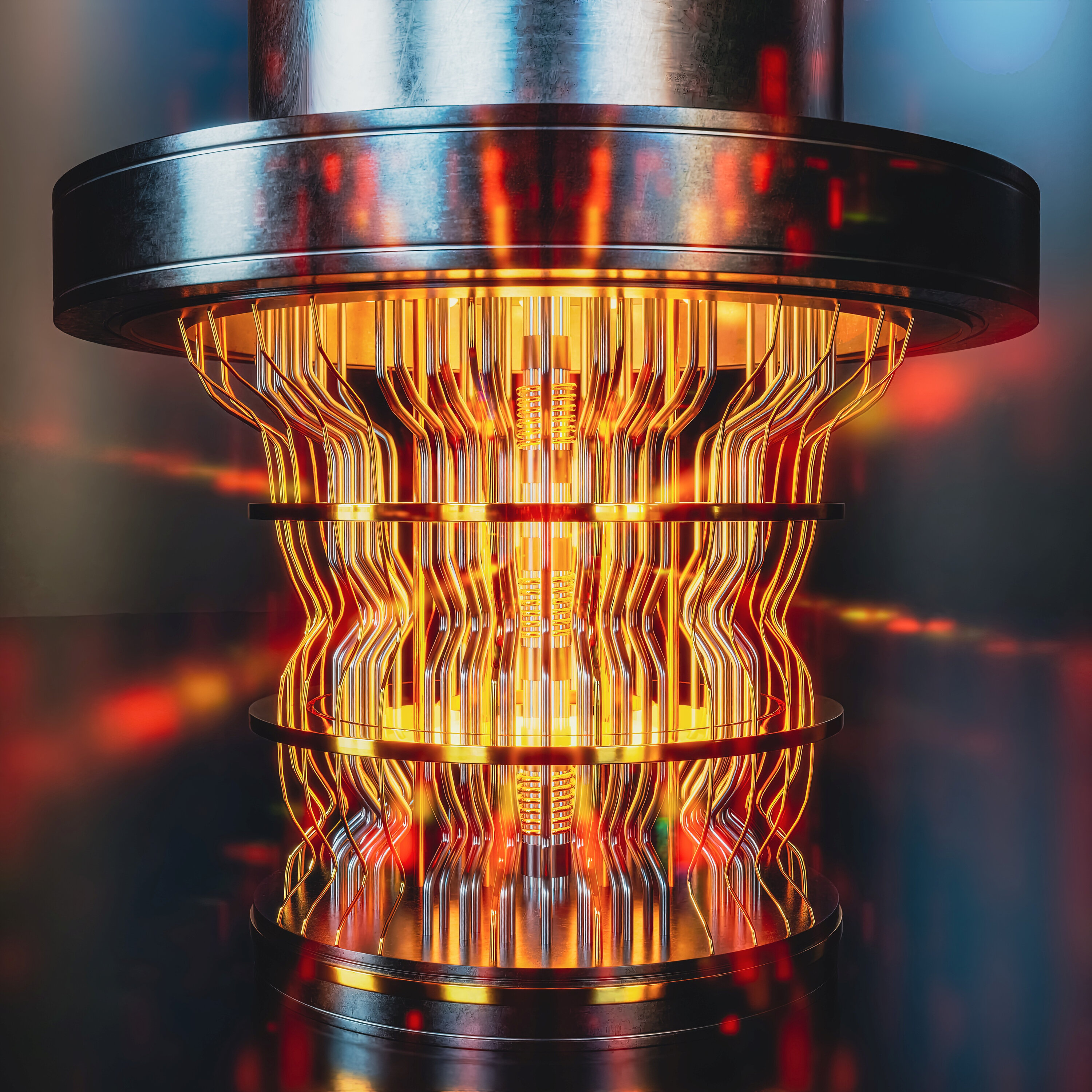
Until this morning, I had never really heard or thought about quantum computing, but maybe I should be. Quantum is expected one day to break the codes that lock everything from national secrets to credit cards. Before we get too far ahead of ourselves, what exactly is quantum computing and why am I talking about it today? This is The Daily J.
I'm Zach Clark. Like most millennials, I consider myself to be relatively tech-savvy. It is the world in which I grew up, at least mostly. We had a PC by the time I was 10, and I was a teenager when I got my first Nokia phone.
But as I drove in this morning, I heard about something that was new to me, quantum computing. Here's Jackie Page. IBM expected to announce its latest advancement in quantum computing today. The technology could transform civilization.
60 Minutes correspondent Scott Pelley has more. There are a half dozen competing designs in the race. China named quantum a top national priority, and the U.S. government is spending nearly a billion dollars a year on research.
The first change comes next year, when the U.S. publishes new standards for encryption. Because quantum is expected one day to break the codes that lock everything from national secrets to credit cards. Experts say large-scale quantum computing could be ready by the end of this decade.
Quantum computing places atomic and subatomic materials into what is called superposition. Our current computers use binary equations. Everything is either a one or a zero, which limits its power. But in quantum computing, the materials can be either one or zero, which leads to infinitely more possibilities.
Are you confused yet? I certainly am. We need somebody smarter. Much smarter.
For that, we turn to Dr. Chris Peikert. He's a computer science and engineering professor at the University of Michigan. If you were to spend it to a five-year-old, what would you say?
Could you do that? I could try. The basic premise of quantum computing is that you can design these computational devices. Like, we have transistors in regular computers.
We can design these very special computing devices that take advantage of the weird and counterintuitive properties of quantum mechanics to perform certain kinds of operations much more efficiently than we know how to do so on regular computers that we're all used to. The thing that gets me about this is that we're talking about using the fabric of the building blocks of life to create quantum computing. The main source is the electron of an atom. The next voice you'll hear belongs to Dr.
Alex Burgers. He, too, is a professor of computer science and engineering at U of M. Because it's so sensitive to the environment, you can create sensors that are profoundly better than what we could have classically. And these things can detect gravitational fields, of course, which is useful for searching for things underneath the earth, like oil, for example.
And so that's another big aspect of what the field is really trying to push on with other types of quantum technologies that are actually, in a lot of ways, being deployed now in terms of sensing and communication. And this is kind of the thing that we're really trying to study here at Michigan. We have this new quantum research institute, which is sort of the university's commitment to the idea that these technologies are really important. It's a collaboration between the College of Literature, Science, and Arts and the College of Engineering to basically enable cross-disciplinary collaborations that can take the technology that's generally been developed in academic labs and try to engineer it in such a way that we can try to deploy these technologies that can actually have impacts in society.
Why does this technology matter now? Well, these days, our data is protected on the Internet by encryption software. That's a method of swambling a large set of letters and numbers to create an uncrackable password. But if quantum computing breaks through, Dr.
Peikert says you can kiss all of that goodbye. One of the most exciting and shocking things that was discovered about quantum computers back in the late 90s was that if we were able to build them up to sufficient size and scale and get them working, that they would be able to break all of the cryptography, all of the secure communications that we use on the Internet today, which is a pretty sobering thought. And so in my research area, I actually work in an area called quantum secure cryptography, which is about redesigning cryptography so that it can be used today on our ordinary computers but would be secure against these quantum attacks. It was a very specific kind of property that classical cryptography is vulnerable to quantum computers, but there's no thing that says all cryptography will be impossible.
It's just the cryptography that we've been using happens to be vulnerable to large-scale quantum computers. I don't want to dumb this down too much, but when you think about encryption and things like that, basically the thought is that if I make this password, there's an assortive of random letters, numbers, and symbols, and I make it long enough that a computer could not do the permutations or equations fast enough to figure it out. But what sounds like it's happening is if we took today's standard of encryption and took it against a quantum computer, that there would be nothing you could do that the computer couldn't solve. Is that right?
Yeah, again, specific kinds of encryption that have been widely deployed across the Internet and across all the computers, and so there are certain mathematical structures that are present in those encryption schemes, and it just so happens that quantum computers would be extremely good and fast at breaking those exact structures and decrypting our communications or forging good-looking data that's actually bogus. I mean, it's almost like you would have one key open every door in the world, right? Yeah, a quantum computer would be a bit like a skeleton key for all of the cryptography we've been using for the past few decades. So that's all pretty scary, right?
I mean, if that technology lands in the wrong hands, it would be a disaster. But we don't have to worry about that, at least not yet. But while scientists are getting a better understanding of quantum computing, there are still large gaps in what we know. You hear stories about Da Vinci, and he'd have these brilliant ideas, but then somehow he would still have this idea, even though a piece of his idea didn't exist.
I can't wrap my head around that. It seems like that's what's happening here. Like, we have this thing, we know something about it, but not everything, and we think it can do more, but we don't know what it is. Yeah, that's a great analogy.
I mean, the kind of breakthrough results in quantum computing came in the late 1990s, when nobody could even imagine having a quantum computer in reality, and yet we had this kind of abstract model, the rules had been laid out, and what kind of things could we do with it? And then, you know, these great discoveries were made. Like you say, with Da Vinci, we're kind of just now starting to build, you know, the first wings, like the Wright Brothers or something like that, and demonstrating that we can get this thing off the ground for a little while, and then it crashes hard, but hopefully we can learn some lessons and figure out how to engineer these things better and make them work and last longer. So it sounds like this technology is years away from being proficient, but it's not about if anymore, it's about when it happens.
So I did ask Dr. Peitert what everyday people like you and me should keep our eyes on. You'll hear announcements like you've heard from IDM. There's a number of startup companies that are all exploring different kinds of technologies to implement quantum computing, so there's a whole variety of different kind of versions of, well, how would you build the underlying transistors or qubits, as they're called, the analogy-tetic transistor.
Lots of different technologies in the labs. Companies are putting a lot of money into it just to kind of get the mind share and exhibit leadership. It's going to be a long slog. It's a marathon, right?
There will be some breakthroughs on the technology side. There will be some setbacks. A lot of ideas won't pan out, but that's how science works. You know, we try a lot of things, and we make progress, and we learn.
Yeah, it's almost like people should, we non-scientists or we non-engineers or what have you, should file this away in the back of our brain because you'll be here again at some point, but maybe not tomorrow. Yeah, that's right. I think you can expect to see, you know, in 10 years, it's very difficult to predict what we'll see. One of the most exciting possibilities is that these computers are demonstrated to have capabilities and to be faster than the kind of ordinary computers that we've got, you know, 80 or 100 years of experience in building.
That would be a real breakthrough day when it's demonstrated that here's a useful task, that we can do better on quantum computers than we can with our best ordinary computers. Could quantum computing be really, really harmful? Yes. But could it also be really, really helpful?
Yes. But scientists aren't sure exactly what the split will be right now. So the big thing to know today is understanding. I don't mean understanding quantum physics or mechanics.
I mean you have to understand how they could be used, and most importantly, what it means for you. Today's big thanks to Dr. Chris Peikert and Dr. Alex Burgers.
Check out www.jnewsradio.com for the top local news stories on demand 24-7. Do you want that Daily J delivered right to you? All you have to do is text WWJ to 20357 and you'll get instantly. Message and data rates may apply.
I'm Zach Clark, and this is The Daily J. Thanks for listening.