
EPISODE · May 1, 2025 · 4 MIN
Quantum Leaps: Ocelot Chip Marries Classical and Quantum Computing
from Quantum Computing 101 · host Liquid Studios
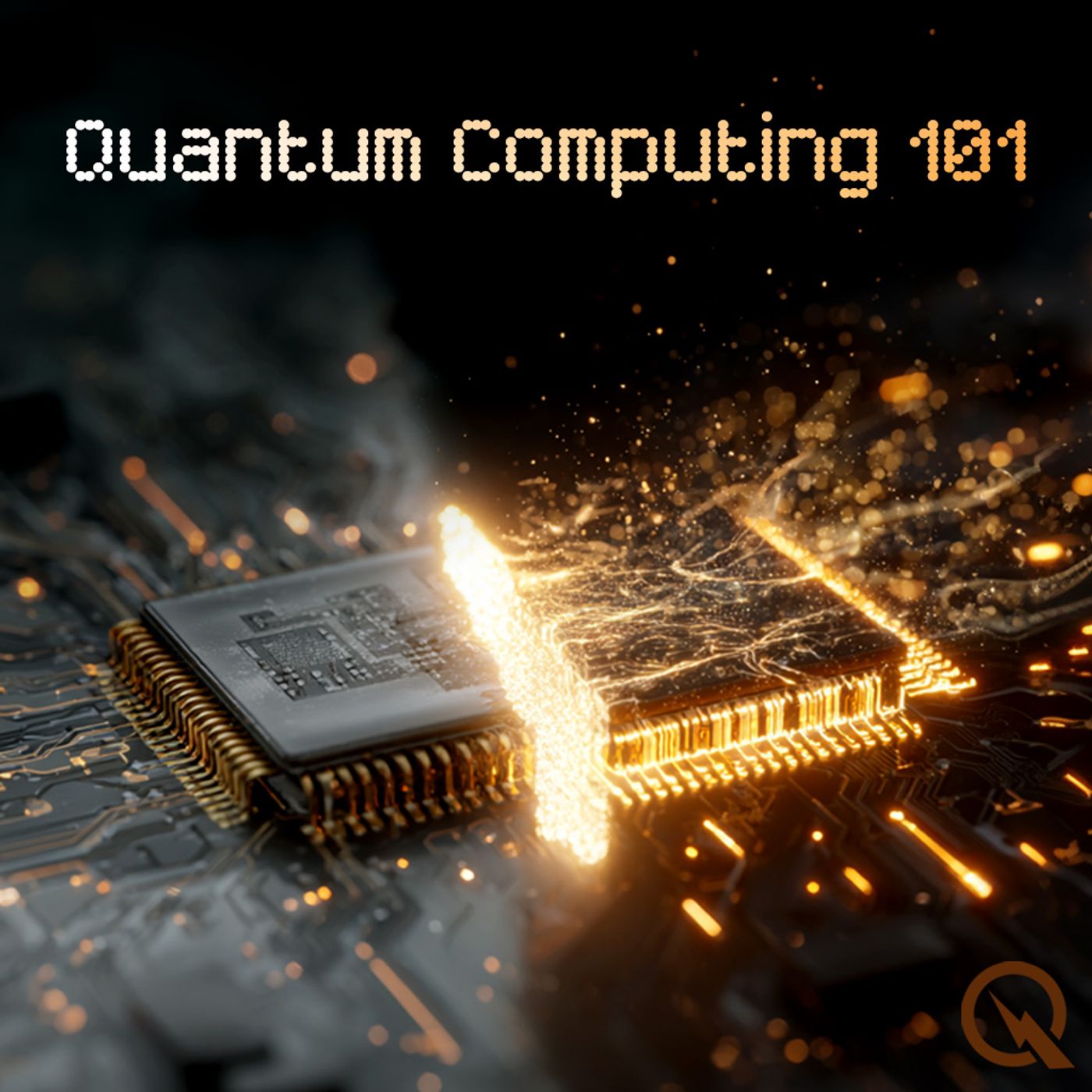
This is your Quantum Computing 101 podcast. Did you feel the tremor last Thursday? I don’t mean a seismic jolt, but a tectonic shift pulsing through the fabric of quantum research labs from Redmond to Seattle, from Google’s quantum cavern in Santa Barbara all the way to the hush of Amazon’s secretive research floor. This is Leo—the Learning Enhanced Operator—here with Quantum Computing 101. Let’s cut quickly to the chase: Hybrid quantum-classical computing has just taken another bold step forward. On March 4, Amazon unveiled its Ocelot chip, a prototype that’s raising eyebrows across the community for a simple reason—it solves two of our field’s greatest conundrums: error correction and scalability. For years, quantum computers have dazzled with their promise, but stumbled on their way to practical reliability—fragile qubits, noisy readouts, limited algorithms. Ocelot represents something rare: a quantum-classical system that’s not just faster, but demonstrably more useful. Picture a humming, liquid-helium-cooled chip surrounded by a moat of conventional silicon—not rivals, but partners. Today’s most intriguing hybrid solution puts classical CPUs and quantum qubits on the same circuit board. As Amazon’s engineers explained, the Ocelot leverages quantum gates for entanglement-heavy computations, the kind of problem where bits alone buckle. But it offloads repetitive logic, data orchestration, and error mediation back onto classical silicon, where mature algorithms and decades of engineering wisdom can keep the show running. If you imagine a relay race where two very different athletes pass the baton back and forth, that’s the Ocelot’s architecture. This hybrid approach isn’t just about speed. It’s about combining the sharp logic of classical computing—the one-and-zero certainty—with the eerie, swirling probabilities of quantum mechanics. Microsoft, for example, just last week announced a new state of matter to power its Majorana 1 chip. “They should win a Nobel Prize,” said John Levy of SEEQC, a firm that’s betting its future on hybrid quantum hardware. Levy’s team is pushing the idea that classical computers alone are “speaking the wrong language.” Quantum, he argues, lets us converse directly with nature. And Google? Their Willow prototype, which made waves in December, ran a benchmark task in less than five minutes—a problem that would take the world’s fastest supercomputer longer than the age of the universe to solve. It’s a stunning comparison, but what matters today is this: Each of these quantum-classical partnerships is less about raw horsepower and more about orchestration. The classical chip does what it’s always done best—managing, filtering, optimizing—while the quantum chip dances briefly with the impossible. Take a step with me into a quantum lab. The room is quiet but alive—a symphony of pumps, chilled cables, the faint tick of oscilloscopes. Here, a single logical qubit comprises dozens, sometimes hundreds, of physical qubi This content was created in partnership and with the help of Artificial Intelligence AI.
Embed this episode
Ready to play
Quantum Leaps: Ocelot Chip Marries Classical and Quantum Computing
No transcript for this episode yet
Similar Episodes
No similar episodes found.