
EPISODE · Dec 21, 2025 · 3 MIN
Quantum's Missing Link: New Chip Marries Classical and Quantum Computing
from Quantum Computing 101 · host Liquid Studios
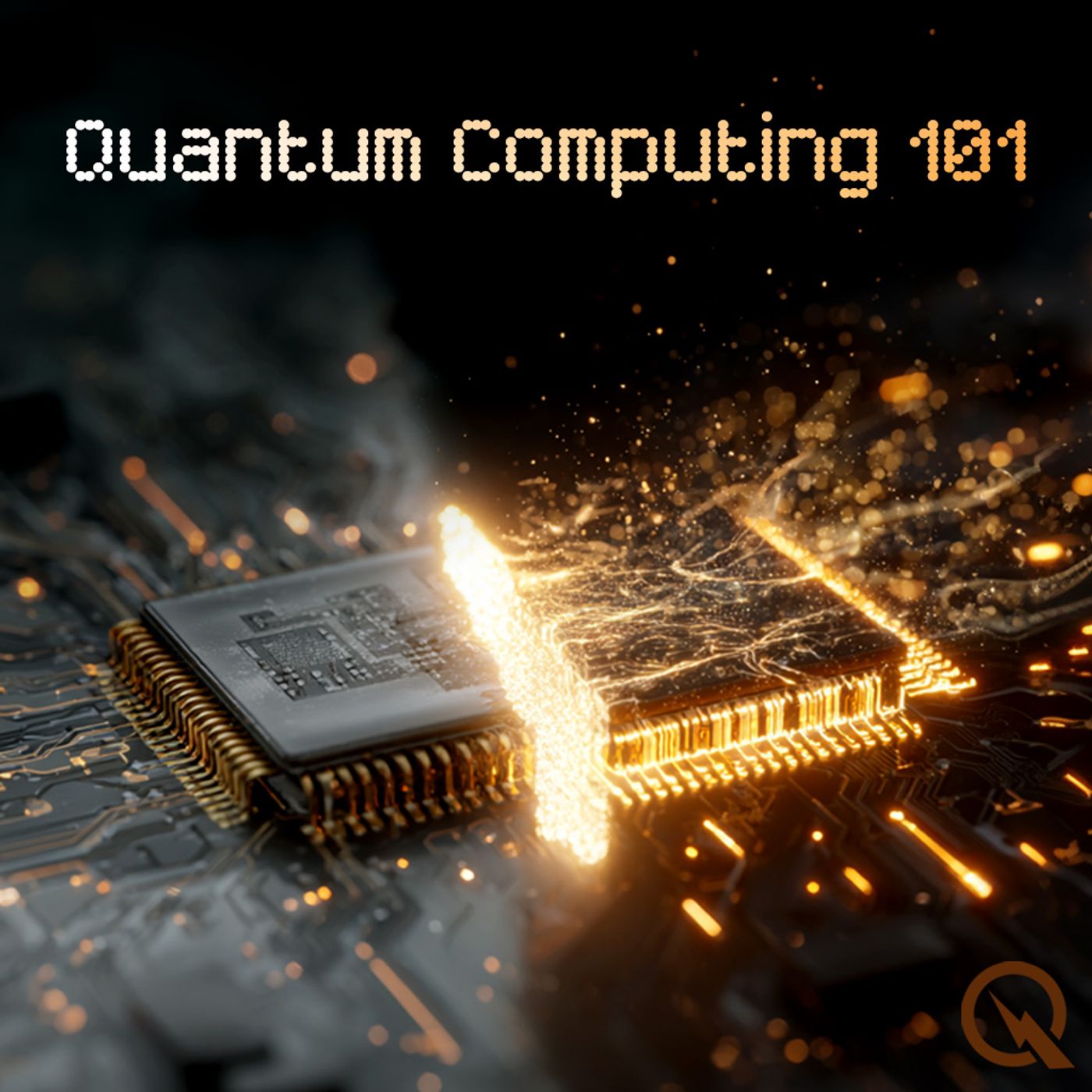
This is your Quantum Computing 101 podcast. You’re listening to Quantum Computing 101. I’m Leo – Learning Enhanced Operator – and today I’m coming to you from a cleanroom that hums like a beehive made of lasers and liquid helium. Two days ago, researchers from New York University and the University of Queensland quietly dropped what might be the most important quantum news of the year: they demonstrated a semiconductor that lets classical and quantum circuitry live on the same chip, in fluent conversation, instead of shouting at each other through slow, noisy interfaces. According to their reports, they used a germanium-based superconductor, subtly doped with gallium, to form a new phase of matter that behaves as a kind of hardware-level interpreter between bits and qubits. This is today’s most interesting quantum–classical hybrid solution, because it doesn’t just bolt a quantum processor next to a classical CPU; it welds them together electrically and conceptually. Picture a chess grandmaster and a supercomputer sharing the same brain: the quantum side explores vast combinatorial forests in parallel, while the classical side prunes, scores, and decides – in nanoseconds, not milliseconds. In front of me, under a microscope, the chip looks utterly ordinary: metallic traces, pale rectangles, the faint scent of photoresist in the air. But on this thumbnail of silicon, the control electronics that shape microwave pulses, the AI accelerators that choose new parameters, and the quantum regions that host fragile superpositions all sit mere micrometers apart. No bulky rack of room‑temperature electronics. No forest of cables plunging into a dilution refrigerator. Just one tight, hybrid nervous system. Here’s how it combines the best of both approaches. Classical logic brings reliability, memory, and fast, deterministic control. Quantum regions contribute superposition, entanglement, and an exponential state space for things like molecular simulation or hard optimization. The classical side runs the outer loop of a variational algorithm, updating parameters, checking constraints, and interfacing with cloud services. The quantum side executes the inner loop: preparing states, applying gates, returning expectation values. With everything on one chip, feedback becomes almost instantaneous, which means faster convergence, better error mitigation, and far more practical workloads. You can feel the broader world vibrating at the same frequency. In national labs, superconducting giants chase fault-tolerant processors; in telecom, operators race to secure networks before large-scale quantum breaks today’s cryptography; in finance and climate science, teams test hybrid algorithms for portfolio optimization and atmospheric modeling. This new semiconductor bridge is the missing piece that lets those ambitions move from fragile lab stacks toward robust products. And that’s the story for today on Quantum Computing 101. Thank you for listening, and if you ever This content was created in partnership and with the help of Artificial Intelligence AI.
Embed this episode
Ready to play
Quantum's Missing Link: New Chip Marries Classical and Quantum Computing
No transcript for this episode yet
Similar Episodes
No similar episodes found.