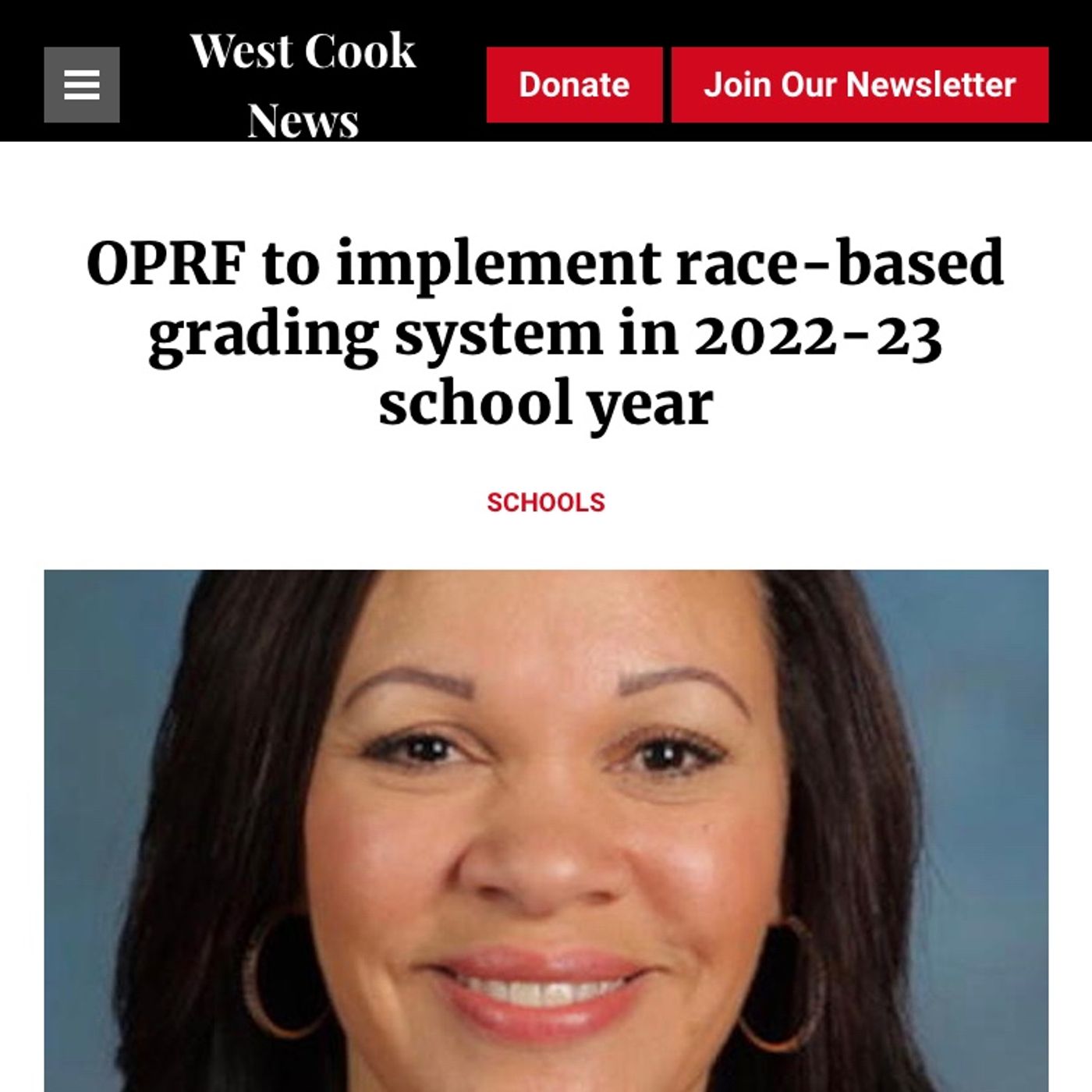
Race Based Grading? episode artwork

EPISODE · Jun 2, 2022 · 11 MIN

Race Based Grading?

from APEX Featuring Ian C Jordan · host APEX

Oak Park and River Forest High School administrators will require teachers next school year to adjust their classroom grading scales to account for the skin color or ethnicity of its students.School board members discussed the plan called “Transformative Education Professional Development & Grading” at a meeting on May 26, presented by Assistant Superintendent for Student Learning Laurie Fiorenza.In an effort to equalize test scores among racial groups, OPRF will order its teachers to exclude from their grading assessments variables it says disproportionally hurt the grades of black students. They can no longer be docked for missing class, misbehaving in school or failing to turn in their assignments, according to the plan.“Traditional grading practices perpetuate inequities and intensify the opportunity gap,” reads a slide in the PowerPoint deck outlining its rationale and goals.It calls for what OPRF leaders describe as “competency-based grading, eliminating zeros from the grade book…encouraging and rewarding growth over time.”Teachers are being instructed how to measure student  “growth” while keeping the school leaders' political ideology in mind.“Teachers and administrators at OPRFHS will continue the process necessary to make grading improvements that reflect our core beliefs,” the plan states, promising to “consistently integrate equitable assessment and grading practices into all academic and elective courses” by fall 2023.According to the Illinois State Board of Education, 38 percent of OPRF sophomore students taking the Scholastic Aptitude Test (SAT) failed.The OPRF failure rate was 77 percent for black students, 49 percent for Hispanics, 27 percent for Asians and 25 percent for whites."Signal and reinforce districts’ DEIJ values”Advocates for so-called "equity based" grading practices, which seek to raise the grade point averages of black students and lower scores of higher-achieving Asian, white and Hispanic ones, say new grading criteria are necessary to further school districts' mission of DEIJ, or "Diversity, Equity, Inclusion and Justice.""By training teachers to remove the non-academic factors from their grading practices and recognize when personal biases manifest, districts can proactively signal a clear commitment toward DEIJ," said Margaret Sullivan, associate director at the Education Advisory Board, which sells consulting services to colleges and universities. Sullivan calls grading based on traditional classroom testing and homework performance “outdated practices” and foster "unconscious biases.""Teachers may unintentionally let non-academic factors—like student behavior or whether a student showed up to virtual class—interfere with their final evaluation of students.," she said. “Traditional student grades include non-academic criteria that do not reflect student learning gains—including participation and on-time homework submission."School districts across the U.S. are "experimenting with getting rid of zero-to-100 point scales and other strategies to keep missed assignments from dramatically bringing down overall grades," according to a March Associated Press report. "Others are allowing students to retake tests and turn work in late. Also coming under scrutiny are extra-credit assignments than can favor students with more advantages."The report interviewed science teacher Brad Beadell of Santa Clara, Calif., who said he has "stopped giving zeros and deducting points for late work" as well as allowing students "unlimited retakes for quizzes and tests."Fiorenza called for a switch to race-based grading last August, after issuing a report chronicling a spike in "F" grades by OPRF students in the 2020-21 school year."OPRF’s administration will adopt language that makes and keeps the system visible and continues to name racism as a complex interconnected structure," she wrote. "We must recognize the unique challenges faced during the pandemic intensify the need for a systemic approach to confronting the racial and socioeconomic discrepancies often experienced by our underrepresented student population."Last year, West Cook News reported on an adjusted grade point average scale implemented by OPRF teacher Fiona Hill. It lowered the score for an "F" to 19 percent.

Episode metadata supplied by the publisher feed · Published Jun 2, 2022

Oak Park and River Forest High School administrators will require teachers next school year to adjust their classroom grading scales to account for the skin color or ethnicity of its students.School board members discussed the plan called “Transformative Education Professional Development & Grading” at a meeting on May 26, presented by Assistant Superintendent for Student Learning Laurie Fiorenza.In an effort to equalize test scores among racial groups, OPRF will order its teachers to exclude from their grading assessments variables it says disproportionally hurt the grades of black students. They can no longer be docked for missing class, misbehaving in school or failing to turn in their assignments, according to the plan.“Traditional grading practices perpetuate inequities and intensify the opportunity gap,” reads a slide in the PowerPoint deck outlining its rationale and goals.It calls for what OPRF leaders describe as “competency-based grading, eliminating zeros from the grade book…encouraging and rewarding growth over time.”Teachers are being instructed how to measure student  “growth” while keeping the school leaders' political ideology in mind.“Teachers and administrators at OPRFHS will continue the process necessary to make grading improvements that reflect our core beliefs,” the plan states, promising to “consistently integrate equitable assessment and grading practices into all academic and elective courses” by fall 2023.According to the Illinois State Board of Education, 38 percent of OPRF sophomore students taking the Scholastic Aptitude Test (SAT) failed.The OPRF failure rate was 77 percent for black students, 49 percent for Hispanics, 27 percent for Asians and 25 percent for whites."Signal and reinforce districts’ DEIJ values”Advocates for so-called "equity based" grading practices, which seek to raise the grade point averages of black students and lower scores of higher-achieving Asian, white and Hispanic ones, say new grading criteria are necessary to further school districts' mission of DEIJ, or "Diversity, Equity, Inclusion and Justice.""By training teachers to remove the non-academic factors from their grading practices and recognize when personal biases manifest, districts can proactively signal a clear commitment toward DEIJ," said Margaret Sullivan, associate director at the Education Advisory Board, which sells consulting services to colleges and universities. Sullivan calls grading based on traditional classroom testing and homework performance “outdated practices” and foster "unconscious biases.""Teachers may unintentionally let non-academic factors—like student behavior or whether a student showed up to virtual class—interfere with their final evaluation of students.," she said. “Traditional student grades include non-academic criteria that do not reflect student learning gains—including participation and on-time homework submission."School districts across the U.S. are "experimenting with getting rid of zero-to-100 point scales and other strategies to keep missed assignments from dramatically bringing down overall grades," according to a March Associated Press report. "Others are allowing students to retake tests and turn work in late. Also coming under scrutiny are extra-credit assignments than can favor students with more advantages."The report interviewed science teacher Brad Beadell of Santa Clara, Calif., who said he has "stopped giving zeros and deducting points for late work" as well as allowing students "unlimited retakes for quizzes and tests."Fiorenza called for a switch to race-based grading last August, after issuing a report chronicling a spike in "F" grades by OPRF students in the 2020-21 school year."OPRF’s administration will adopt language that makes and keeps the system...

PodParley-generated summary based on available episode metadata and transcript content.

NOW PLAYING

Race Based Grading?

0:00 11:51

No transcript for this episode yet

We transcribe on demand. Request one and we'll notify you when it's ready — usually under 10 minutes.

Shut Up I Love It Sasha Feiler and Joe Cabello Many years ago, Sasha Feiler and Joe Cabello met in line for an improv show. They were young, dumb, and full of it. What followed were comedy shows so explicit, “genitalia” was practically a term of endearment.Fast forward 5 dogs, 6 cats, and way too many weird inside jokes later, Sasha and Joe are no longer young or dumb—but they’re still brimming with you-know-what. Here, they’ve teamed up to bring you a podcast where they interview a guest who passionately defends something universally hated, misunderstood, forgotten, overlooked, Mandela-effected, canceled—you name it. The key? They LOVE it. From toupees... to B-movies... to aliens, psychedelics, and the occasional surprise character, Sasha and Joe are here to spread love to the world that birthed them (but maybe should’ve used protection).So come and get that love because no one else will give it to you like we do.Also, don’t forget to check out the Patreon Bonus version of the show:https://www.patreon.com/c/ShutUpILoveItP Explicit Radio BSOTS Macedonia This is a freeform music program featuring independent and Creative Commons licensed works from a variety of musical genres. Hosted by Macedonia, this show digs through the cyberspace crates to bring you the best in hip-hop, jazz, electronic, soul, funk, and more. Explicit Bumming with Bobcat Bum Wine Bob Bum Wine Bob is the everyman's drinking man and bum wine connoisseur. Featuring all your favorite bottom shelf and budget beverages that are cheap in price, but not in quality. Bum wine, beers, 40's, malt liquor, and MORE! Bringing you the best of the worst in cheap booze at bumwinebob.com since 2014. Come take a ride with Bum Wine Bob and some special guests! Cheers! Explicit Gorilla Radio Show Gorilla Radio Podcast Network Podcast about primates featuring a junior primatologist and maybe some other guys. Jane Goodall please don't sue us.https://www.patreon.com/gorillaradioshow Explicit

Frequently Asked Questions

How long is this episode of APEX Featuring Ian C Jordan?

This episode is 11 minutes long.

When was this APEX Featuring Ian C Jordan episode published?

This episode was published on June 2, 2022.

What is this episode about?

Oak Park and River Forest High School administrators will require teachers next school year to adjust their classroom grading scales to account for the skin color or ethnicity of its students.School board members discussed the plan called...

Can I download this APEX Featuring Ian C Jordan episode?

Yes, you can download this episode by clicking the download button on the episode player, or subscribe to the podcast in your preferred podcast app for automatic downloads.
URL copied to clipboard!