Rare Earth Metals
from The Innovation Attorney Podcast Hosted by The Innovation Attorney
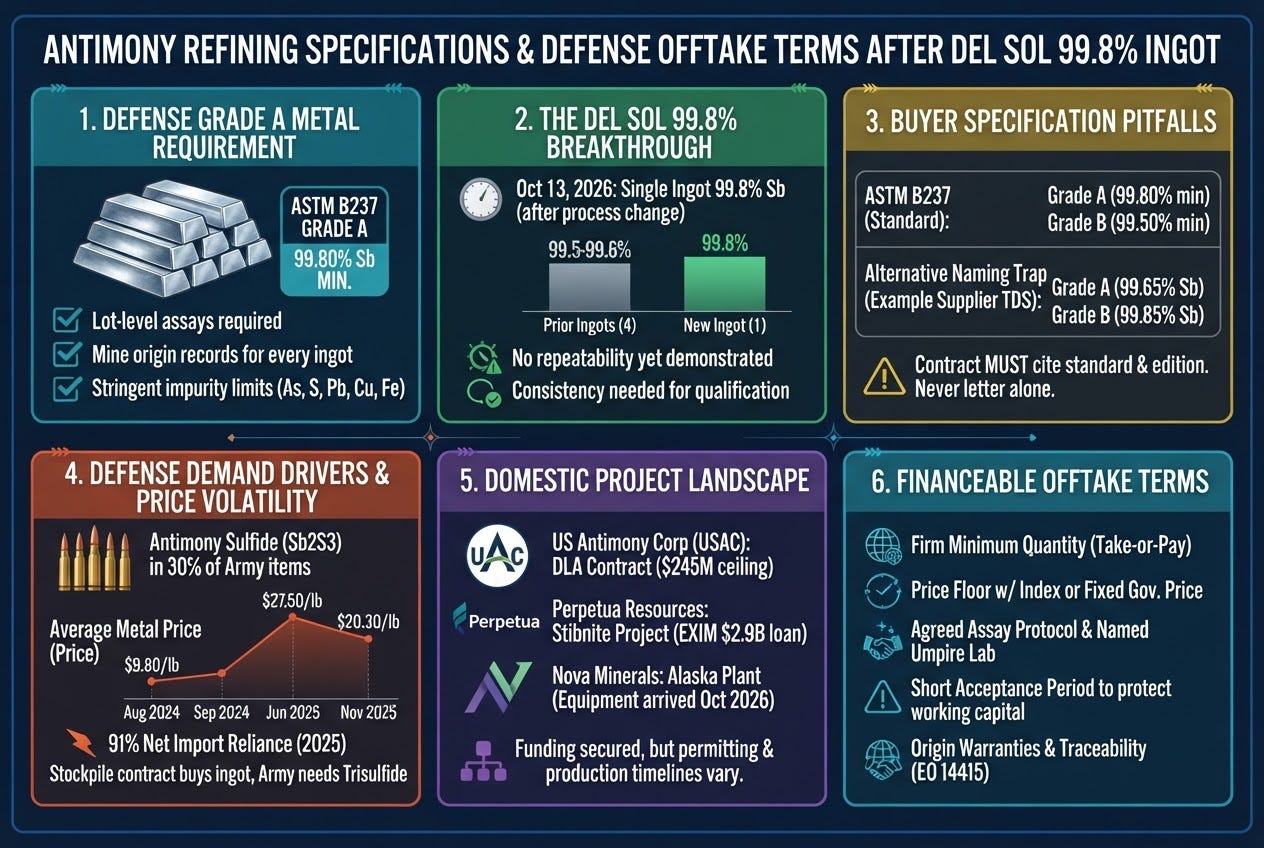
Antimony refining startups selling to defense buyers need ASTM B237 Grade A metal at 99.80 percent antimony or better, with lot level assays and mine origin records for every ingot. American Tungsten and Antimony reported on October 13, 2026 that one ingot from its Del Sol refinery in Amargosa Valley, Nevada assayed 99.8 percent antimony, while four earlier ingots assayed 99.5 to 99.6 percent. One passing sample clears the Grade A floor and shows a process change worked. It shows no repeatability, and the Defense Logistics Agency and the Army buy lots, records and continuity of supply. Financeable offtake terms include a stated minimum quantity, a price floor, an agreed assay protocol with a named umpire laboratory, and acceptance periods short enough to protect working capital. Three domestic projects frame the supplier side: a Defense Logistics Agency contract worth up to $245 million for ingots from United States Antimony Corporation, a $2.9 billion Export Import Bank loan to Perpetua Resources for its Idaho mine, and Nova Minerals’ Alaska plant, where all key equipment arrived on October 6, 2026. The Grade A threshold, the federal awards and the July 20, 2026 tracing order for defense contractors are established. Repeatability at Del Sol, completion of its parent’s acquisition of the site, and the price the government pays when spot prices fall are not. Detailed Findings What Did the Del Sol Assay Actually Show? The Del Sol result is one 99.8 percent antimony assay on one ingot, produced after the company changed its electrowinning conditions, and it sits exactly at the ASTM B237 Grade A minimum of 99.80 percent. In its October 13, 2026 announcement the company said NSL Analytical Services of Cleveland, Ohio tested drill shavings from five ingots made from ore from the White Spar Antimony Mine in Yavapai County, Arizona. Sample 294 of the S260930 series returned 99.8 percent. Samples 290 through 293 returned 99.5 to 99.6 percent, and only the fifth ingot came from the optimized electrowinning conditions. The laboratory measured impurities by inductively coupled plasma mass spectrometry, sulfur by pyrohydrolysis followed by ion chromatography, and mercury by cold vapor atomic absorption. It calculated antimony by difference. A by difference result equals 100 percent minus every impurity measured, so an element nobody measured counts as antimony. A buyer’s specification therefore has to name the element list as well as the antimony floor. Reporting to one decimal place also leaves no margin: a true value of 99.76 percent rounds to 99.8, so the rounding rule belongs in the contract. Coverage of the announcement states that the 99.8 percent sample met the Grade A chemical limits for lead, arsenic, copper, nickel and iron. The coverage reviewed published no impurity values, no recovery rates, no volumes, no funding and no offtake commitment, and it records that the company’s acquisition of the entities holding Del Sol and White Spar has not completed. The company’s first ingot announcement came on September 22, 2026 and said the ingot was made without new processing infrastructure or new permitting for the current campaign. The company now says the result lets it approach the Defense Logistics Agency, Project Vault and defense primes. It also says it expects consistent output above the commercial grade, which it has not demonstrated. On October 5, 2026 a company executive joined a delegation at White House and Office of the United States Trade Representative roundtables, where the contacts included the Trade Representative, a National Security Council official and the director of the Office of Strategic Capital. The discussion centered on funding and offtake with the federal government and defense primes. No agreement was reported. What Grades and Impurity Limits Do Antimony Buyers Use? Antimony ingot trades against three reference points: a 99.65 percent commercial grade, a 99.85 percent premium grade, and ASTM B237 Grade A at 99.80 percent minimum. The standard covers refined antimony as ingot, pig or cake in Grades A and B, sets limits for arsenic, sulfur, lead and other impurities, and allows any smelting or refining route, from ore or recycled feed, that meets the chemistry. Reports of the standard give Grade B a 99.50 percent minimum. The 99.65 percent commercial grade, sold as Regulus II or Grade II, carries maximums of 0.15 percent arsenic, 0.005 percent selenium and 0.06 percent sulfur in one published trading specification. A supplier data sheet adds 0.20 percent lead, 0.002 percent copper and 0.02 percent iron for the same antimony floor. A 99.85 percent ingot assessed by a price reporting agency carries 0.05 percent maximum arsenic, 0.15 percent maximum lead and 100 parts per million maximum bismuth, and the supplier data sheet lists 0.085 percent lead, 0.001 percent copper and 0.04 percent sulfur for its 99.85 percent product. Naming creates a trap. In that supplier data sheet Grade A means 99.65 percent antimony and Grade B means 99.85 percent, the reverse of the ASTM labels, where Grade A is the 99.80 percent product. A contract must cite the standard and its edition, never the letter alone. Physical conventions are consistent across sources: ingots of 25 to 30 kilograms, bundled or palletized near 1,000 kilograms, lots of 25 metric tons in the trading specification, and a certificate of analysis with each delivery. The Defense Logistics Agency’s own ingot specification does not appear in the sources reviewed. The contractor describes it as stringent and gives no standard. A startup should obtain the specification attached to the stockpile solicitation and design to the stricter of that document and Grade A. Why Do Defense Buyers Want Antimony Metal and Antimony Trisulfide? Defense programs need antimony because ammunition consumes it and because foreign producers control most of the supply. Federal minerals data for 2025 estimates that 49 percent of United States use went to metal products including flame retardants, 40 percent to antimonial lead and ammunition, and 11 percent to ceramics, glass and rubber. Spent lead acid batteries supply most secondary antimony, which met 12 percent of 2025 apparent consumption. The Army states that antimony sulfide is a key ingredient in nearly 30 percent of military ammunition items, where it helps primers operate across all temperature ranges, and that the United States sourced it from China until 2021. Net import reliance for antimony was an estimated 91 percent in 2025. China supplied 55 percent of imported antimony metal and oxide from 2021 through 2024. China announced export restrictions in August 2024 and banned shipments to the United States in December 2024, and controls remained after it suspended that ban in November 2025. The average metal price rose from $9.80 per pound in August 2024 to $18.10 in December 2024, reached $27.50 in June 2025 and stood at $20.30 in November 2025. Product choice sets the customer. Ingot is what the stockpile contract buys. Trisulfide is what the Army and ammunition makers need. Oxide, the flame retardant feedstock, is the largest import line at an estimated 39,000 metric tons in 2025, against 4,500 metric tons of unwrought metal and powder. A refiner that serves defense buyers still competes for commercial volume, because defense stockpile demand is small. The fiscal year 2025 annual materials plan listed potential antimony acquisitions of 700 tons, and the fiscal year 2026 plan had not been released when the 2026 federal data were published. Which US Producers Are Already Selling or Building? United States Antimony Corporation is the supplier delivering metal ingots to the Defense Logistics Agency under the contract reviewed here, and its second quarter 2026 results show the price risk a startup would inherit. The company sells antimony oxide, metal ingots and trisulfide from North American smelters. It reported 428,425 pounds of antimony sold in the second quarter of 202… This is a public episode. If you'd like to discuss this with other subscribers or get access to bonus episodes, visit theinnovationattorney.substack.com/subscribe
Embed this episode
No transcript yet.