
EPISODE · Mar 1, 2023 · 7 MIN
Reader Question: Why do they say that "obesity" is a chronic disease like asthma and type 2 diabetes?
from Weight and Healthcare · host Ragen Chastain
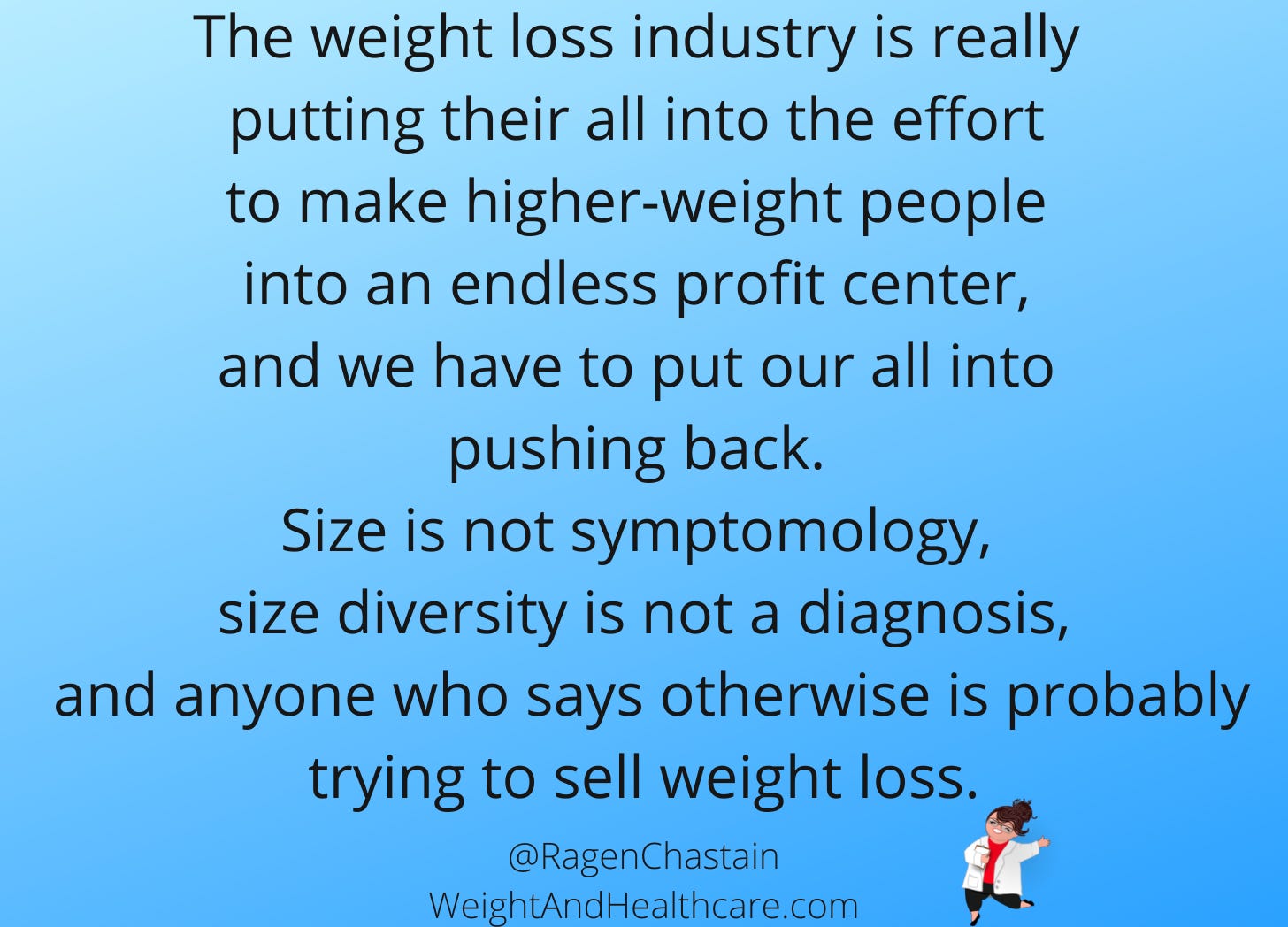
Transcript:This is the Weight and Healthcare newsletter! If you like what you are reading, please consider subscribing and/or sharing!Reader Eliah sent me the following email:I’ve seen you write about how the idea of “ob*sity”* as a disease is problematic which is I think why I started noticing that in all the articles about these new diet drugs it seems like it says at least once that “ob*sity is a disease like asthma or type 2 diabetes” I thought you might have some insight into the concept in general and why this specific phrasing is being used.This is a great question. This specific phrase “ob*sity is a chronic disease like asthma or type 2 diabetes” is indeed making the rounds. I’ll start by talking about the veracity of the claim, and then answer the question as to why people are saying it.Before I dig in, I want to be clear that there is absolutely no shame in having a disease or diagnosis of any kind, this is about the intentional misapplication of the concept and the damage it does.First let’s answer the basic question: Is “ob*sity” a chronic disease like asthma or type 2 diabetes? In order to get to the bottom of this, let’s examine each diagnosis in turn.In order to be diagnosed with asthma, there has to be documentation of signs or symptoms of airflow obstruction, reversibility of obstruction (that the signs or symptoms decrease with asthma therapy,) and no clinical suspicion of an alternative diagnosis.In order to be diagnosed with type 2 diabetes one of the following thresholds must be met (typically with at least one repetition): an A1C of greater than or equal to 6.5%, fasting blood glucose of greater than or equal to 126 mg/dl, a two-hour blood glucose of greater than or equal to 200 mg/dl on an Oral Glucose Tolerance Test, or blood glucose of greater than or equal to 200 mg/dl on a Random Plasma Glucose Test.In order to be “diagnosed” as “ob*se” one’s weight in pounds times 703 divided by their height in inches squared has to be 30.0 or higher. There is no shared symptomology among this group of people, it includes people with various health diagnoses, people without any health diagnoses, and with widely varying cardiometabolic health, body composition, etc. Literally, the only thing this group has in common is a similar ratio of weight and height (and being “diagnosed” using a deeply problematic math equation.)When you take into account the “class” system (ie: class 1, class 2, and class 3 ob*sity) the folly of this becomes even more apparent. Consider that, for class 1 ob*sity, 1 pound, or 1 inch in height canbe the only difference between someone who is “diagnosed” with “ob*sity” and someone who is not, again with no shared symptomology or cardiometabolic profile. Even more ridiculous, while class 1 and 2 each encompass a 4.9 point BMI spread, class 3 is defined as a BMI of 40 to…infinity. That does not have the ring of sound science.Then there is the issue of treatment. For both asthma and type 2 diabetes, treatments focus on managing the common symptomology. With “ob*sity” the “treatment” is focused on making the patient look different by changing their size. Setting aside that the “treatment” almost never works and has considerable risks, no matter what size someone ends up at, there will be people of that size who have the same (and different) actual health issues.So the answer to the question of whether ob*sity is a disease like asthma and type 2 diabetes is: No, it absolutely is not.This is pretty clear cut, so why are people (including doctors) still spouting this nonsense? In a word (or four): the weight loss industry. The classification of simply existing in a higher-weight body as a “disease” is the holy grail for them. It increases their market to every fat person for the entire time that they are alive. They’ve been pushing this (both blatantly and surreptitiously,) pouring money into the effort for many years. I’ve been writing and speaking about this since 2009, and there are many people who have been doing it far longer (including since before I was born.) It’s actually one of the first things I wrote about when I launched this newsletter. So we’ve heard them try to claim that being fat is a “chronic lifelong health condition.” The addition of this comparison to type 2 diabetes and asthma seems to be specifically in the service of selling diet drugs like Wegovy.Novo Nordisk’s research has shown repeatedly that, while people lose weight short-term on their drug (though even in their 68-week trial weight loss had leveled off by the end) as soon as people go off the drug the rapid weight regain begins. Participants regained 2/3 of the weight they had lost, and lost 2/3 of the cardiometabolic health benefits in just the first year off the drug. So Novo Nordisk’s (wildly profitable, completely untested) “solution” is just to suggest that people stay on the drug for the rest of their lives.So the use of this phrase is them trying to take advantage of people’s understanding that actual chronic health conditions require lifelong treatment, to suggest that their $1,300+ a month drug should be taken by people for life despite the fact that they only have 68 weeks of data about the weight loss (and even in that short term they had significant, dangerous side effects and the weight loss had already leveled off.) There is also a horrid irony here in that Novo Nordisk’s aggressive price gouging of insulin killed people with diabetes because they could not access the needed treatment, so that Novo Nordisk could maximize their profits.The use of this phrase also allows for the dangerous re-branding of weight cycling (also known as yo-yo dieting) into a so-called successful intervention that people are told to simply repeat for the rest of their lives, thus exposing higher-weight people to very real, and wholly unnecessary, health risks.Obviously, it makes sense for the weight loss industry, but what is going on with doctors? The enmeshment of the weight loss industry in the healthcare system is almost impossible to overstate, from medical education, to major health organization committee assignments, and more the weight loss industry is constantly working to transform their marketing messages into healthcare education and practice and so it’s not surprising if even well-meaning healthcare practitioners get caught up in it.Beyond this, companies like Novo Nordisk simply pay a stable of doctors to serve on their “speaker’s bureau” or provide “consulting” or “education. Those doctors are then foisted on unsuspecting audiences of medical students and practitioners, and interviewed as “experts” by the media where they toe the party line (typically without any disclosure of their financial relationship with the companies whose marketing copy and drugs they are promoting.)I want to repeat that there is no shame at all in having a disease. The issue is that simply existing in a higher-weight body doesn’t qualify, and claiming that it does causes massive harm to higher-weight people, with the most harm done to those at the highest weights and those with multiple marginalized identities.The weight loss industry is really putting their all into the effort to make higher-weight people into an endless profit center, and we have to put our all into pushing back. Size is not symptomology, size diversity is not a diagnosis, and anyone who says otherwise is probably trying to sell weight loss.Did you find this post helpful? You can subscribe for free to get future posts delivered direct to your inbox, or choose a paid subscription to support the newsletter and get special benefits! Click the Subscribe button below for details:More research:https://haeshealthsheets.com/resources/*Note on language: I use “fat” as a neutral descriptor as used by the fat activist community, I use “ob*se” and “overw*ight to acknowledge that these are terms that were created to medicalize and pathologize fat bodies, with roots in racism and specifically anti-Blackness. Please read Sabrina Strings’ Fearing the Black Body – the Racial Origins of Fat Phobia and Da’Shaun Harrison’s Belly of the Beast: The Politics of Anti-Fatness as Anti-Blackness for more on this. Get full access to Weight and Healthcare at weightandhealthcare.substack.com/subscribe
Embed this episode
NOW PLAYING
Reader Question: Why do they say that "obesity" is a chronic disease like asthma and type 2 diabetes?
No transcript for this episode yet
Similar Episodes
No similar episodes found.
Similar Podcasts
No similar podcasts found.