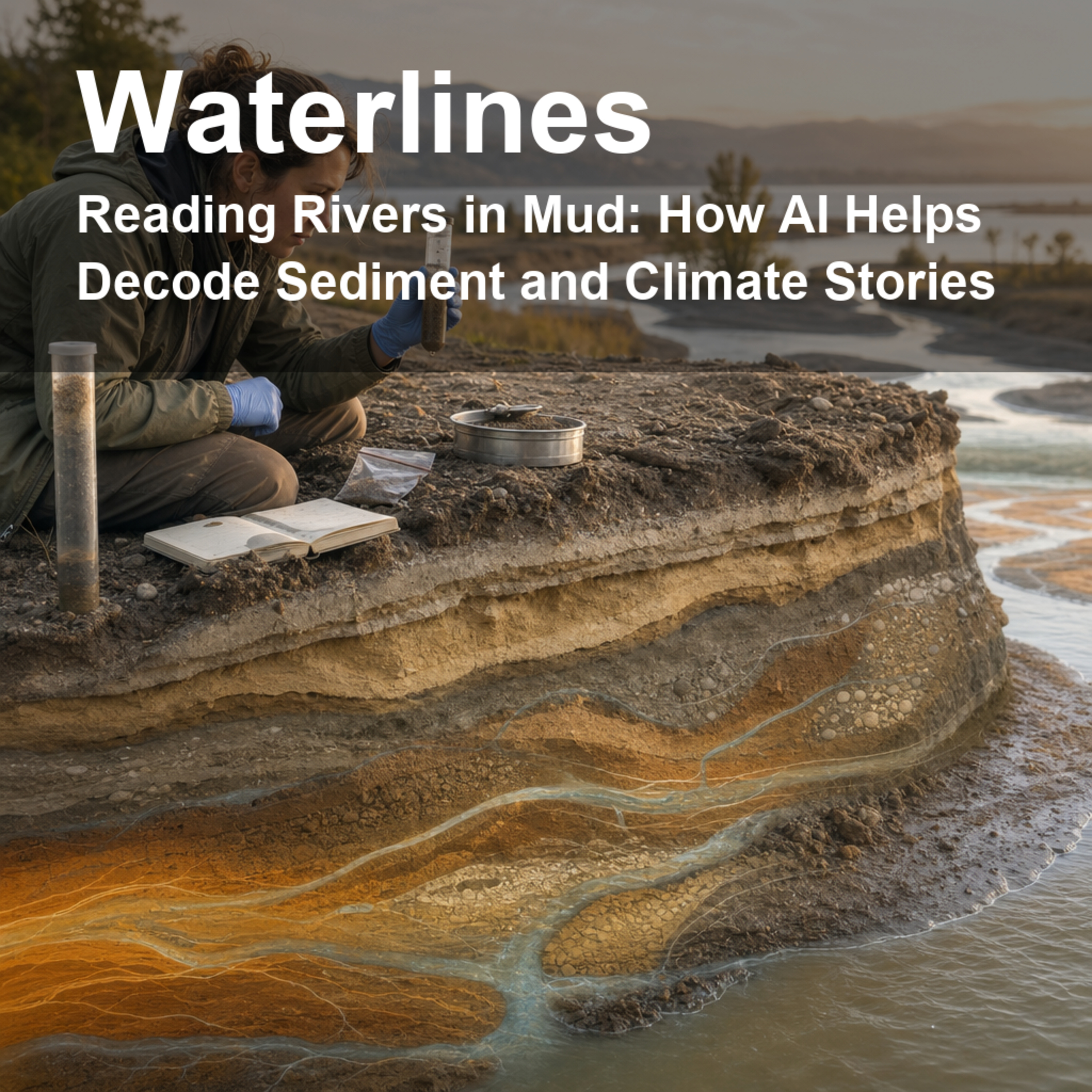
Reading Rivers in Mud: How AI Helps Decode Sediment and Climate Stories episode artwork

EPISODE · May 27, 2026 · 11 MIN

Reading Rivers in Mud: How AI Helps Decode Sediment and Climate Stories

from Waterlines: How Water Shapes Our World · host jaywen

A handful of mud can hold the memory of a river flood, a lake edge, or a dust storm that crossed a continent. That matters because sediments are one of the main ways water leaves a record of past environments, climate shifts, and landscape change. In this episode of Waterlines, we unpack a new study that asks a practical question: if scientists use grain size to read those records, how can they reduce the human guesswork built into the methods?The paper follows 73,393 sediment samples from loess, river, and lake-delta settings, mostly in China and Central Asia. The authors use an existing grain-size decomposition approach to create training examples, then bring in deep learning, including convolutional neural networks and generative adversarial networks, to build a more consistent tool for separating mixed sediment into likely components. We explain the idea with everyday analogies: sorting trail mix after it has been shaken together, reading the energy of water from sand and silt, and teaching a model with both real and carefully generated examples.We also talk about what the work does not solve. The model performed well where training data matched the new samples, but struggled where loess from Central Asia differed from loess on the Chinese Loess Plateau. That limitation is important: AI does not remove the need for field knowledge, shared data, and careful interpretation. It may, however, help scientists compare sediment records more fairly across river basins, lakes, deserts, and ancient climate archives.Citation: Liu, Y., Wang, T., Wen, T., Zhang, J., Liu, B., Li, Y., Zhang, H., Rong, X., Ma, L., Guo, F., Liu, X. and Sun, Y. (2024) Deep learning-based grain-size decomposition model: A feasible solution for dealing with methodological uncertainty. Sedimentology. doi: 10.1111/sed.13195.Disclosure: This Waterlines episode package is written for public science communication and is intended to be performed with AI-generated voices.

A handful of mud can hold the memory of a river flood, a lake edge, or a dust storm that crossed a continent. That matters because sediments are one of the main ways water leaves a record of past environments, climate shifts, and landscape change. In this episode of Waterlines, we unpack a new study that asks a practical question: if scientists use grain size to read those records, how can they reduce the human guesswork built into the methods?The paper follows 73,393 sediment samples from loess, river, and lake-delta settings, mostly in China and Central Asia. The authors use an existing grain-size decomposition approach to create training examples, then bring in deep learning, including convolutional neural networks and generative adversarial networks, to build a more consistent tool for separating mixed sediment into likely components. We explain the idea with everyday analogies: sorting trail mix after it has been shaken together, reading the energy of water from sand and silt, and teaching a model with both real and carefully generated examples.We also talk about what the work does not solve. The model performed well where training data matched the new samples, but struggled where loess from Central Asia differed from loess on the Chinese Loess Plateau. That limitation is important: AI does not remove the need for field knowledge, shared data, and careful interpretation. It may, however, help scientists compare sediment records more fairly across river basins, lakes, deserts, and ancient climate archives.Citation: Liu, Y., Wang, T., Wen, T., Zhang, J., Liu, B., Li, Y., Zhang, H., Rong, X., Ma, L., Guo, F., Liu, X. and Sun, Y. (2024) Deep learning-based grain-size decomposition model: A feasible solution for dealing with methodological uncertainty. Sedimentology. doi: 10.1111/sed.13195.Disclosure: This Waterlines episode package is written for public science communication and is intended to be performed with AI-generated voices.

NOW PLAYING

Reading Rivers in Mud: How AI Helps Decode Sediment and Climate Stories

0:00 11:38

No transcript for this episode yet

We transcribe on demand. Request one and we'll notify you when it's ready — usually under 10 minutes.

Eat to Live Jenna Fuhrman, Dr. Fuhrman Our health is our most precious gift and smart nutrition can change your life. Each month, join Dr. Fuhrman and his daughter, Jenna Fuhrman as they discuss important topics in the world of nutrition. Eat to Live will change the way you eat and think about food. French Your Way Jessica: Native French teacher founder of French Your Way Boost your French listening skills and test your comprehension with this one of a kind series of podcasts. Get the chance to listen to a real conversation between native speakers talking at normal speed AND customise your learning experience through carefully designed sets of questions (2 levels of difficulty) available for download at www.frenchvoicespodcast.com. All interviews also come with the transcript. French teacher Jessica interviews native speakers of French from around the world who share a bit of their life and passion. Where else would you meet in one same place a French yoga teacher based in Melbourne, a soap manufacturer from Provence, or a couple cycling around the world? HOMELAND HOMELAND The Church is a body not a building. It's the bride of Jesus Christ! Jesus is coming back for a mature bride. That means it's time for the church of Jesus Christ to move from milk to meat. This is the hour of maturity!HOMELAND is an announcement that the church is being set free. Only the church has the ability to transform the world. The kingdom's of this world will become the kingdoms of our Lord and Savior!All of creation has been waiting for this moment! Sons and daughters of God are rising up and taking their seat! XXX Tech by SOVRYN Dr. Brian Sovryn The crossroads between technology, sensuality, and metaphysics - and the longest running anarchist podcast in the world! Brought to you by Dr. Brian Sovryn.

Frequently Asked Questions

How long is this episode of Waterlines: How Water Shapes Our World?

This episode is 11 minutes long.

When was this Waterlines: How Water Shapes Our World episode published?

This episode was published on May 27, 2026.

What is this episode about?

A handful of mud can hold the memory of a river flood, a lake edge, or a dust storm that crossed a continent. That matters because sediments are one of the main ways water leaves a record of past environments, climate shifts, and landscape change....

Can I download this Waterlines: How Water Shapes Our World episode?

Yes, you can download this episode by clicking the download button on the episode player, or subscribe to the podcast in your preferred podcast app for automatic downloads.
URL copied to clipboard!