
EPISODE · May 27, 2026 · 11 MIN
Reading Well Water With Nitrogen: Tracking Stray Natural Gas in Texas Groundwater
from Waterlines: How Water Shapes Our World · host jaywen
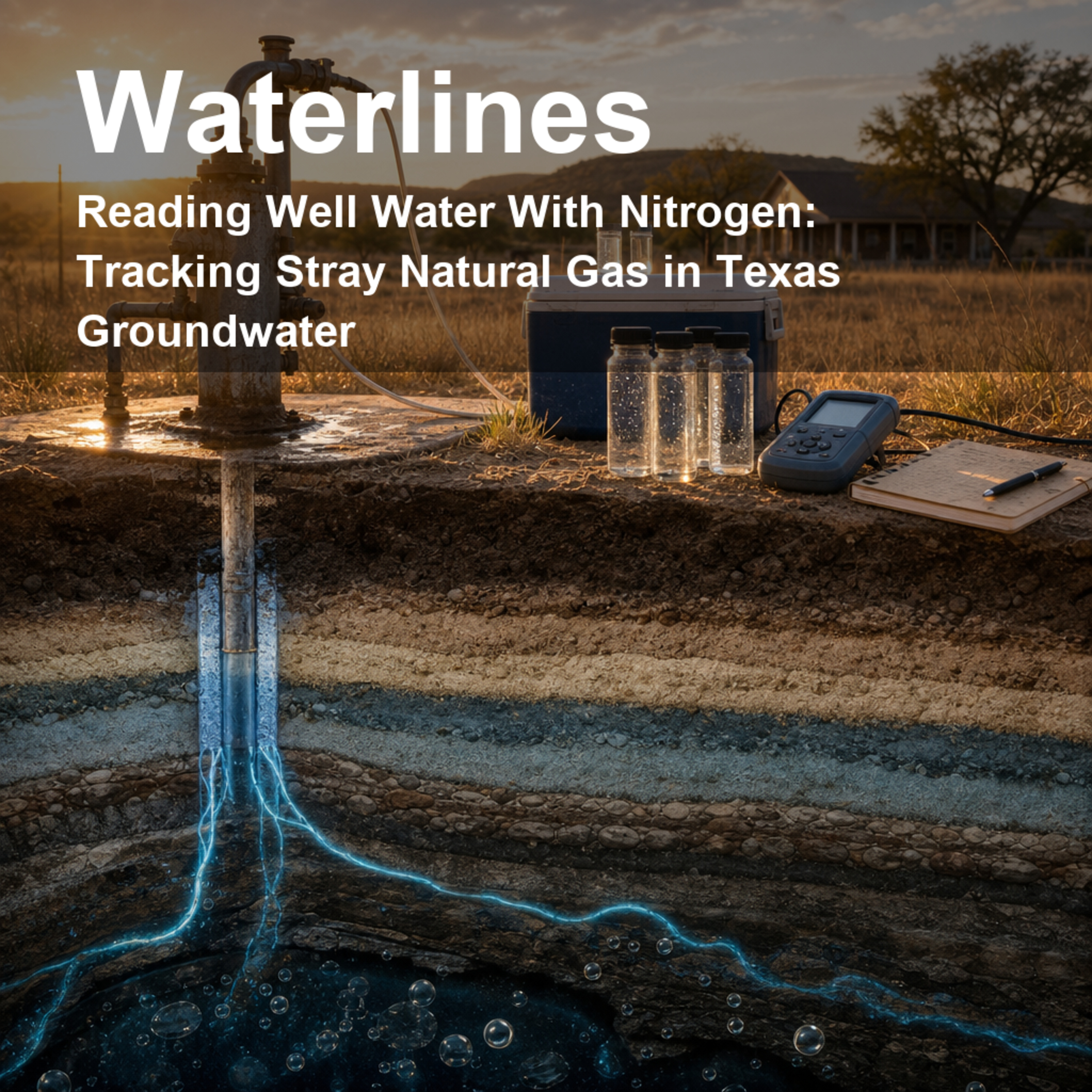
When people turn on a kitchen tap near oil and gas fields, they are not asking an abstract question: they want to know whether their water is safe, where any gas came from, and what evidence can actually answer that. This episode follows scientists in Parker and Hood Counties, Texas, who used an unexpected clue—dissolved nitrogen—to help read the history of methane in groundwater. Methane alone can be a loud signal but a poor storyteller: a tiny amount of natural gas can make methane measurements jump. Nitrogen, because it is already abundant in air-recharged groundwater and relatively low in natural gas, changes more slowly. That makes it useful for separating small traces from larger gas influxes and for comparing possible sources.We unpack how researchers sampled household, irrigation, and municipal wells, compared groundwater gases with nearby production gases, and used simple mixing ideas to ask whether methane looked microbial, thermogenic, Barnett Shale-like, or more consistent with the shallower Strawn Group. The practical takeaway is careful and grounded: most wells had trace to nondetectable methane; a localized cluster had higher methane; and the nitrogen evidence pointed toward localized gas from shallower Strawn reservoirs rather than hydraulic fracturing of the deeper Barnett Shale in this area. We also talk about uncertainty, why multiple chemical clues matter, and what this means for well owners, regulators, and communities trying to make sense of water data.Citation: Larson, T. E., Nicot, J.-P., Mickler, P., Castro, M. C., Darvari, R., Wen, T., & Hall, C. M. (2018). Monitoring stray natural gas in groundwater with dissolved nitrogen. An example from Parker County, Texas. Water Resources Research, 54, 6024–6041. https://doi.org/10.1029/2018WR022612Disclosure: This Waterlines episode package is written for public science communication and uses AI-generated voices for the hosts.
Embed this episode
NOW PLAYING
Reading Well Water With Nitrogen: Tracking Stray Natural Gas in Texas Groundwater
No transcript for this episode yet
Similar Episodes
No similar episodes found.
Similar Podcasts
No similar podcasts found.