
EPISODE · Jun 13, 2026 · 1H 59M
Reasoning with Concepts (Gärdenfors & Matías Osta-Vélez, 2026) - Weekend Book Review
from Revise and Resubmit - The Mayukh Show · host Mayukh Mukhopadhyay
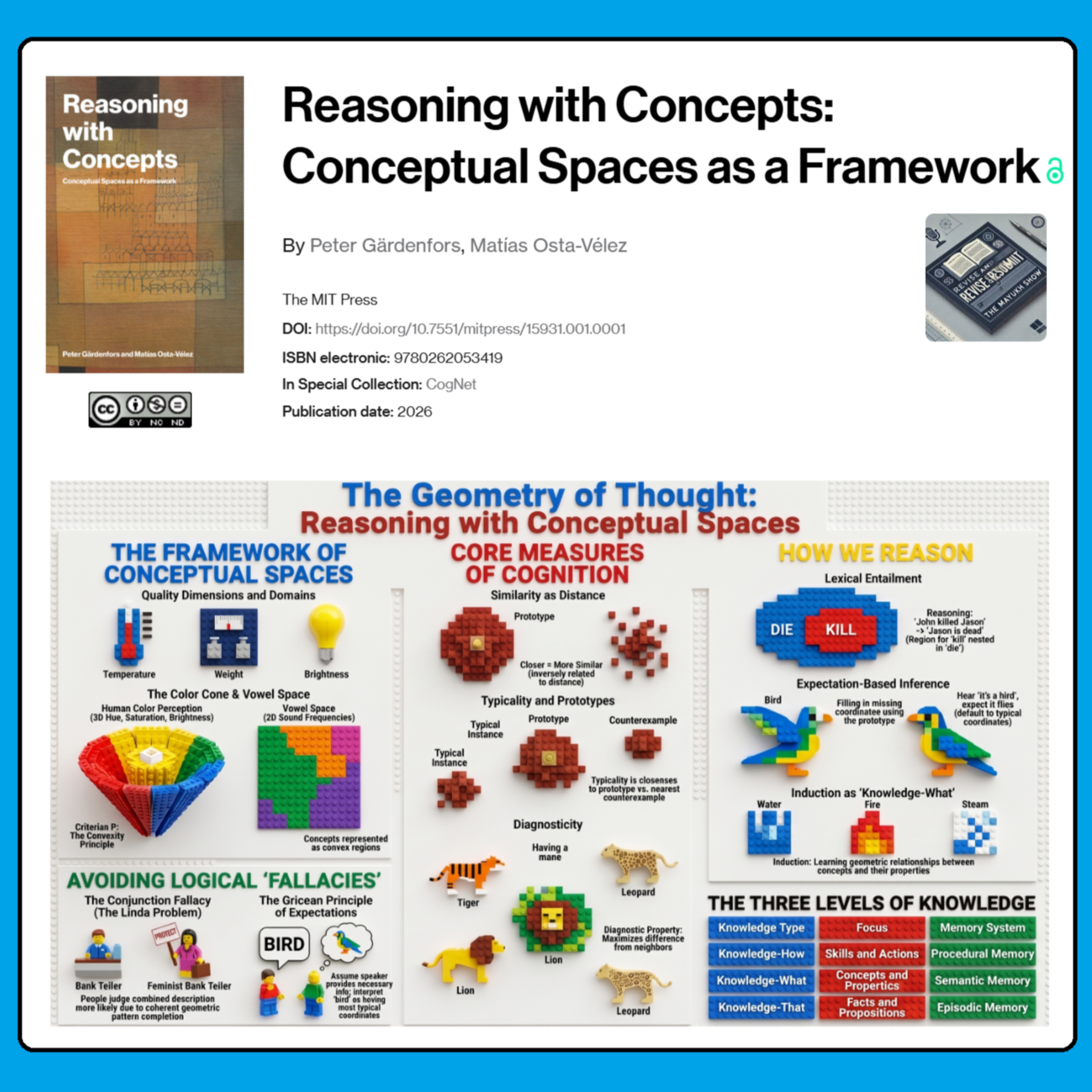
English Podcast starts at 00:00:00Bengali Podcast Starts at 00:49:04Hindi Podcast Starts at 01:12:26Danish Podcast Starts at 01:35:54 ReferenceGärdenfors, P., & Matías Osta-Vélez. (2026). Reasoning with Concepts. In The MIT Press eBooks. The MIT Press. https://doi.org/10.7551/mitpress/15931.001.0001Youtube channel link https://www.youtube.com/@weekendresearcherPodcast Websitehttps://mayukhmukhopadhyay.com/reviseandresubmitAcademy of Management PDW on Space Economy Registration Flyerhttps://cto.aom.org/discussion/flagship-aom-2026-pdw-space-economy-consolidating-a-research-agenda-8AOM SIM Curriculum Committeehttps://sim.aom.org/curriculum/curriculum-committeeAOM SIM-Bytes Episode 1 - Dr Ed Freemanhttps://www.youtube.com/shorts/EBSA7WvQNSIA discussion note on SIMByteshttps://sim.aom.org/discussion/a-message-from-sims-curriculum-committee-chair-sheldene-simola-with-jennifer-griffin🎧✨ Welcome to Revise and Resubmit. This is our Weekend Book Review, the little corner of the week where I get to sit down with a book that asks us to think a little harder about the world and, perhaps, about ourselves.You know, we often imagine that reasoning is something cold and mechanical. We picture logic as a row of tidy equations marching across a blackboard. But then you watch a child recognize a dog they have never seen before, or you hear someone say, "This feels like home," and suddenly you realize that the mind works less like a calculator and more like a landscape.That is exactly where Peter Gärdenfors and Matías Osta-Vélez invite us to wander in their remarkable new book, Reasoning with Concepts: Conceptual Spaces as a Framework, published by The MIT Press on 26 May 2026. Gärdenfors, one of the pioneers of cognitive science and the architect behind the theory of conceptual spaces, has spent decades asking how meaning itself is organized. Alongside him, philosopher of science Matías Osta-Vélez brings a deep curiosity about how humans and intelligent systems actually make sense of the world.And together they offer a beautiful, almost geometric idea. Maybe our minds do not reason by following rigid rules. Maybe we move through invisible spaces, where thoughts have shape, memories have distance, and ideas become neighbors. Similarity, typicality, analogy, expectation, they are not separate puzzles at all. They are different paths through the same mental landscape.As someone fascinated by both marketing and artificial intelligence, I found myself wondering whether the future of AI will belong not to machines that calculate faster, but to machines that can understand concepts the way people do. Perhaps intelligence is less about finding the right answer and more about knowing which ideas belong close together.📖 So today, we are going to explore a book that quietly bridges psychology, philosophy, cognitive science, and AI, and asks one deceptively simple question: How do our minds know what belongs where?💛 A heartfelt thank you to authors Peter Gärdenfors and Matías Osta-Vélez, and to The MIT Press, for bringing this thought-provoking work into the world.🎙️ If you enjoy conversations where research feels a little more human, please subscribe to Revise and Resubmit on Spotify and follow our YouTube channel, Weekend Researcher. You can also find us on Amazon Prime Music and Apple Podcast.🌌 And when this episode is over, I hope one question stays with you: if our lives are really built from concepts connected by invisible distances, then what forgotten idea has been sitting quietly at the center of your own mental map, waiting for you to notice it?
Embed this episode
Ready to play
Reasoning with Concepts (Gärdenfors & Matías Osta-Vélez, 2026) - Weekend Book Review
No transcript for this episode yet
Similar Episodes
No similar episodes found.
Similar Podcasts
No similar podcasts found.