Redefining the Product Manager Role
from The Innovation Attorney Podcast Hosted by The Innovation Attorney
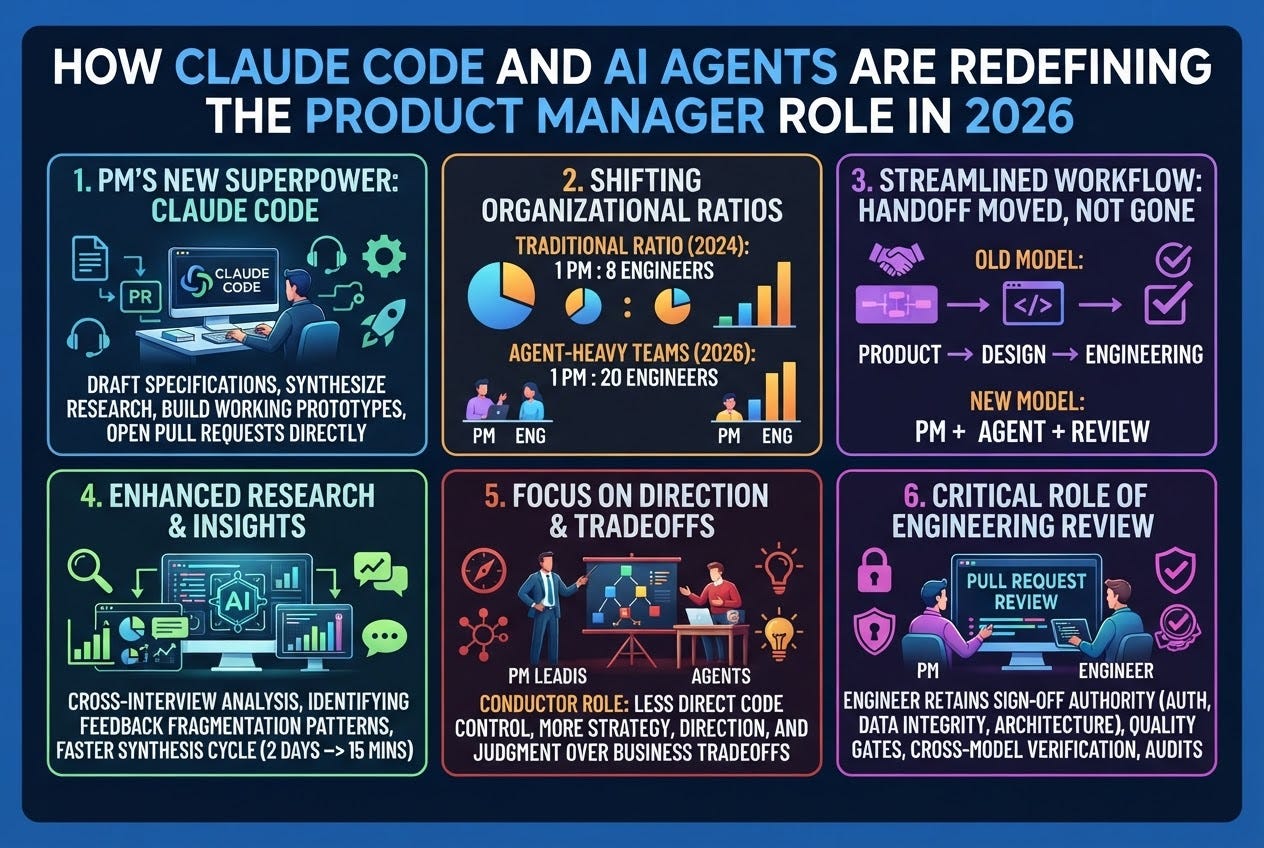
An AI coding agent such as Claude Code now lets a single product manager draft a specification, synthesize customer interviews, build a working prototype, and in a growing number of companies open a pull request that ships to production, work that as recently as 2024 moved through an engineer by default. Reporting published June 27, 2026 described Anthropic’s own growth team being told to hire more product managers rather than fewer once its engineering organization began shipping at roughly three times its prior headcount, and the same reporting put the traditional one to eight product manager to engineer ratio at an effective one to twenty inside agent heavy teams. The shift is uneven. A 2024 Pragmatic Institute survey found that sixty five percent of product professionals had already integrated AI into their work, concentrated in routine and descriptive tasks, while a 2026 developer survey found that forty six percent of engineers still distrust the output AI tools produce, up from thirty one percent the year before. The central finding of this report is that the handoff point between product management and engineering has moved, not disappeared. Product managers at Amazon, Google, Meta, LinkedIn, and a small cluster of independent software companies are now shipping prototypes, internal tools, and in some documented cases production fixes directly, while engineers retain sign off authority on anything that touches authentication, data integrity, or system architecture. A March 18, 2026 content analysis of 638 published Lenny’s Newsletter and podcast items, built with a Claude Opus 4.6 multi agent research team, found that artificial intelligence became the dominant lens for discussing product management starting in the second quarter of 2024, rising from under four percent of coverage in late 2022 to sixty seven percent in the first quarter of 2026. For investors and operators allocating capital to product organizations, the practical implication is that headcount models built on a fixed product manager to engineer ratio are already out of date at companies that have adopted agentic coding tools, and the associate product manager track, the traditional entry point for junior hires, is contracting faster than any other segment of the profession. Definition, Scope, and Technical Context An AI agent, for purposes of this report, is a large language model deployed with tool access: the ability to read and write files, execute code, run tests, query databases, browse the web, and complete multi step tasks with limited human prompting between steps. This definition separates an agent from a conversational chatbot. Tal Raviv, writing for Lenny’s Newsletter on April 29, 2025, drew this same line, distinguishing agents by their capacity to act proactively, draw on company context and live data, take real actions, and check their own output. Claude Code, Anthropic’s command line coding agent, and comparable tools such as Cursor and OpenAI’s Codex, are the dominant instances of this category inside product organizations as of October 2026. The scope of this report is the set of tasks that moved, or are moving, from a product manager’s engineering handoff to an agent: drafting specifications, synthesizing user research, building interactive prototypes, writing code for internal tools and small production fixes, and the review structure that now governs that code before it reaches customers. The report excludes the law and regulation that may someday govern agent authored software, consistent with the scope the user set for this engagement, and it excludes agent use inside pure engineering teams that does not touch the product management function. The system under analysis sits inside the broader category of agentic software engineering, a 2025 and 2026 development that layers planning, tool use, and self checking on top of a foundation model’s text generation capability. The product management variant of this system differs from its engineering counterpart principally in who holds the keyboard: the operator is frequently a person without a formal computer science background, supervising an agent that performs the implementation work a software engineer once performed by hand. Underlying Scientific and Engineering Principles An agentic coding tool operates as a loop: the model receives an instruction, forms a plan, calls a tool such as a shell command or a file edit, observes the result, and repeats until it judges the task complete or asks for human input. Paweł Huryn, writing in The Product Compass on May 31, 2026, described building three public repositories this way, including a Visual Studio Code extension called PM Brain supported by more than eight hundred automated tests, without personally reading most of the underlying code. The mechanism that makes this possible is a combination of a large context window, the ability to execute and observe code and run it again, and an iterative test and correct cycle that substitutes for a human’s step by step verification. Two constraints govern what this loop can do, and they sit in different categories. The first is contingent: context window size, inference cost, and the breadth of tool integrations have all expanded rapidly since 2023 and will likely keep expanding, the same way compute cost per unit of inference has fallen steadily since large language models reached commercial deployment. The second sits closer to the specification problem long studied in software engineering: an agent verifies its output against the tests and instructions it was given, a narrower target than the business intent that produced those instructions. Huryn’s own account notes that models tend to overrate the severity of their own findings, so a human or a second model still has to judge which flagged issues matter, a judgment step that more context or faster inference has not yet resolved on its own. My own engineering background offers a useful point of comparison. A nuclear submarine’s engineering watch qualification process, like a semiconductor fabrication line’s design rule check, builds in an independent verification step performed by someone other than the person who did the work, because self assessment under operational pressure carries real failure rates in both domains, regardless of how competent the operator is. The code review requirement that persists at every company examined in this report, even where a product manager writes the code, follows the same pattern: an independent reviewer catches what the author of a change cannot see in the author’s own work, whether the author is a submarine officer, a fabrication engineer, or a large language model. System Architecture and Process Flow The agent augmented product workflow documented across the companies in this report runs on three layers. The first is a context layer that the product manager maintains: strategy documents, architecture notes, and what Huryn calls agent contracts, which are written rules that tell an agent what it is and is not permitted to change. The second is the agent layer itself, which plans, writes code, and runs tests, frequently delegated to sub agents for narrower tasks such as a scheduled process that triages incoming pull requests and feature requests without a human initiating each run. The third is a verification layer, which combines automated test suites, mechanical permission gates that block certain classes of change outright, such as an auto merge rule that refuses anything touching authentication or secrets, and in several accounts a second model from a different vendor reviewing the first model’s output before a human looks at it. Anna Mulry, an AI product manager at Orbital Witness, described this architecture in practice in a February 18, 2026 account. She diagnosed an unreliable citation rendering bug in the company’s drafting output, changed the underlying logic herself, opened a pull request, and shipped the fix after review, while… This is a public episode. If you'd like to discuss this with other subscribers or get access to bonus episodes, visit theinnovationattorney.substack.com/subscribe
Embed this episode
No transcript yet.