Reforming the Demiurge
from Gnostic Reformation, Clear and Simple Hosted by Cyd Ropp
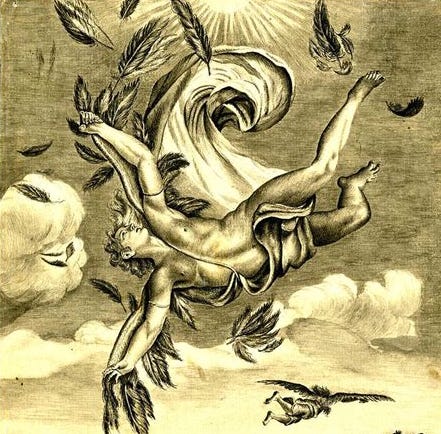
Welcome back to Gnostic Insights and to the Gnostic Reformation on Substack. First I have to tell you, what was lost has been found. I went back to White City VA yesterday and had an acupuncture treatment. And on my way out of the building, I saw a maintenance man, a custodian at his cart with his broom. I thought to myself, well, if anybody should be able to find something, it would be this guy. I told him I lost a book two weeks ago, somewhere between 201 and 209 in a lady’s room on a windowsill. And he says, “Well, what was the name of the book?” And I said, “Culpability.” And indeed, the recognition went across his face. He said, “I have seen that book. I have dusted that book every day for two weeks.” And I said, “Why didn’t you turn it into lost and found?” He goes, “Well, it’s not my book. It belongs to somebody. So I just left it there.” So then we had to look for the restroom that he had found it in, because he cleans a lot of ladies rooms in that big span of buildings. I told him it was on the second floor, that it was somewhere between 201 and on my way to the chiropractor in building 209. And so we went upstairs together and he took me right to the bathroom. And there was the book where I had laid it down. I was absolutely overjoyed. I thanked him profusely for his assistance. And I asked him if I could give him a hug. And he said, yeah, sure. So I gave him a big hug and it was wonderful. It was just wonderful. We went back downstairs together. I proceeded out the door and he proceeded with his cart down the hall. I was ecstatic. I should mention that his name was Lester. That way we can all give a blessing for Lester. Thank you, Lester! ***************************** Now, the past couple of weeks, we’ve talked about this Gnostic Reformation here at Gnostic Insights. My Gnosticism that I’m sharing with you is not different than classical Gnosticism, but it is a further refinement. It’s a proceeding onward. We don’t go back into history. We go forward into the future. Today, we’re going to talk about the Demiurge and how this view of the Demiurge that I have is slightly different than the view that a lot of people have. See, most people think of the Demiurge as malicious, as an evil being. And when I first was studying Gnosticism, I was pretty much along those lines as well. I thought that the Demiurge was a very bad guy. But over the past few years, I’ve come to see that the Demiurge isn’t a bad guy. That he’s doing his best. He is the, as I like to say, he is the god of this world. So he’s done a pretty darn good job. He’s done better than you and I could do building a world. But how did he do that? Why is he thought to be malicious? I mean, I often speak of him—and again, I say him, but it’s really an it. Because first off, let’s remember, the Demiurge is not a stand-alone entity. The Demiurge is the separated ego or identity—the presenting face of the Aeon known as Logos, the Aeon who fell. And when Logos fell because he overreached, his ego overreached and thought it could become plugged back into the Father the way the Son is plugged into the Father. Logos mistook himself for the Son, you could say. You could also say he mistook himself for the Fullness. Because there he is sitting right there at the very tippy top of the hierarchy of the Fullness of God–the very top. He was the final Aeon to be produced by the commingling of all of the Aeons giving glory to the Father and the Son. So Logos was sitting way up there at the tippy top. He didn’t have any neighbors to his left and right because he was the capstone. He didn’t have anybody over above him other than the Father. And the rest of the Pleroma was down there beneath him because he’s sitting as a capstone on the hierarchy of the Fullness of God, which looks like a pyramid. So I think that Logos simply mistook himself for the Son or mistook that he could go ahead and plug in to the Father. He’s right there. He’s so close. You know, we have echoes of that same Fall in the story of the Tower of Babel where the humans built this incredibly tall tower reaching to the heavens, reaching to God. And God, [and in this case it was probably Jehovah, probably the Demiurge because we’re downstream here in the cosmos], thought that was not a good idea. And so he cast them into confusion by a proliferation of languages that they couldn’t understand each other and they stopped building and the tower fell. Italian humanist manuscript late 15th century It’s also the story of Icarus where he made wings and he flew too close to the sun, S-U-N in that case. And when he flew too close to the sun, it melted the wax that was holding his wings together and Icarus fell. These are other examples of falling. 18th century engraving by Bernard Picart So in this case with Logos, Logos wanted to go up to the Father with his Pleroma, which was perfect because the Pleroma of Logos is a fractal of the Fullness of God. It’s a fractal copy of the entire hierarchy. Logos had within its Pleroma a fractal, one level down, of all of the other Aeons. He had a full and complete Pleroma. He had the entire plans. He knew everything to put together paradise, to put together the cosmos. But that wasn’t his job and so he overreached. His ego got out of control and it was his ego that impelled him to overreach, which caused the Fall. The Father couldn’t allow Logos to plug back into him because, well, that space is taken by the Son. But not only that, the Father is too immense, is too illimitable, is too powerful for a lowly Aeon to be able to plug directly in. No one can control that much power. No one can hold that much energy except the Son. So Logos was repelled by the Father to save him from becoming cinders in the light of his immensity. And he fell and he broke apart down here outside of the Pleroma of the Fullness. And it was his broken bits that became the quantum foam of this cosmos. Logos couldn’t get it back together. He couldn’t stuff it all back in. He couldn’t contain the chaos that erupted from him once his ego took over. And I hope, as I talk about the Demiurge, that you can hear the parallels to our egos when our own egos get out of control. That’s when all hell breaks loose. The Aeons were designed to stay in the glory beam of the Father and the Son. They each had their position, place, duty, name in the hierarchy. And Logos overreached his position, place, duty, name. His ego took over. That’s why he fell. And then it was nothing but ego down here. The best part of Logos, it says in the Tripartite Tractate, was horrified. And it abandoned the chaos below and returned to the Aeons in the Fullness. But he was broken. He left half of himself behind. So let’s look at this Demiurge that was left behind. The Demiurge is not a character that stands alone. The Demiurge is the shadow of the Fallen Aeon. The Demiurge is the shadow of Logos. Because when his ego took over and separated, all that was left was the shadows. So the Pleroma of the Demiurge is a shadow of the Pleroma of Logos. We know that the Pleroma of Logos is a fractal level down from the hierarchy of the Fullness. What does it mean to be the shadow of that Pleroma? That’s what makes up the body and energy of the Demiurge. So there’s two questions that Gnostics have often wrestled with over the years, particularly the Sethians and then the Platonists in the Greek strain of thought. And these were the questions. How can the Demiurge be ignorant without being evil? And how can the cosmos be orderly yet spiritually deficient? This is answered by thinking of the Demiurge as the shadow of the Fallen Aeon. This means that the Demiurge is not malicious; he’s not autonomous either. He is not the source of being. The Demiurge is a distorted reflection of the higher principle that was Logos. When we think of the Demiurge this way, we can preserve the goodness of the Father and the integrity of t… This is a public episode. If you'd like to discuss this with other subscribers or get access to bonus episodes, visit cydropp.substack.com/subscribe
Embed this episode
No transcript yet.