Regreening the Sinai: Interview with Ties Van der Hoeven
from Climate Water Project Hosted by Alpha Lo
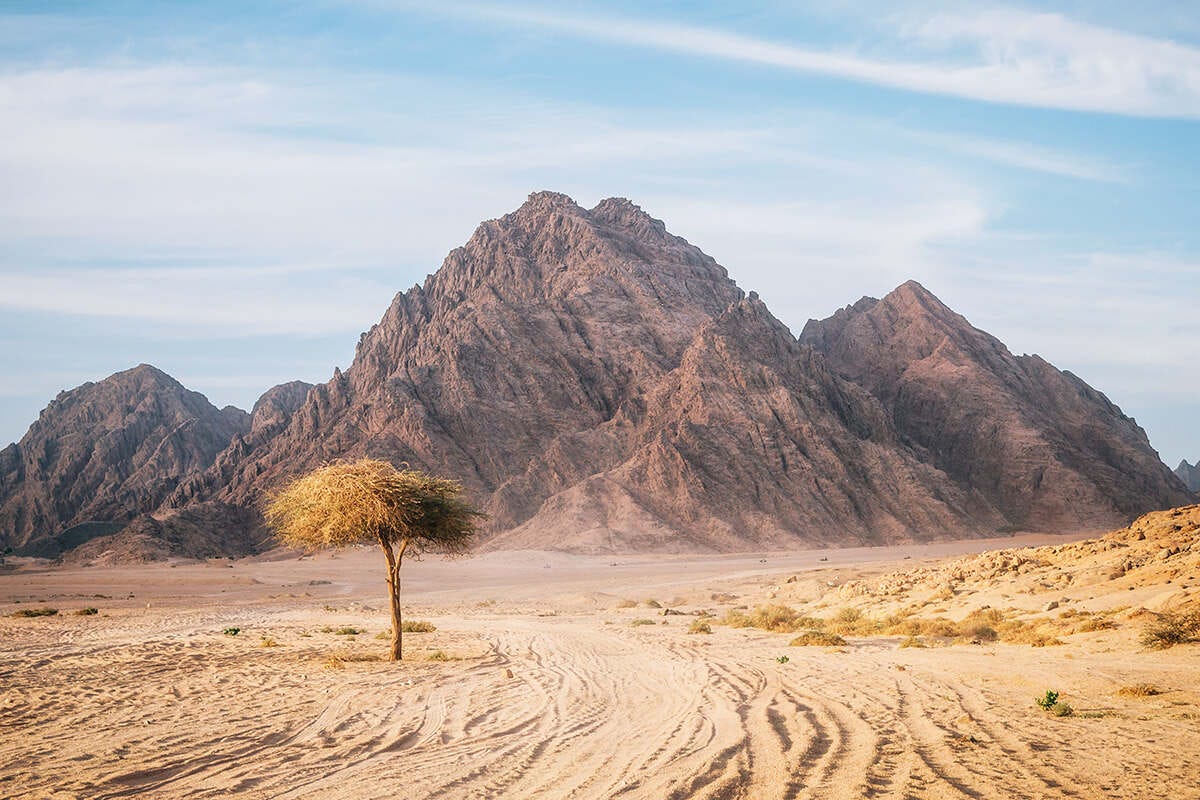
Having been admiring their regreening project from afar for awhile, I was honored when I got the chance to interview Ties Van De Hoeven for this podcast, and learn about the whole array of techniques they would use for such a vast restoration undertaking. (The timestamps are available at end of this post). I wrote an essay about the project : Regreening the Sinai The Sinai is a vast, wedge-shaped, tract of desert in northwest Egypt, sandwiched between the Mediterraen Sea and the Red Sea. A third the size of Florida, it is a land of bleached yellow sand, vast rolling dunes, and ochre cliffs. Vipers and lizards roam. The rugged landscape is made of granite and metamorphic rocks, limestone and sandstone chiseled by the wind. Vegetation is sparse. Scattered sparingly through the landscape are red-berried hawthorn trees, purple flowered thornbushes, fury green mirr higher in the landscape, and the prickly zilla lining the dry, ancient riverbeds that once carried water through the lush landscape. Less than 2 inches of rain fall down from the sky in a year. Half of that usually comes in one convective storm that brings with it mudslides and landslides crashing through the landscape. This is the land that Ties Van der Hoeven and his team is working ambitiously to regreen. It started as a smaller project when Ties was invited to use his dredging skills to help rehabilitate Lake Bardawil, located in the northern Sinai, adjacent to the Mediterranean Sea. The project then morphed into a larger enterprise to regreen the Sinai, and bring rain back to the region. It is a lake-restoration dredging project that became a land-restoration ecology project that became a regional climate restoration project. “Weathermakers”, Ties calls his team. [my interview with Ties van der Hoeven in video form] Early on, Ties Van der Hoeven connected with John Liu, a videographer turned eco-ringleader, who had documented the ecorestoration of the vast Loess Plain desert in China, and founded the network of Ecosystem Restoration Camps. John connected Ties with what he refers to as his team of Jedis, a team which includes people like John Todd, the ecologist who pioneered the use of emergent communities of microbes and plants to heal ecosystems, and Millan Millan, a hydroclimatologist who helped us understand how vegetation creates rain. Working together, the code for how to regenerate the desert began to emerge. It involved jumpstarting things just enough that nature could then take over. It entailed understanding how to get numerous feedback loops going - that between soil and microbes, between fish and plants, between carbon decomposers and carbon composers, between ecology and geomorphology, and between vegetation and climate. It involved setting in motion nutrient pathways and ecosystem self-regulation. Human technology would be used not to further separate man and nature, but instead to catalyse ecorestoration. Lake Bardawil is a 19 mile long saline lagoon, separated by a three meter sand-bar from the Mediterranean, and shaped like a triangle with a fish tail. The lake contains a memory of what happened long ago. Stored in its sediment, preserved by salt, and layered over by sand, were the complex carbon chains of long dead vegetation and animals that once dotted the lush Sinai. The lake, once twenty to forty meters deep, was now just 1.3 meters deep on average. This lake history holds the seeds of regenesis. Ties’s team first step is to reawaken the slumbered sediment. Geomorphology will activate ecology. Opening inlets and creating tidal gullies will allow the water from the Mediterranean, cooler and less salty, to come in to stir up the sediment, so that the sediment can once again enter into the carbon cycle arena. Here microbes, algae, diatoms will feed on it, pooping out nutrient material. Some of the sediment will escape through the inlet and attract fish towards the lake. Tides will bring some of the lake waters onto the mudflats where microbes can break down the sediment into soil. Saltmarshes will enlarge, and attract more birds. Over time food webs will grow in the lake - seagrass, bacterioplankton, zooplankton, miobenthos, mussels, crabs, bass and mullet - more biomass and more material that can become soil. The next stage in the project is to regenerate the land, to figure out how to grow vegetation on the sandy land with little or no rain. “Water begets water, soil is the womb, vegetation is the midwife” is the aphorism that Millan Millan expounds. Soil is the womb that absorbs water and grows the vegetation. Vegetation is the midwife that facilitates in the rain. When there is enough water in a system, it will attract more water. A decent proportion of the two and a half billon cubic meters of lake sediment from Lake Bardawil will be dredged up to use as soil in the Sinai peninsula. The plan is transform the salty sediment into nutrient-rich soil. The sediment will be laid out in shade-covered fields, where a serial progession of halophytes (salt tolerant plants) - grasses, potatoes, and then salt-friendly trees, will grow in them to help transform the sediment. They will also use a multitude of transparent geodesic domes, each containing a variety of tanks. In them, they will set up aquaponic systems, where microbial communities will grow, and where fish will eat plants, and plants will feed off the fish poop in a feedback loop that creates more nutrients. These nutrients are then used to enrich the sediment. The fish are delivered to enrich the local economy. And each day the saltwater in the tanks will evaporate, and then condense on the geodesic roof to form indoor rain which irrigates the soil. The nutrient rich soil and plants will be transported up to key places in the Sinai landscape where winds bring more water vapor. Fog nets will initally be set up to help with irrigation. As the plants and trees grow, multiply, and spread, there will be a point when the nascent ecosystem evolves to cross a critical point, a meteorological threshhold. Then something rather extraordinary will happen. From the wild sky, precious rain will begin to appear more frequently. The is because the relationship between vegetation and weather is reciprocal. It is not a one way causal relationship. Rain grows vegetation. And vegetation can also grow rain. Not only does climate affect biology. But biology affects climate. The hydroclimatologist Millan Millan figured out this causal logic while researching why rain loss was happening in Spain. Chopping down Spanish vegetation was decreasing the evapotranspiration, and that evapotranspiration was both needed to add to the ocean water vapor to create sufficient humidity for rain, and needed to cool the atmosphere so that the dew point for water vapor condensation was lower. [ref 1] In the Sinai, a continental divide like Spain, thermals rising from the desert create a low pressure system which sucks in the air from the Mediterranean Sea. The winds gain velocity, sweep across the dunes, ascend over southern Mount Catharina, and then rush out into the Red Sea. The water vapor the wind carries, usually has nary a chance to drop onto the hot, parched land. As Millan Millan studied the meteorological situation in the Sinai he concluded that when the vegetation became abundant enough, they would evapotranspire enough water vapor to add to the sea wind moisture, to be able to create rain. The cooling effect of the evaporotranspiration would also help slow the water vapor molecules, increasing their chances of nucleating into rain. Tree create turbulent friction in atmosphere that can decrease wind speed enough for water vapor molecules to find each other. The formation of the rain would help the winds to slow down, and the winds would even turn downward and flow back to where it came from. The rain would infiltrate into the soil, and then be ready to evapotranspire back up to help create the small water cycle. Once this biology-rain feedback loop is acti… This is a public episode. If you'd like to discuss this with other subscribers or get access to bonus episodes, visit climatewaterproject.substack.com/subscribe
Embed this episode
No transcript yet.