
EPISODE · Apr 19, 2023 · 1H 23M
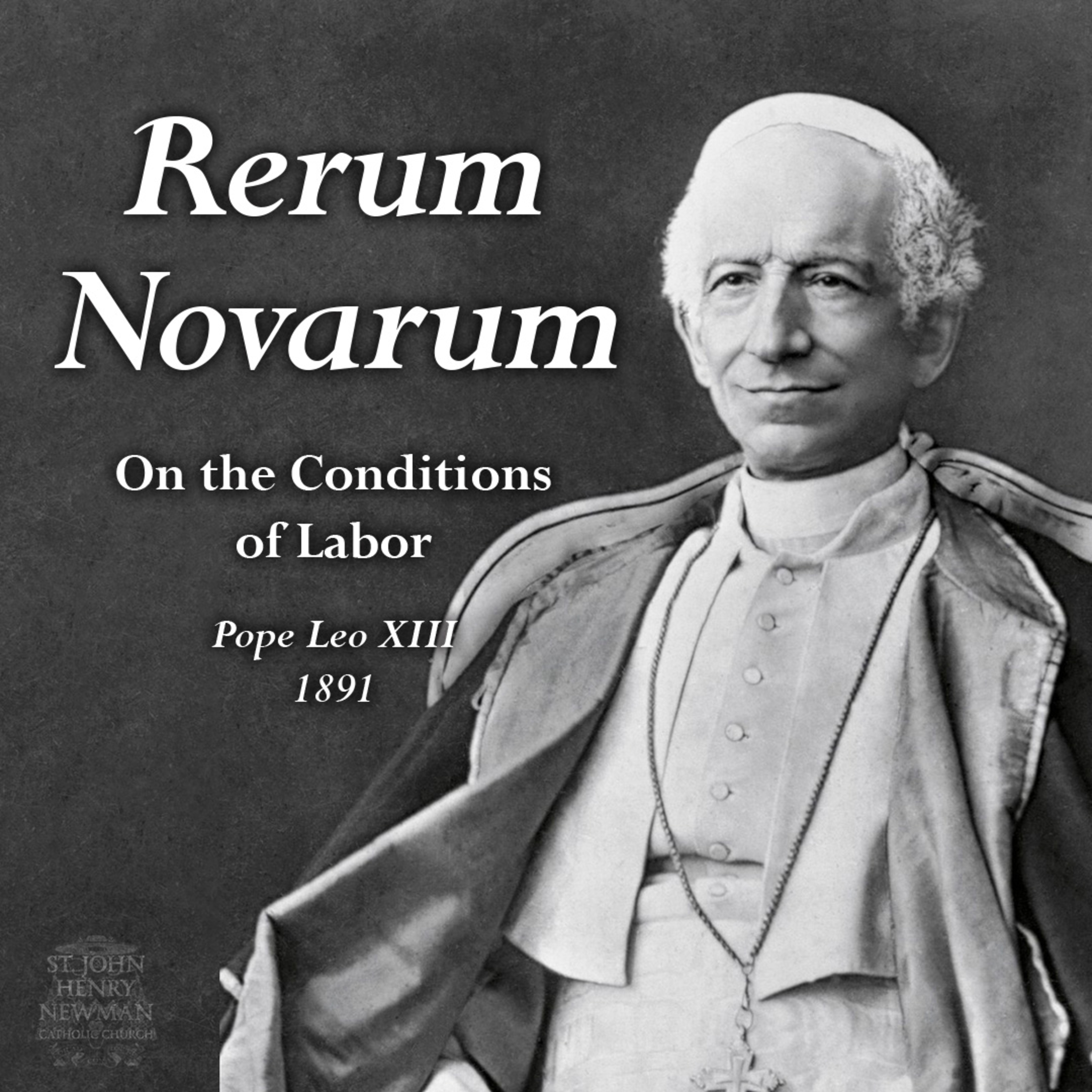
Rerum Novarum (On Capital and Labor) by Pope Leo XIII (1891)
from Theology on Tap - Orange County · host Theology on Tap - Orange County
Here are some notable quotations from Pope Leo XIII's encyclical: "The contention, then, that the civil government should at its option intrude into and exercise intimate control over the family and the household is a great and pernicious error. True, if a family finds itself in exceeding distress, utterly deprived of the counsel of friends, and without any prospect of extricating itself, it is right that extreme necessity be met by public aid, since each family is a part of the commonwealth." (par. 14) "The first and most fundamental principle, therefore, if one would undertake to alleviate the condition of the masses, must be the inviolability of private property." (par. 15) "[F]or no practical solution of this question will be found apart from the intervention of religion and of the Church." (par. 16) "If any there are who pretend differently - who hold out to a hard-pressed people the boon of freedom from pain and trouble, an undisturbed repose, and constant enjoyment - they delude the people and impose upon them, and their lying promises will only one day bring forth evils worse than the present. Nothing is more useful than to look upon the world as it really is, and at the same time to seek elsewhere, as We have said, for the solace to its troubles." (par. 18) "[I]t is more easy to understand that the true worth and nobility of man lie in his moral qualities, that is, in virtue; that virtue is, moreover, the common inheritance of men, equally within the reach of high and low, rich and poor; and that virtue, and virtue alone, wherever found, will be followed by the rewards of everlasting happiness." (par. 24) "No matter what changes may occur in forms of government, there will ever be differences and inequalities of condition in the State. Society cannot exist or be conceived of without them. Some there must be who devote themselves to the work of the commonwealth, who make the laws or administer justice, or whose advice and authority govern the nation in times of peace, and defend it in war." (par.34) "[N]o man has in this matter power over himself. To consent to any treatment which is calculated to defeat the end and purpose of his being is beyond his right; he cannot give up his soul to servitude, for it is not man's own rights which are here in question, but the rights of God, the most sacred and inviolable of rights." (par. 40) "Women, again, are not suited for certain occupations; a woman is by nature fitted for home-work, and it is that which is best adapted at once to preserve her modesty and to promote the good bringing up of children and the well-being of the family." (par. 42) "We have seen that this great labor question cannot be solved save by assuming as a principle that private ownership must be held sacred and inviolable. The law, therefore, should favor ownership, and its policy should be to induce as many as possible of the people to become owners." (par.46) "But every precaution should be taken not to violate the rights of individuals and not to impose unreasonable regulations under pretense of public benefit. For laws only bind when they are in accordance with right reason, and, hence, with the eternal law of God." (par. 52) "To sum up, then, We may lay it down as a general and lasting law that working men's associations should be so organized and governed as to furnish the best and most suitable means for attaining what is aimed at, that is to say, for helping each individual member to better his condition to the utmost in body, soul, and property." (par. 57) "[A]nd since religion alone... can avail to destroy the evil at its root, all men should rest persuaded that main thing needful is to re-establish Christian morals, apart from which all the plans and devices of the wisest will prove of little avail." (par. 62)
Embed this episode
NOW PLAYING
Rerum Novarum (On Capital and Labor) by Pope Leo XIII (1891)
No transcript for this episode yet
Similar Episodes
No similar episodes found.
Similar Podcasts
No similar podcasts found.