Resolving Somalia's electoral confusion
from Somali Waa kuma Podcast Hosted by MI
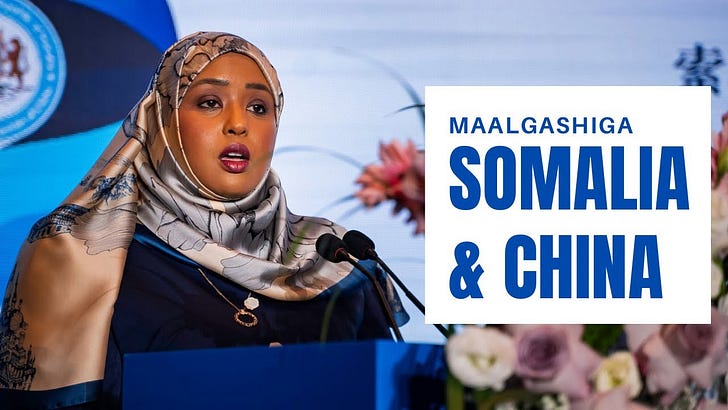
Week 51 of MI’s 5 Minutes of Fame opens with a note of commendation, before getting into the complex terrain of Somali politics and elections. It is important to acknowledge the exemplary work of Somalia’s Ambassador to China in advancing diplomatic engagement and deepening economic cooperation between Mogadishu and Beijing. Through sustained dialogue, institutional outreach, and strategic visibility, the Embassy has contributed meaningfully to repositioning Somalia as a credible partner within China’s foreign policy and commercial ecosystem. At a time when Somalia’s international standing demands consistency and professionalism, such diplomacy merits recognition both as a practical achievement and as a reminder of what disciplined statecraft can deliver when it is pursued with seriousness and purpose. As noted in the introductory video accompanying this Substack post, I am sharing the full recording here for readers who wish to view it in its entirety: Beyond its immediate content, the video also illustrates the value of proactive public diplomacy - communicating clearly and making diplomatic engagement visible to citizens and partners alike. It is my hope that other Somali missions will adopt similarly transparent and outward-facing practices, strengthening coherence across Somalia’s external representation and reinforcing public trust in the state’s diplomatic efforts. From a broader policy perspective, I would welcome a recalibration of Somalia’s foreign affairs outlook toward progressive, pragmatic, and fast-developing economies such as China and South Korea, alongside wider engagement with Asia-Pacific partners. Such a shift would reflect a forward-looking diplomacy grounded in economic transformation, technological learning, and development-oriented cooperation, rather than an exclusive reliance on traditional or legacy alignments. Sabotaging Progress Shifting from the international arena to the domestic sphere, Somalia’s internal political dynamics reveal sharper tensions and contradictions during the electoral process. From a critical governance perspective, the conduct of two Somali federal states has been distinctly unhelpful, adding further ambiguity to an already fragile and confusing electoral process. Rather than contributing constructively to institutional consolidation, their actions have deepened fragmentation, weakened coordination, and undermined public confidence in the credibility of elections at a pivotal moment for the state. By contrast, and notwithstanding its well-documented shortcomings, the current Somalia Federal Government made a serious, if politically costly, effort to advance the principle of one person, one vote as a pathway toward restoring electoral legitimacy and citizen ownership of the political process. This initiative represented a necessary, if incomplete, departure from elite-mediated arrangements that have long distorted representation. All federal member states should have aligned behind this reform agenda. Sustained resistance not only delays democratic normalization but also entrenches the very opacity and elite bargaining that continue to weaken Somalia’s state-building project. Unacceptable Aid leakages exposed Turning from politics to political economy, many Somalis are disappointed with the recent article by the Governor of the Central Bank of Somalia in The Banker, which documents how tens of millions of US dollars in development and humanitarian aid are lost annually through correspondent banking costs, intermediary channels, delays, and compliance-driven rerouting. As the Governor argues, this form of financial leakage is not merely technical inefficiency but a structural injustice. For a low-income, post-conflict country like Somalia, where every dollar of aid could translate into schools, clinics, salaries, or basic infrastructure such losses are indefensible and demand urgent reform of cross-border payment arrangements and international financial practices. As I have already underscored in the introductory video, this issue deserves far greater analytical and public attention than it has so far received. The scale of financial leakage through correspondent banking constraints is not a technical inconvenience but a structural drain on a fragile economy that depends on every dollar of external support. I therefore intend to dedicate a detailed, stand-alone note to this subject in the near future, examining the institutional causes, quantifying the opportunity costs, and outlining policy pathways to safeguard aid flows and national resources more effectively. Diaspora Resilience Tested Somalis in the United States and increasingly in other host societies are navigating a period of heightened social and political strain. It is important to state clearly, and without defensiveness, that the Somali diaspora is overwhelmingly hardworking, law-abiding, and civically engaged, contributing meaningfully to local economies and social life. As with any community, however, a very small minority may fall short of these standards; such cases should neither define the whole nor obscure the broader record of diligence and aspiration. Addressing these challenges constructively calls for renewed leadership within the community: sustained awareness-raising, a stronger emphasis on education and skills development, and a clear articulation of the value of productivity, lawful conduct, and civic participation. By reinforcing these norms, community leaders can help ensure that moments of difficulty become opportunities for reaffirming shared values and strengthening integration, citizenship, and mutual trust in the societies Somalis call home. Scholarly Contributions in Progress Finally, on a more forward-looking note, I am pleased to share that my colleagues Ahmed Nur in Melbourne, Hussein Mohamed in the UK and I are about to publish on two complementary book projects on Somalia, focusing respectively on finance and diplomacy. These works are conceived as rigorous yet accessible contributions to Somali scholarship, grounded in empirical analysis and historical reflection. Our hope is that they will not only enrich the existing academic literature, but also inform policymakers, practitioners, and the wider public about critical dimensions of Somalia’s political economy and external relations, fostering more informed debate and understanding beyond specialist circles. See this. Looking Back, Looking Forward In closing, I invite readers to engage with the forthcoming special note examining the Somali Central Bank Governor’s remarks on the loss of millions of dollars through correspondent banking constraints and intermediary channels—an issue with profound implications for fiscal sovereignty, aid effectiveness, and national development. This deeper reflection aims to move beyond diagnosis toward informed public debate on remedies and reform. As this series draws toward its conclusion, I also encourage readers to stay tuned for the final edition of MI’s 5 Minutes of Fame, framed around the theme looking back, looking forward, a reflective assessment of 2025 and a forward-facing outlook toward 2026. It is an opportunity to take stock of lessons learned, acknowledge progress where it has occurred, and outline priorities for a more accountable, resilient, and future-oriented Somali state. Comments and feedback as always welcome. This is a public episode. If you would like to discuss this with other subscribers or get access to bonus episodes, visit somalia.substack.com
Embed this episode
No transcript yet.