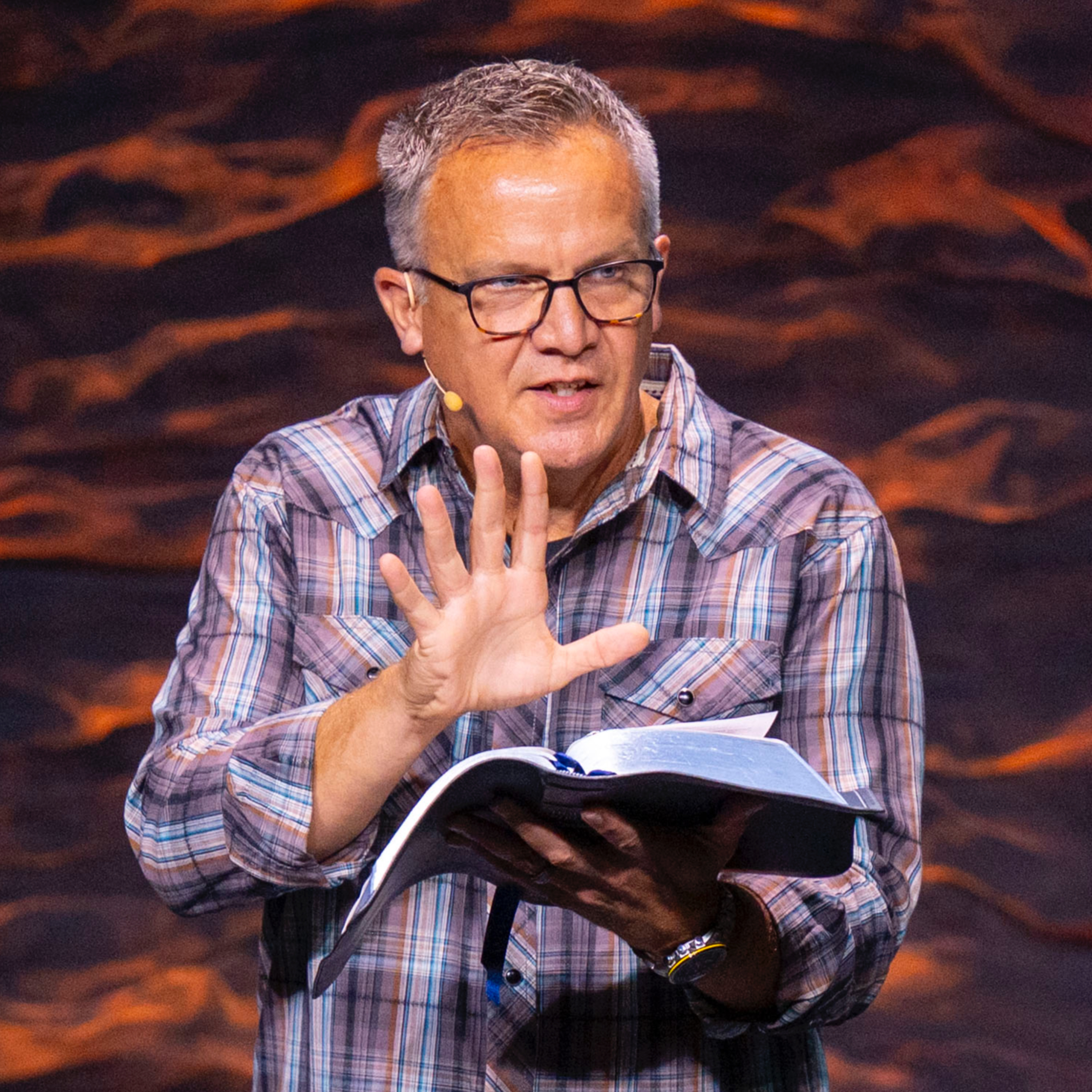
Good morning, Tabernacle. Thank you for being with us today. My name is John, I'm one of the pastors, and we want to welcome those who are tuning in in Manistee and also in Cadillac and online, and want to say, if you're new here, we're so glad that you're here. I would love to meet you. I will probably meet you at least six times for the first time.
It's my fault. It's not yours, right? So I'm in the coaching world again, and I was watching the middle school game happening, and there was this one player that looked pretty familiar to me. And I was talking to some guys, hey, what's that kid's name? And man, he looks so familiar to me. He's probably a 12-year-old kid, maybe 10. I guess middle school, he'd probably be 12 or 13, but at 55, I can't judge ages anymore.
And so I'm asking people, and all they knew was the first name. And finally, the kid's waiting to sub in the game. And I say, hey, man. I called him by his first name that someone else told me. And I said, hey, what's your last name? And he told me his last name. He's quite a good little player, right? And then he turned back around, and one of his teammates goes, who's that? And I heard the kid say, that's my pastor.
That's where I know him from. So we want you to feel welcome. If you have a Bible, would you turn with us to Acts chapter 13? We're continuing our study, our journey with the early apostles in planting the early church. And if you have the app, I'm excited. This is not just App Sunday, but if you open to the new app and you go to this week's message, which hasn't been posted yet because we're doing it right now, you can click on it and your notes are there.
Let's just give it up for Lindsay Hoflinger. Yeah, yeah, sweet, yeah. So if you forgot to pick them up, they're right there. And so I want to start with the title of this message, which is The Gospel Divides. The Gospel Divides. In its very nature, it's divisive. It doesn't aim to be. In fact, the gospel does not aim to divide, but when truth confronts darkness, when truth walks in the room, inevitably, it draws a line in the sand.
And if you've wondered why the world hates Christianity and hates the church, that's it. That's it. It doesn't aim to divide. But whenever truth confronts darkness, that's where it leaves us. And so if you're with me, either in a Bible or a flat screen, we're starting in verse 13 of Acts chapter 13, the gospel divides. It says, now Paul and his companions set sail from Paphos and came to Perga in Pamphylia. And John left them and returned to Jerusalem. But they went on from Perga and came to Antioch in Pisidia.
And on the Sabbath day, they went into the synagogue and sat down. After the reading from the law and the prophets, the rulers of the synagogue sent a message to them saying, brothers, if you have any word of encouragement for the people, say it. Now we want to pause right there because I know you love visuals. And so we've got some visuals. I brought us a map because we're talking about ancient cities and we don't all have paid attention in geography class. So here we go, right? You'll see Paphos right down there on the island of Cyprus. This is where Paul and Barnabas had been ministering. And now their party on this first missionary journey has grown to include Luke, who's writing the book of Acts, and one John Mark and possibly others. And so they sail from Paphos to Perga. Now, depending on the weather, that might've taken three days. That might've taken five days, depending on the winds. But it's an arduous journey. And when they arrive in Perga, in Pamphylia,
It's a coastal region that's very marshy, and it was known for causing people, whenever you have marshy, you have mosquitoes, it's known to be a place in the ancient world where you could get malaria, right? And so we know from other epistles, I believe it's in Ephesians, sorry, it's in Galatians, in Galatians chapter five, where Paul reminds them of when he first came there, he was ill, and it's possible that he had malaria. We don't know, it's not important to the story, except he arrived and didn't stay very long in Perga, and then the really hard part of the journey is from Perga to Antioch, but this is a different Antioch. You guys remember Antioch from a couple weeks ago? You'll notice that's to the right. That's Antioch in Syria. This is Antioch in what is present day Turkey. It's a city of about 15,000, 10 to 15,000 people. And it's at elevation. And that journey from Perga to Antioch, these missionaries were risking their very lives because it was at least a hundred miles. They did not have high-tech footwear, right? They weren't all dressed in Kuyu camo outdoor gear.
And that started a fight on Mossy Oak, on First Light, whatever. They didn't have anything from Columbia, right? They're in sandals and robes and they make this journey up to Antioch. There's a lot of cities called Antioch. That's a different historical lesson, but it was difficult. Not only that, but they risked their very lives because it was infested with bandits. So this journey is difficult. And essentially what the text has told us so far, they do what they always do, which is go to the synagogue. And after the reading from the law and the prophets, that would be the Old Testament. They go, oh, we have visitors. Paul is known because he was at the school of Gamaliel. And they're like, hey, Paul.
Do you have a word of encouragement for us, visitor? And Paul, like he does, goes, a word? Don't mind if I do. And so now we get a little picture of Paul's sermon on this Sabbath day in verse 16. So Paul stood up and motioning with his hand said, men of Israel and you who fear God, listen.
The God of this people Israel chose our fathers and made the people great during their stay in the land of Egypt. And with uplifted arm, he led them out of it. And for about 40 years, he put up with them in the wilderness. And after destroying seven nations in the land of Canaan, he gave them their land as an inheritance. All this took about 450 years. And after that, he gave them judges until Samuel the prophet.
Then they asked for a king and God gave them Saul, the son of Kish, a man of the tribe of Benjamin for 40 years. And when he had removed him, he raised up David to be their king, of whom he testified and said, I have found in David, the son of Jesse, a man after my heart who will do all my will. Of this man's offspring, God has brought to Israel a savior, Jesus, as he promised. Before his coming, John had proclaimed a baptism of repentance to all the people of Israel. And as John was finishing his course, he said, what do you suppose that I am? I am not he. No, but behold, after me, one is coming, the sandals of whose feet I am not worthy to untie.
Brothers, sons of the family of Abraham and those among you who fear God, to us has been sent the message of this salvation. For those who live in Jerusalem and their rulers, because they did not recognize him nor understand the utterances of the prophets, which are read every Sabbath, fulfilled them by condemning him. And though they found in him no guilt worthy of death, they asked Pilate to have him executed. And when they had carried out all that was written of him, they took him down from the tree and laid him in a tomb. But God raised him from the dead. And for many days, he appeared to those who had come up with him from Galilee to Jerusalem, who are now witnesses to the people.
And we bring you the good news that what God promised to the fathers, this he has fulfilled to us their children by raising Jesus as also it is written in the second Psalm. You are my son, today I've begotten you. And as for the fact that he raised him from the dead, no more to return to corruption, he has spoken in this way. I will give you the holy and sure blessings of David. Therefore, he says also in another Psalm, you will not let your holy ones see corruption.
For David, after he had served the purpose of God in his own generation, fell asleep and was laid with his fathers and saw corruption. But he whom God raised up did not see corruption. Let it be known to you, therefore, brothers, that through this man forgiveness of sins is proclaimed to you. And by him, everyone who believes is freed from everything from which you could not be freed by the law of Moses. Beware, therefore, lest what is said in the prophets should come about. Look, you scoffers, be astounded and perish, for I am doing a work in your days, a work that you will not believe, even if it one tells it to you. So that was Paul's sermon.
and I read that in about five minutes, and I know what some of you are thinking. John, you would do well to follow Paul's example. You were thinking that a little bit, weren't you? So I just want to remind you that this is a condensed version of his message. He was given the opportunity to speak, and so he stands up and speaks, and because he's in a synagogue speaking primarily to Jewish people, he takes the opportunity to basically summarize all the Old Testament, all the fulfilled prophecies, or at least some of the, he couldn't have done all of them, but some of the fulfilled prophecies pointing to how the Old Testament points to Jesus.
He started out with the fact that there are chosen people, that they'd been enslaved in Egypt, that God set them free, that they spent some time in the wilderness. I don't know if you caught that. And he says, for about 40 years, he put up with them in the wilderness. And if you know your Bible history, that's funny, right? The stiff neck, grumbling, complaining people reminds me of some people in Northern Michigan. But anyways.
And then he gave them a land. And then after that came the judges who were raised up to lead them. And then the first major prophet, Samuel. And then the people begged for a king. And first they had a not so good king who was Saul. And then there was a king after his own heart who was David. And from his line was promised a savior, a Messiah. He reminded them of the ministry of John the Baptist because some of them believe maybe John was the Messiah until he was beheaded by Herod. And he reminded them that John himself said, I'm not he, but one's coming after me of whom his sandals I'm not worthy to untie.
And then he takes them to the cross, reminding them that they were the ones, the Jewish nation who put Jesus to death, but he didn't stay dead. His body did not go to corruption. Corruption means to decay, to dust, to ashes. He was raised from the dead. And he says, we are witnesses to that. And so the whole thing is pointing out how Jesus was the Messiah. And in fact, when you get to verses 38 and 39, he goes even further. He says that it's through this man, Jesus, that forgiveness of sins is proclaimed. And by believing on him, you're freed from this law of Moses.
Right here, Paul, for some people, is picking a fight. For others, they're hearing freedom, that this is the way, and Jesus is the only way. So that's his sermon. It's condensed. Luke just gave us the highlight reel, so I'll keep going, right? So let's look at their responses. In verse 42, as they went out, the people begged that these things might be told them the next Sabbath.
And after the meeting of the synagogue broke up, many Jews and devout converts to Judaism followed Paul and Barnabas, who as they spoke with them, urged them to continue in the grace of God. The next Sabbath, almost the whole city gathered to hear the word of the Lord. That was a serious church service right there. A city of 10 to 15,000, almost the whole city. Verse 45, but when the Jews saw the crowds, they were filled with jealousy and began to contradict what was spoken by Paul, reviling him.
And Paul and Barnabas spoke out boldly saying, it was necessary that the word of God be spoken first to you, meaning the Jews. Since you thrust it aside and judge yourselves unworthy of eternal life, behold, we are turning to the Gentiles. For so the Lord has commanded us saying, I've made you a light for the Gentiles that you may bring salvation to the ends of the earth. And when the Gentiles heard this, they began rejoicing and glorifying the word of the Lord. And as many as were appointed to eternal life believed.
And the word of the Lord was spreading throughout the whole region. But the Jews, inside of the devout women of high standing and the leading men of the city, stirred up persecution against Paul and Barnabas and drove them out of their district. But they shook off the dust from their feet against them and went to Iconium. And the disciples were filled with joy and with the Holy Spirit. This is God's word. And it's interesting to me what we see as a result of the proclamation of the gospel. The truth divides. The truth walks in. Light confronts darkness. Truth confronts falsehood. And we see different responses. For some people, it's rejoicing. And they receive Jesus as their Lord and Savior. And they receive Paul and Barnabas with gladness. And they continue to meet with them. But then there's others that are filled with jealousy. And they stir up persecution. And so the end result, we don't know how long that they were there, is they're driven out of the district.
And this is what always happens. And don't read too much into the fact that it says, and Paul and Barnabas shook off the dust from that place and moved on. All that means, it doesn't mean, ah, forget you guys. We don't love you. We don't care. Now the gospel's for someone else. It's we've been faithful. And since you've judged yourselves unworthy of eternal life, that's on you.
And despite the persecution, as so many passages end with Paul and Barnabas and all the apostles, regardless of a beating or a revival, right? We say wherever Paul goes, he seems to start a riot or a revival, right? In this case, it was a little bit of both. Regardless, it says the disciples were filled with joy and with the Holy Spirit. I mean, that's almost like a refrain. They were beaten to an inch of their own life and they were filled with joy and the Holy Spirit moved on. But we do see in those responses that this gospel, it divides.
And as Christians, or even if you're here and you're not a Christian, you need to understand that that's not the aim of the gospel, but it is inevitable. The gospel draws a line in the sand because the gospel says Jesus is the only way. There's no other way. And so if you're taking notes, and I hope you are, here's the first thing that you may have missed because it divides on multiple levels. And if you go back to verse 13, it says, now Paul and his companion set sail from Paphos and came to Perga in Pamphylia and John left them and returned to Jerusalem.
Now, do you remember the map? Have you already forgotten the map? Okay, remember the map. Okay, I don't know if John, it's referring to John Mark. Remember, there's several in this party. Did he get seasick? Did he not like boats? Was he out there remembering Jonah? When they got to Perga, did he not like the marshy coastal land? Did he look ahead and hear the stories? It's about 100 miles up Antioch, and we're climbing, and we don't have proper gear and modern hiking shoes, and there's bandits. I think I want to go home.
Now, I'm not reading a ton into that passage because if you flip over to Acts chapter 15, okay, this is a spoiler alert that's what's gonna happen later on. We don't know, was it weeks, months, maybe years later? In Acts chapter 15, it gives an account of Paul and Barnabas parting ways. These super apostles who are planting churches, the first real missionaries, right? It says in verse 36, after some days, Paul said to Barnabas, let us return and visit the brothers in every city where we preach the word of God. In verse 37, it says, now Barnabas wanted to take with them John called Mark.
But Paul thought best not to take with them one who had withdrawn from them in Pamphylia and had not gone with them to the work. The ESV, which I'm preaching from here, says withdrawn. It's being kind. Other translation says, Paul thought it best not to take one who had deserted them. He had deserted them. Verse 39 says, there rose such a sharp disagreement that they separated from each other. Barnabas took Mark with him and sailed away to Cyprus, but Paul chose Silas and departed.
The note here is that the gospel divides the faithful from the fickle. The gospel divides the faithful from the fickle. Now you may think that's harsh for me to call John Mark fickle because we don't know exactly why. Maybe it wasn't because it was too hard, but maybe he was choosing comfort. Maybe it wasn't comfort that he was choosing. Maybe he needed to go back to Jerusalem and finish the book he started, which was the gospel of Mark. And so what I'm trying to point out is that even within the church, even within Christianity, the gospel can cause division. This is my calling. This is my calling. Well, I'm completely committed to my calling. You're committed to yours and there can be a fierce conflict.
But sometimes when I say that the gospel divides the faithful from the fickle, it's people follow Jesus for a while and then they realize, oh, Jesus wants to come into my marriage. Jesus impacts how I raise my kids. Jesus impacts how I spend my money. Jesus wants all of me. And it becomes too much. The cost becomes too great. And how many times did Jesus say, you must count the cost of following him? And sometimes, and this is the hardest part, this has been the hardest part of ministry for me. 24 years in a local church. You can ask anyone, those that know me best, you can ask Pastor Tim. The hardest thing on John.
has been when people that I love and I've invested in, people I may have led to Christ, even baptized, had them in a fight club, discipled, when they walk away. And it happens. It happens. I called a pastor years ago about how to deal with that. And I said, how do you guard your heart against, you know, you open your heart to someone and then they betray or you open your heart to someone and then they just say, you know what? I don't wanna follow Jesus anymore. I don't wanna be a part of church anymore. You know what? This isn't for me. And then they walk. I go, how do I guard my heart?
And this pastor, I don't think I've said this publicly before. He just says to me, he goes, John, really? You want me to tell you how to guard your heart against loving people that might hurt you? And I knew at the moment he said it. He goes, if I could tell you how to do that, you'd be a really crappy pastor now, wouldn't you? And I said, so what are you saying? He said, man, you need to buck up, little cowboy. But that's a reality.
The gospel divides the faithful from the fickle. Now there's good news with Paul and John Mark because the scripture says there was a fierce disagreement. But if you go all the way to 2 Timothy, this is years later, maybe even decades later, where he's giving final instructions to Timothy. And in verse 11 of 2 Timothy 4, he says, Luke alone is with me. Get Mark and bring him with you for he's very useful to me in ministry.
And so we do see that there's a reconciliation. But it's comforting for me that sometimes the conflict, the gospel that divides even in church can be reconciled. Jesus said in Luke chapter nine, that no one who puts his hand to the plow and looks back is fit for the kingdom of God. And so it raises the question, will you follow Jesus no matter what? Or will you walk away? When it gets hard, you know, right now it's super exciting at all of our campuses, but it's not always super exciting. February's coming. Will you walk away? When someone hurts your feelings in small group.
And this happens over and over and over again. I'm fighting the urge to be discouraged again because the events of a week and a half ago where we see a Christian, faithful follower of Jesus, a husband, a father, an apologist, a defender of the faith, who had a huge platform, who dared to talk about three things that the world does not want Christians to talk about. Our faith that Jesus is the only way. He dared to speak about what Jesus the only way has to say about gender and about marriage. And he had the audacity to say, as a Christian, this is how it plays out in the political conversation. And he did it on college campuses. And he was cut down. And I told our staff, if you want to know what the world, and when I say the world, I may not be talking about people. I'm talking about Satan, sin and death. This is what the world thinks of you. If you were unfortunate enough to see the screen or to watch the murder in public, which I was, I wish I'd never seen it. That's what Satan thinks of you. That's what the enemy wants to do to you. And that happened. And I'm watching a small division of the faithful and the fickle within the church.
Colleagues, pastor friends are afraid to say the name Charlie Kirk because they don't want to offend parts of their congregation. Or, well, I may not have agreed with his methods. He put himself out there for Jesus. The least we can do as a church is acknowledge it and be emboldened by it and not be fickle about it and say, I want to stand for truth in the same way. The gospel divides within the church the faithful from the fickle.
The second thing we see, the way the gospel divides, and this is probably my favorite part of this passage. The gospel divides faith in Jesus from faith in works. You must be half asleep. The gospel divides faith in Jesus from faith in works. Remember I said in verses 38 and 39, he says, this man, through this man, forgiveness of sins is proclaimed to you. And by him, everyone who believes in him is freed from everything from which you could not be freed from the law of Moses. He's saying, if you want to be saved, it's by grace, through faith in Jesus. There's no other way. It's not being spiritual. It's not being a good person. It's not cleaning yourself up before you let him clean you up. It's only faith in Jesus. It's always been by faith. Do we believe that church?
So that's what Paul, when they're like, hey, visiting rabbi scholar, do you have a word? Don't mind if I do. It's all about Jesus. And he makes a clear division that it's no longer through the Old Testament rules. The reason that is divisive, even in churches, there are some Christians, wrongheaded, maybe wrong motives, I don't know, but they want to say, no, you have to look like me, act like me, you got to check the boxes like me. It's about our works. It always creeps in. A works-based righteousness is inherent to human beings because we are full of pride. We don't want to depend on God. We don't want to depend on a savior. We want to depend on me. That's why even in churches, even in our church, someone will say, well, you know, if they're really believers, well, then your life will surely show it.
Or they point to the book of James, which is true. Faith without works is dead. But it's not a comparison game. Faith is what gets you saved, and that's faith alone. There's even a shirt on the swag store that proclaims it. I love it because my daughter designed it. But it's a pair of brass knuckles, right? And it proclaims the five solas of the Reformation, which is the best theology. It's grace alone, through faith alone, through Christ alone, as proclaimed by the scriptures alone, for the glory of God alone. That's how you're saved. Do I need to calm down? I think I'm a little worked up right here.
It's grace through faith in Jesus. The problem is people that love their works are hostile to this. That's why the Jews got stirred up because they didn't see how the whole Old Testament pointed to Jesus, how he was a fulfillment, how all of the Old Testament was showing them that you can never be good enough. You'll always need a blood sacrifice. Here, we'll provide the ultimate blood sacrifice, the perfect one, Jesus, the son of God. And you put faith in him. And now we don't go to church with our goats or our lambs or the bulls or the pigeons, depending on whatever your sin is. It's only through faith.
Now, I'm not trying to make this just a political commentary, but if you're wondering about the ideologies of the day, this is why woke ideology hates the church. Now watch this. Some of you will get this. Some of you have to process it. It's okay. But I think about these things. By nature, woke ideology, cancel culture, is a works-based religion. Think this way. Believe this way. Talk this way. Vote this way. And if you step out of line and claim that you have an exclusive truth, you're mean. Christians are hateful.
The church is full of bigots. Anyone ever heard that? It's a workspace righteousness. Because if you don't toe the line, you're canceled. You don't dare say that there's a biblical view of gender and God's way is the only way. Because we as sinful, pride-filled human beings, just like our first parents in the garden, we want to be God. Remember what the enemy said to our first parents. He says, no, God doesn't want you to eat it because he knows when you do, you'll be like him.
And so we want to make our own decisions. We want to be whatever we want to be. And we've been told a lie that you can be whatever you want to be. You can be whatever gender you want to be. You can have sex with whoever or whatever you want. That's what the world says. And then Jesus comes along and says, I'm the only way and my way is the only way. And do we wonder why they're hostile? That's what's at the heart of it. Jesus is the only way that offends human pride because you don't dare speak against the pluralism of the world.
That's from Paul's sermon. And then lastly, we see in the responses how the gospel divides. The gospel divides open hearts from hard hearts. Open hearts from hard hearts. In verses 42 through 49, we see all sorts of responses. Some begged for more. Many were converted and received Christ by faith. The whole city came out, but there was also jealousy. There was reviling. The Gentiles, when they heard that Paul and Barnabas were now exclusively gonna go to Gentile cities, they rejoiced. They rejoiced greatly.
But again, this persecution forced them out. It was the same message, but there were two reactions. And we can also get bent out of shape about what it says, as many as were appointed believed. And so please, in your small groups, don't divide over Calvinism versus free will. It's not an interesting debate to me. How much of this is God in charge of? How much of this are we a part of in salvation? I'm speaking in shorthand now, but God is sovereign and he is eternal, but he also gives us a free will. That means if you're a Christian, you are chosen, but you received it freely. How it works out, have fun with that.
God knew that those would be appointed to eternal life. And that was their day to believe. In John 6, verse 44, Jesus said, no one comes to me unless my father in heaven draws him first. What does that mean? God draws different people at different times. That's above my pay grade. I don't know who he's drawing and who he's not. All I know is I've proclaimed the gospel a lot. And sometimes it's to a hard heart. And sometimes it's to an open heart. And I don't know when it's hardened and when it's opened.
but God does. My job is to be faithful in doing that. That's why Paul and Barnabas could shake the dust off and say, well, we were filled with joy in the Holy Spirit. We were persecuted some, but we also planted a church. Let's go on. That should be the response of anyone who's trying to live an intentional life of ministry for Christ. Anyone who's trying to be a domino. And by the way, there's always new people here. If you don't know what dominoes are, go to the website. It's part of our culture. It's just living my life in everyday places and spaces to influence and point people to Jesus. It doesn't mean I have to lead the barista to Christ right there in that moment. I might, but I might just tip really, really, really well.
Or I might say, hey, God bless you. It's anything that I can do to be that influence. And this is the beautiful thing about that whole idea is success is measured by faithfulness. I'm not in charge of hearts because we have a choice to harden our heart or to have an open heart. And God in heaven is softening hearts and he's also opening hearts. And it's a mystery how it all works. But we see one message proclaimed and there'll be multiple reactions. It's like when you put a...
I don't know, a lump of wax and a lump of clay outside on a hot summer day. Let's not say Michigan, in South Florida, right? On a really hot day in South Florida, right? The sun will melt the wax, but the clay will be hardened. Same sun, two different reactions. But the gospel divides. Open hearts from hard hearts. Our job, just like Paul and Barnabas, is to be faithful. It's to be faithful. And not be surprised that the gospel divides.
we're not responsible for how they will react. We are responsible to be faithful. And some of us have never taken that step. At your job, they might vaguely know that you go to church, but you might imply that it's just to keep your wife happy. Well, if you believe this and you have an open heart, you have no idea if there might be a revival that's just waiting to happen in a life at your work or at your school. This is how the gospel has been proclaimed for 2,000 years by the everyday, ordinary people in everyday, ordinary spaces and places.
knowing that some people will receive it. Some people will beg for more. Some people, their lives will be changed. And for some people, it'll mean persecution for you. You know, if there's anything that I saw this week, it's a call to step up, to be more bold, to be fearless. I'm on this chain of...
pastors of large churches from all over the country. And I was so disappointed to say, oh, we chose not to say anything. Oh, we don't want to offend. We don't make any. Finally, I want you to know your pastor or one of your pastors finally had to chime in. And I said, gentlemen, I don't know if it was right or wrong. Nobody responded to me. It was crickets. And I said, if there's ever a time our churches need bold and courageous leadership, it's right now. We cannot be ruled by fear. But I'm not talking about pastors. I'm talking about you and I. Our job is to proclaim it.
Our job is to shout it. Our job, regardless of the response, shake the dust off your feet. It's not up to you. You know you're saved. He loves you. You've been faithful. Move on. Our job is to be filled with joy in the Holy Spirit. The gospel is the most exclusive, inclusive truth that's ever been proclaimed.
Is it exclusive? You betcha. Some people will say, oh, you Christians, you have an exclusive club. It's only exclusive because we say Jesus is the only way, but it's also the most inclusive because we say whosoever will may come, regardless of race, regardless of your orientation or what it has been, regardless of what you've done. He offers salvation for all who would call on his name. Will you proclaim it, regardless of the responses, or will you be ruled by fear? I wanna go to my death, even if I get shot, because this world is not our home. Would you bow your heads with me?
Father, thank you for your gospel. Thank you for Jesus. Thank you that he is the only way. Spirit, would you soften hard hearts? Spirit, would you open hearts, even now in our services, but tonight when the gospel is proclaimed in Traverse City to student athletes, as we go and we speak truth, God, I pray that by your spirit, if there's anyone here who doesn't know you, that maybe today is the day that they choose to receive your grace through faith in Christ and Christ alone. Would you help us not to be people ruled by fear, but keeping one eye,
on heaven, and one eye on our calling, that you would find us faithful for your glory and for Jesus' sake, in whose name we pray, amen.