
EPISODE · Jun 21, 2026 · 7 MIN
Right Wing Baby Boomers Destroyed America
from The Lucas Bean Show · host Lucas Bean
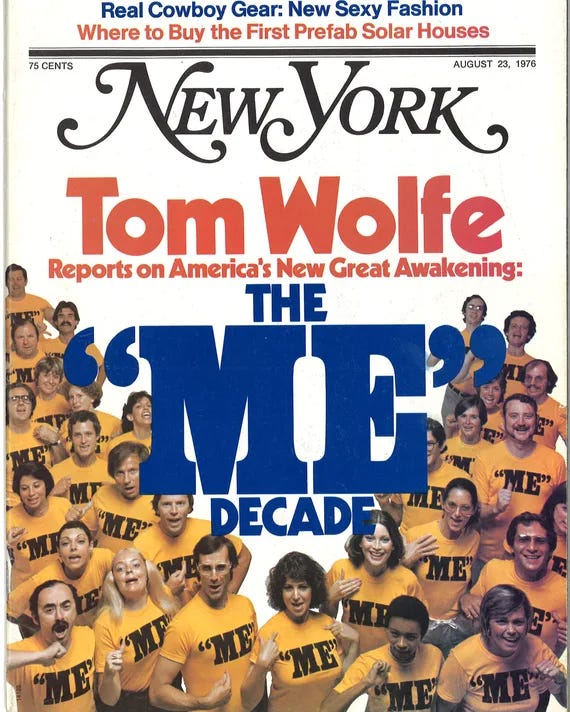
There is a research trail behind this. And it goes back fifty years.This is not about every Boomer. The greatest activists, organizers, and truth tellers of the last half century came from that generation. Many of them have spent their entire lives fighting the exact forces this piece is about.This is about a specific faction. The ones who followed a very specific psychological path. From individualism to narcissism to isolation to authoritarianism. The ones who inherited the strongest democracy in the world and are watching it collapse while arguing about their stock portfolios.That path has a name. It has researchers. It has documented mechanisms. And understanding it is the only way to understand how America ended up here.The Me DecadeIn 1976 journalist and cultural critic Tom Wolfe published an essay in New York Magazine called The Me Decade. Wolfe had been watching something shift in American culture for years. A generation that had inherited extraordinary prosperity was turning inward. Away from community. Away from obligation. Toward the self.Wolfe thought he was describing a moment.He was describing the next fifty years.For most of human history cultures were built around a single organizing principle: you owe something to the people around you. Duty to family. Duty to community. Duty to the generation that would come after you. This was not idealism. It was the practical recognition that human beings survive and thrive collectively, not individually. The infrastructure of civilization, roads, institutions, schools, social trust, does not build itself. It requires people who believe they owe something to people they will never meet.Then something changed.Psychologist Harry Triandis at the University of Illinois spent decades studying the difference between cultures built around individual fulfillment and cultures built around collective responsibility. His research produced one of the most consequential findings in modern social psychology.As individualism increases, obligation to others decreases at exactly the same rate.Triandis called this the individualism-collectivism dimension. It is the degree to which a culture prioritizes personal goals and self-fulfillment over the needs and obligations of the group. And what his research showed was not that individualism is bad in small doses. It is that past a certain threshold, individualism stops being a value and becomes an excuse. A cultural permission slip to stop showing up for anyone outside your immediate self-interest.Find yourself. Follow your dreams. Do what makes you happy.These were not just slogans. They were a cultural instruction to an entire generation. And the generation that received that instruction built a country that reflects it in every institution, every policy, and every political choice they made over the following five decades.Everyone who came after them is living in the result.The Narcissism EpidemicOnce a culture teaches people that the self is the priority it does not stop there.It teaches them that the self is everything.Psychologists Jean Twenge at San Diego State University and Keith Campbell at the University of Georgia spent years tracking narcissism scores across American generations. They were not looking for anecdotal evidence or cultural impressions. They were tracking measurable psychological data across decades of standardized assessments.What they found was not a gradual drift. It was an epidemic.Narcissism scores rose consistently and significantly across every decade from the 1970s onward. By the time Twenge and Campbell published their findings, the average American college student scored higher on narcissism measures than 65 percent of students from previous generations. The rise was not explained by age. It was generational. Something had changed in the culture that was producing measurably more narcissistic people decade after decade.Twenge and Campbell called this the narcissism epidemic.The narcissism epidemic is the measurable generational rise in self-importance, entitlement, and the need for external validation that reshaped American culture from the inside out. It did not happen in a vacuum. It was produced by specific cultural forces that rewarded self-promotion, status, and personal branding above contribution, sacrifice, or competence.The self-esteem movement told every child they were special regardless of what they did. Celebrity culture turned attention into the highest form of achievement. Personal branding turned identity into a product to be marketed. Social media turned every ordinary moment into a performance for an audience.The self became the center of everything.And a generation that made the self the center of everything produced institutions, politicians, and policies that serve the self. The tax cuts that benefited the wealthy and gutted public investment. The deregulation that enriched corporations and devastated communities. The defunding of the exact civic infrastructure that the next generation would need to inherit.Everyone else pays the bill.The Collapse of Social CapitalWhile individualism was rising, something else was quietly disappearing.Community.Sociologist Robert Putnam at Harvard University spent decades tracking civic participation across America. He was measuring something specific: the degree to which Americans showed up for each other. Joined organizations. Attended civic meetings. Participated in the informal networks of trust and reciprocity that allow communities to function.What he found was a collapse that ran parallel to the rise of individualism with almost mathematical precision.Putnam called this the decline of social capital. Social capital is the networks, norms, and trust that allow communities to function and people to act collectively on behalf of something larger than themselves. It is not abstract. It is bowling leagues and church attendance and local organizations and the simple act of knowing your neighbor’s name. It is the infrastructure of human connection that does not show up on a balance sheet but without which nothing else works.That infrastructure collapsed.Bowling leagues dissolved. Church attendance dropped. Local organizations emptied out. Neighborhood associations disappeared. An entire civic architecture that took generations to build vanished in thirty years.Not because people were forced out of it. Because they chose themselves instead. Because the culture told them that showing up for others was optional and enough of them believed it.When you stop showing up for your community your community stops existing. The right wing Boomer faction stopped showing up and called it freedom. The generation that inherited their absence is still paying for it. Not metaphorically. In the form of collapsed civic institutions, atomized communities, and the social isolation that Putnam’s research showed produces measurably worse outcomes across every dimension of human wellbeing.The Authoritarian CompensationHere is where fifty years of individualism produces its most dangerous result.People who lose community and meaning do not stay empty. The human brain is not built for sustained isolation and purposelessness. It looks for something to fill the void. And what fills it is rarely good.Psychologist and social theorist Erich Fromm at Columbia University published Escape from Freedom in 1941. He had lived through the rise of Nazism in Germany and fled to America. He was not writing theory. He was trying to understand something that had happened to an entire civilization in real time. How did one of the most educated, culturally sophisticated populations in Europe surrender its freedom to a fascist movement?His answer was not that they were forced. His answer was that they ran toward it.Fromm called this the escape from freedom. When people are stripped of community, belonging, and shared purpose they become psychologically burdened by the isolation and uncertainty that individual freedom produces. The freedom to be whoever you want is only liberating if you have the internal resources and external support to use it. Without those, freedom becomes loneliness. Loneliness becomes anxiety. And anxiety looks for relief.Authoritarian movements offer exactly that relief. They offer belonging. A tribe. A rally. A group that sees the same enemies and shares the same grievances. They offer certainty. Simple answers to complicated problems. Immigrants did it. Elites did it. The deep state did it. They offer purpose. A mission. A fight. Something worth showing up for. And they offer an enemy. Someone to blame for everything that was lost.Trump gave the right wing Boomer faction all four of those things simultaneously.They did not run toward him because they were evil. They ran toward him because fifty years of individualism had hollowed them out. Decades of being told to focus on themselves had left them with no community, no shared purpose, and no framework for meaning beyond personal consumption and resentment. Trump was the first person to hand them back a sense of belonging without asking them to sacrifice anything to get it. No contribution required. No service required. No accountability required. Just loyalty and submission and the warm satisfaction of having an enemy.Fromm wrote Escape from Freedom in 1941 watching Germany collapse into fascism.He was describing America eighty years later with a precision that should disturb everyone still paying attention.A culture obsessed with the individual does not stay individualist forever. It eventually produces a mob desperate for a leader to tell them what to do. And the leader who shows up for that mob is never the one who demands the best from them. It is always the one who tells them the problem is someone else.What This MeansTom Wolfe thought he was describing the 1970s.He was not.He was describing the next fifty years of America.The individualism that started as liberation became selfishness. The selfishness became narcissism. The narcissism destroyed community. And the destroyed community built the exact psychological conditions every authoritarian movement in history has needed to take hold and stay.This is not a coincidence. It is a sequence. Each stage produced the next with the kind of causal logic that only becomes visible in retrospect, when the damage is already done and the question is no longer how to prevent it but how to survive it.For the right wing Boomers who recognize themselves in this: the debt exists whether you acknowledge it or not. The communities you did not show up for did not rebuild themselves. The institutions you defunded did not refund themselves. The generation you handed this to did not choose it.For the rest of us: we are living in the country they built when they stopped caring about anyone but themselves.And the authoritarian they ran toward is now running the country.Watch on YouTubeSourcesTriandis, H. C. (1995). Individualism and Collectivism. Westview Press.Triandis, H. C., and Hui, C. H. (1986). Individualism-collectivism: A study of cross-cultural researchers. Journal of Cross-Cultural Psychology, 17(2), 225-248.Twenge, J. M., and Campbell, W. K. (2009). The Narcissism Epidemic: Living in the Age of Entitlement. Free Press.Twenge, J. M., Konrath, S., Foster, J. D., Campbell, W. K., and Bushman, B. J. (2008). Egos inflating over time: A cross-temporal meta-analysis of the Narcissistic Personality Inventory. Journal of Personality, 76(4), 875-902.Putnam, R. D. (2000). Bowling Alone: The Collapse and Revival of American Community. Simon and Schuster.Fromm, E. (1941). Escape from Freedom. Holt, Rinehart, and Winston.Wolfe, T. (1976). The Me Decade and the Third Great Awakening. New York Magazine, August 23, 1976. This is a public episode. If you'd like to discuss this with other subscribers or get access to bonus episodes, visit lucasbean.substack.com/subscribe
Embed this episode
Ready to play
Right Wing Baby Boomers Destroyed America
No transcript for this episode yet
Similar Episodes
No similar episodes found.
Similar Podcasts
No similar podcasts found.