ROBBERS, GIANTS, GHOSTS
from THE ANNALS OF HAROLD Hosted by HAROLD
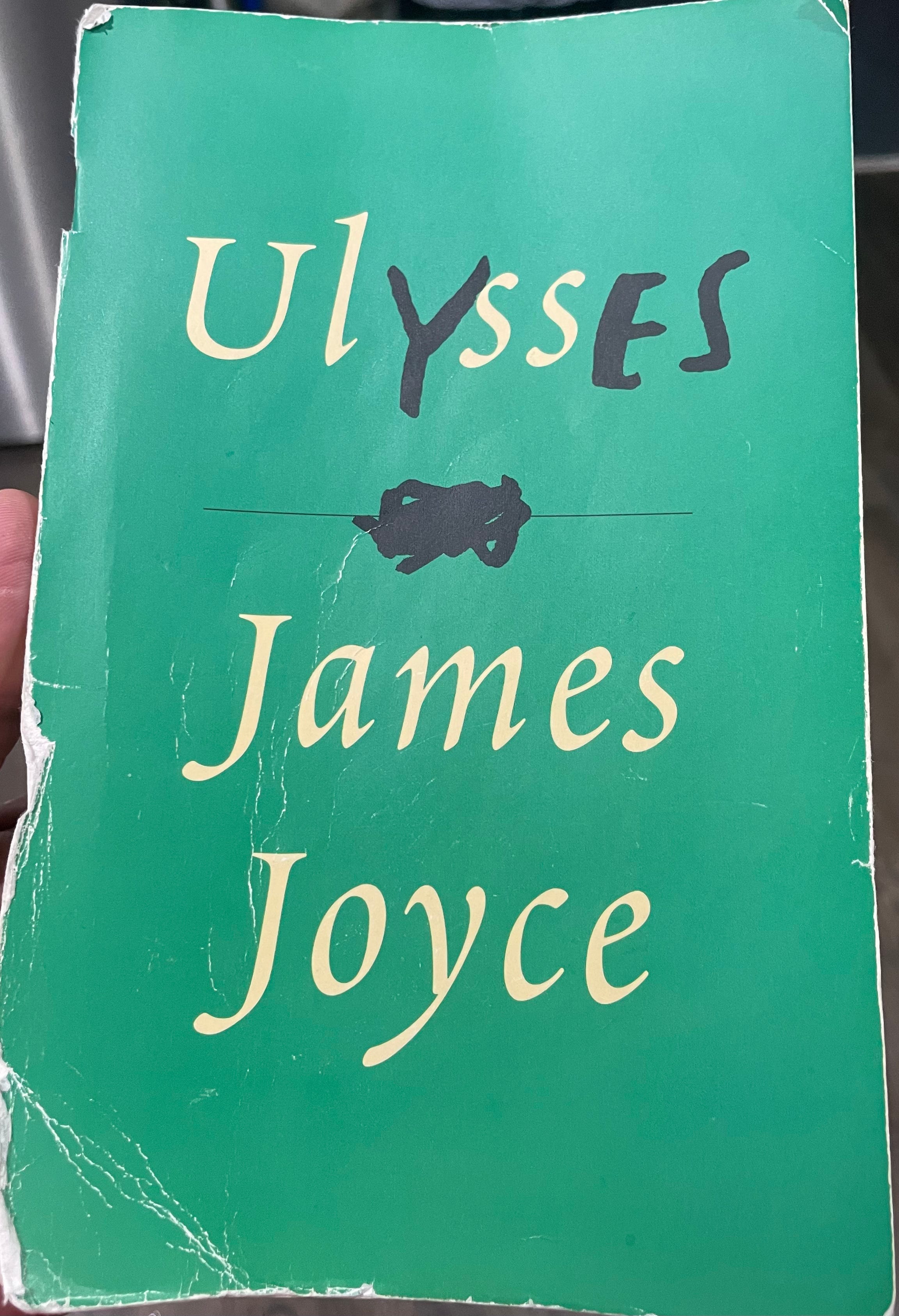
Let’s start easy. Taking our clue from the most notoriously difficult novel of the 20th century, ULYSSES (1922) by James Joyce, with its eminently comprehensible opening paragraph: Stately, plump Buck Mulligan came from the stairhead, bearing a bowl of lather on which a mirror and a razor lay crossed. A yellow dressinggown, ungirdled, was sustained gently behind him by the mild morning air. He held the bowl aloft and intoned: —Introibo ad altare Dei. The novel opens on Stephen Dedalus’s frenemy and soon-to-be-ex-roommate Buck Mulligan who is plump and stately, a rich robust relief, a goading contrapunct, of emaciated and pauperish Stephen who is deadbroke and hungry. I guess we do run into our first difficulty: the latin at the end of the passage. But those are just the first words of the latin mass. Buck is doing a fake mass as a joke. The whole opening chapter is basically boisterous Buck f*****g around with grim moody funereal Stephen. Buck’s talking about how he needs to give Stephen more clothes (brokeass Stephen is already wearing his pants) and he says he has a grey pair to toss him, and Stephen says that he can’t wear them if they are grey. And Buck goes, —He can’t wear them, Buck Mulligan told his face in the mirror. Etiquette is etiquette. He kills his mother but he can’t wear grey trousers. The reason twentytwoyearold Stephen is in such a bleak mood is because his mother is in fact dead: Buck says he killed her because while she was on her death bed, she asked Stephen to kneel down and pray with her and he refused. Though Stephen believes in the integrity of not kneeling kowtow to a God he don’t believe in, the moment haunts him, Pain, that was not yet the pain of love, fretted his heart. Silently, in a dream she had come to him after her death, her wasted body within its loose brown grave clothes giving off an odour of wax and rosewood, her breath that had bent upon him, mute, reproachful, a faint odour of wetted ashes… A bowl of white china had stood beside her deathbed holding the green sluggish bile which she had torn up from her rotting liver by fits of loud groaning vomiting. I want you to remember that line: pain, that was not yet the pain of love. Is it too early to say that Stephen is Hamlet? Ok, Stephen is Hamlet. But we won’t fixate on that now. Basically though, he is griefstricken, grieffrozen. Buck says, —The fellow I was with last night says you suffer from g.p.i… general paralysis of the insane. Like Hamlet, the immensity of death has made him incomprehensible inward inscrutable in a way that looks like insanity. Does it matter to you that Stephen Dedalus is the same age that James Joyce was on June 16, 1904, that he had lost his own mother to a sudden bout of cancer in the same way Stephen lost his, that he was out in Paris, dawdling around the library with his literary aspirations, under the guise of going to medical school (though his french was not nearly good enough to understand the technical lectures) not eating for 30 hours at a time due to emptypockets, writing harried letters home begging for money from his financially desultory family, making his mother weep so worried for her son until her and his father would scrape and scrounge a few bucks that the spendthrift Joyce would immediately blow, until the real Joyce, the fake Stephen, was yanked out of this Parisian fantasy back to Dublin to sit at his mother’s bedside while she endured a brutal illness and end and sent his convivial wastrel of a father off the pitiable deep end and plunged the robust Joyce clan (it seems like he had about 100 sisters) into ruin? Joyce gives us a very loving (love in the form of careful attention), if true-to-his-detriment, portrait of his father in this book. Stephen’s sister Dilly Dedalus is standing on the curb listening to an auctioneer sell off lovely cosy curtains she yearns for and her dad, Simon, pulls up on her, —Stand up straight for the love of the lord Jesus, Mr. Dedalus said. Are you trying to imitate your uncle John the cornetplayer, head upon shoulders? Melancholy God! Dilly shrugged her shoulders. Mr. Dedalus placed his hands on them and held them back. —Stand up straight, girl, he said. You’ll get curvature of the spine. Do you know what you look like? He let his head sink suddenly down and forward, hunching his shoulder and dropping his underjaw. —Give it up father, Dilly said. All the people are looking at you. Mr. Dedalus drew himself upright and tugged again at his moustache. —Did you get any money? Dilly asked. —Where would I get any money? Mr. Dedalus said. There is no one in Dublin who would lend me fourpence. —You got some, Dilly said, looking in his eyes. After making fun of his daughter in a scene I find extremely charming, Dilly turns it on Simon: she knows that he got some money because he’s drunk, she can tell he’s drunk, once again he drank away the family money. He’s humiliated by her recognition and snaps, You’re like the rest of them, are you? An insolent pack of little b*****s since your poor mother died… Wouldn’t care if I was stretched out stiff. He’s dead. The man upstairs is dead. Are you surprised to find a scene like this in a towering work of Difficult Modernism? I read this scene to Gaby in my effort to prove that ULYSSES is actually easy and for everybody. She found it likewise charming, but her reaction was also like, So? Can’t you just get something like this in a contemporary novel? That’s a very good point. And as Pound tells us in his ABCs of Reading, you can’t fall in love with anachronism in an old work: i.e. you can’t be impressed by a word just cause it’s old, or by a scene just cause it’s recognizable of life 100 years later. Still, this scene is exquisitely perceptive, and is Tolstoyan in its realism (Joyce adored Tolstoy). It culminates a few pages later when Stephen sees her, “Dilly’s high shoulders and shabby dress” and she’s holding a book in her hand, a French primer. Stephen told her about Paris and now she wants to learn French. —What did you buy that for? he asked. To learn French? She nodded, reddening and closing tight her lips. Show no surprise. Quite natural. —Here, Stephen said. It’s all right. Mind Maggy doesn’t pawn it on you. I suppose all my books are gone. —Some, Dilly said. We had to. She is drowning. Agenbite. Save her. Agenbite. All against us. She will drown me with her, eyes and hair. Lank coils of seaweed hair around me, my heart, my soul. Salt green death. We. Agenbite of inwit. Inwit’s agenbite. Misery! Misery! Stephen feels bad for his family, for his sisters, but he also has a calling to be a great artist, and if he’s gonna do what he’s gotta do, he can’t let Dilly drown him, and he can’t succumb to his mother’s request that he pray with her. Ok, there is a weird word in what I just quoted: Agenbite. We were easing into it, but let’s escalate a little bit now. “Agenbite of inwit” is a phrase that Stephen thinks very early on and it becomes (like many, many things) a motif thru-out the book. Basically it’s an anglosaxon word that means conscience or guilt, and it’s important to Joyce’s project because of how the meaning of the word is expressed in the word itself: inwit is obviously your inner wit, right? and the agenbite: it’s biting at you again and again. The word is what it is; as Samuel Beckett would say about Finnegans Wake (the culmination of Joyce’s project with language): Here is the savage economy of hieroglyphics. Ok, let’s pick up a thread I put down. Why read Joyce’s work autobiographically? Well, I think when you’re talking about a musty book fusting on our shelves unused, it’s good to dust it off, remind people that this book didn’t spring out of the ether a codified classic; it’s a product of a real dude who was really out here, devoting his life to writing these big goofy books, in exile from his home city nearly his entire life, married (Joyce once said facetiously that he couldn’t really admire Jesus Christ b/c he never did the hardest thing a man could do: Live … This is a public episode. If you would like to discuss this with other subscribers or get access to bonus episodes, visit haroldrogers.substack.com
Embed this episode
No transcript yet.