
The Telegraph. Rob showed her friend Aisha, CIBC Investors Edge while at the carnival. Aisha thinks gut-wrenching ups and downs should be for roller coasters, and not her investments. Now, with CIBC Investors Edge, she has all the tools to invest confidently.
Ollie Robbins, the senior civil servant sacked over the Mandelson saga, has just torn the Prime Minister's defence to shreds. He has set out how Number 10 tried to stop Mandelson being vetted at all and put constant pressure on officials to, quote, just effing approve the appointment. Also, Labour peer Maurice Glassman says Starmer must go and tells us that growing numbers of Labour backbenchers agree with him. Welcome to The Daily Te, with me, Camilla Tominey.
And me, Tim Stanley. Tim, The Daily Te is going on the road and we have a new bus driver in Ollie Robbins, who has proved so adept at reversing over the Prime Minister after he was thrown under the wheels of said bus. And we will get onto that in a minute, but we have something exciting to announce. Guess who we've got for our Monday, the 27th lineup in London?
Tell me. Reforms, Zia Youssef, Ching, James Cleverley from the Tories, Ka-ching. Rachel Reeves is right-hand man, James Murray, the Chief Secretary to the Treasury. Very good.
We're going to have some kind of three-way ding-dong. You and I are the referees. It's two Jameses and a Zia. Well, what's not to love?
I just want them to be just slinging mud in each other's directions while we look on. You, the Daily Te audience, will have a chance to ask questions if you attend the event on Monday. So make sure you get your ticket now, which can be found in the link in the episode description or on the Telegraph website. We're all over the website.
You and me are big faces. We are going to be in Cardiff on Tuesday, Warwick on Wednesday with Jacob Rees-Mogg. He's going to be taking on the students there. And then Thursday's event in Worthing is going to be fun.
It's going to be a right royal Daily Te because we're going to have Phil Dampier, who is a royal reporter extraordinaire, written a number of books, including What's in the Queen's Handbag. And let's describe her as the irrepressible Lady Colin Campbell, who is a purveyor of royal gossip. Oh, yes. She's fun.
I'm slightly worried. We may need to put that particular podcast through robust legal vetting. Yes. Speaking of which, do you see what I've just done?
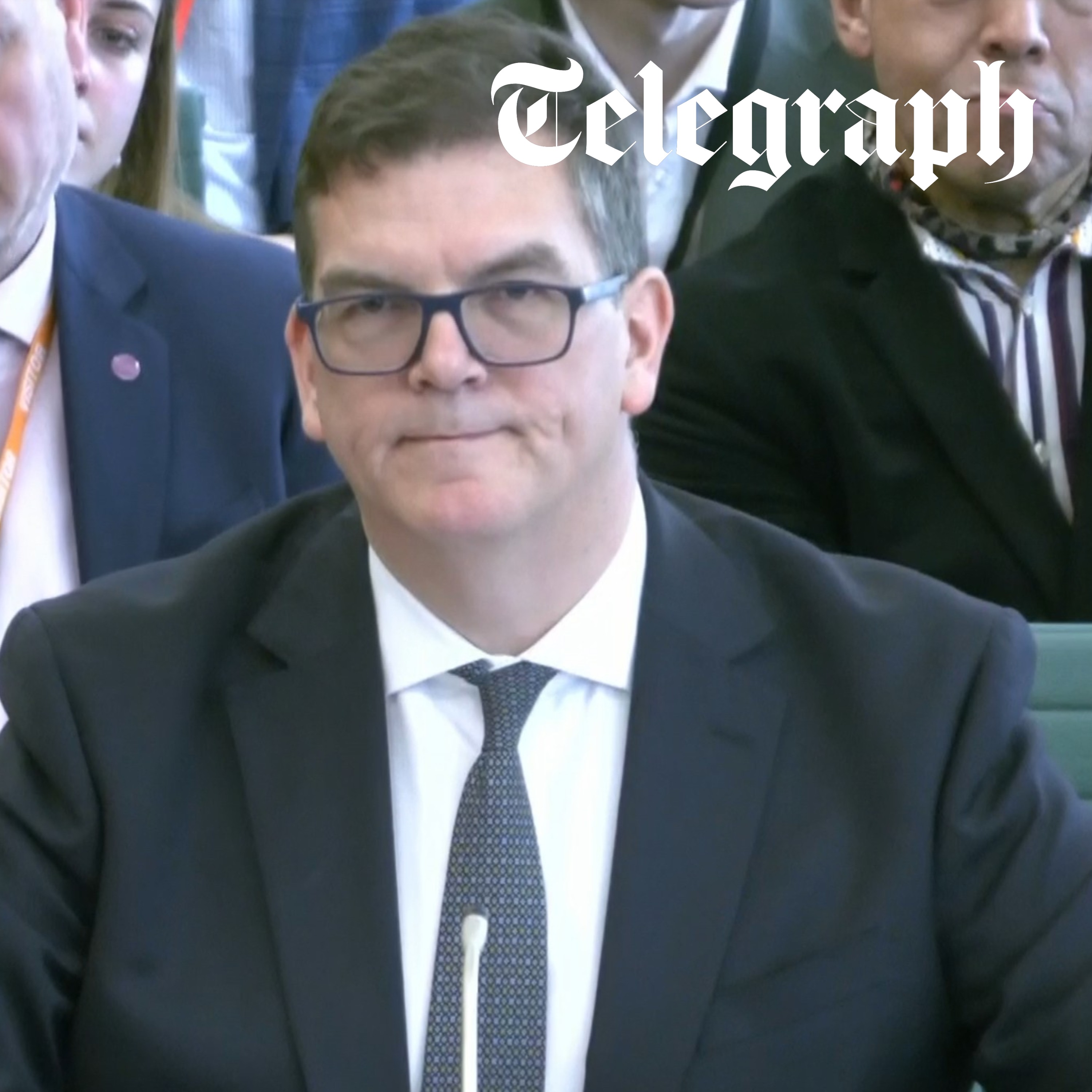
Very clever. Ollie Robbins. Yes. Faced the Foreign Affairs Committee chaired by Emily Thornberry.
Your favorite. Yes. She was amazing. Emily Thornberry brought to this exactly the right mix of authority and camp, which is what made this country great.
It was Rumpole of the Bailey meets Butlins. It was. I had said in my sketch on Monday that she had been dressed like Star Trek in the comments. But today there's a little more Games of Thrones.
She even had a brooch that indicated loyalty to some terrifying blood soaked house. And she opened by striking an almost therapeutic tone. Yes. It was as if she were saying to him, point to where on the doll Keir Starmer stabbed you.
So it wasn't inquisitorial, is my point. Her tone was kind as if she was inviting Ollie Robbins to open up and be as honest as possible. And I think that was very clever because it persuaded a civil servant to talk increasingly in personal terms, which we shall get to. And things can go very differently.
People forget that in 2016, Ollie Robbins, who's a career civil servant and has worked at the Treasury, Home Office, Foreign Office. In 2016, he was working at the Home Office and he was called before the Home Affairs Committee to talk about the budget for the Border Force. And his answers were judged to be so elliptical and poor that he was asked to leave the meeting after 20 minutes. Wow.
So what a difference. I know. Ten years make. Maybe he's had some select committee training.
Yeah, it is funny how this bete noire of Brexiteers has now become the hero. Yes. Who could be capable of bringing Starmer down. He was Theresa May's shepherd during Brexit.
And James from The Spectator joked that the mood among Tories this morning is, Can I surprise you? I like Ollie Robbins because they thought he was the man who was undermining Brexit in late 2010. He was the architect of the Chequers deal that prompted the resignations of David Davis and Boris Johnson. And we'll bring this conversation full circle with the Johnson factor in a bit later.
So he came to this committee under a lot of pressure. His reputation was under attack, too, because the implication of what Number 10 was saying and what many people intuited for several days was that the Foreign Office knew something that it didn't tell Number 10, that it deliberately withheld it. And Starmer is trying to put the blame squarely on his shoulders, which is why he had to go. And so Ollie Robbins is fighting no longer for his job.
He's lost that, but for his reputation at the end of a long career to prove that he didn't undermine the Prime Minister and responsibility for the decision lay with him. At the same time, he has that very civil service style, which I find incredibly irritating, of always talking in polite ambiguities. So the classic civil service phrase, which he used a couple of times, is, I was not privy to that conversation. Yes.
Where do they teach people to speak like this? I know, but then, I mean, career civil servant having to be diplomatic. Yes. Having served in a lot of different prime ministers.
He doesn't want to name names of his staff. He doesn't want to blame his staff. Which is in stark contrast to the Prime Minister. Stark contrast to Starmer.
We'll discuss all this and also aware that he's defending the reputation of the institution as well. Yes. And throughout this, he defended the processes, too, even though the government is saying the process is broken. I think this was a very clever example of someone starting from quite a weak hand and turning it into a positive and giving just enough of themselves, showing just enough emotion, not to come across like a train wreck, but a highly educated professional man who's telling you as much as he can to give you as clear a picture as possible of why it's not his fault.
And also a human being who has been at the centre of an absolute media storm. Yes. A couple of occasions we did see him sort of well up and he reflected on how he couldn't get a coffee without being chased down the road and the impact on his family. It says so much about the Prime Minister that he somehow managed to make a chief civil servant look human.
Yes. In comparison. Exactly. Let's go through the bombshells then, Tim.
Bombshell number one. Number 10 tried to prevent Mandelson from having any vetting at all. We did not know that before. I'm afraid I don't think at the point of his appointment and four days thereafter, it was actually a given that he would be vetted.
Again, if you look at the documents submitted under the humble address, there is no there is no stipulation from Number 10 that he should be vetted. The welcome that was sent to him immediately afterwards doesn't say welcome to the Foreign Office subject to vetting. The announcement put out on the 20th of December says that he will be out early in the new year. It does not say subject to vetting.
A position taken from the Cabinet Office was that there was no need to vet Mandelson. He was a member of the House of Lords. He was a Privy Councillor. The risks that attending his appointment were well known and had been made clear to the Prime Minister before appointment.
Bombshell number two. Number 10 didn't actually consult the Foreign and Commonwealth Development Office before the appointment. I hope that if I'd been in the system at the time those decisions were being made, firstly, I hope that Number 10 or the Cabinet Office might have wanted to consult me. I don't think at the time the Foreign Office was consulted.
And then I hope my advice would have been that's adding unnecessary to your risk, Prime Minister. Bombshell number three. And this gives us the context because the question that remains unanswered and it was unanswered by the Prime Minister yesterday when he paid tribute to Epstein's victims is why on earth, if you care about Epstein's victims, did you appoint this man in the first place? And bombshell number three explains it quite clearly that actually Number 10 were agitating for this despite the concerns that were raised.
I'm afraid I walked into a situation in which there was already a very, very strong expectation. And you will see in the papers released already under the humble address that's coming from Number 10 that he needed to be in post and in America as quickly as humanly possible. The very first formal communication of this to my predecessor from Number 10 private office being that they wanted all this done at pace and Mandelson in post before inauguration. So that's the situation I faced.
So I'm afraid what that translated into for my team in the Foreign Office and certainly the handover briefing I was getting as I arrived at post was what I felt was a generally dismissive attitude to his vetting clearance. I think throughout January, honestly, my my office, the Foreign Secretary's office were under constant pressure. There was a there was an atmosphere of constant chasing. The perspective of the civil service is supposed to be, I am not the elected person.
I am here to facilitate the elected people and what they want to do. Advise as advise, Prime Minister's decide I think it's important just to note this whole idea that no one else could do this job and the closeness of the Labour machine to Mandelson and the indication and we'll come up to probably the biggest sort of revelation in the whole of this committee in just a moment, how despite Starmer claiming to be a man of integrity and decency and trying to end the sort of chumocracy of the past, that this was also just a case of jobs for the boys. It involved a risk, and Peter Carr has said it was a risk and we knew it was a risk. So I come back to when we're wondering why then would civil servants not bang the table and say you must not appoint this person, something they're not supposed to do anyway.
Why would they not do that? Well, because they would reasonably calculate that whatever came up in vetting, the government knew about and chose to take the risk anyway. Yes. And therefore, it all comes back to the original political decision.
And this, I think, is the key point at the heart of the whole drama. What does it say about Keir Starmer's judgment that the man he picked to be ambassador to the United States failed or half failed the vetting? Yes. And by the way, what does it say that the man who failed or half failed vetting not only for his associations with Jeffrey Epstein, but also with Russia and China, what does it say about the Prime Minister that despite those red flags being waved, he then went on to conduct a charm offensive with Beijing?
Right, right. Yes, yes. But the revelation that No. 10 also put pressure on Ollie Robbins to give Matthew Doyle an ambassadorial job is absolutely staggering.
There were several discussions initiated by No. 10 with me about potentially finding a head of mission opportunity for Matthew Doyle, who was then the Prime Minister's director of communications. And I was under strict instruction not to discuss that with the then Foreign Secretary, which was uncomfortable. It reminds me, Matthew Doyle is the former director of communications for No.
10, who was later revealed to have been a close friend of a man who went on to be convicted of paedophilia. Yes. So we've got the PM. And I'm not saying there's a pattern there, because it was complicated and other people campaigned for this man too, who denied the allegations against him, and there's no evidence that Doyle remained an associate of his after his conviction, etc., etc.
Judgment, judgment, judgment, a man who was a former director of public prosecutions has now been revealed to have agitated for two friends of convicted paedophiles to get cushy jobs, one in Washington, one somewhere else. What does that say about his judgment? And second of all, why was Ollie Robbins told to keep this idea of appointing Doyle to some embassy somewhere across the world secret from the then Foreign Secretary? That again suggests this is kind of, you know, people rubbing backs and we don't want Lamy to agitate against this.
And as Robbins points out, that could have really peed off whichever diplomat was going to be replaced by this political appointee. And you wonder why there's no moral hazard or why it takes so long to fix things in the public sector, because that's basically what politics is, the public sector, where if you fail, you are rewarded by being sent to be the ambassador for Micronesia. Yes, yes. You fail upwards and outwards.
I know, but even if you fail, hang on a minute, though, but even if you fail and you're twice sacked from government, you actually get the plum ambassadorial role of all, not least in the advent of Trump 2.0, which is Washington. And newspapers by the bizarre convention of little England are still required to refer to you as Lord. Yes. I wish we would stop doing that.
Let's stop doing that. Let's just hear Robbins saying or summarising whether he regretted what has happened. I regret that this process was not done before announcement. I regret that the due diligence process, which threw up, as I understand it, serious reputational risks, didn't colour the Prime Minister's judgment in making the appointment.
There's quite a lot about this situation over the last year and a half I regret. I had no regrets about the work of my brilliant team and the judgment that we came to. Stark contrast to Starmer, who, despite running for his present job saying I would never blame things on my staff, has blamed things on countless staff. Sacked lots of ministers, sacked lots of people who work for him, from Morgan McSweeney through to Doyle, and is always very quick to find someone else responsible for what he's done.
Whereas Robbins insisting this is not about the process or the institution or the fine people who work for me. This is about me. And here I am taking, giving my account of what happened. Yes.
Do we think that cabinet loyalty is going to remain? We discussed this yesterday, how could the Prime Minister be ousted? And until this point, we hadn't really heard too much dissent from his colleagues. Ed Miliband this morning telling Sky News the following.
Prime ministers make errors. Prime ministers are fallible. Prime ministers are human. You know, as you know, I steered well clear of Peter Mandelson when I became Labour leader in 2010.
But people make mistakes. And, you know, the point about a mistake is, do you fess up to it and say, yeah, I made an error? And he's been clear on a number of occasions, including yesterday in the House of Commons. You said that you steered clear of Peter Mandelson when you were Labour leader.
What went through your mind when you saw he'd been appointed as US ambassador? Well, that it could that it could blow up, that it could go wrong. Did you say that to anyone? I had a conversation with David Lammy about it before the appointment.
And I said I was worried about it. I do want to say one thing, though, which is what did David Lammy say then? Well, I think he was worried about it, too. Look, look, I think I think I do want to say one thing.
Sure, sure. But of course, and look, a judgment was made. But I just want to say one thing about this, which is Peter Mandelson was a very familiar figure in the sort of 30 year history of the Labour Party. And it's almost like that familiarity kind of meant that people sort of, it's almost like his, his flaws and so on just got almost sort of faded into the background.
And that was obviously wrong. So we now have this little like just trickling up to the surface of Miliband saying, well, I advised against it. And I think now Lammy coming forward saying, well, he had concerns, although, of course, publicly, he decreed this to be a great appointment. So I think Lammy's on slightly tricky ground, but whatever.
I'm not sure whether the likes of very upstanding Bridget Phillipson is going to be able to hold her tongue. I was born on a council estate. I've improved my lot. I don't like jobs for the boys, sort of boys club Downing streets.
You know, Angela Rayner's out on the campaign trail yesterday. How long is it going to be before we start getting little kind of tones of discontent? Well, the official Labour line is that this isn't coming up on the doorstep, that this is a Westminster obsession. What?
Plus, they are saying that this is about the failure of officials and process. And it's exactly the sort of thing Labour was elected to fix. The mood in Parliament on Monday. I can't speak to Tuesday because I haven't been in, was that this was embarrassing for the Prime Minister, but not the reason for him to go.
That really nothing substantially new had come out of it that moves the scandal further down the road of pushing the Prime Minister out. That may change with Ollie Robbins, because it once again makes the Prime Minister's story that I wasn't told look unfeasible. Also, there's something technical that needs to be pointed out here. The Prime Minister's excuse for not immediately correcting the record on Wednesday after he had learned last Tuesday night of the failed vetting was that he needed to carry out a thorough investigation.
That he needed time. He needed the time between finding out on Tuesday and Monday to put his statement together, having asked all the relevant people what went on. Why then was he so quick to sack Ollie Robbins? If he'd carried out a thorough investigation, he wouldn't have thrown Robbins under the bus that quickly because he wouldn't have had all of the facts.
True. I'm not sure Labour MPs have much affection for Ollie Robbins. It has to be said. And also many of the people who they blame for this have already gone.
And the Prime Minister's tone of government has already changed. He is moving a little more to the left. He's being a bit more combative with reform in the Tories. He's essentially going towards where the party wants him to be.
The people who have spoken out against him are mostly the usual suspects, the left. And we should point out that Emily Thornberry is someone who should have been promoted in a just world. She would be in the cabinet. But she was overlooked by Starmer.
Don't you remember? I think I had a role in kiboshing Emily Thornberry's return to a Labour cabinet. They were in opposition. It was the campaign.
I asked her whether VAT on private school fees ran the risk of making state school classes bigger. She said yes. I mean, she gave an honest answer, as she often does. And, of course, the whole Labour machine closed down and said, no, we don't want her in any future government.
Well, there you go. But the most important thing in all of this is we are to be taken seriously as a global statesman. Precisely. He can't even keep things under control at home.
And it's always a rule in politics and life, whatever people say about themselves, the opposite is usually true. Keir Starmer was supposed to be all about the process and super serious and doing things the right way. This appointment was fundamentally ridiculous. Yes.
And should never have been done. There's been an opposition debate, Tim, and it's just worth a mention of the increasingly frosty relationship between the Speaker of the House of Commons, Sir Lindsay Hoyle, and the Prime Minister. This makes things even harder for Keir Starmer in Parliament. There was a rumor prior to now that Lindsay Hoyle felt beholden to the Labour leadership.
That's certainly how the Tories saw it, because of some history between them. But that seems to have changed. We have seen in the past few weeks Hoyle getting visibly irritated with the Prime Minister dodging questions and also the old sore of the government announcing things outside of Parliament rather than inside it. There was a big bust up that was caught on video where Keir Starmer appeared to bang his little trotter on his chair.
And I think a good example of the change in Hoyle's strategy was Monday's debate. Not just it went on for a very long time, putting Keir Starmer through a physically grueling, a grilling, but also the order in which Hoyle invited people in to speak. Notable critics from the backbenches who previously I think Hoyle would have made them wait an hour or two before they could speak. Instead, they're being brought in early.
So as things get tougher for the government over this term, I think they're going to face a speaker who is determined, rightly, to see the executive held to account. So far, Tim, two senior Labour figures have called on the Prime Minister to go. Anna Sarwar up north, the Scottish leader, and the Labour peer Morris Glassman. And we're going to speak to him next.
Labour peer and founder of the Blue Labour movement, Morris Glassman, joins us in the Daily Studio. Lovely to see you. Now, you told the Telegraph at the weekend about Keir Starmer, quotes, he cannot conceivably continue as a credible Prime Minister any longer. And that's all because he cannot say, I made a mistake, I'm sorry.
Do you stand by that appraisal having watched Oly Robbins at the Foreign Affairs Select Committee? Yeah, I haven't been given any really profound reasons to revise my judgment on that. Do you think he's made it worse for the Prime Minister, more difficult for the Prime Minister to stay in office, now he's basically indicated that due process wasn't followed? In fact, Mandelson's appointment was rushed through because it's what Downing Street wanted.
Yeah, I mean, this is the bizarre nature of this. This is very typical of the Prime Minister to turn a basic political misjudgment into a procedural matter. A political decision was made that Peter Mandelson was the best guy to go to DC. That was because he did the Good Friday Agreement.
He did Lisbon. He's a very, very, very experienced negotiator of complex deals. He actually did do the trade deal with the United States. And I think the basic idea was you send in a snake into a snake pit.
But it was a political decision. And it was pushed through. Now, everybody knew, Camilla and Tim, I mean, I just knew, and so did millions of other people, their global council was deeply involved with Russian oligarchs across and with Chinese, particularly Peter Mandelson being an ex-member of the Communist Party for 15 years. Just to remind you of who he actually is, was a very big fan of China and globalisation and the EU and multilateral treaties and all of this.
I'm just going to caveat all that by saying that Peter Mandelson would doubtlessly deny links to the Chinese or Russian regime, although Global Council did have Chinese and Russian ties. I'm just going to say that to be legally safe. No, completely. I'll just be truthful.
What I'm saying is that everybody knew. Everybody knew that Peter Mandelson had extensive contacts and commercial contacts with Russia and with China. So none of this is news. This was all known.
Plus, when I went to the inauguration, I was literally bombarded with Americans showing me photos of Peter Mandelson with Jeffrey Epstein, blowing out the candles, going underwear shopping. Peter Mandelson in a dressing. I had to sit there and say, and they would say to me, why is this guy being appointed? It was deeply hostile to him, the whole atmosphere.
And I was reduced to saying, well, Good Friday Agreement, you know, a very good negotiator. I mean, and it's openly known that I wrote a memo to Number 10 saying, whatever you do, do not appoint Peter Mandelson to that. So all of this is just a bad political judgment that is deeply consistent with the continuity of new Labour with this government. But Keir Starmer has apologised for that political judgment.
So what is it that you're unsatisfied with? Well, he's still saying, he's still hiding behind bad advice when I'm saying it was common knowledge that all of this was common knowledge. You know, but he has said I shouldn't have made the appointment. We should make that clear.
He has apologised to Epstein's victims. Yeah, this apologies without penance is empty. You know, this is the point. It's that all of this was known before.
No new information has come. So this was a political appointment. And I make the distinction between good and bad and right and wrong. You know, there's that fantastic clip in the Watergate tapes where Ehrlichman and Haldeman say to President Nixon, well, Mr President, we could take out this guy.
That's deeply true. And he says, well, that would be wrong from a legal point of view. What I'm saying is, is that all of this is getting obscured in legal procedures when it's a straightforward bad judgment. And all of this was known.
All of this was known 18 months ago. So he has apologised for the appointment, but he hasn't quite acknowledged that the genesis of the appointment is his own flawed judgment. That's correct. But I think there's more to it than that.
He suggested that he didn't know things, which we all know he should have known. Yes. So this comes back to the Diane Abbott stroke Kemi Badenoch line of attack, which is, as Maurice is saying here, everybody knew, not just around the time of the appointment, but for years and years and years before that Peter Mandelson was a controversial figure. Therefore, it doesn't hold up to scrutiny.
It isn't credible that a former lawyer, a former prosecutor, could be taken in by Peter Mandelson's lies when nobody else was. That's also the problem, isn't it? Well, it's a deeper thing again. What is the identity of this government?
What is its strategy? What is its sense of direction and mission? And it turned out that it turned out to be a new Labour government. And there is no more important figure in that than Peter Mandelson, who chose Blair and Brown, who had his epiphany in really 92 when he realized that, you know, the phrase he uses Mandelson is that you can't win a Grand Prix in a Ford Cortina, that there had to be a fundamental renewal of Labour's identity.
That was new Labour, that it had to be a globalist. It had to be pro-EU. It had to reject the old industrial forms. It had to accept the trade union reforms.
These are really significant changes in our politics. I mean, he's one of the two most significant figures of the last 40 to 50 years. I would say Farage is the other one because of the stubbornness about Brexit. But Mandelson completely transformed the nature of British politics so that Labour was not just market friendly, but capital friendly.
I mean, we've got to give Peter Mandelson his proper place. Yes, I know, but you're still arguing it was wrong to appoint him as US ambassador. Yeah, that's the point. That's why.
The left of the party would agree with you too. What I'd like to know from you is what Labourites, old, new, blue, red, what they're now saying about the Prime Minister, because we've got Kevin Maguire, who's a very senior commentator on the left, used to be on the Daily Mirror, saying that he's been contacted by backbenchers saying Starmer's basically F'd. Sorry, we've used a lot of F-bombs in this podcast. What do you think your Labour colleagues are thinking right now?
And are they going to agitate for the Prime Minister to resign? Well, the question is, what is the ideological and strategic nature of this government? Now, Keir Starmer was elected to detoxify after Corbyn. I mean, and I will always give Morgan McQueen really great credit for really pushing that.
So who are they? Who are they now, the MPs and certainly the membership who elected Keir Starmer? They're on the whole green, remain progressives. So if you ask me, what is the greatest threat that faces our country?
I would say Islamism and violent Islamism. China, with its complete repression and our greatest weakness is the depletion of our armed forces and inability to have a coherent foreign policy. They would say it's climate change and the reform party. There we go.
So you're saying they're going to stick with him because they think that something even worse could happen, which is Nigel Farage as prime minister. But they do want to win and they don't want their agenda to lose. So are you aware of any more of them since the weekend when you said he should go? Have any more of them started to agree with you?
Yeah, but what they may prefer is Ed Miliband That's the key. That's what's shifted. I mean, he's become a... you pointed it out earlier.
He's become a ridiculous figure, and it's very hard to recover from that. Yes, that's the tipping point. A couple of more questions just quickly. Have you spoken to Morgan McSweeney lately?
No, not at all. And I'm sad about that. I think my lines of communication where he's phoned. Do you believe that his phone was stolen, as described?
I've got no idea. I really genuinely have no idea. I don't know. Are the likes of McSweeney now likely to be vindicated somewhat, or do you think it was right that he fell on his sword?
He did the honourable thing. I really, at this period, knew him very well and was in regular communication with him. But it looks like he really made a huge error with Mandelson, and he did the completely correct thing, and he resigned. I mean, I think he...
yes, he did the right thing. Absolutely. Could we see a cabinet mutiny? Possibly.
I doubt that. I very much doubt that. It's not as if... when I think back, when I think about Bolfcastle, when I think about Jim Callaghan, when I think about Tony Benn, when I think about Crossland and Crossland, and I think about Dennis Healy and the Labour cabinets that dominated my childhood, these were giant figures who we knew.
I mean, we knew them kind of intimately. We knew where they stood on a huge number of things and who they were. I don't think this is true of this cabinet. I don't think the cabinet is either carrying that degree of weight.
Lord Glasman, thank you very much. Thank you. And we'll be back tomorrow at 5pm with a barnstorming PMQs, and you're going to be in the House for it. Oh, yes.