
EPISODE · Jun 7, 2024 · 6 MIN
Robert Gould Shaw
from Historical Snapshots · host Historical Snapshots
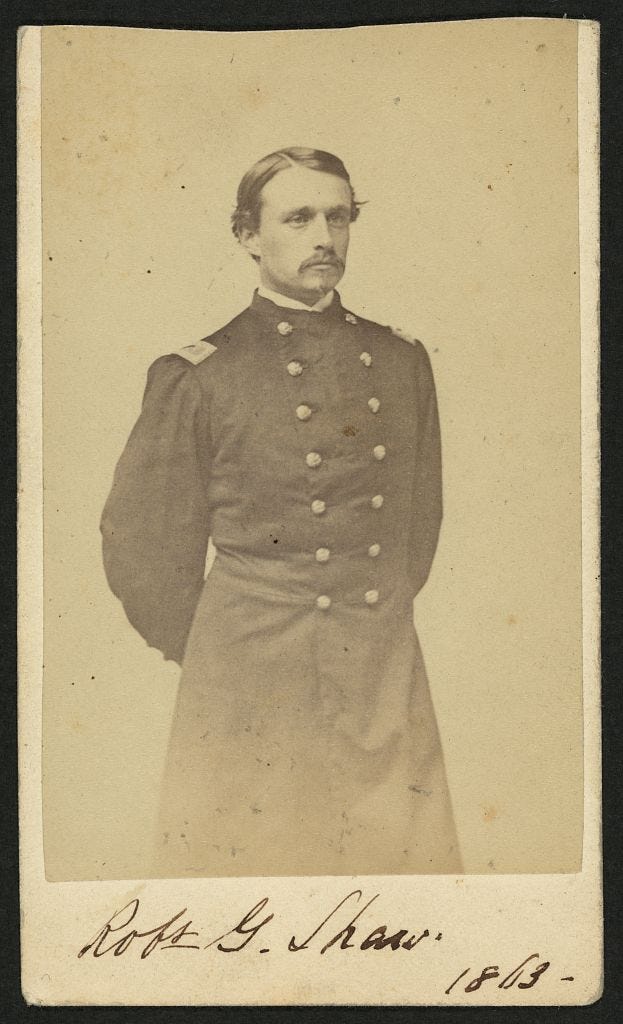
It is desirable to paint a pure picture of a man as special in history as Robert Gould Shaw. He deserves that for the sacrifices he made during the U.S. Civil War. Yet, part of life is growing and recognizing misshaped or uninformed perspectives. Robert did just that, and that, too, is a part of his story. Robert was born in Boston, Massachusetts, on October 10, 1837, into a wealthy and prominent abolitionist family. Despite the views of his parents, a passion for abolition did not mark Robert's early years. He even wrote at one point, "I don't want to become reformer, Apostle, or anything of that kind." And despite his family's great wealth, he did not seem to have much motivation to become a business success like his grandfathers, who first achieved the family fortune in trade. Robert was more interested in enjoying life. "I have no taste for anything excepting amusing myself!" Robert wrote to his mother when he was sixteen while living in Germany for school in a home paid for by his parents. One can certainly interpret Robert as a spoiled teenager enjoying life using his parents' wealth. He did do that. At the same time, he worked hard at his studies, loved literature and music, had a wanderlust that led him to see many parts of Europe and was popular among his peers. He was also close to his family, writing them often and missing them dearly when apart. And as a teenage boy, he had typical struggles, particularly with his height - he stood 5 feet 5 inches tall but felt distressed at not growing more. After graduating from high school in Europe, Robert returned to the U.S. to begin studies at Harvard. The school, however, turned out to be a bad fit, as in one of the great ironies of his life given his future Army fame, Robert abhorred discipline and authority. Harvard stressed both, unlike the more lax environment of Robert's European schooling. As a result, Robert did poorly in his coursework and eventually dropped out, joining his uncles in their firm in New York City in 1859. While he enjoyed the work at first and looked forward to opportunities in the future, Robert soon became dissatisfied, writing to a friend, "I am a slave now." When the Civil War broke out in 1861, Robert enlisted in the 7th New York Militia and later transferred to the 2nd Massachusetts Infantry. After years of looking for purpose and fulfillment, Robert found both in the army. He developed a reputation for bravery and competence in battle and grew as a soldier through scares, such as a battle in 1862 in which Robert's pocket watch deflected a bullet that could have seriously wounded him. He even changed his perspective on discipline, writing, "Discipline is wonderful." In 1863, the Governor of Massachusetts selected Robert to command the 54th Massachusetts Infantry, the first all-black Union Army regiment. Robert was hesitant to take the role, as he felt unsure about leading black soldiers, the significant scrutiny of such a position, and the likelihood of success. His initial response was to reject the position. What made him change his mind isn't clear. But he wrote to his fiancee upon the rejection, "Mother will think I am shirking my duty." Shortly after he accepted the command and wrote his fiancee, "It is needless for me to overwhelm you with a quantity of arguments in favour of the negro troops; because you are with Mother, the warmest advocate the cause can have. I am inclined to think that the undertaking will not meet with so much opposition as was at first supposed. All sensible men in the army, of all parties, after a little thought, say that it is the best thing that can be done; and surely those at home, who are not brave or patriotic enough to enlist, should not ridicule, or throw obstacles in the way of men who are going to fight for them. There is a great prejudice against it; but now that it has become a government matter, that will probably wear away. At any rate, I shan't be frightened out of it by its unpopularity; and I hope you won't care if it is made fun of." Robert faced immense challenges as leader of the 54th Massachusetts. The men under his command were eager to prove their worth, but they were often treated with skepticism and outright racism by other Union soldiers and officers. Robert himself had some doubts at the outset. However, his attitude quickly changed as he got to know his soldiers and witnessed their dedication and courage. One significant turning point occurred when Robert staunchly advocated for equal pay for his men. Initially, the Union Army promised black soldiers the same pay as white soldiers. However, the black soldiers received less. Robert passionately fought against this, refusing his own pay in solidarity with his men until the issue was resolved. Which it was. This solidarity earned him respect from his regiment. Under his leadership, the 54th Massachusetts would be essential in the Union Army's assault on Fort Wagner in South Carolina. In this battle, Robert's leadership and bravery inspired many. As the regiment came under heavy fire, Robert moved to the front, yelling, "Forward 54th!" He led his men until he was shot and killed during the battle. The Confederate Army buried Robert in a mass grave with his men, a gesture intended to demean him. Instead, it became a powerful symbol of his solidarity with his troops. There is little doubt that he would have wanted to be buried any other way. In his last letter, written to his father on the day he was killed, Robert said, "We hear nothing but praise of the Fifty-fourth on all hands." Sources (footnotes for quotes below): * "COL Robert Gould Shaw." On Point, vol. 10, no. 1, 2004, pp. 15–15. JSTOR, http://www.jstor.org/stable/44610474. Accessed 7 Jun. 2024. * “Robert Gould Shaw.” Fordham University, Office of the President, https://www.fordham.edu/about/leadership-and-administration/administrative-offices/office-of-the-president/about/hall-of-honor/robert-gould-shaw/ * “Robert Gould Shaw.” Wikipedia, Wikimedia Foundation, https://en.wikipedia.org/wiki/Robert_Gould_Shaw * Robt. G. Shaw / Whipple, 96 Washington Street, Boston. Photograph. Retrieved from the Library of Congress, www.loc.gov/item/2010647752/>. * Shaw, Robert Gould. Blue-eyed child of fortune: the Civil War letters of Colonel Robert Gould Shaw. Athens, University of Georgia Press, 1992. (Internet Archive) This is a public episode. If you'd like to discuss this with other subscribers or get access to bonus episodes, visit historicalsnapshots.substack.com/subscribe
Embed this episode
Ready to play
Robert Gould Shaw
No transcript for this episode yet
Similar Episodes
No similar episodes found.