
EPISODE · May 7, 2026 · 23 MIN
Robust Representation Learning through Explicit Environment Modeling
from Best AI papers explained · host Enoch H. Kang
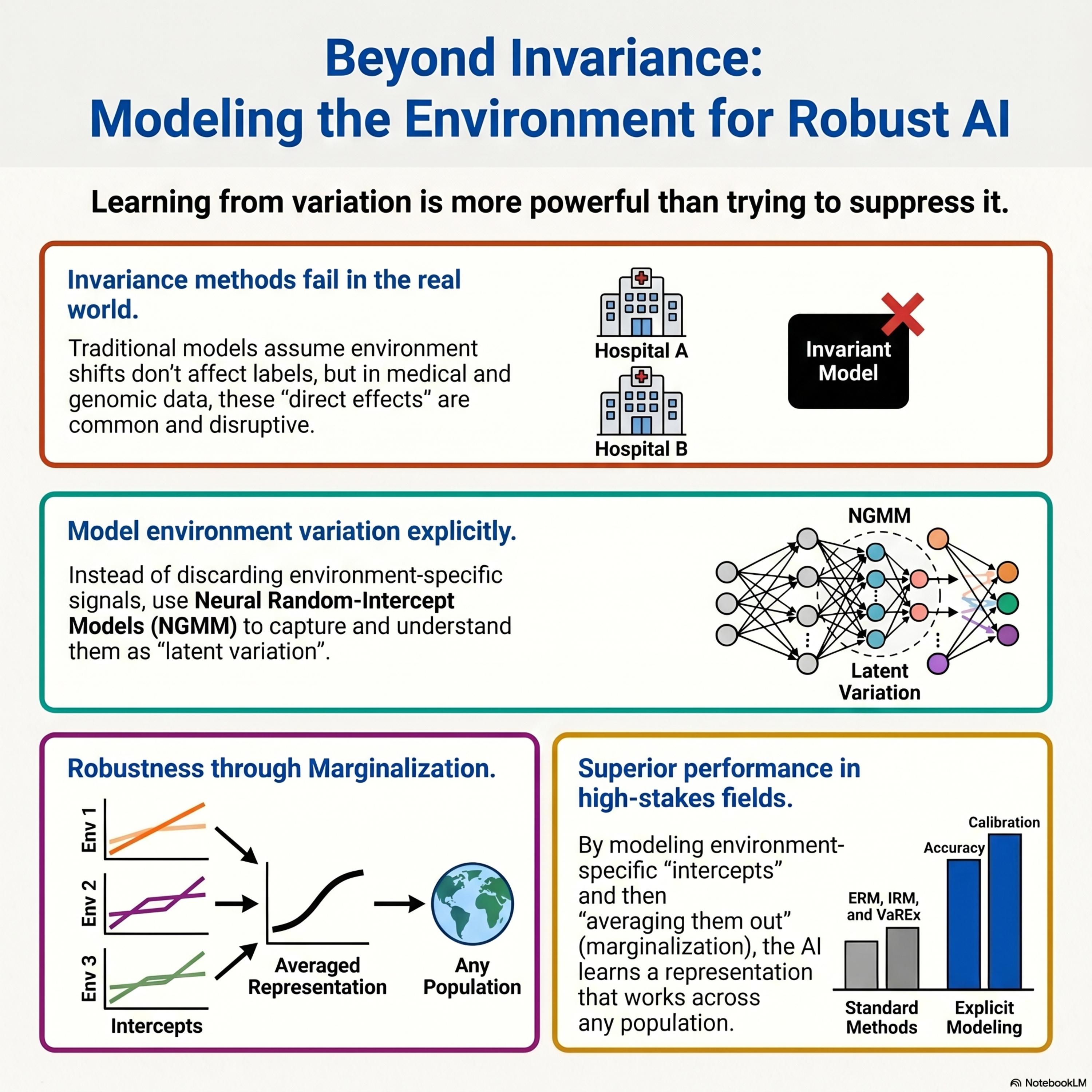
This research addresses out-of-distribution generalization by proposing a shift from traditional causal invariance to explicit environment modeling. While standard methods attempt to discard all environment-dependent information, this paper argues that such features can be predictive when the environment directly influences the target. The authors introduce neural generalized random-intercept models, which capture shared structures across settings while accounting for environment-specific variation through marginalization. This framework minimizes environment-average risk, ensuring robust predictions in entirely new contexts. Theoretical analysis and empirical tests on datasets like Colored MNIST and Camelyon-17 demonstrate that this approach consistently outperforms invariance-seeking techniques. Ultimately, the work proves that marginalizing environment effects preserves more useful information than attempting to force absolute representation stability.
Embed this episode
Ready to play
Robust Representation Learning through Explicit Environment Modeling
No transcript for this episode yet
Similar Episodes
No similar episodes found.