
EPISODE · Jul 16, 2026 · 9 MIN
Rock v. Stone: The Great Conundrum
from Street Smart Naturalist · host David B. Williams
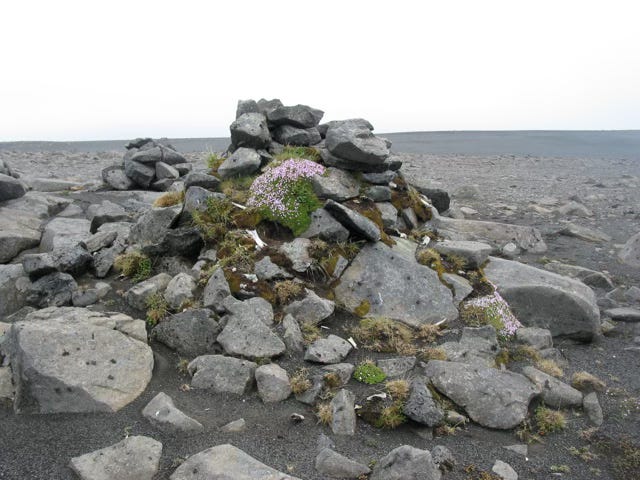
Rock or Stone? Questions such as this that have tempted many of the great minds over the centuries. Not surprisingly, I, too, a geogeek, have pondered this conundrum and its implications. In my book, Stories in Stone, I used the terms interchangeably, based mostly on how they sounded or how frequently I used one or the other. I still do that, but realize that there might be other ways to consider the use of rock and stone.In his wonderful book, Stone by Stone, Robert Thorson writes: “Rock is raw material in situ. Stone usually connotes either human handling or human use….” In other words, rock is wild and stone is tamed, somewhat akin to the difference between wood and lumber. Or, taking a more capitalistic approach, stone is rock that you pay money for. But then again there are those who think that stone is more British, that stones are smooth and rocks rough, or stones are small and rocks are big. Seeking a more erudite source in my quest for petrilexigraphic knowledge, I turned to one of my favorite books, the Oxford English Dictionary (OED), to get the fine opinion of its worthy editors. The first definition for rock is “A large rugged mass of hard mineral material or stone.” Its first use comes from Old English, dated at 950 to 1100. The OED defines stone as “A piece of rock or hard mineral substance of a small or moderate size,” first used in 825. Apparently I was wrong in hoping the erudite Oxfordites would help!I did though learn that the word stonerock, defined as “A pointed or projecting rock, a peak, a crag; a detached mass of rock, a boulder or large stone,” predates either of the singular words stone or rock. Stonerock, or stanrocces, as it was spelled, dates from the Early Old English, used from 600 to 950. I am not sure that this clarifies my quest but as is the norm for the OED, I enjoyed the many definitions and uses of the terms, which run to three pages for rock, including rock nosing, rockchuck, and rock-embosomed; and four and a half for stone, with such nifty combinations as stone harmonicon, stone-pock, and stone-toter.Ever optimistic, I thought I might find further illumination from on high. In the King James Bible, stone and rock seemed interchangeable, such as in Genesis 31:46, where we read of Jacob telling his brethren to “Gather stones; and they took stones, and made an heap.” (As someone who wrote an entire book about heaps of rock, I don’t know why those KJB writers didn't use the far better term, cairn! And, they call the KJB authoritative!) But there are two situations where stone and rock cannot be substituted for one another. The first is the surprisingly common Biblical pastime (at least a dozen times) where somebody must “stone them/him/her with stones.” You can “stone them with rocks” but no matter how tin your ear is you cannot “rock them with rocks,” which allows for the introduction of this silly phrase: you can, at least since the 1960s, “rock them with The Stones.”More common than death by stone is the affirmation of a Holy Being as the “rock of one’s salvation.” Certainly, except for the most geodorky, one would never say the “stone of one’s salvation.” This sense highlights a central difference between the words. People often use rock to refer to something solid, large, grounded, substantial, or something to base your faith upon, such as a mountain or palisade. Basically, this is Mr. Thorson’s definition of raw material in situ. Stone, while connoting a hard mineral substance, favors smaller objects, such as something you can pick up in your hands, for example, the stones for the cairn gathered by Jacob’s pals.Seeking out an even higher authority I turned to Shakespeare. He also incorporated stone and rock into his writings, more than 115 times and 50 times, respectively (which includes the plural forms.) One of his most famous uses comes from As You Like It, in the banished Duke’s ode to a new forested life: “And this our life exempt from public haunt/Finds tongues in trees, books in the running brooks,/Sermons in stones and good in every thing.” Clearly the Bard chose stone for the alliteration and sound, as he did in Titus Andronicus, where the title character states “A stone is soft as wax,—tribunes more hard than stones; A stone is silent, and offendeth not.” (One of my favorite poets, Robinson Jeffers, refers to the “insolent quietness of stone.”)Shakespeare’s use of rock was often specific to the sea, as something to fear. “Rocks that threaten us with wreck,” Henry VI, Part 3, Act 5, Scene 4. “And then there is the peril of waters, winds and rocks,” The Merchant of Venice, Act 1 Scene 3. “Alas, the sea hath cast me on the rocks,” Pericles, Act 2, Scene 1. No one, especially one with Shakespeare’s gifts, would substitute stone in these situations. Again, his use of rock reflects the idea that rock refers to massive, immovable matter, though this idea does not limit rock to this definition.I cannot end my consideration of these two terms without turning to one final source of inspiration, that of big time wrestling, or “rassling,” as one former National Park Service superintendent called it. I refer to the two icons of that theater, The Rock and Stone Cold Steve Austin. Mr. Rock, or Dwayne Johnson, as he is formally known, starred in two movies about geology, San Andreas and Journey 2, each of which is equally preposterous from a geological point of view. According to Wikipedia, Mr. Austin’s name came about in reference to a cup of tea and its temperature. What these fellows illustrate is that although rock and stone can often be interchangeable there are times when one is more appropriate than the other. I doubt that the two chaps would want to be known as The Stone or Rock Cold Steve Austin. Wrestling aside, I do think that there is some difference between the terms. Stone more often implies some sort of human use and also seems more restricted to smaller material. But rock can also be used in these situations. Ultimately, I am back to a simple, but basically useless, statement: all stones are rocks but not all rocks are stones. Clear as mud.This newsletter is adapted from a blog posting I wrote in 2014. Get full access to Street Smart Naturalist: Explorations of the Urban Kind at streetsmartnaturalist.substack.com/subscribe
NOW PLAYING
Rock v. Stone: The Great Conundrum
No transcript for this episode yet
Similar Episodes
Mar 19, 2026 ·34m
Feb 18, 2026 ·11m
Feb 11, 2026 ·45m
Nov 12, 2025 ·35m
Oct 17, 2025 ·40m