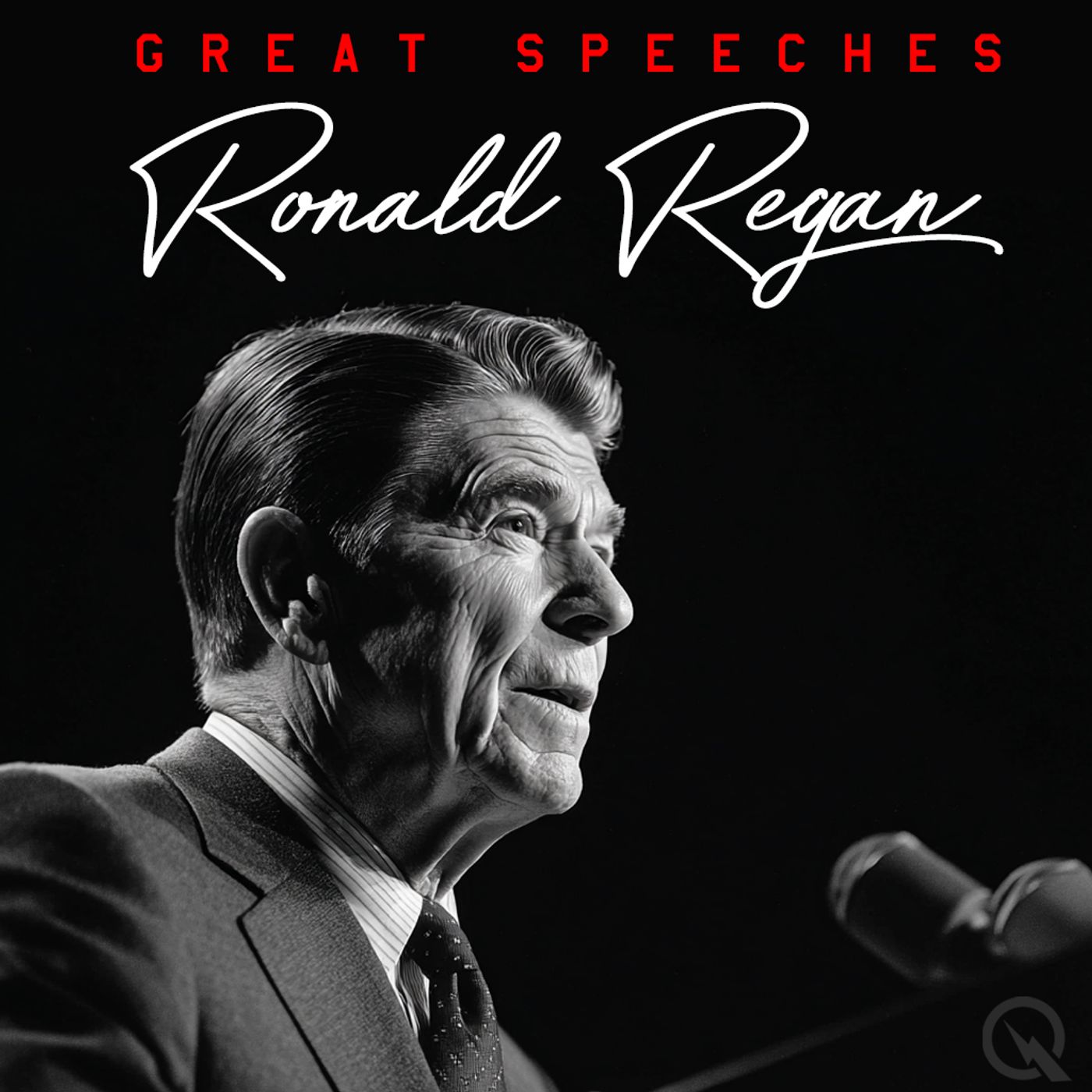
Ronald Reagan - October 27, 1964: "A Time for Choosing" episode artwork

EPISODE · Nov 2, 2023 · 27 MIN

Ronald Reagan - October 27, 1964: "A Time for Choosing"

from Ronald Reagan - Great Speeches · host Inception Point Ai

Thank you. Thank you very much. Thank you and good evening. The sponsor has been identified, but unlike most television programs, the performer hasn't been provided with a script. As a matter of fact, I have been permitted to choose my own words and discuss my own ideas regarding the choice that we face in the next few weeks.I have spent most of my life as a Democrat. I recently have seen fit to follow another course. I believe that the issues confronting us cross party lines. Now, one side in this campaign has been telling us that the issues of this election are the maintenance of peace and prosperity. The line has been used, "We've never had it so good."But I have an uncomfortable feeling that this prosperity isn't something on which we can base our hopes for the future. No nation in history has ever survived a tax burden that reached a third of its national income. Today, 37 cents out of every dollar earned in this country is the tax collector's share, and yet our government continues to spend 17 million dollars a day more than the government takes in. We haven't balanced our budget 28 out of the last 34 years. We've raised our debt limit three times in the last twelve months, and now our national debt is one and a half times bigger than all the combined debts of all the nations of the world. We have 15 billion dollars in gold in our treasury; we don't own an ounce. Foreign dollar claims are 27.3 billion dollars. And we've just had announced that the dollar of 1939 will now purchase 45 cents in its total value.As for the peace that we would preserve, I wonder who among us would like to approach the wife or mother whose husband or son has died in South Vietnam and ask them if they think this is a peace that should be maintained indefinitely. Do they mean peace, or do they mean we just want to be left in peace? There can be no real peace while one American is dying some place in the world for the rest of us. We're at war with the most dangerous enemy that has ever faced mankind in his long climb from the swamp to the stars, and it's been said if we lose that war, and in so doing lose this way of freedom of ours, history will record with the greatest astonishment that those who had the most to lose did the least to prevent its happening. Well I think it's time we ask ourselves if we still know the freedoms that were intended for us by the Founding Fathers.Not too long ago, two friends of mine were talking to a Cuban refugee, a businessman who had escaped from Castro, and in the midst of his story one of my friends turned to the other and said, "We don't know how lucky we are." And the Cuban stopped and said, "How lucky you are? I had someplace to escape to." And in that sentence he told us the entire story. If we lose freedom here, there's no place to escape to. This is the last stand on earth.And this idea that government is beholden to the people, that it has no other source of power except the sovereign people, is still the newest and the most unique idea in all the long history of man's relation to man.This is the issue of this election: Whether we believe in our capacity for self-government or whether we abandon the American revolution and confess that a little intellectual elite in a far-distant capitol can plan our lives for us better than we can plan them ourselves.You and I are told increasingly we have to choose between a left or right. Well I'd like to suggest there is no such thing as a left or right. There's only an up or down—[up] man's old—old-aged dream, the ultimate in individual freedom consistent with law and order, or down to the ant heap of totalitarianism. And regardless of their sincerity, their humanitarian motives, those who would trade our freedom for security have embarked on this downward course.In this vote-harvesting time, they use terms like the "Great Society," or as we were told a few days ago by the President, we must accept a greater government activity in the affairs of the people. But they've been a little more explicit in the past and among themselves; and all of the things I now will quote have appeared in print. These are not Republican accusations. For example, they have voices that say, "The cold war will end through our acceptance of a not undemocratic socialism." Another voice says, "The profit motive has become outmoded. It must be replaced by the incentives of the welfare state." Or, "Our traditional system of individual freedom is incapable of solving the complex problems of the 20th century." Senator Fullbright has said at Stanford University that the Constitution is outmoded. He referred to the President as "our moral teacher and our leader," and he says he is "hobbled in his task by the restrictions of power imposed on him by this antiquated document." He must "be freed," so that he "can do for us" what he knows "is best." And Senator Clark of Pennsylvania, another articulate spokesman, defines liberalism as "meeting the material needs of the masses through the full power of centralized government."Well, I, for one, resent it when a representative of the people refers to you and me, the free men and women of this country, as "the masses." This is a term we haven't applied to ourselves in America. But beyond that, "the full power of centralized government"—this was the very thing the Founding Fathers sought to minimize. They knew that governments don't control things. A government can't control the economy without controlling people. And they know when a government sets out to do that, it must use force and coercion to achieve its purpose. They also knew, those Founding Fathers, that outside of its legitimate functions, government does nothing as well or as economically as the private sector of the economy.Now, we have no better example of this than government's involvement in the farm economy over the last 30 years. Since 1955, the cost of this program has nearly doubled. One-fourth of farming in America is responsible for 85 percent of the farm surplus. Three-fourths of farming is out on the free market and has known a 21 percent increase in the per capita consumption of all its produce. You see, that one-fourth of farming—that's regulated and controlled by the federal government. In the last three years we've spent 43 dollars in the feed grain program for every dollar bushel of corn we don't grow.Senator Humphrey last week charged that Barry Goldwater, as President, would seek to eliminate farmers. He should do his homework a little better, because he'll find out that we've had a decline of 5 million in the farm population under these government programs. He'll also find that the Democratic administration has sought to get from Congress [an] extension of the farm program to include that three-fourths that is now free. He'll find that they've also asked for the right to imprison farmers who wouldn't keep books as prescribed by the federal government. The Secretary of Agriculture asked for the right to seize farms through condemnation and resell them to other individuals. And contained in that same program was a provision that would have allowed the federal government to remove 2 million farmers from the soil.At the same time, there's been an increase in the Department of Agriculture employees. There's now one for every 30 farms in the United States, and still they can't tell us how 66 shiploads of grain headed for Austria disappeared without a trace and Billie Sol Estes never left shore.Every responsible farmer and farm organization has repeatedly asked the government to free the farm economy, but how—who are farmers to know what's best for them? The wheat farmers voted against a wheat program. The government passed it anyway. Now the price of bread goes up; the price of wheat to the farmer goes down.Meanwhile, back in the city, under urban renewal the assault on freedom carries on. Private property rights [are] so diluted that public interest is almost anything a few government planners decide it should be. In a program that takes from the needy and gives to the greedy, we see such spectacles as in Cleveland, Ohio, a million-and-a-half-dollar building completed only three years ago must be destroyed to make way for what government officials call a "more compatible use of the land." The President tells us he's now going to start building public housing units in the thousands, where heretofore we've only built them in the hundreds. But FHA [Federal Housing Authority] and the Veterans Administration tell us they have 120,000 housing units they've taken back through mortgage foreclosure. For three decades, we've sought to solve the problems of unemployment through government planning, and the more the plans fail, the more the planners plan. The latest is the Area Redevelopment Agency.They've just declared Rice County, Kansas, a depressed area. Rice County, Kansas, has two hundred oil wells, and the 14,000 people there have over 30 million dollars on deposit in personal savings in their banks. And when the government tells you you're depressed, lie down and be depressed.We have so many people who can't see a fat man standing beside a thin one without coming to the conclusion the fat man got that way by taking advantage of the thin one. So they're going to solve all the problems of human misery through government and government planning. Well, now, if government planning and welfare had the answer—and they've had almost 30 years of it—shouldn't we expect government to read the score to us once in a while? Shouldn't they be telling us about the decline each year in the number of people needing help? The reduction in the need for public housing?But the reverse is true. Each year the need grows greater; the program grows greater. We were told four years ago that 17 million people went to bed hungry each night. Well that wasThis content was created in partnership and with the help of Artificial Intelligence AIThis episode includes AI-generated content.

NOW PLAYING

Ronald Reagan - October 27, 1964: "A Time for Choosing"

0:00 27:51

No transcript for this episode yet

We transcribe on demand. Request one and we'll notify you when it's ready — usually under 10 minutes.

The Field Priest Methodius Chwastek The Field is a place of cultivation and of battle. In the Church, we learn to cultivate a life pleasing to God. This life is shaped in the spiritual battle. This series examines, chapter by chapter, the Christian classic The Field, by Saint Ignatius Brianchaninov. Please join me as I explain this great work in terms the modern Orthodox Christian can understand.  Hiking Grand Canyon This series contains great information for those who will be hiking the Grand Canyon. A variety of topics are discussed, including safety measures to take, camping suggestions, and how to preserve the canyon. Vampires of the Paper Flower Consortium Elizabeth Guizzetti Come for the evening, stay for eternity! Paper Flower Consortium is a podcast from the largest vampire coven in Seattle. Their stories are told by Loretta Fabron Onfoy, coven historian and librarian, in the hope that the modern vampire's way of life is not lost during the next great language transformation. Some tales in this anthology are horrific, some are droll, some are filled with misadventure--just like any eternal existence. Episodes sponsored by the Paper Flower Consortium's Business Community. The history is followed by questions from curious initiates. Want to ask Lady Loretta a question about vampirism? Have a topic you want to see discussed? Email [email protected] The Ten Commandments Chad Boersema Many focus on MAKING disciples, we hope to help in the process of BEING a disciple of Jesus. Understanding the ten commandments can be a good place to reflect on, as they were one of Israel's first introductions to learning how to relate to God and live in His way. Jesus also references the commandments in his sermon on the mount saying, “...whoever does them [the commandments] will be called great in the kingdom of heaven.” (Matthew 5:19) Looking forward to exploring these with you! Thanks for listening!web - jesusdisciple.info facebook - facebook.com/jesusdisciple.info twitter - twitter.com/fellow_disciple instagram - instagram.com/jesusdisciple.info

Frequently Asked Questions

How long is this episode of Ronald Reagan - Great Speeches?

This episode is 27 minutes long.

When was this Ronald Reagan - Great Speeches episode published?

This episode was published on November 2, 2023.

What is this episode about?

Thank you. Thank you very much. Thank you and good evening. The sponsor has been identified, but unlike most television programs, the performer hasn't been provided with a script. As a matter of fact, I have been permitted to choose my own words and...

Is there a transcript available for this episode?

Yes, a full transcript is available for this episode. You can read the complete transcript on the episode page.

Can I download this Ronald Reagan - Great Speeches episode?

Yes, you can download this episode by clicking the download button on the episode player, or subscribe to the podcast in your preferred podcast app for automatic downloads.
URL copied to clipboard!