Rowhammer in the Wild: Large-Scale Insights from FlippyR.AM (39c3) episode artwork

EPISODE · Dec 29, 2025 · 40 MIN

Rowhammer in the Wild: Large-Scale Insights from FlippyR.AM (39c3)

from Chaos Computer Club - recent audio-only feed · host Martin Heckel, Florian Adamsky, Daniel Gruss

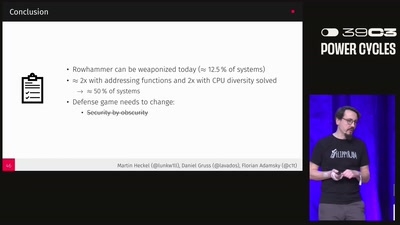
Last year at 38c3, we gave a talk titled "Ten Years of Rowhammer: A Retrospect (and Path to the Future)." In this talk, we summarized 10 years of Rowhammer research and highlighted gaps in our understanding. For instance, although nearly all DRAM generations from DDR3 to DDR5 are vulnerable to the Rowhammer effect, we still do not know its real-world prevalence. For that reason, we invited everyone at 38c3 last year to participate in our large-scale Rowhammer prevalence study. In this year's talk, we will first provide an update on Rowhammer research and present our results from that study. A lot has happened in Rowhammer research in 2025. We have evidence that DDR5 is as vulnerable to Rowhammer as previous generations. Other research shows that not only can adversaries target rows, but columns can also be addressed and used for bit flips. Browser-based Rowhammer attacks are back on the table with Posthammer and with ECC. fail, we can mount Rowhammer attacks on DDR4 with ECC memory. In our large-scale study, we measure Rowhammer prevalence in a fully automated cross-platform framework, FlippyR.AM, using the available state-of-the-art software-based DRAM and Rowhammer tools. Our framework automatically gathers information about the DRAM and uses 5 tools to reverse-engineer the DRAM addressing functions, and based on the reverse-engineered functions, uses 7 tools to mount Rowhammer. We distributed the framework online and via USB thumb drives to thousands of participants from December 30, 2024, to June 30, 2025. Overall, we collected 1006 datasets from 822 systems with various CPUs, DRAM generations, and vendors. Our study reveals that out of 1006 datasets, 453 (371 of the 822 unique systems) succeeded in the first stage of reverse-engineering the DRAM addressing functions, indicating that successfully and reliably recovering DRAM addressing functions remains a significant open problem. In the second stage, 126 (12.5 % of all datasets) exhibited bit flips in our fully automated Rowhammer attacks. Our results show that fully automated, i.e., weaponizable, Rowhammer attacks work on a lower share of systems than FPGA-based and lab experiments indicated, but at 12.5%, are still a practical vector for threat actors. Furthermore, our results highlight that the two most pressing research challenges around Rowhammer exploitability are more reliable reverse-engineering tools for DRAM addressing functions, as 50 % of datasets without bit flips failed in the DRAM reverse-engineering stage, and reliable Rowhammer attacks across diverse processor microarchitectures, as only 12.5 % of datasets contained bit flips. Addressing each of these challenges could double the number of systems susceptible to Rowhammer and make Rowhammer a more pressing threat in real-world scenarios. This will be a followup talk after our talk "Ten Years of Rowhammer: A Retrospect (and Path to the Future)" at 38C3. In the talk last year we gave an overview of the current state of Rowhammer and highlighted that there are no large-scale prevalence studies. We wanted to change that and asked the audience to participate in our large-scale study on Rowhammer prevalence. We performed the large-scale study on Rowhammer prevalence thanks to many volunteers supporting our study by measuring their systems. In total, we collected 1006 datasets on 822 different systems (some systems were measured multiple times). We show that 126 of them (12.5%) are affected by Rowhammer with our fully-automated setup. This should be seen as a lower bound, since the preconditions required for effective tools failed on ~50% of the systems. Among many other insights, we learned that the fully-automated reverse-engineering of DRAM addressing functions is still an open problem and we assume the actual number of affected systems to be higher as the 12.5% we measured in our study. Now, one year after our talk at the 38C3, we want to give an update on the current state of Rowhammer, since multiple new insights were published in the last year: The first reliable Rowhammer exploit on DDR5, a JavaScript implementation of Rowhammer that works on current DDR4 systems, and an ECC bypass on DDR4, just to name a few. Additionally, we want to present the results of our large-scale study on Rowhammer prevalence which was supported by the audience from last year's talk. Licensed to the public under http://creativecommons.org/licenses/by/4.0 about this event: https://events.ccc.de/congress/2025/hub/event/detail/rowhammer-in-the-wild-large-scale-insights-from-flippyr-am

Last year at 38c3, we gave a talk titled "Ten Years of Rowhammer: A Retrospect (and Path to the Future)." In this talk, we summarized 10 years of Rowhammer research and highlighted gaps in our understanding. For instance, although nearly all DRAM generations from DDR3 to DDR5 are vulnerable to the Rowhammer effect, we still do not know its real-world prevalence. For that reason, we invited everyone at 38c3 last year to participate in our large-scale Rowhammer prevalence study. In this year's talk, we will first provide an update on Rowhammer research and present our results from that study. A lot has happened in Rowhammer research in 2025. We have evidence that DDR5 is as vulnerable to Rowhammer as previous generations. Other research shows that not only can adversaries target rows, but columns can also be addressed and used for bit flips. Browser-based Rowhammer attacks are back on the table with Posthammer and with ECC. fail, we can mount Rowhammer attacks on DDR4 with ECC memory. In our large-scale study, we measure Rowhammer prevalence in a fully automated cross-platform framework, FlippyR.AM, using the available state-of-the-art software-based DRAM and Rowhammer tools. Our framework automatically gathers information about the DRAM and uses 5 tools to reverse-engineer the DRAM addressing functions, and based on the reverse-engineered functions, uses 7 tools to mount Rowhammer. We distributed the framework online and via USB thumb drives to thousands of participants from December 30, 2024, to June 30, 2025. Overall, we collected 1006 datasets from 822 systems with various CPUs, DRAM generations, and vendors. Our study reveals that out of 1006 datasets, 453 (371 of the 822 unique systems) succeeded in the first stage of reverse-engineering the DRAM addressing functions, indicating that successfully and reliably recovering DRAM addressing functions remains a significant open problem. In the second stage, 126 (12.5 % of all datasets) exhibited bit flips in our fully automated Rowhammer attacks. Our results show that fully automated, i.e., weaponizable, Rowhammer attacks work on a lower share of systems than FPGA-based and lab experiments indicated, but at 12.5%, are still a practical vector for threat actors. Furthermore, our results highlight that the two most pressing research challenges around Rowhammer exploitability are more reliable reverse-engineering tools for DRAM addressing functions, as 50 % of datasets without bit flips failed in the DRAM reverse-engineering stage, and reliable Rowhammer attacks across diverse processor microarchitectures, as only 12.5 % of datasets contained bit flips. Addressing each of these challenges could double the number of systems susceptible to Rowhammer and make Rowhammer a more pressing threat in real-world scenarios. This will be a followup talk after our talk "Ten Years of Rowhammer: A Retrospect (and Path to the Future)" at 38C3. In the talk last year we gave an overview of the current state of Rowhammer and highlighted that there are no large-scale prevalence studies. We wanted to change that and asked the audience to participate in our large-scale study on Rowhammer prevalence. We performed the large-scale study on Rowhammer prevalence thanks to many volunteers supporting our study by measuring their systems. In total, we collected 1006 datasets on 822 different systems (some systems were measured multiple times). We show that 126 of them (12.5%) are affected by Rowhammer with our fully-automated setup. This should be seen as a lower bound, since the preconditions required for effective tools failed on ~50% of the systems. Among many other insights, we learned that the fully-automated reverse-engineering of DRAM addressing functions is still an open problem and we assume the actual number of affected systems to be higher as the 12.5% we measured in our study. Now, one year after our talk at the 38C3, we want to give an update on the current state of Rowhammer, since multiple new insights were published in the last year: The first reliable Rowhammer exploit on DDR5, a JavaScript implementation of Rowhammer that works on current DDR4 systems, and an ECC bypass on DDR4, just to name a few. Additionally, we want to present the results of our large-scale study on Rowhammer prevalence which was supported by the audience from last year's talk. Licensed to the public under http://creativecommons.org/licenses/by/4.0 about this event: https://events.ccc.de/congress/2025/hub/event/detail/rowhammer-in-the-wild-large-scale-insights-from-flippyr-am

NOW PLAYING

Rowhammer in the Wild: Large-Scale Insights from FlippyR.AM (39c3)

0:00 40:26

No transcript for this episode yet

We transcribe on demand. Request one and we'll notify you when it's ready — usually under 10 minutes.

Breaking News Show | eTurboNews Juergen Thomas Steinmetz News is relevant to the global travel and tourism industry, human rights and global issues.Breaking news when it happens and only from the source. That Hoarder: Overcome Compulsive Hoarding That Hoarder Hoarding disorder is stigmatised and people who hoard feel vast amounts of shame. This podcast began life as an audio diary, an anonymous outlet for somebody with this weird condition. That Hoarder speaks about her experiences living with compulsive hoarding, she interviews therapists, academics, researchers, children of hoarders, professional organisers and influencers, and she shares insight and tips for others with the problem. Listened to by people who hoard as well as those who love them and those who work with them, Overcome Compulsive Hoarding with That Hoarder aims to shatter the stigma, share the truth and speak openly and honestly to improve lives. HOMELAND HOMELAND The Church is a body not a building. It's the bride of Jesus Christ! Jesus is coming back for a mature bride. That means it's time for the church of Jesus Christ to move from milk to meat. This is the hour of maturity!HOMELAND is an announcement that the church is being set free. Only the church has the ability to transform the world. The kingdom's of this world will become the kingdoms of our Lord and Savior!All of creation has been waiting for this moment! Sons and daughters of God are rising up and taking their seat! LIGHTS, CAMERA, SMILE! Creatives Club Media Lights, Camera, Smile, is a podcast for anyone with a dream to share something with the world, out of the overflow of themselves - be it their mind, their heart, their personalities, and much more. Each of us are alive in this moment in time, with an innate ability to have ideas and create various things to benefit both ourselves and the people around us for a reason, and here, you will find the encouragement, the inspiration, and the motivation to do just that. Hosted by Cicily, founder of Creatives Club, she dives into various topics surrounding creativity and business. Exploring entrepreneurship for creatives in a corporate reality, sharing tips and tricks in a media centered company, answering questions regarding what a creative actually is are just a few of the things discussed on this podcast. Be encouraged to create for yourself as Cicily gets vulnerable by pivoting the camera to herself for the first time.To submit questions for Cicily to answer, or have her address certain t

Frequently Asked Questions

How long is this episode of Chaos Computer Club - recent audio-only feed?

This episode is 40 minutes long.

When was this Chaos Computer Club - recent audio-only feed episode published?

This episode was published on December 29, 2025.

What is this episode about?

Last year at 38c3, we gave a talk titled "Ten Years of Rowhammer: A Retrospect (and Path to the Future)." In this talk, we summarized 10 years of Rowhammer research and highlighted gaps in our understanding. For instance, although nearly all DRAM...

Can I download this Chaos Computer Club - recent audio-only feed episode?

Yes, you can download this episode by clicking the download button on the episode player, or subscribe to the podcast in your preferred podcast app for automatic downloads.
URL copied to clipboard!