
EPISODE · Jan 27, 2026 · 32 MIN
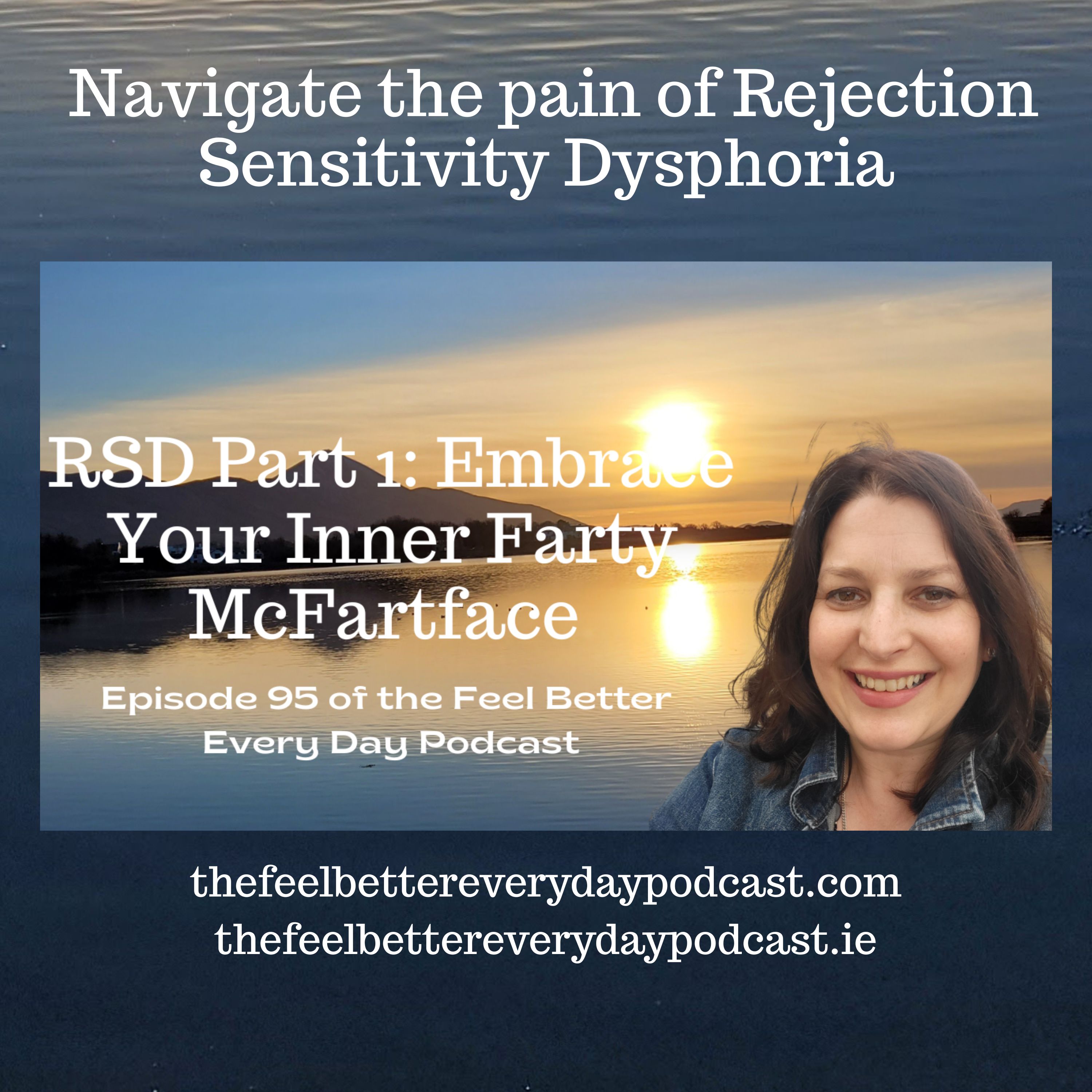
RSD Part 1: Embrace Your Inner Farty McFartface
from Soles to Soul Care for Trauma and AuDHD
Rejection Sensitivity Dysphoria (RSD) can feel debilitating when you’re living with AuDHD (autism and ADHD). In this episode, I share some of my personal journey with RSD - even at age 50! - and introduce some practical tools that help me and which can support you in stopping rejecting yourself.CHAPTERS0:00–2:22 Introduction to RSD and nervous system–informed support2:22–5:23 Why RSD is so excruciating and how self-rejection develops5:23–8:15 Early criticism, negative conditioning, and the ADHD/RSD cycle8:15–11:47 RSD in creativity, work, relationships, and self-worth11:47–13:45 Self-acceptance, self-love, and healing RSD in community13:45–15:58 Expanding life again: stopping self-rejection and finding support15:58–19:40 The Feel Love Heal framework and non-violent communication19:40–24:52 Giraffe and jackal energy: compassion, blame, and nervous system responses24:52–27:54 Fear of rejection, shame, and a very human yoga story27:54–31:55 Integration, encouragement, and closing reflectionsLINKSEpisode 71: Shadow Work with Black Cats and SharksEpisode 72: The “Independent Woman” Trap365 Ways to Feel Better: Self-care Ideas for Embodied Wellbeing https://selfcarecoaching.net/book/https://selfcarecoaching.net/2018/12/05/wellbeing-wednesday-advent-gratitude-practice-and-giraffes-and-jackals-for-better-communication-with-yourself-and-others/FULL TRANSCRIPTWelcome to Episode 95 of the Feel Better Every Day Podcast and it’s part one of on RSD, Rejection Sensitivity Dysphoria, which is so prevalent with AuDHD and that’s autism and ADHD. And it can feel debilitating.Hi, I’m Eve Menezes Cunningham and you’re listening to the Feel Better Every Day Podcast. You can find out more and access older episodes at thefeelbettereverydaypodcast.com and you can also access loads of free resources and find out more about the book, 365 Ways to Feel Better: Self-care Ideas for Embodied Wellbeing, the column I write for Platinum every month, other titles I contribute to, my work, loads of free resources I’ve created over the years.I really hope you enjoy this episode and if you haven’t already signed up for my free newsletter, it goes out on a Monday, Míle Buíochas Mondays. Míle buíochas means a thousand thank yous in Irish, which I’m very slowly learning and it’s polyvagal-informed journal prompts to help you each week. There’s the gratitude practice element, figuring out more of what brings you joy on a daily basis, what helps you feel in that ventral vagal (I call Purr!) when I use the rescue cats with the Polyvagal Purrs approach. And I also share some of my own gratitude, some of the things that have helped me feel more in ventral vagal that week. Some of those will be resources that might benefit you and I also share news about upcoming events, special offers, things like that.The journal prompts also include encouragement to look at what is creating sympathetic survival responses (that Hiss! with the Polyvagal Purrs approach) and potentially the dorsal vagal (Freeze!) It’s really helping you learn to map your own nervous system, get to know yourself and get to support yourself and it’s all free. If you haven’t already you can sign up at selfcarecoaching.net and if you have any questions again let me know either in the comments or at selfcarecoaching.netI hope you enjoy this episode. I’m not normally someone who re-records things, my style is quite natural and unpolished and sometimes haphazard, but this is possibly the latest, since I started doing the podcast, that I’ve left it in terms of getting the episodes to my amazing virtual assistant who then sorts transcription and all out for me in terms of getting it all scheduled and ready for going out on Tuesday.But I just woke up this morning thinking what I’d recorded I couldn’t share, I rejected it and that wasn’t my first attempt. It’s really weird. This is part one of a series, an occasional series, I was going to say part two would follow in a couple of weeks but I’m not going to put that pressure on myself.RSD, Rejection Sensitivity Dysphoria, Rejection Sensitivity Disorder, it is one of the most debilitating, excruciating elements of being alive with AuDHD, autism and ADHD. And I had no idea what it was until I began exploring ADHD however many years ago now and more so with the autism, with the ADHD medication treating so many of those symptoms.But I’m 50 years old and I’ve spent much of the past nine months or so feeling like a teenager in terms of the RSD. I’m feeling it so, so strong and it always makes me laugh when people have other impressions of me because I know how excruciating life can feel from the inside out and also I’m aware that my bandwidth is lower with various things going on in life.I thought I’d do this episode and I’m going to share some ways in which you can work with your own as well as giving you a bit more understanding around what it is. If you haven’t already come across, you probably have, Alex Partridge’s ADHD Chatterbox podcast, his gorgeous book Now It All Makes Sense has been out for a good while, been recommending that for a good while and he has a new book coming out Why Does Everybody Hate Me? which is specifically about RSD.He’s doing amazing work in this area bringing together different experts and sharing his own experiences and I’m hoping that this, some of my own experiences as well as the ways in which you might choose to work with it will help you because ultimately we can’t control what happens around us but we can stop rejecting ourselves and I think this is where RSD is so enormous for so many of us with neurodivergence, with AuDHD, with autism, with ADHD where our parents potentially were undiagnosed, unknowing and they were projecting parts of themselves out onto Little Us’s and recognising, like I know when I look back, my parents, all the yelling, all the like criticism, they were trying to protect me. I then developed a very strong self-loathing inner critic but I understand they were both immigrants and they were not in the most welcoming part of the world for immigrants although I think it’s worse now.I think they were both undiagnosed, autism and ADHD and they both had their own trauma.I am very very fortunate that I have a lovely relationship with both of them, challenging as well but that I’ve been able to heal so much and I think the Inner Child work I continue to do, the reparenting I continue to do, I think it’s helping them as well.I like to think that because sometimes that’s excruciating as well but I can recognise as a 50 year old that an enormous amount of the criticism and an enormous amount of like me being told everything I did was wrong, like from my London Essex accent, so every time I opened my mouth my speech would be corrected, the way I tied my shoelaces or held my pen or all these things.Additude magazine which is for ADHDers, it’s an American publication, had a study a while ago and it wasn’t a huge study but the number has kind of reverberated around the world that ADHDers typically get 20,000 more negative inputs by the age of 10 than their neurotypical peers.If you think about how we then start to police ourselves and how we then, we might make a mistake, we might do something embarrassing, we might do something ridiculous and in order to try and not be yelled at or criticised or bullied or made fun of or shamed or any of the things that have happened a gazillion times to us, we tear ourselves down. The attempt is to try and protect ourselves from doing it again in the future but of course it just makes it worse.If you haven’t already seen the film Penelope, I recommend you watch it. It stars Christina Ricci, Reece Witherspoon, James McAvoy, Catherine O’Hara and I can’t remember who else, I’ve seen it several times but the message is just glorious and it hugely applies around any kind of rejection, any kind of sensitivity. Being a writer, professional writer since 2004, that has forced me to confront my RSD long before I understood what RSD was. I thought everyone felt like that but you can’t afford to not put yourself out there, your ideas out there, your work out there, no matter how excruciating it may feel if you want to share your work.Same could go for being an entrepreneur and being any kind of creative person.I was single for 23 years because I made some terrible decisions which were bad for me when I was younger and also the more I understand about RSD, it’s like just the excruciatingness of being, attempting to be in relationship when I was so rejecting of myself.And I know that when I began building my business in 2004, a lot of things that I had to overcome and learn and expand into as a business owner, as a freelance writer, as a coach, complimentary therapist, therapist, supervisor, all of it, it all continually comes up for healing and then by the age, by the year 2022, I had the realisation that in spite of all this work I was doing on myself and with clients and with groups and with readers and with audiences, all of it, I believed that I was unlovable and that was why I was single.I thought Yikes! If a client came to me and had recognised that, I would be working with them to help them heal because of course everyone is lovable, my whole business, my whole practice is based around us all like the more we can imagine...
NOW PLAYING
RSD Part 1: Embrace Your Inner Farty McFartface
No transcript for this episode yet
Similar Episodes
Mar 26, 2026 ·1m
Mar 19, 2026 ·34m
Feb 18, 2026 ·11m
Feb 11, 2026 ·45m