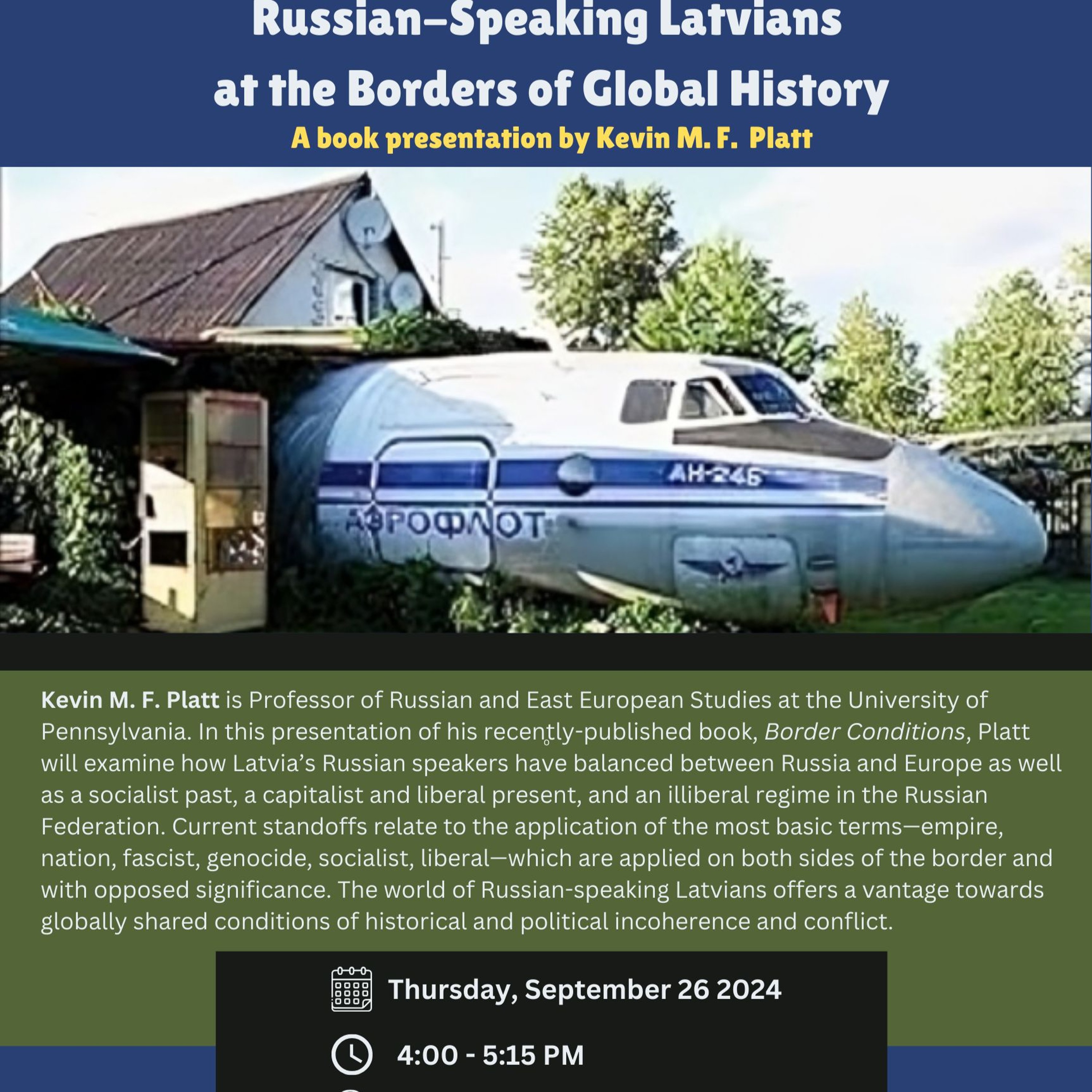
Russian-Speaking Latvians at the Borders of Global History episode artwork

EPISODE · Sep 30, 2024 · 53 MIN

Russian-Speaking Latvians at the Borders of Global History

from CREECA Lecture Series Podcast · host Center for Russia, East Europe, and Central Asia at the University of Wisconsin, Madison

About the lecture: In December 1989, in officially recognizing the authenticity of the 1939 Molotov-Ribbentrop Pact’s secret protocol, the USSR Congress of People’s Deputies evinced the hope that the globally divided historical consciousness of the Cold War would be replaced with a new conception of the past, reflecting “a whole and mutually interdependent world and increasing mutual understanding.” While there was cause for hope in the immediate post-Soviet years that such a “flat earth” of shared accounts of history—the foundation for a world of shared political values—would emerge, subsequent decades led to renewed, often weaponized fragmentation of historical vision across political borders, and especially at the border separating Europe from the Russian Federation. However, in distinction from the Cold War opposition of ideologically differentiated accounts of history, current standoffs relate to the application of the most basic terms—empire, nation, fascist, genocide, socialist, liberal—which are applied on both sides of borders and conflict zones, yet with opposed significance. Rather than a confrontation of historical ideologies, this is a standoff of historical ontologies. In this presentation of his recently published book "Border Conditions: Russian-Speaking Latvians Between World Orders", Platt will examine the etiology of this ontological conflict, as it emerges from the experience of a population that has been located since the end of the Cold War in the interstitial zone at the borders of Europe: Russian-speaking Latvians. Their world, riven by contradiction, offers a vantage, as through a keyhole, toward globally shared conditions of historical and political incoherence and conflict at the start of the twenty-first century. About the speaker: Kevin M. F. Platt is Professor of Russian and East European Studies at the University of Pennsylvania. His scholarly work focuses on Russian and East European culture, history, poetry, and fiction. He is author or editor of a number of scholarly books, among them "Terror and Greatness: Ivan and Peter as Russian Myths" (Cornell, 2011), "Global Russian Cultures" (Wisconsin, 2019), and, most recently, "Border Conditions: Russian-Speaking Latvians Between World Orders" (Cornell/NIUP, 2024). His translations of Russian and Latvian poetry have appeared in "World Literature Today:, "Jacket2", "Fence", and other journals. He is the founder and organizer of the poetry translation symposium Your Language My Ear. His current project is entitled “Cultural Arbitrage in the Age of Three Worlds.”

About the lecture: In December 1989, in officially recognizing the authenticity of the 1939 Molotov-Ribbentrop Pact’s secret protocol, the USSR Congress of People’s Deputies evinced the hope that the globally divided historical consciousness of the Cold War would be replaced with a new conception of the past, reflecting “a whole and mutually interdependent world and increasing mutual understanding.” While there was cause for hope in the immediate post-Soviet years that such a “flat earth” of shared accounts of history—the foundation for a world of shared political values—would emerge, subsequent decades led to renewed, often weaponized fragmentation of historical vision across political borders, and especially at the border separating Europe from the Russian Federation. However, in distinction from the Cold War opposition of ideologically differentiated accounts of history, current standoffs relate to the application of the most basic terms—empire, nation, fascist, genocide, socialist, liberal—which are applied on both sides of borders and conflict zones, yet with opposed significance. Rather than a confrontation of historical ideologies, this is a standoff of historical ontologies. In this presentation of his recently published book "Border Conditions: Russian-Speaking Latvians Between World Orders", Platt will examine the etiology of this ontological conflict, as it emerges from the experience of a population that has been located since the end of the Cold War in the interstitial zone at the borders of Europe: Russian-speaking Latvians. Their world, riven by contradiction, offers a vantage, as through a keyhole, toward globally shared conditions of historical and political incoherence and conflict at the start of the twenty-first century. About the speaker: Kevin M. F. Platt is Professor of Russian and East European Studies at the University of Pennsylvania. His scholarly work focuses on Russian and East European culture, history, poetry, and fiction. He is author or editor of a number of scholarly books, among them "Terror and Greatness: Ivan and Peter as Russian Myths" (Cornell, 2011), "Global Russian Cultures" (Wisconsin, 2019), and, most recently, "Border Conditions: Russian-Speaking Latvians Between World Orders" (Cornell/NIUP, 2024). His translations of Russian and Latvian poetry have appeared in "World Literature Today:, "Jacket2", "Fence", and other journals. He is the founder and organizer of the poetry translation symposium Your Language My Ear. His current project is entitled “Cultural Arbitrage in the Age of Three Worlds.”

NOW PLAYING

Russian-Speaking Latvians at the Borders of Global History

0:00 53:53

No transcript for this episode yet

We transcribe on demand. Request one and we'll notify you when it's ready — usually under 10 minutes.

French Your Way Jessica: Native French teacher founder of French Your Way Boost your French listening skills and test your comprehension with this one of a kind series of podcasts. Get the chance to listen to a real conversation between native speakers talking at normal speed AND customise your learning experience through carefully designed sets of questions (2 levels of difficulty) available for download at www.frenchvoicespodcast.com. All interviews also come with the transcript. French teacher Jessica interviews native speakers of French from around the world who share a bit of their life and passion. Where else would you meet in one same place a French yoga teacher based in Melbourne, a soap manufacturer from Provence, or a couple cycling around the world? That Hoarder: Overcome Compulsive Hoarding That Hoarder Hoarding disorder is stigmatised and people who hoard feel vast amounts of shame. This podcast began life as an audio diary, an anonymous outlet for somebody with this weird condition. That Hoarder speaks about her experiences living with compulsive hoarding, she interviews therapists, academics, researchers, children of hoarders, professional organisers and influencers, and she shares insight and tips for others with the problem. Listened to by people who hoard as well as those who love them and those who work with them, Overcome Compulsive Hoarding with That Hoarder aims to shatter the stigma, share the truth and speak openly and honestly to improve lives. The Small Business Startup School – Business Notes | Financial Literacy | Retail Psychology – For Professionals & Entrepreneurs The Small Business Startup School Inc. Starting or buying a small business? While personal circumstances may vary, business patterns remain timeless. On The Small Business Startup School, we explore strategies, insights, and practical solutions to help entrepreneurs confidently navigate their journey.Hosted by Ola Williams—a retail entrepreneur, fintech founder, and financial coach with over two decades of experience—this podcast marries financial awareness and retail psychology with optimism to deliver actionable takeaways.Join us to learn, grow, and connect as we uncover the keys to business success.Let’s continue to learn together and be encouraged to keep on connecting! DIOSA. Carolina Sanper This podcast is a sacred space created by Carolina Sanper where you connect with your inner wisdom and embody your magnetic feminine power.It is the realization that the mystical realm is where you plant the seeds of your desired reality.It is a portal to your true essence: awareness, presence, and receiving with ease. Welcome home, DIOSA. 🖤

Frequently Asked Questions

How long is this episode of CREECA Lecture Series Podcast?

This episode is 53 minutes long.

When was this CREECA Lecture Series Podcast episode published?

This episode was published on September 30, 2024.

What is this episode about?

About the lecture: In December 1989, in officially recognizing the authenticity of the 1939 Molotov-Ribbentrop Pact’s secret protocol, the USSR Congress of People’s Deputies evinced the hope that the globally divided historical consciousness of the...

Can I download this CREECA Lecture Series Podcast episode?

Yes, you can download this episode by clicking the download button on the episode player, or subscribe to the podcast in your preferred podcast app for automatic downloads.
URL copied to clipboard!