
EPISODE · Aug 1, 2025 · 26 MIN
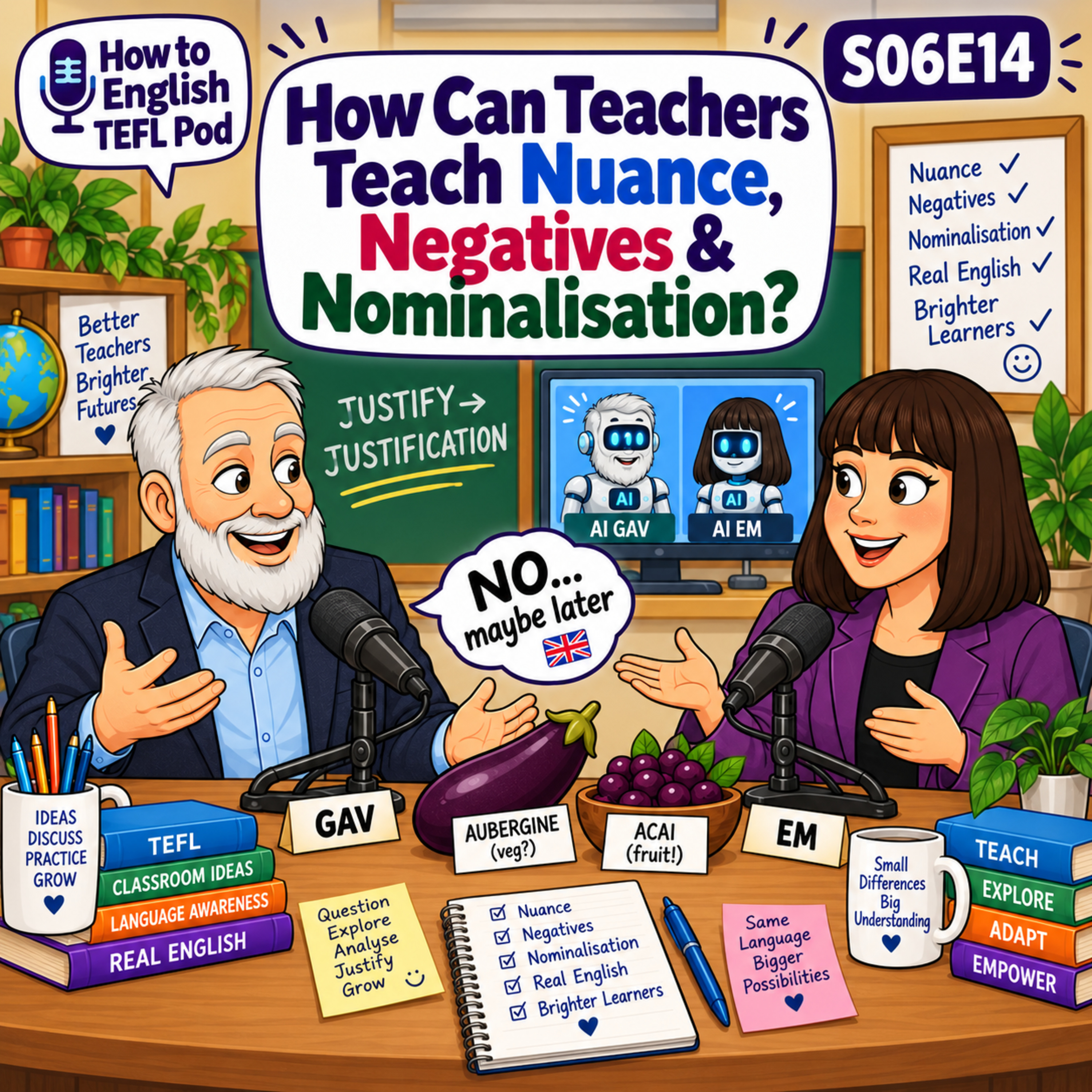
How Can Teachers Teach Nuance, Negative Answers and Nominalisation? TEFL A-Z N – S06E14
from How to English TEFL Podcast · host Gav and Em
How can English teachers explain subtle differences between words, practise negative forms and make nominalisation memorable?In this episode of the How to English TEFL Podcast, Gav and Em reach N in their A–Z of TEFL. They begin with some necessary notes and corrections involving aubergines, acai, postpone, matching activities and the surprisingly important differences between gelato and ice cream.Em explores linguistic nuance through the difference between bad and wicked. How much detail should teachers give when learners ask about two apparently similar words? And what happens when both words can change meaning in different contexts?Gav then demonstrates a personalised grammar activity for practising negative answers. Learners respond to deliberately ridiculous questions using forms such as “No, I don’t”, “No, I’m not” and “No, I haven’t” before adding their own ideas. It is a simple way to combine grammar practice, humour and memorable personalised language.Why do British English speakers often avoid saying no directly? Gav and Em examine softer refusals such as “Maybe later”, “I’d love to, but…” and “It’s very cold outside”. These indirect answers can sound positive to learners who miss the speaker’s real intention.The episode also includes a fast-paced nominalisation game. Em transforms verbs such as allocate, justify, implement, transmit and oppose into nouns, revealing why nominalisation is useful in academic, legal and Business English.Finally, AI-generated versions of Gav and Em present eight teaching tips covering lesson aims, learning names, thinking time, boardwork, instruction checking, flexibility, student-generated language and post-lesson reflection. The real Gav and Em then react to their strangely refined digital doubles and consider where AI-generated podcasting might lead.Drawing on their classroom experience, Gav and Em turn some potentially dry language points into practical activities teachers can adapt for their own lessons.If you find the show useful, you can send us a thanks at https://ko-fi.com/howtoenglishpodVisit https://howtoenglishpod.com for practical teaching ideas and resources ready to use.ReferencesVoice cloning:https://www.uberduck.ai/voice-cloningBackground music:https://www.youtube.com/watch?v=W16EsK4JCKM&list=PL170TfEhZz-_GstI3bsghBfuD-u8nlHHD&index=1Chapters00:00 – Alphabet confusion and the A–Z of TEFL01:35 – Notes, corrections and fruit-related facts05:16 – Matching activities and pelmanism06:22 – Gelato versus ice cream08:01 – Explaining nuance: bad, wicked and changing meanings11:09 – A personalised activity for practising negative answers14:48 – How British English speakers say no indirectly17:38 – What is nominalisation and why is it useful?18:27 – Nominalisation noun-forming challenge21:17 – AI Gav and Em’s eight tips for TEFL teachers23:01 – The real Gav and Em react to their AI voices25:07 – Is AI-generated podcasting the future?25:46 – Alphabet confusion returns and the episode ends
Embed this episode
Ready to play
How Can Teachers Teach Nuance, Negative Answers and Nominalisation? TEFL A-Z N – S06E14
No transcript for this episode yet
Similar Episodes
No similar episodes found.
Similar Podcasts
No similar podcasts found.