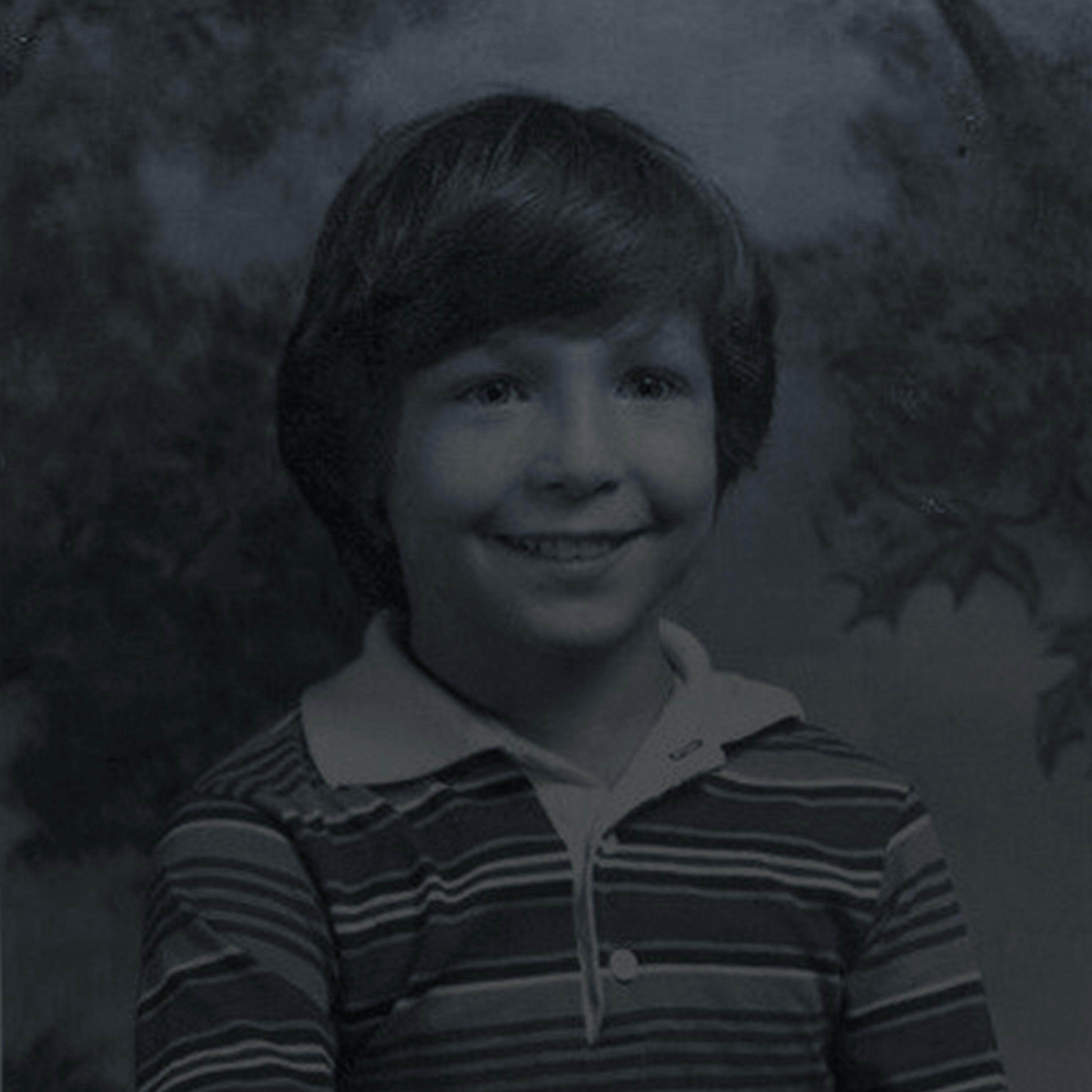
Many people know what it's like to live in the shadow of their parents. But some shadows are longer and darker than others. Before Terry Rasmussen killed four people and dumped them in the woods near Bearbrook State Park, before he was a serial killer, a chameleon, he had a family. In my reporting, I was able to speak to one of his children, his daughter, Diane. You heard from her in episode six. Terry Rasmussen also had a son. Can I have you just introduce yourself, your name and your relationship to this case and why we're talking?
My name is Eric. Terry Rasmussen is my father. And I guess we're talking about it to try and find some answers. I couldn't find Eric when I was first reporting this series. But a few months after we released the podcast, an email sent by someone with the last name Rasmussen caught my eye. Eric wrote to say that he had listened to the podcast. He said he was glad to hear that with the breakthroughs in genetic genealogy, at least some good had come from the case. But listening to it also had him thinking about his father. Ever since Eric learned about Terry Rasmussen's crimes, he's been holding up an image of his father's life next to his own.
and what he's seen has changed him. This is Bear Brook, update number two, a conversation with Eric Rasmussen. I'm Jason Moon. Eric, you can hear me okay and everything? I can. Okay, great. A few weeks ago, Eric and I sat down to talk about what this story has meant for him.
I started by asking him about the day this all began for him. Remember, like Diane, Eric grew up not knowing all that much about his father. As far as he knew, he was just a deadbeat dad who left him when he was five years old. Since then, Eric grew up, joined the Marine Corps, then the Army, had some kids, got married and divorced a few times. Then in 2017, four decades after he last saw his dad, Eric got a phone call from the New Hampshire State Police. I mean, it was very surreal. I mean, it was, you know, you just, you can't.
It's nothing life prepares you for a phone call like that. I mean, it's just, I guess the only way I really dealt with it at that first moment was that it just wasn't true. Eric says it didn't fully sink in until later, when the detective sent him an email with some more information about the case. It really became real when I clicked on the link to the interview that he did in California. And I heard his voice. Now I haven't talked anymore about him's problems or my problems, because frankly...
That's when it really just became 100% real for me, is I heard that voice from the past. It's hard to explain, you know. I guess the closest I could put it, and forgive me if I go off on a tangent here, is when I was in Desert Storm, we had been across the Kuwaiti border for about a day, and we were moving towards Kuwait City, and we had camp for the night, basically, with a bunch of tanks laid out, and we were digging foxholes, and there was machine gun fire that starts up, and then all of a sudden there's this call of gas because this missile had landed, and my gas mask wouldn't seal. And the sheer terror of that, of...
of your mask and not sealing. You think you're going to die. You're starting to panic somewhat. You're trying to keep cool at the same time. And just that feeling that builds up in you of all this stress, this anxiety, this terror. And that's what I felt when I heard his voice. Well, let's go back to that phone call if we can for just a minute. Did he have any questions for you? He asked me what I remembered about my father. And what did you tell him? I told him the two prominent memories I have of my father. I remember...
when he came to visit us in Arizona after my mother had left him. Just a reminder, this is the unexpected visit that Terry Rasmussen made sometime in 1975 or 76. It was the last time his family saw him. Terry had with him an unidentified woman who investigators believe may be another victim. And I remember him being with a brunette woman. You know, I remember that. I remember him not saying much.
He said something to my mother and that he kind of looked at us. But, you know, I'm a father myself. And, you know, the first thing you do when you when you when you contact your children after not seeing him for a while is you want to physically be there for him. And he just didn't seem to hold that connection. The other memory Eric has of his father is something that Diane also mentioned to me. She said it was the moment that finally convinced their mother to leave Terry. I remember the day that he he burned me with cigarettes. I don't remember if it was one or two, but I remember feeling burnt. And I remember crying, you know, and I just remember the look he gave me.
It just, it was just so, it's hard to describe. It was just, it was like a dead man looking at you in some ways. Do you remember how old you were at that time? I think this was, I was right about three and a half to four right in there. Wow. Any recollection or idea as to, not that there's a good reason, but why he would have been doing that to you? You know, that goes to the question I think everybody has, is how does a man like that exist? And how does a man like that do anything? I guess it doesn't make sense to me.
But I kind of really need to know in kind of a morbid sort of way. This is the shadow that Terry Rasmussen casts over Eric Rasmussen. Ever since he learned about his father's crimes, Eric has been gripped by questions of how and why. Questions that I think we all try to answer when we hear a story like this. But the difference for Eric is that whatever answers he comes to also say something about him. Not just because Terry was his father, but because Eric has come to realize that he and his father's lives have in some ways moved along a parallel trajectory.
It's a really odd parallel because, you know, there were two things that he was heavily interested in, and that was mechanical and electronics. And the way that my, unknowingly, my path directed was exactly down those same ways. You know, I spent time as an auto mechanic. I spent time in the dino field, which is heavily electronic. I mean, he went into the Navy. I spent time in the Marine Corps. I don't want to be like him, but unfortunately, I mean, I kind of am in a way. And that is a scary thought in itself. I mean, that's the one when I can't sleep at 3 o'clock in the morning that draws me.
You know, I know I'm not going to do what he did, but I don't want to get anywhere close to that line. And that's the one that keeps me up. It's not only the outlines of a career path that Eric and Terry share. They also bear a striking physical resemblance. Diane told me that when the state troopers were first breaking the news to her, one thing that helped convince her it was real were the mugshots of Terry and how much they looked like Eric. You know, you read about, you know, the people that talked to him and the detective in California said, oh, gosh, those crystal blue eyes. I get that every week, at least once a week. Somebody says, oh, my God, you have just gorgeous crystal blue eyes. And I'm like, I just don't want them. But, you know, I look like him. Yeah. I wonder.
What was your idea of your father as you were growing up and after he had left? What was your sense of him? My mother, which has never been very forthcoming with a lot of details, constantly reinforced the idea he was a bad man. But she couldn't quite say why. Sometimes it would be because he drank. Sometimes it would be because he slept around with all the babysitters. Well, I mean, there were some times she said to me, you're just like him.
which really is a phrase that kind of drags home now. And she would tell me how I looked like him, how I was just like him, and then she would take it out on me physically. But you were curious despite all that. Oh, yeah. I mean, you're growing up in a single-parent home. I mean, you want to know the other half of you. So has this led to other conversations within your extended family? I mean, I know obviously that...
Your relationship with your mom is fraught for obvious reasons, but have you found yourself talking to family members from his side or reconnecting with folks? I have. I have found a few family members from his side that are willing to talk, and the one story that came out that really struck me as intuitive was they were at a picnic, and he was maybe 8 or 9. I mean, Terry was 8 or 9. Yeah, and he chased someone around at the picnic with a knife he'd been using to cut watermelon because he became so angry.
So talk to other members on that side of the family who talk about a darkness that flows in the Rasmussen family. And they don't call it depression. They call it darkness. Hearing stories about Terry's childhood has helped Eric to fill in some sections of his father's portrait. But the more Eric has learned, the more he's come to place meaning on a different part of Terry's life, his time in the Navy.
It's a chapter that Eric can relate to because he recognizes the effects of it in himself. Remember when one of Terry's co-workers at the mill in New Hampshire heard him screaming in his sleep? That's a PTSD moment. I mean, that's classic. That's chronic signs, you know. I suffer from that. What did he suffer from? Did that push him across the line? Terry Rasmussen served in the Navy from 1961 to 1967. He was stationed at bases along the West Coast and also at Okinawa in the Pacific. Eric has been studying his discharge paperwork, a form called a DD-214.
It has some details about Terry's military career, but it also raises a lot of questions. Like how from 1961 to 1964, there's little mention about what Terry was actually doing. Those were the early years of the Vietnam War, and it was before the Navy trained Terry as an electrician. And Eric wonders if that's when Terry saw something, or did something, that changed him. There had to be this divining moment where it all became nothing. When the value of human life became zero with him. Because you don't... It's one thing to shoot a man you don't know.
Trust me on that. It's another thing to harm someone that you know, that you're around every day. Something pushed him. There's no proof that Terry Rasmussen ever saw any action. But then you don't necessarily have to to get PTSD. There are some clues on Terry's DD-214 that point to signs of trouble, a few periods classified as lost time. It's usually code for being away without leave or being confined in the brig. And his form also has a re-enlistment code that basically amounts to the Navy telling him, don't come back.
In any case, this idea that something pushed Terry is what ultimately convinced Eric to change his life. After learning about all this in the summer of 2017, he left a lucrative career in engineering to work with vets. You know, he did so many bad things in this world. I had to do something positive, something good, not to redeem him, but to redeem myself. And so, you know, I got a job at the VA. I figured at least I could help other vets.
Maybe in an instant, maybe one word, maybe one moment, a handshake, hey, the coffee's over there. Something would make their day just a little bit more. And maybe they wouldn't push themselves over the edge, you know? So how much is Terry on your mind when you're there and talking to vets? Do you see sort of shades of him or versions, you know, of him in the vets you're speaking to? Oh, God. There isn't a day that goes by that I don't see somebody in a Navy Seabees hat. And so it's always on my mind, unfortunately, you know. Because I wish it wasn't so much, but it is. Yeah.
Well, it's interesting to me because one thing that we have tried to do in telling the story is not to focus too much on him and his story in the way that sometimes stories about serial killers can get sensationalized to an extent where it seems to be more about that person's life than the lives of the victims they had. And in a weird way, they can almost end up being glorified. But you find you're in a situation where you can't help but want to know everything you can about him because it's in a strange way also about you.
It is about me. It's about at least half of me. You know, there's no other thing for me to do except for move forward and trying to find at least some answers. Because what I know now isn't enough for me. And it's not because I'm fascinated by this killer. It's because I want to know what drove him. And that's really what I have to know is what drove him. It almost sounds like that has become the new purpose of your life, if I could put it so bluntly. Yeah. It's to not to be him.
to do whatever I can to not be him. For all the ways that Eric seems to be reaching for meaning in all this, it strikes me that there probably are no good answers waiting for him in the thicket of his father's past. No moment of truth in the Navy. No family medical predisposition that could ever fully explain who Terry Rasmussen was and why he did what he did. How much of his father is in himself is a question that Eric may always wrestle with. But then Eric isn't just looking for meaning in his father's life. He's creating meaning in his own. By having honest conversations like this. By helping other veterans to find themselves.
And in that way, the way that matters, Eric has already answered his own question. He's nothing like his father. Stay subscribed to Bearbrook to hear future updates in the case. We're hoping to bring you more episodes soon. Bearbrook is reported and produced by me, Jason Moon. Taylor Quimby is senior producer. Editing help this episode came from Dan Barrick, Maureen McMurray, Corey Princell, and Erica Janik. Special thanks this episode to Professor Edward Miller at Dartmouth College. Original music for this show was composed by me, Jason Moon, and Taylor Quimby. Bearbrook is a production of New Hampshire Public Radio.
What does it really take to start a startup? I'm David Rasenko, entrepreneur, investor, and the host of Leap Forward. In each episode, I go behind the scenes with successful founders and someone who knew them before they were famous. Their college roommate, their first employee, or their mom. To hear the sometimes uncomfortable, but very real inside stories of how companies actually get built. Companies like Reddit, Airbnb, or Twitch. Listen to the new season of Leap Forward for never-before-heard stories behind the world's most iconic companies.