
EPISODE · Mar 19, 2024 · 20 MIN
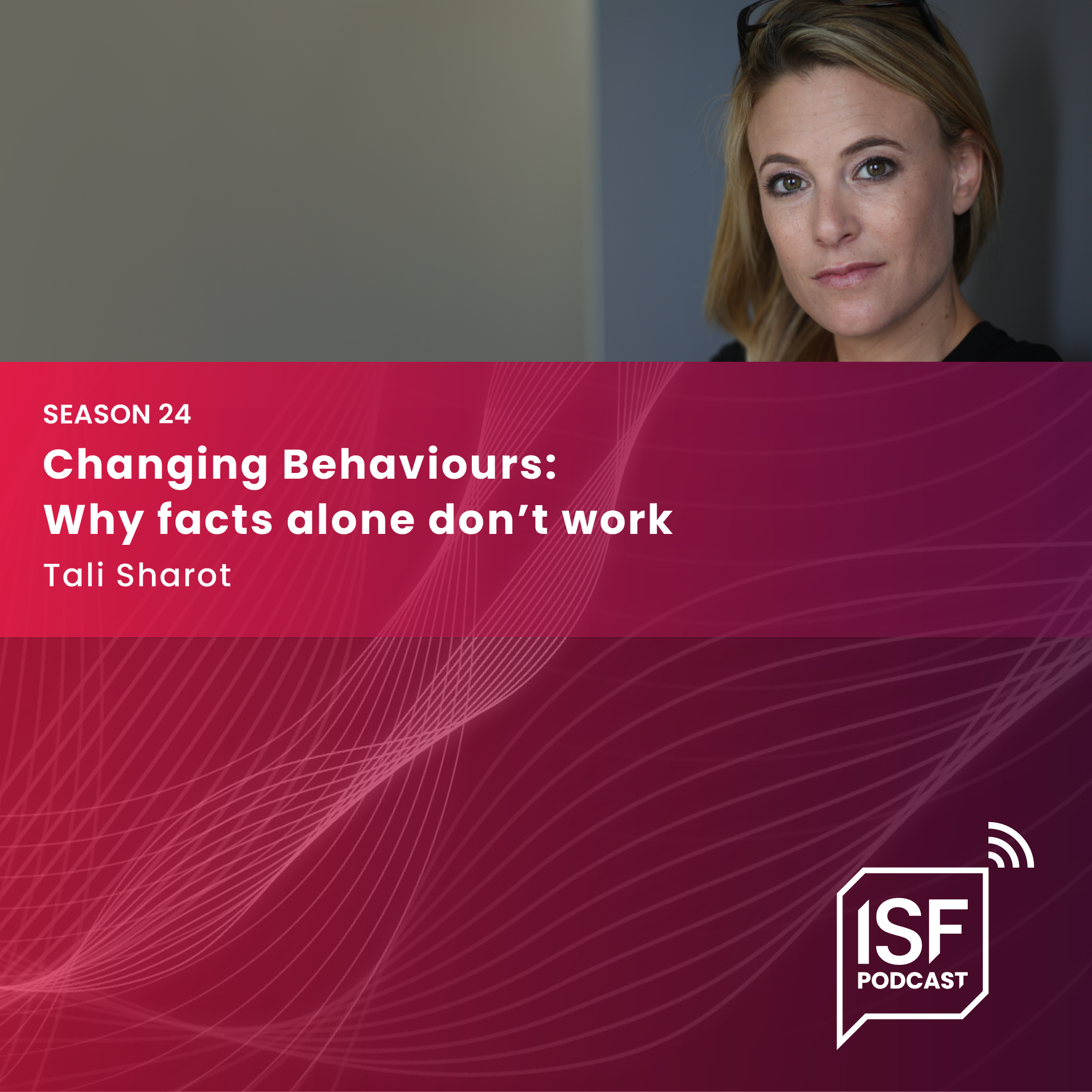
S24 Ep11: Tali Sharot - Changing Behaviours: Why facts alone don't work
from ISF Podcast · host Information Security Forum Podcast
Today’s episode was recorded at ISF’s 2023 Congress in Rotterdam. Steve sat down with Tali Sharot, professor of neuroscience at University College London, to talk about her fascinating research on optimism bias. Tali offers fresh, evidence-based ideas on effective communication for security leaders seeking to present their message to their board and raise cyber awareness within the organisation.Key Takeaways:1. Innately, the brain is an optimist.2. Implications for the business community.3. Present bias means that people care more about now than the future.4. Data is key, and pairing anecdotes with data can be more effective.Tune in to hear more about:1. Sharot’s research about how emotion affects memory (0:28)2. Optimism bias has implications for the way we evaluate risk (4:25)3. Sharot considers present bias and how it shows up in organisations (9:39)4. Why storytelling is so effective when paired with data (15:30)Standout Quotes:1. “It turns out that in behavioral economics, there was quite a lot of research about this thing called the optimism bias, which is our tendency to imagine the future as better than the past, than the present. And that's exactly what I was seeing in this experiment. And that was really the first experiment that I did looking at what goes on inside the brain that causes us to have these kind of rose-colored glasses on when we think about the future.” -Tali Sharot2. “What we find again and again is that people underestimate the risk. And that's, of course, a problem. And it's not just underestimating risk. People also underestimate how long projects will take to complete, how much it would cost, underestimating budgets. All these are related to this phenomena of the optimism bias. And so it's really difficult to try to convince people that their estimate is incorrect. Because what we found is that if you give people information to try to correct their estimate, and you tell them actually, it's much worse than what you thought, your risk is much higher than what you're thinking, people don't take that information and change their belief to the extent that they should. They do learn a little bit, but not enough … However, if you tell them actually, you don't have as much risk as you think, you're in a great position, then they learn really quickly.” -Tali Sharot3. “The immediacy is quite important, because we have what's called a present bias. We care more about the now than the future. In general, even if we're not aware of that.” -Tali Sharot4. “And what stories do, they do a few things. First of all, we're more likely to attend to stories, right to listen, they're more interesting, they're more colorful, they're more detailed, we're more likely to remember them, partially because they usually elicit more emotion than just the data. So it's good to pair the two, to have the anecdote that kind of illustrates the data that you already have in hand.” -Tali SharotMentioned in this episode: Human-centred Security: Positively influencing security behaviour ISF Analyst Insight Podcast books by Tali Sharot Read the transcript of this episodeSubscribe to the ISF Podcast wherever you listen to podcastsConnect with us on LinkedIn and TwitterFrom the Information Security Forum, the leading authority on cyber, information security, and risk management.
Embed this episode
Ready to play
S24 Ep11: Tali Sharot - Changing Behaviours: Why facts alone don't work
No transcript for this episode yet
Similar Episodes
No similar episodes found.