
EPISODE · Feb 11, 2026 · 55 MIN
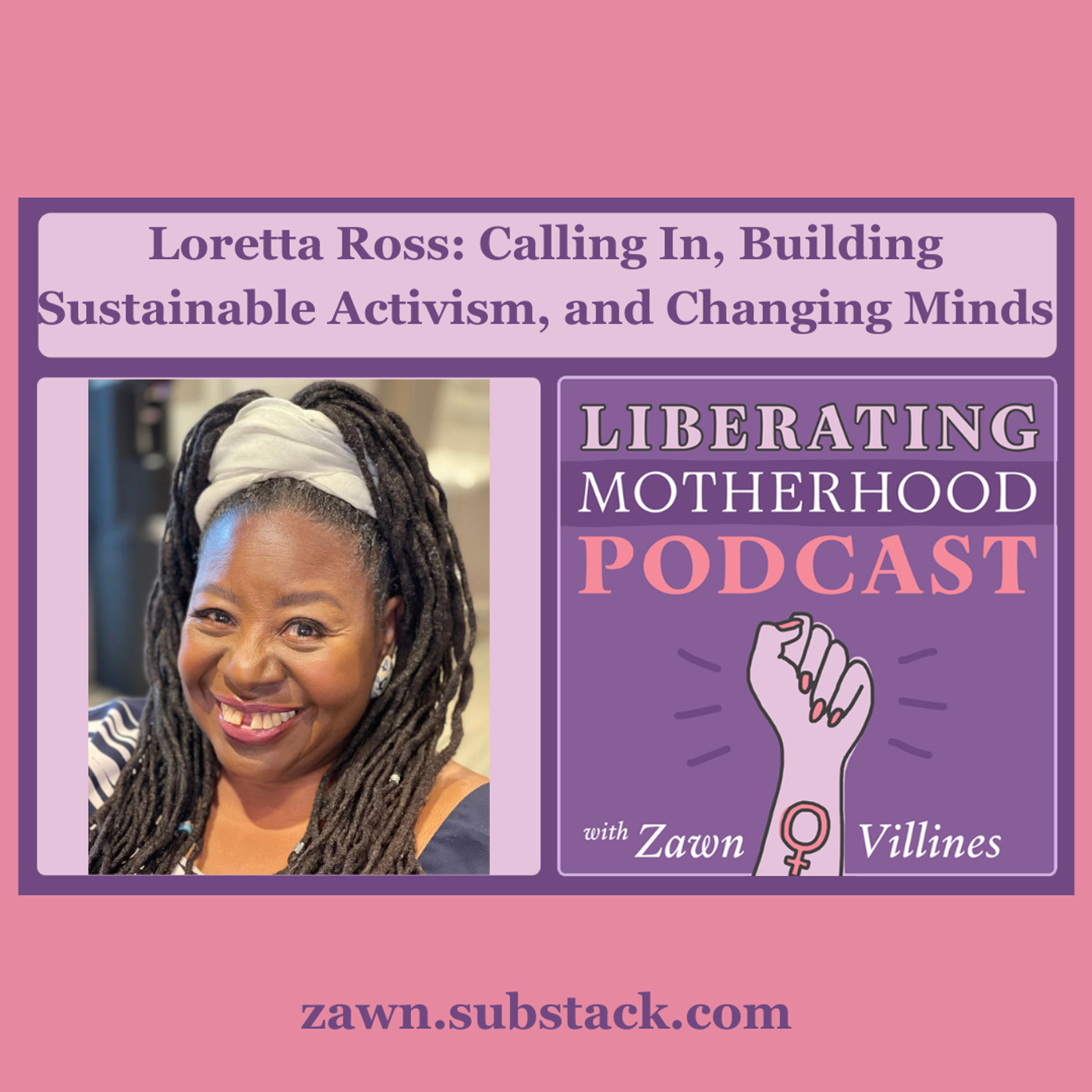
S3 Ep5: Loretta Ross: Calling In, Building Sustainable Activism, and Changing Minds
from Liberating Motherhood · host Liberating Motherhood
Today we are going to be learning from the legendary reproductive justice activist Loretta Ross. Loretta is my feminist hero and role model, and I feel so lucky that she was willing to share some time with me. How is it that a human rights movement rooted in the shared value and worth of every human being so often devolves into a toxic stew of abuse and hurt feelings? Anyone who participates in leftist political movements has seen small disagreements spiral into mutual attacks, psychological brutality, and worst of all, fractured and less powerful movements. Lasting change requires us to build solidarity across difference. At the very least, we must be able to resolve small disagreements. Ideally, though, we have to bring more people into the fold—including people we really don’t like, including people with whom we have very significant moral disagreements. I’ve often noted that the anti-choice movement succeeded by standing in lockstep with one another, no matter how much they hated each other. They built a movement for 50 years, and they succeeded. We can learn a lot from them. But leftist coalitions are diverse and highly principled. These are good things, but they can make it challenging to work together. So I’ve been thinking a lot about how we can do this. And then I found Loretta Ross’s book, Calling In. It has helped me to consider my own role in toxic call-out culture, and to seize opportunities to build consensus and coalitions rather than elevating myself and my ego. This, I think, is the only way we move forward. There’s lots of advice about how to be a better activist, what this moment means, and how to deal with people who disagree with us. I think the most useful advice comes from people who have actually succeeded at sustaining a lifetime of activism. Loretta has changed hearts and minds over and over, working with people many of us would never even want to talk to. She has done the work that progress demands, and now she’s here to teach us how to do it, too. You’ll recognize some of what we discuss from my earlier episode about sustaining hope as an activist. I cannot over-emphasize how much Loretta’s work has shifted my consciousness and influenced my own work, and I hope you find her wisdom as valuable as I do. Some of the topics we cover in this conversation include: Toxic call-out culture, and how it is destroying individual well-being as well as activist movements. How childhood wounds create toxic shame that we then foist onto our activist colleagues. How we build resilience and capacity to work across difference. Calling out vs. calling in, and how we know when to do each. Loretta’s experiences working with rapists and deprogramming white supremacist. How our egos can undermine our activism, and how we resist that temptation. The components of an effective call-in, and how to know when a call-in is likely to work. “When you ask people to give up hate, you must be prepared to be there for them when they do.” The concept of the victimized violator—the person who feels entitled to violate others because of their own victimization. How to respond to a call-out or call-in. Can we use calling in with ICE officers? How we can acknowledge the humanity of those doing harm without losing sight of their victims. How we sustain hope and avoid despair. About Loretta Ross Loretta J. Ross is a Professor at Smith College in Northampton, MA in the Program for the Study of Women and Gender. She teaches courses on white supremacy, human rights, and calling in the calling out culture. She has taught at Hampshire College and Arizona State University. She is a graduate of Agnes Scott College and holds an honorary Doctorate of Civil Law degree awarded in 2003 from Arcadia University and a second honorary doctorate degree awarded from Smith College in 2013. She also has credits towards a Ph.D. in Women’s Studies from Emory University. She serves as a consultant for Smith College, collecting oral histories of feminists of color for the Sophia Smith Collection, which also contains her personal archives. Loretta also is a recipient of a MacArthur Fellow, Class of 2022, for her work as an advocate of Reproductive Justice and Human Rights, and an inductee into the 2024 National Women’s Hall of Fame.Loretta’s activism began when she was tear-gassed at a demonstration as a first-year student at Howard University in 1970. As a teenager, she was involved in anti-apartheid and anti-gentrification activism in Washington, DC as a founding member of the DC Study Group. As part of a 50-year history in social justice activism until her retirement from community organizing in 2012, she was the National Coordinator of the SisterSong Women of Color Reproductive Justice Collective from 2005-2012 and co-created the theory of Reproductive Justice in 1994.Loretta was National Co-Director of April 25, 2004, March for Women’s Lives in Washington D.C., the largest protest march in U.S. history at that time with 1.15 million participants. She founded the National Center for Human Rights Education (NCHRE) in Atlanta, Georgia from 1996-2004. She launched the Women of Color Program for the National Organization for Women (NOW) in the 1980s and was the national program director of the National Black Women’s Health Project. Loretta was one of the first African American women to direct a rape crisis center in the 1970s, launching her career by pioneering work on violence against women, as the third Executive Director of the D.C. Rape Crisis Center. She is a member of the Women’s Media Center’s Progressive Women’s Voices. Watch Makers: Women Who Make America video.Loretta has co-written three books on reproductive justice: Undivided Rights: Women of Color Organize for Reproductive Justice in 2004; Reproductive Justice: An Introduction in March 2017; and Radical Reproductive Justice: Foundations, Theory, Practice, Critique in October 2017. Her newest book, Calling In: How to Start Making Change with Those You’d Rather Cancel is available now!Loretta is a rape survivor, forced to raise a child born of incest, and also a survivor of sterilization abuse at age 23. She is a model of how to survive and thrive despite the traumas that disproportionately affect low-income women of color.Loretta is a mother, grandmother, and great-grandmother.You can find all of Loretta’s books, as well as all books recommended on the podcast, at the Liberating Motherhood Bookshop page.
Embed this episode
Ready to play
S3 Ep5: Loretta Ross: Calling In, Building Sustainable Activism, and Changing Minds
No transcript for this episode yet
Similar Episodes
No similar episodes found.
Similar Podcasts
No similar podcasts found.