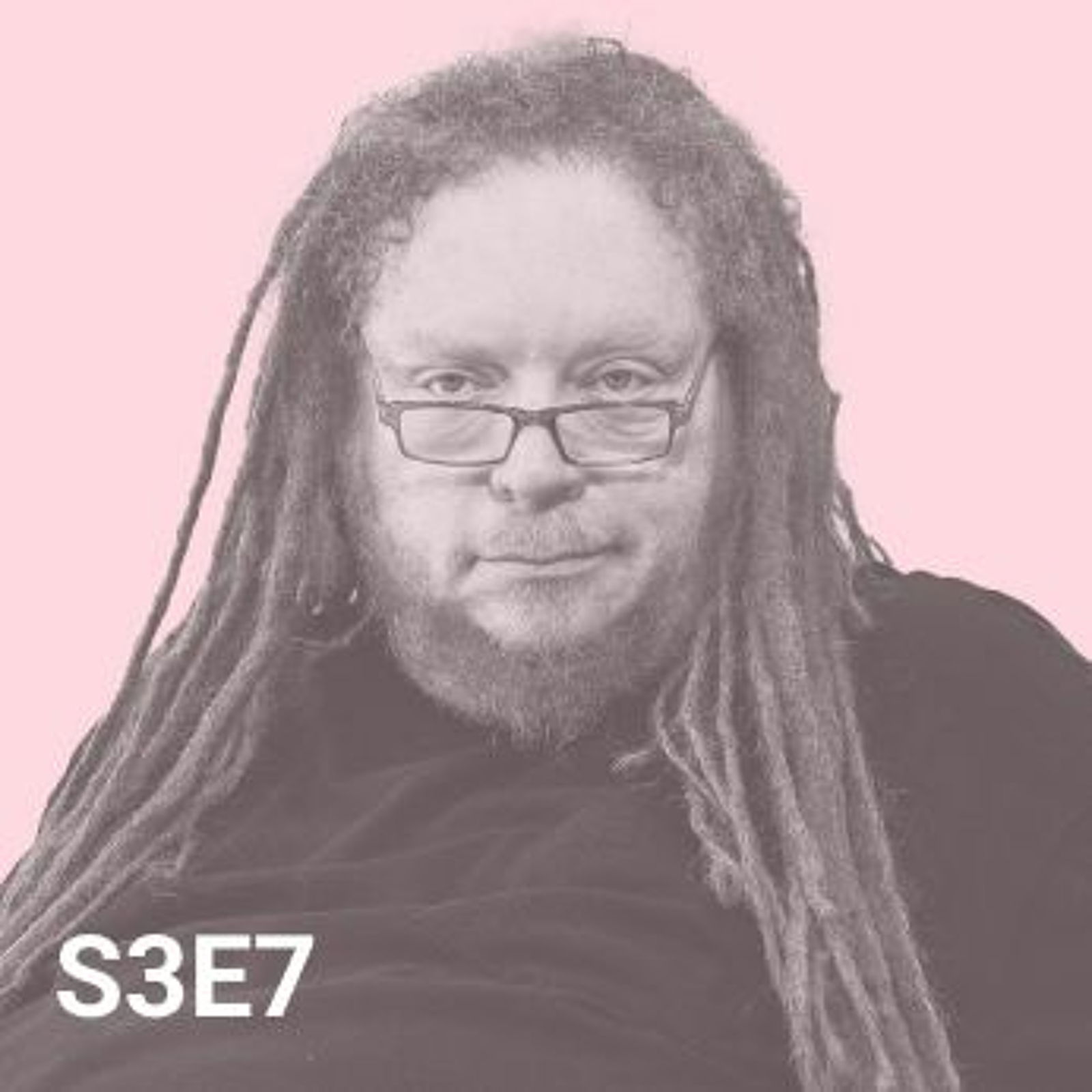
Greetings and salutations. I'm Josh Tyson, co-author of Age of Invisible Machines, the first best-selling book about conversational AI. Age of Invisible Machines explores the learnings of conversational AI veteran and OneReach.ai CEO Rob Wilson. Each week, Rob and I bring in a guest to continue the conversations we started in the pages of our book. This week on the Invisible Machines podcast, we're talking about how singularity might lead to supreme ignorance, the fight to repeal Section 230, which could fundamentally alter the way interactions online are incentivized, why we shouldn't be afraid of paying for content, and the critical moment in a VR experience when the user rejoins the real world. Our guest is Jaron Lenyer, who left Atari in the 1980s to launch virtual reality technology as we know it as co-founder of VPL Research. He's currently Microsoft's prime unifying scientist. Jaron is also an accomplished composer and artist, and his passionate takes on technology include a universal call to abandon social media. This is an episode that questions everything, including the questions themselves, so buckle up for a mind-bending chat with Jaron Lenyer.
Invisible Machines is produced in partnership with OneReach.ai. Their generative Studio X platform is the only orchestration platform that's been named a leader by every major analyst group. Enterprises and other organizations are already using GSX to create technology ecosystems where they can grow their own digital teammates called intelligent digital workers. These IDWs can be set to work with hundreds of customizable skills utilizing GSX's no-code building tools. Head to OneReach.ai to test drive an IDW and experience the next phase of generative AI. Jaron, wonderful to have you on the podcast. We are very excited for this conversation.
Well, thanks for having me. And Rob, a pleasure is always seeing you. Yep. I catch it. All right. Well, Jaron, we, we have quite a list of things that we would love to talk with you about, but we thought to kick it off, you know, we probably spent a lot of time on this podcast and I'm, I feel like out in the world, the discussion is kind of centered around all the ways that AI is going to change everything. So we thought it might be interesting to get your take on some of the things that aren't going to change as technology grows, you know, ever more sophisticated and we can now have conversations with it. What are some of the things that you think aren't going to change at all? Well,
I mean, I like to think of the future of how people are and what people do as being somewhat open-ended. So I don't like the idea of saying, well, I believe this is a constant and this is a way that people will always be the same. Because honestly, I don't think any of us are entirely happy with how people are. So I want to hold on to some hope that we might become a little better in some ways. But present...
Present trends would seem to indicate that a lot of the issues that have tripped us up in the past around bizarre ego and insecurity issues for a lot of people and capable young men being high on the list. Maybe those are sticking around and in a way seem to almost be the most immutable features as things change. But, you know. Once again, I want to remain optimistic. I think declaring, oh, this is definitely how it's going to be. I mean, some things we know. I'd be very surprised if computers compute the whole universe into some other state where it's no longer based on infinitudes and conserved properties and such things. And some of my colleagues...
have ideas in their heads about how we're about to sort of exit reality as we know it and computation will totally change everything very fundamentally. And I think they're incorrect about that. I think that's based on a misunderstanding of how computation works. But, you know, that's in a way criticizing such an out there idea that most people haven't even encountered. So I don't even know if it's worth doing. So that's something I think is wrong. But, you know, I want to stay open minded. I mean, I think people can become worse. But in the course of history.
somehow things seem to get better and one of the great mysteries is how that's possible since any freeze frame in history shows us being horrible and yet you put all the freeze frames together and we get a little better over time how does that work right is it our ideas is it something about um game theory as we see in setting the prisoner's dilemma is it some combination i i don't think we actually quite know how that works and uh so oh whatever it is i hope it keeps on going yeah yeah let's keep it going I can't help but see all the instruments in the back and go, we're always going to want to make music, right? Like, we've been making music for a long time. We're always going to want to make music. I mean, I hope that's true. I mean, it's like, it's an interesting question to say. Are there things that everybody used to like to do that we kind of gave up on that we just saw? It's an interesting question. I mean,
I, you know, like you might say, well, everybody used to make sacrificial offerings all the time in many cultures, if not all, in one way or another. And we don't do that. Or maybe we do. It's just that we've kind of maybe wasting a bunch of your income on a designer bag that perhaps isn't a fake. Perhaps that's our new offer. Like, I mean, these things are a little hard to nail down. And so music is such an undefinable, unclear thing. It's not clear to me what is music and what is. So it might be pretty hard to tell if the future has it or not whenever people in the future are around to look at it. Yeah, but...
Certainly something's different now than it used to be. I'm struck when literacy and the ability to publish became more prominent, people became more careful speakers. And if you look at how people, look, by all accounts, two centuries ago, let's say, they were speaking, or at least people were pretending they were speaking in full paragraphs. You see that today in some cultures where it arrived a little more recently, perhaps. I read occasionally Pakistani newspapers, and they're still in that. They speak in this very elaborate full paragraph mode, or at least they were until a few years ago. And so that's something that's shifted, and we just kind of gradually decided it didn't matter as much. Yeah, it's sort of like if you get to the heart of writing, it's not...
It's not writing. It's sharing ideas. And it's telling stories. And will we always tell stories? I think so. Will we always want to share ideas? I think so. I think that, to your point, the format might change. Is it a piece of paper in a book? Or is it the written language? Is it spoken? How we share ideas might change. But we're addicted to storytelling. We love to hear stories. And we like to feel connected to those stories. A story about our grandfather is more interesting than a story about someone else's grandfather.
People have the power to do that to ourselves. I want the future, and what you said remains true, so I'm with you, but we have to recognize it as a hope rather than a certainty. If you say, well, something's intrinsic to the way brains work. Well, we might change how brains work. Maybe brains will be filled with implants in the future or holographic energy patterns will be broadcast into them all the time and change their functions. So who knows? Maybe the modality of stories or navigation or any of the things that seem so intrinsic to our brains might shift. If you do something that's a radical shift that you might even call a singularity, what you're doing is you're rejecting feedback loops because you're saying this is a break. This is something so different.
that what happened before and what happened after aren't so connected. So a singularity means the end of feedback. It means the end of learning. And fundamentally, it means embracing ignorance. It means giving up on intelligence. It means giving up on information theory. It means giving up on organization. It means increasing a kind of a lack of cumulative wisdom. And so in that sense, I think it's in a literal way at a number of levels, the stupidest possible idea.
And yet it's embraced as this high-tech beacon. We'll have this singularity. It's like our GPS the moment you stop. You just do whatever it tells you to do. We're just going to follow it blindly. It's far worse than that. It's like a GPS where you've destroyed all the satellites with missiles. I mean, it's really, really bad.
I think there's an important distinction to be made. One can accept a highly radical future in the sense that you don't rule anything out. We say, maybe this will happen to our brains. Maybe we won't be individuals anymore. Maybe, maybe, maybe. All kinds of crazy things could happen. Maybe we'll start to live in a higher dimensional world than three and whatever.
anything you can come up with. I don't want to disallow any of those, especially if we have an open-ended future that might be quite distant. However, the thing I want to demand is continuity on the way so that feedback loops and learning and culture and science and intelligence and the very notion of thought, of coherence, of meaning that these things can be present on the journey, however radical the destination of the journey might be. And I think that that's the reasonable intermediate place to go. The problem isn't...
that we imagine features that are too radical, the problems that we imagine getting there through discontinuities that would, by definition, demand the absolute imposition of idiocy on everyone to the total extreme. That's the problem. So Rob and I actually were having this conversation last week about the notion of organizational AGI, where, you know, if you had an organization with a, I guess, a cognitive architecture that would allow people to converse with machines within the organization that kind of know all of the organization's business, like that it could develop this sense of kind of knowing, I guess, almost like a cephalopod or something, right? Where the brain is the body. And so it just kind of, even though someone in the marketing team is interacting with, we call them intelligent digital workers, like that intelligent digital worker also kind of knows what's happening in shipping because it's part of this organizational intelligence. But what was interesting to me that Rob said that I think connects with what you're saying is.
that these things will be somewhat deterministic because people are going to be designing these automations. People are going to be designing them, I guess, to protect business interests probably, but also to protect consumers and employees. And so there might actually be this human in the loop feature that's ongoing because as that sense of general intelligence evolves in an organization and then those organizations start talking and maybe that does lead to a broader AGI, the humans have been building upon it intrinsically in the trenches all along. So it does become less of like a separate entity maybe. Does that track for you?
Well, I mean, it doesn't because you're using a vocabulary that to me is nonsensical, so I can't even answer you. So I don't think of AI as creating new entities. I think of it as a form of collaboration between people. That's the only way to think about using it well. And so since I don't think AI is this entity that you talk to, I can't even address what you said. I understand you think that way, but I don't. And so to me, it's all a form of collaboration very clearly. And the sooner we see that, the sooner we can actually design useful systems. And I've just seen that consistently.
I don't think it does any damage to the importance of what's going on with the AI. In fact, I think it celebrates it. I think it celebrates the utility of the kinds of software advances we've had in the last year or two. So to me, there's only people. There's people collaborating this way or that way. One way is by contributing data to a large model. Another way is by something like Wikipedia. The distinction has to do with the algorithms involved, but the fundamental principle is similar. I think it works better when people aren't anonymized in the process, which is a principle we call data dignity for AI. But that's a point where reasonable people can disagree. I think imagining AI as an entity just confuses everything, though. Yeah, I agree with that. We sort of think of it in an anthropomorphic way, but same idea. It's not a thing. It's not a single thing. It's a...
It's a bunch of ideas that are oversimplified so that we can have conversations with people that understand or that do and just don't want to go through the long list of what it actually is, if it's anything. The thing that I was kind of centering on was... more the manipulation side of the tool. So I think what you're saying, or at least part of what you're saying is, you know, what we refer to as AI commonly now is a tool for exchanging knowledge and information as one of the things that it is between humans. And it's more efficient potentially than some of our existing tools for exchanging knowledge and information. And, but one of the things I've heard you talk about is the corruptibility of that through like an advertising model where now you have like a agenda or a agent.
in the middle that's got maybe not the end party's best interest at heart, but its own interest at heart and appears invisible. So its manipulation is not an overt awareness. And so I really dug in, I guess, connected with that idea that the advertising model in the middle of communication is super dangerous when you're trying to say it's just communication and you're treating it like it's just a telephone, but it's not because something's in the middle manipulating it and changing the message. I don't know if you have thoughts. No, I mean, sure.
This is something I've been writing about. It's weird. I was looking at some of my old essays the other day. I've actually been writing about this theme for 30 years because from before, we know the internet was barely a thing because it was so obvious that the way we were setting it up was going to lead to this and the way we were doing it. But at any rate, yeah, so the problem is we've designed the internet as a giant copying machine where you can copy data from here to there and then the, which...
wasn't similar to the copyright regime that preceded the internet. And the digital world really didn't like copyright, really wanted everything to freely copy. But then the issue with that is that then if you want to build a business, you have really only one kind of business model left for a lot of cases. There's some cases where you can still have unique data that other people can't copy. Like if you're a dating website, there are laws that protect the dating profiles or whatever. But for most stuff, your only choice is to rely on network effect to become one of the very small number of giant winners of the network effect game. So it's not like theirs.
you know, 300 companies that are half the size of Meta. Instead, it just falls off, right? And then the particular business model that's available is to get third parties, not the users, to pay you to use your power to either influence or route information to the users. And then that, in turn, creates a motivation to engage people as much as possible. And if you look at people in a natural setting, they can be engaged in a variety of ways emotionally.
In terms of the fastest responses that the algorithms respond to the most, it gets out of balance and it's the fight or flight responses. So you tend to have a lot of alarming inflammatory stuff that ends up making people vain and irritable and paranoid and all that. And we've seen that over and over again. And then that transforms politics negatively. It's like the cortisol driven messages. Yeah. Okay. I'll take that. And so that whole thing is really bad. A good thing.
is that the importance of big AI models seems to gravitate against that way of doing things at about the same time that possibly the only thing the American left and right agree on is that they don't like the companies that use it a lot. The last point of agreement in our society. And so the reason the AI models gravitate against it is you can use an AI model to get, in a way, a better result than a straight search. And it might have references, but people might not follow those. And so what that means is that the whole will direct...
will direct traffic to you and all that starts to cease to be a business model and there'll be widespread rebellion. And I think the companies that run the search realize that and realize I have to figure something else out. And so I think there's starting to be a little bit of hope that we can move the internet to some sort of an alternate methodology that's a little better for people. It might even happen pretty quickly because this thing is breaking pretty fast. I'll give you an example. I needed to find something really obscure about how to run a really tedious piece of equipment with a lot of details in it that had a whole bunch of owner's manuals for different revisions that were all really badly written. And I used our chat. I'm not speaking from Microsoft here, but I'm called the prime scientist at Microsoft. I tried our chat in Bing, which is similar, not quite the same, but similar to what you get from a direct open AI thing. And it teased it out and solved it for me. And I just couldn't do it with search strings. I just couldn't do it. So it's superior. It actually has a superior technology.
It's not, how can I put this? It gives it to you in one big gulp. Maybe Google can start putting ads next to the output of an AI, but it's really not the same. There's no way, like there can't be 20 ads next to a single unified AI output because nobody will see most of them. So the whole business model does really start to have to shift. My opinion, it'll shift for the better. I think I, of course, you never know. Sometimes people can come up with some unsuspected way to make things worse. You know, it happens, but you know, I'm going to be optimistic. Yeah, I mean.
I wonder if there's an age of also like manipulating the data that goes in, you know, now instead of putting it in Wikipedia, for example, so that someone would read it in Wikipedia, you can put it in Wikipedia so that it gets consumed by an LLM and gets spit out. Um, and so you're still putting it in Wikipedia, but in a way you're formatting it now for the machines. consumption versus the human consumption. There's a peculiar situation now where whenever you speak in a broad sense, whether you're adding some commentary online or uploading a whole video or documentary or doing a podcast like this, you have two...
audiences, if you like. One is the people who might receive it in one way or another, whether directly or indirectly. And then the other is whatever company runs the hub over which you're traveling. Your case might include something like YouTube. I don't know what you do, but something that seems plausible. So then the problem is that that second audience, which is this company, is very colored by this attention economy.
situation which gives them perverse incentives uh to um amplify or de-amplify things based on how well they engage and it's not there's some stuff that engages that's great but you know um statistically makes it more likely that crappy stuff will be amplified so um uh you would do better reaching people if i were sniper wolf right now and so i'm sorry i am not and uh but that is that is how you know that is how it currently works and so you have this other target um that has a perverse effect and I think ultimately shuts down speech. I mean, there's this perception that the current model maximizes free speech, which you see, for instance, in the way X has approached things. But in fact, it doesn't. What it does is it de-emphasizes sort of normal non-inflammatory speech and amplifies inflammatory speech. And so it is a form of censorship. It's a form of bias. And it's not entirely new in human history. It's just more so than it's been in human history for the most part. And I think we need to overcome it.
We, uh, we've been working with some friends at IDEO on sort of a skill that we're calling catch up at the moment, but the idea is that it can kind of scan Slack channels and then deliver a summary of what might've gone on that day to ideally save someone time or, you know, brain space. Uh, there's also like arc search, you know, which kind of lets you conduct a web search that kind of clears out some of the noise. And we've been thinking too about like. Could there be sort of a conversational interface that could somewhat shield you from kind of the poisonous aspects of social media and that maybe you could train it to prevent you from seeing things that put you into kind of a doom scrolling moment or, you know, protect kids from certain types of content and just could offer maybe a healthier relationship with that. Because there are people that I think would like to not use them, but need access to them for even like professional reasons. So I wonder if you see potential there. Well, I mean, it's the most inefficient way to do something.
There have been a few times where there have been drugs proposed that would make people feel ill if they took an illegal substance to block them. And I don't know, I mean, if absolutely nothing else works, but I mean, it always makes, or this also reminds me of carbon capture as opposed to reducing carbon emission. I'm not saying there's no role for it, but obviously the most important and most efficient thing is to go upstream to where the problem comes from and to try to reduce the problem. And then also, I mean... A lot of people propose the sort of thing you're suggesting, and then the question is, what motivates someone to use it? And so here we have a sort of a tragedy of game theory where...
You have a system where any particular bad actor is rewarded, even though overall everybody would do better if none of the bad actors were rewarded, right? So that's the kind of thing where there should be some sort of law or civil society remedy, you know, not just personal incentives because you can't really design them to work. So to get any particular person to say, okay, I will filter my stuff. I mean, I think some people will do it, but I think they tend to not be the ones who really need it the most. I mean, there's a little bit of that already. There's some people who use screen international limitation features built into...
you know, their devices or whatever. I don't know the data on how many people use it, but I doubt it's the majority. And so you really need to, in a situation where the individual incentives are to be creepy and crappy, there has to be the creation of law. That's why law exists. You know, I mean, that's exactly, you know, at any given time, the individual incentive is to go commit a burglary. And yet if you make burglaries illegal, everybody benefits and the society as a whole becomes richer and more happy, you know, and there has to be not just an after the fact kind of.
plug inserted it just won't get used very much there has to be societal agreement and in this case a very obvious way to start is to repeal section 230 so that you stop pretending that internet hubs are not what they actually are they're not just telephone networks they have to impose the selective amplification or de-amplification for the present business model and if you remove the incentive for the present business model then the amplification starts to decrease and then we can start to talk about free speech in a rational way right Yeah, I guess it's just this acknowledgement that any editing of the communication is a manipulation and therefore you're not a telephone company. We have to get to that point. I mean, otherwise we're lying to ourselves and that just doesn't work, you know? Right, right, right, right, right. Yeah, and if the manipulation is gone, does the revenue dry up essentially from the advertising that they can't manipulate? Does that make the channel less valuable to them or does it just leave them nowhere else to go? Well, you know...
Throughout the history of transverse world media, there have been multiple business models, and there still will be. It's just that this particular one of being paid to selectively amplify a route content is deleterious for society. So if we remove that one, then the other ones will come back into prominence. The term advertising should not be confused with what's going on now. I would say Google doesn't have advertisements. There's nothing. There's only manipulation if we see what. Actual advertisement would be what we used to call banner ads, where somebody wants to attach their ad to an article or something. But we do see it today with...
sponsor ads for YouTubers, you know? Right, right. And I don't know how well that's working out for the people who are paying for them. I'd be interested in that. But a lot of my favorite YouTubers run ads from someplace like Brilliant or whatever. And, you know, good for them. That is legitimate advertising. That's not manipulation and routing. And I have no problem with that. Zero problem. You know, we can't confuse the two things. Or another example, which is the thing that everybody's terrified of is pay for content, you know? And here, this is another game theory tragedy where if paying for content was normal,
there would be a lot more people earning from the content ecosystem than there are now. I mean, there are some, but it's much more of a kind of a difficult network effect. Before the internet, there were vastly more people, local news being an example. There were a lot more people who were able to make their way. The number of musicians who were making a living before the internet, as far as I can tell, was two orders of magnitude greater than at present, even though the illusion is that, I mean, there are a lot of people who make a living off it, but not compared to what there used to be. So the thing is, because people aren't making money from it, then they resent the idea of having to pay for it because that would be correctly perceived as being kind of unfair and out of balance.
But if they were paying for it, and they're also being paid for it, it would just make an expanded economy that would benefit more people. So it's a case where we need to make a leap from one energy level in a game theory situation, if you like, a higher shelf, a better game. That's a hard transition to make. And yet, like I was saying before, somehow in history, we seem to do it. Somehow people manage leaps. So I hope we do it again.
I can't have one vector to look at here in my mind is the whole centralization, decentralization component. It's sort of like centralization in a lot of ways can move things faster, but then creates like more power and more sort of whites. It's like blend algorithms that say, hey, if every inkjet printer bought their ink through some sort of algorithm and then all of a sudden the cheapest ink comes out and they all buy the same ink and everyone that sold ink that was slightly less goes out of business in one day, right? We have this like... it's like blunt everyone should eat carrots and now there's a run on carrots um and so there's like this move fast by centralization move slow by decentralization slower in some cases but is decentralization really like where this needs to go um yeah and network effect and this has this overlap i know you talk a lot about network and saying like is decentralization real like can it really happen Well, I have many dear friends who are really into decentralization. I personally think the whole topic's a bit of a distraction, like either whatever it is works better or not. And I think the question of what's centralized or decentralized is actually more fuzzy and harder to really determine than is often stated. For instance, people will say, well, blockchain's decentralized. On the other hand, there's an incredible plutocracy, more centralization in the ownership of Bitcoin than maybe any other currency, certainly more than gold, which it's supposed to emulate. And it's built in structurally.
So it would seem to me to arguably be the most centralized currency, not the least. And so it depends which way you want to think about it. So you can say, well, social media is decentralized because anybody can post. But on the other hand, there's a gatekeeper who routes and amplifies people selectively at the center. So is it decentralized or is it even more centralized than anything else I've ever spent? Well, the answer is both. And so I tend to not be interested in the question of centralization versus decentralization because I think any real world system will have aspects of both qualities. And it's a distraction to worry about which way to talk about it.
The right questions are, how well does it work? Who gets the power? What's its feature? Is it the staple? Does it lead potentially smoothly to better systems in the future if people decide they want them? Or does it resist any change once it's in place? There are all kinds of questions like that, that to me...
are the important ones. And I don't think there's any usable definition of centralization or decentralization, actually. In the left, we tend to have inherited a feeling that decentralization must be a good thing because historically, a lot of the things that people on the left like, but also libertarians, you know, they had a decentralized feeling, but as to whether they were actually decentralized, I mean, communism was supposed to be decentralized, but it turned out to be the most centralized thing short of, you know, an emperor system from the past. You'd be turned into it, you know? So...
I would caution you against taking the questions too seriously. I'm sorry to keep on asking the questions you asked me. No, I mean, maybe decentralization is one of those, or centralization is one of those things that won't change. You know, maybe that's as much as we all think it will. Maybe that's like music. I don't think the math of game theory or network effects will change. However, the way society interacts with those things can change and has changed. I mean, there are societies with varying levels of wealth and power concentration. They're not stable when they reach the extremes in either direction. But there is a range from, you know,
And you can argue about whether they're good or bad, whether they last or they don't. But I actually think if what you care about is the overall functional quality of the system and the question of how centralized wealth and power are, and a few other questions like that, which are different from whether the scheme is decentralized or not, I think you are asking reasonable questions and you can see a variety of answers online in different ways. And I guess the thing that's tricky is, especially when you're working in kind of a digital realm, which feels more pristine and platonic and mathematical, you want to say, what's the optimal? What's the ideal? And I can tell you, there isn't one. Right. Like maybe balances it. Maybe it's just yet again, right? It's balanced. There's a fuzzy cluster of okay solutions that are hard to compare. I think that's the reality in any complex system. There's no ideal, perfect level of taxation for all time. There's no ideal, perfect, you know, means of arbitrating.
online policies, you know, but there are clusters of reasonably comparable, reasonably survivable, reasonably functional options. And we have to be in there and something. So can you talk a little bit about network effect? Cause I really think it's, it's one of those critical sort of. things that sort of push against the utopia idea. Oh, yeah. Networking stack actually is a term that predates the digital networks. It was originally applied in thinking about telephone networks, although if you want to see ways to apply it, you can go back to ancient times. It had to do with trade routes and all kinds of things. So the idea is that sometimes if you have a bunch of components that connect together in some way...
when something's more connected, it becomes more valuable. And then that can become a self-fulfilling prophecy or self-reforcing looper becomes more and more valuable until at the end of the day, you end up with a small number of things that are vastly more powerful than everything else. And it's very hard to catch up with them or dethrone them. So really early, the Dutch East India Company had had the trade routes, it had the ships and gradually got more and more and more and more until it became this giant thing. So that's a network effect. And then in the digital, so in the pre-digital but electronic era, it was an argument about how phone, telephone, analog telephone systems develop.
and why there's sort of natural monopolies inherent in them. And it was one of the arguments that led to the breakup of the original AT&T, not the one that runs phones now, which just inherited the name. Although it's also become a beneficiary of network effect because effect is math. It's always going to happen. And then, of course, in the digital area, you have this very intense network effect where...
In theory, all kinds of people can start a new search engine or a new package, a new place to order goods and services to compete with Amazon or whatever. It's just really hard. It's just really hard because as soon as you build up some momentum, it compounds and it compounds and it compounds. It's really, really hard to start. You know, we have two major phone operating systems, Android and iOS. Starting a third one is really, really hard, even if you put a lot of money into it, because the network effects are just so hard to fight, even if people like it. And that's been tried a bunch of times. It's just really, really hard to do. So network effects become this giant thing that has to be acknowledged.
you can view them as being this distortion that's unfair, or you can just view them as a fact of life and work with them as just a normal thing, which I think is the right approach. I don't think moral judgment about them helps anybody, but I do think the way we regulate our society, the way we think, has to acknowledge that it's very real and it'll always be with us. Because it's math. Right. Math will continue. So math won't change. Yeah, yeah. Physics won't change. I think so. I mean, there's a slight chance physics could change. Maybe we're in some weird cubby hole where once we do the right experiment, we realize that we can change our little physics or something. I think it's very unlikely, but...
there's, it's at least slightly infinitesimally more conceivable than fundamental math changing. So let's talk about something fun, VR, and as it relates to this, like this scomorphic or anthropomorphic or whatever you want to call it, like, is VR more fun when the physics are the same with the real world? Or is it more fun when the physics are different and we get to float and fly? You know, it can go either way. In my opinion, The best uses of VR are two extremes. Either one where what you care about is getting something practical done or when you want stuff to be as weird as possible and see that that's the most radical possible art. I like both of those. I like the really practical stuff.
greatest honor in my career was being able to co-create the first surgical simulator that turned into a whole thing. And I feel really great about that. That's a super practical thing. Very challenging. Trying to accomplish something practical is hard because you have to deal with reality and reality is just really stubborn and doesn't care what's convenient for you. I love that. And then I like the really weird stuff. I like turning into animals and sharing bodies and making everything really strange. I love all that stuff. I still do. The part that is a bit iffy is the in-between of like what you see in every company's video pitches for their headsets.
Oh, you're going to be in here and you'll talk to people and do your email and watch your movies with a thing on your head. Maybe, you know, a little, a little. I've done a lot of it until fairly recently. I probably did more than anybody, but all bets are off now. Obviously, in the last few years. And...
I don't think people are going to overall want to be in it all the time for little things that they could just as do without it, just as easily do without it. I just don't, I'm going to be wrong, you know, I don't have, I don't have like some certificate as a guaranteed reliable protocol, but my own experience makes me to feel like the extremes make more sense in the middle. I'll tell you what I do believe though. The thing that's really magic, which a lot of the people who make and sell headsets don't seem to have fully embraced yet for whatever reason is, You can combine the latest generative AI stuff with virtual reality stuff, and you can be in virtual reality and ask for something and have it appear. So one of my research groups has been pushing on that for a couple of years. And if anybody's curious, they can just look up our papers at conferences. It's all open and published work. But the thing is, you've had some great successes. Actually, the coolest one isn't published yet, but it will be. So you can go in and you can say, I want, instead of saying, oh, is there a painting program where I can use my hands in one of the stores, in a meta store, an Apple store or something, you can just ask for it. Say, hey, I want to be able to paint in the air with my hands, and I'd like to be able to use my fingers to change this. And I'm like, it just appears. I mean, that we've done. That's an easy one. And so the question is, once you can do that,
I don't want to put developers out of work, but I want to bump them up to a higher level. I want that to become just ordinary and easy and available. Because I think if people can just ask for the simple apps they want, they'll discover what the headsets are for and waiting for an app ecosystem for people to code all this risk and upload the thing and get it approved. I mean, it's just like, I mean, it's just sludge, you know, and I don't think we need it for simple VR experiences anymore. Like we should really just move to prompt-based spontaneous generation of simple VR experiences. And I think, I think people will like that. And I think that'll become much more creative and interesting.
Cool. I've heard you talk to you about like how important that moment is with a VR experience where you take the headset off and reacclamates reality. And that, that struck me as really important too, because it feels like the technology hurdles have disappeared now. Like it probably would be conceivable to create a very, very realistic VR experience, but. how much value really is there in that if there's if like as you're describing like the real magic is in creating these kind of like out there yeah narratives or kind of like a maybe almost a stripped down version of reality well look i i try to i'm trying to find a difficult line to keep to here on the one hand i do want to express opinions and i want to be clear and honest about what i think but on the other hand i don't want to judge and certainly not prejudge other people and i want to be open to the possibility i'm wrong so my own take on what the best way to use vr is is what i just said um It'd be disappointing if I lived in a world where everybody agreed with me. That'd be boring. So there might be somebody out there who will make a fool of me on these points and more power to them. You know, like I think the key thing, and this is where the current model has failed us. And what I mean is the attention driving virality model that drives social media and so on. Where that's failed us is it creates perverse incentives for cruel and just sort of nasty creativity. And what...
I think if we can remove those perverse incentives, I think people overall would revert to their mediocre muddle of semi-decency that's gotten us through all these millennia pretty well. And I'd rather see that. And so I'm a little, this thing about whether VR could be used for cruelty, of course it can. And we've already seen some examples of that. Can it be used to mess people up, make people depressed? Yeah, sure, it can do that. Can we use it to do damage to people's cognitive development, physical development? Yeah, yeah, yeah. I mean, like, honestly, it's real. Anything that has any kind of power can be used badly.
I think we have to just be aware of stupid, perverse incentives that tend to bias the whole thing for the worse. And then we at least cut down the problem of the bad actors to more of a size where we can think about what's the best way to address them, you know, which might be a degree of tolerance or degree of enforcement or whatever, but we have to first not expand the problem. Yeah. Well, cool. This was a great conversation. We really, really appreciate it. I didn't, I got through half of my list. Yeah. All right. Well, thanks for being interested in talking to me. I appreciate it. Yeah, you too. Yeah, absolutely. Thanks for all you've done. All right. Bye. Bye.
All right. Well, thanks again for joining this ongoing conversation about conversational AI. Be sure to subscribe to Invisible Machines wherever you get your podcasts. And if you feel so inclined, please leave us a review on the Apple Podcast app. You can also watch these conversations on the Invisible Machines YouTube channel. This podcast is produced for UX Magazine in partnership with OneReach.ai. Over the past five years, our team of nearly 200 engineers, scientists, experienced designers, anthropologists, and linguists have been developing Generative Studio X, an award-winning platform that has the lone distinction of being named a leader by every major analyst group.
GSX is a complete environment for hosting, creating, analyzing, and scaling your own digital teammates called Intelligent Digital Workers. For an interactive demo of IDWs in action and to learn more about the GSX platform, head to OneReach.ai. This podcast would not be possible without the hard work and dedication of executive producer Elias Parker and producer Kate Timchenko. Our video and audio editor is Michael Lipanov, and we rely on support from the marketing team at OneReach.ai, including Allison Harshberger, Anastasia Nechitalio, and Vera Pekotko. Thanks again, and we look forward to connecting with you next week right here on Invisible Machines.