
EPISODE · Aug 6, 2026 · 1H 2M
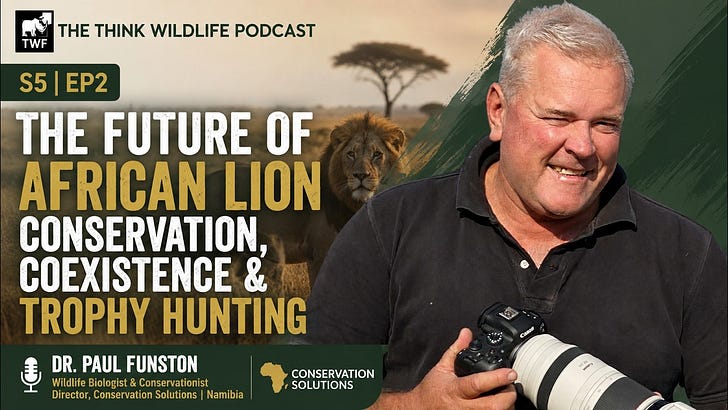
S5|EP2- The Future of African Lion Conservation, Coexistence and Trophy Hunting | Dr. Paul Funston
from The Think Wildlife Podcast · host The Think Wildlife Podcast
African lions have disappeared from over 90% of their historic range, and fewer than 25,000 lions remain in the wild. In this episode of the Think Wildlife Podcast, host Anish Banerjee is joined by Dr. Paul Funston, Executive Director of African Lion Conservation and one of the world’s leading lion biologists, to explore the science, conservation, and future of one of Earth’s most iconic predators. The conversation covers his decades of research on lion ecology, predator behaviour, conservation policy, and the challenges facing lions across Africa. It also examines the growing impacts of wildlife crime, the illegal wildlife trade, habitat loss, and human-lion conflict. The episode opens by introducing Dr. Funston’s career and the urgent conservation status of African lions.Dr. Funston reflects on how childhood experiences in South Africa’s protected areas inspired a lifelong career in conservation before discussing his PhD research in Kruger National Park, where he investigated lion territoriality, predator-prey dynamics, and how drought influenced buffalo populations and lion behaviour. He also reveals surprising discoveries about male lions, challenging long-held myths by explaining that they are highly active, efficient hunters that play a critical role in defending prides and maintaining territories.The discussion then shifts to the Kgalagadi Transfrontier Park, where Dr. Funston studied lion ecology in one of Africa’s most extreme environments. He explains how this research shaped his understanding of human-lion conflict.One of the episode’s central themes is the growing threat of wildlife crime and the illegal wildlife trade. Dr. Funston explains how the demand for lion body parts has increased across Asia, contributing to rising poaching pressure in protected areas such as Kruger National Park. He discusses the emergence of organised wildlife trafficking, international wildlife trafficking, and the role of international crime syndicates and transboundary crime syndicates in moving lion body parts across borders. The conversation explores why stronger law enforcement, wildlife law enforcement, intelligence-led investigations, and international cooperation are becoming increasingly important to combat environmental crime and protect Africa’s remaining lion populations.The episode also tackles the controversial captive lion industry in South Africa. Dr. Funston explains why captive breeding, captive wildlife tourism, canned hunting, and commercial lion facilities raise serious conservation, ethical, and animal welfare concerns. He discusses how restrictions on legal exports may have unintentionally increased incentives for poaching, creating new challenges for conservation authorities already facing an escalating poaching crisis.Another major topic is trophy hunting. Rather than offering simplistic answers, Dr. Funston evaluates the scientific evidence behind trophy hunting as a conservation tool. He explains why governance, protected area funding, anti-poaching investment, and effective management ultimately determine conservation outcomes, while arguing that many hunting landscapes across Africa remain severely underfunded.Moving beyond threats, the conversation explores what makes lions unique among large carnivores. Dr. Funston discusses lion social organisation, pride structure, territorial behaviour, and ecological adaptations across diverse African landscapes. He explains why lions remain remarkably consistent in their social systems despite living in habitats ranging from the Serengeti to the semi-arid Kgalagadi.The episode then focuses on human-lion coexistence, examining why lions often interact differently with people than other large carnivores such as tigers and leopards. Dr. Funston shares practical strategies for mitigating human-lion conflict, improving livestock protection, strengthening community engagement, and supporting coexistence between people and wildlife.Finally, the conversation covers lion rewilding, the conservation of Asiatic lions, recent advances in lion genetics, and Dr. Funston’s upcoming book and documentary project. He concludes by reflecting on more than three decades dedicated to conserving Africa’s largest predator and offers an optimistic vision for the future of lion conservation.If you enjoy conversations about African lions, wildlife conservation, biodiversity conservation, wildlife crime, illegal wildlife trade, poaching, rewilding, and large carnivore ecology, be sure to Like, Subscribe, and turn on notifications for future episodes of the Think Wildlife Podcast.Timestamps00:00 Introduction01:20 Getting Into Conservation02:11 PhD at Kruger National Park06:10 Kgalagadi Transfrontier Park09:20 Poaching Threats in Kruger13:57 Captive Lion Industry18:57 Trophy Hunting28:23 Lion Social Adaptations35:40 Mitigating Human-Lion Conflict39:24 Rewilding Lions45:04 Vantara and Asiatic Lions48:44 Lion Genetics Reclassification57:08 Upcoming Book and Film59:17 Career Reflections#AfricanLions #LionConservation #WildlifeConservation #BiodiversityConservation #WildlifeCrime #EnvironmentalCrime #IllegalWildlifeTrade #WildlifeTrade #WildlifeTrafficking #InternationalWildlifeTrafficking #LawEnforcement #WildlifeLawEnforcement #WildlifeCrimes #InternationalCrime #InternationalCrimeSyndicates #TransboundaryCrime #TransboundaryCrimeSyndicates #CriminalSyndicates #Investigation #Poaching #PoachingCrisis #CaptiveBreeding #CaptiveWildlife #AnimalWelfare #HumanLionConflict #Rewilding #KrugerNationalPark #Kgalagadi #TrophyHunting #ThinkWildlifePodcast Get full access to The Think Wildlife Podcast at anishbanerjee.substack.com/subscribe
Embed this episode
NOW PLAYING
S5|EP2- The Future of African Lion Conservation, Coexistence and Trophy Hunting | Dr. Paul Funston
No transcript for this episode yet
Similar Episodes
No similar episodes found.
Similar Podcasts
No similar podcasts found.