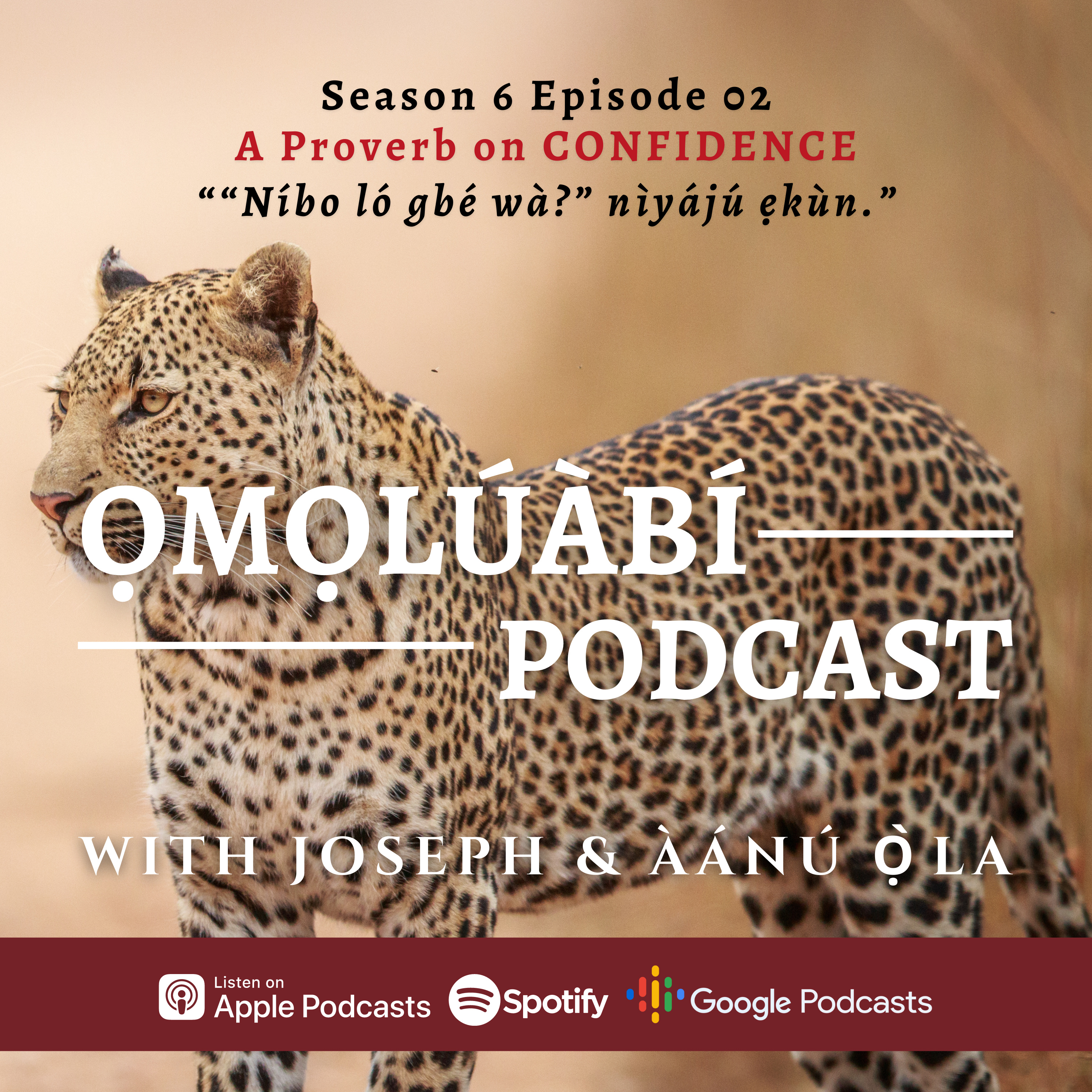
S6E02 - A Proverb on CONFIDENCE - ““Níbo ló gbé wà?” nìyájú ẹkùn.” episode artwork

EPISODE · May 13, 2024 · 11 MIN

S6E02 - A Proverb on CONFIDENCE - ““Níbo ló gbé wà?” nìyájú ẹkùn.”

from Omoluabi Podcast · host Joseph and Anu Ola

Omoluabi Podcast | Season 6 Episode 2 PROVERB CONSIDERED: ““Níbo ló gbé wà?” nìyájú ẹkùn.” (Translation: "[To ask] ‘Where is it?’ is a great insult to the leopard.") REFLECTION To put the proverb in context, imagine yourself in one of Kenya’s national parks. Your son has been looking forward to seeing his favourite animal—the leopard—up close in the wild. As your tour guide drove you around from place to place across the park showcasing various animals to you, you finally arrived at a vast expanse of grassland where you could see an animal with black spots as well as a lion and a black rhino. Your tour guide tells you, “Look over there! That’s the leopard.” You looked. You saw the lion, the rhino, and the other animal covered in black spots, but still, you asked, “Where is it? Where is the leopard?” The proverb we considered in this episode says, for you to ask such a question is an insult to the leopard! What kind of person would not be able to tell which is the leopard among a lion, a rhino, and a spotted animal? If the leopard could understand your language and heard you ask such a dumb question, it would probably teach you a lesson! Indeed, the leopard is a rather unmistakable creature in the wild, isn't it? That's the point of this proverb—one should be knowledgeable enough to avoid displaying ignorance about things they should know. But sometimes, in life, we do the exact opposite. We speak or choose to think in ways that reveal our ignorance! In our biblical reflection on this proverb, we offer two distinct interpretations of the proverb: 1. Living as a Christian and reflecting God's presence: Anu applies the proverb to the concept of Christian identity. Relating it to Romans 8:16 and 2 Timothy 2:4, she emphasises the importance of Christians embodying their faith in all aspects of life. Christians, like leopards, should be easily identifiable in any sphere they find themselves in. They shouldn't need to camouflage or compromise their identity to fit in. This perspective underscores the significance of living a life that reflects the indwelling presence of the Holy Spirit. 2. Awakening from Ignorance: Joseph takes a different approach. He sees the proverb as a way to highlight someone's ignorance. Asking "where is it?" about something obvious is a way to point out a lack of awareness. He connects this to the story of King Nebuchadnezzar, who forgot God's role in his achievements (Daniel 4:29-35). This serves as a caution against the human tendency to take credit for God's work, thereby diminishing His glory. This should prompt us to consider our own actions and speech, ensuring that we never rob God of the glory that rightfully belongs to Him. Furthermore, the episode highlights the subtle attacks on our faith, whether through external challenges or internal complacency. The devil will always seek to downplay the importance of faith for us in times of comfort or difficulty. However, a strong Christian identity, rooted in the knowledge of God, allows one to resist such temptations. “. . . the people who know their God shall be strong, and carry out great exploits.” (Daniel 11:32 NKJV) Anu's reminder to hold onto the truth of our identity as children of God, as affirmed by the Spirit, is both comforting and empowering. In the face of such attacks, there's no need to engage in futile arguments or attempts to prove our faith. Instead, we can find solace in the knowledge of whose we are. Key Takeaways: Christians should strive to live in a way that reflects their faith authentically. We should desist from acting in ways that reveal our ignorance of God’s all-pervasive role in our life. He alone deserves the glory for any accomplishments we may achieve in life. A strong Christian identity helps resist temptations that might lead one astray. Someone with a strong sense of self-worth wouldn't need constant validation. 
LISTEN TO THE EPISODE:  ✥ Our Website — ⁠https://www.josephkolawole.org/omoluabi  ✥ Other Platforms — https://pod.link/1550735589  FOR MORE RESOURCES FROM JOSEPH & ANU OLA:  Explore additional resources and content from Joseph and Anu Ola on various platforms: ✥ Linktree — ⁠https://linktr.ee/josephola⁠  ✥ Disha Page — ⁠https://josephola.disha.page/⁠ JOIN THE OMOLUABI COMMUNITY: Stay connected with us as we journey together towards becoming true Omoluabis — people of character and wisdom. You can like our Facebook page at ⁠⁠https://www.facebook.com/omoluabipodcast/⁠⁠ or join Alive Mentorship Group at https://www.facebook.com/groups/alivementorship. If you have African proverbs you'd like us to discuss in future episodes, you can submit them through our website — https://www.josephkolawole.org/contact or reach out on social media.  Till next time, remain an Omoluabi.

Omoluabi Podcast | Season 6 Episode 2 PROVERB CONSIDERED: ““Níbo ló gbé wà?” nìyájú ẹkùn.” (Translation: "[To ask] ‘Where is it?’ is a great insult to the leopard.") REFLECTION To put the proverb in context, imagine yourself in one of Kenya’s national parks. Your son has been looking forward to seeing his favourite animal—the leopard—up close in the wild. As your tour guide drove you around from place to place across the park showcasing various animals to you, you finally arrived at a vast expanse of grassland where you could see an animal with black spots as well as a lion and a black rhino. Your tour guide tells you, “Look over there! That’s the leopard.” You looked. You saw the lion, the rhino, and the other animal covered in black spots, but still, you asked, “Where is it? Where is the leopard?” The proverb we considered in this episode says, for you to ask such a question is an insult to the leopard! What kind of person would not be able to tell which is the leopard among a lion, a rhino, and a spotted animal? If the leopard could understand your language and heard you ask such a dumb question, it would probably teach you a lesson! Indeed, the leopard is a rather unmistakable creature in the wild, isn't it? That's the point of this proverb—one should be knowledgeable enough to avoid displaying ignorance about things they should know. But sometimes, in life, we do the exact opposite. We speak or choose to think in ways that reveal our ignorance! In our biblical reflection on this proverb, we offer two distinct interpretations of the proverb: 1. Living as a Christian and reflecting God's presence: Anu applies the proverb to the concept of Christian identity. Relating it to Romans 8:16 and 2 Timothy 2:4, she emphasises the importance of Christians embodying their faith in all aspects of life. Christians, like leopards, should be easily identifiable in any sphere they find themselves in. They shouldn't need to camouflage or compromise their identity to fit in. This perspective underscores the significance of living a life that reflects the indwelling presence of the Holy Spirit. 2. Awakening from Ignorance: Joseph takes a different approach. He sees the proverb as a way to highlight someone's ignorance. Asking "where is it?" about something obvious is a way to point out a lack of awareness. He connects this to the story of King Nebuchadnezzar, who forgot God's role in his achievements (Daniel 4:29-35). This serves as a caution against the human tendency to take credit for God's work, thereby diminishing His glory. This should prompt us to consider our own actions and speech, ensuring that we never rob God of the glory that rightfully belongs to Him. Furthermore, the episode highlights the subtle attacks on our faith, whether through external challenges or internal complacency. The devil will always seek to downplay the importance of faith for us in times of comfort or difficulty. However, a strong Christian identity, rooted in the knowledge of God, allows one to resist such temptations. “. . . the people who know their God shall be strong, and carry out great exploits.” (Daniel 11:32 NKJV) Anu's reminder to hold onto the truth of our identity as children of God, as affirmed by the Spirit, is both comforting and empowering. In the face of such attacks, there's no need to engage in futile arguments or attempts to prove our faith. Instead, we can find solace in the knowledge of whose we are. Key Takeaways: Christians should strive to live in a way that reflects their faith authentically. We should desist from acting in ways that reveal our ignorance of God’s all-pervasive role in our life. He alone deserves the glory for any accomplishments we may achieve in life. A strong Christian identity helps resist temptations that might lead one astray. Someone with a strong sense of self-worth wouldn't need constant validation. 
LISTEN TO THE EPISODE:  ✥ Our Website — ⁠https://www.josephkolawole.org/omoluabi  ✥ Other Platforms — https://pod.link/1550735589  FOR MORE RESOURCES FROM JOSEPH & ANU OLA:  Explore additional resources and content from Joseph and Anu Ola on various platforms: ✥ Linktree — ⁠https://linktr.ee/josephola⁠  ✥ Disha Page — ⁠https://josephola.disha.page/⁠ JOIN THE OMOLUABI COMMUNITY: Stay connected with us as we journey together towards becoming true Omoluabis — people of character and wisdom. You can like our Facebook page at ⁠⁠https://www.facebook.com/omoluabipodcast/⁠⁠ or join Alive Mentorship Group at https://www.facebook.com/groups/alivementorship. If you have African proverbs you'd like us to discuss in future episodes, you can submit them through our website — https://www.josephkolawole.org/contact or reach out on social media.  Till next time, remain an Omoluabi.

NOW PLAYING

S6E02 - A Proverb on CONFIDENCE - ““Níbo ló gbé wà?” nìyájú ẹkùn.”

0:00 11:16

No transcript for this episode yet

We transcribe on demand. Request one and we'll notify you when it's ready — usually under 10 minutes.

That Hoarder: Overcome Compulsive Hoarding That Hoarder Hoarding disorder is stigmatised and people who hoard feel vast amounts of shame. This podcast began life as an audio diary, an anonymous outlet for somebody with this weird condition. That Hoarder speaks about her experiences living with compulsive hoarding, she interviews therapists, academics, researchers, children of hoarders, professional organisers and influencers, and she shares insight and tips for others with the problem. Listened to by people who hoard as well as those who love them and those who work with them, Overcome Compulsive Hoarding with That Hoarder aims to shatter the stigma, share the truth and speak openly and honestly to improve lives. The Small Business Startup School – Business Notes | Financial Literacy | Retail Psychology – For Professionals & Entrepreneurs The Small Business Startup School Inc. Starting or buying a small business? While personal circumstances may vary, business patterns remain timeless. On The Small Business Startup School, we explore strategies, insights, and practical solutions to help entrepreneurs confidently navigate their journey.Hosted by Ola Williams—a retail entrepreneur, fintech founder, and financial coach with over two decades of experience—this podcast marries financial awareness and retail psychology with optimism to deliver actionable takeaways.Join us to learn, grow, and connect as we uncover the keys to business success.Let’s continue to learn together and be encouraged to keep on connecting! DIOSA. Carolina Sanper This podcast is a sacred space created by Carolina Sanper where you connect with your inner wisdom and embody your magnetic feminine power.It is the realization that the mystical realm is where you plant the seeds of your desired reality.It is a portal to your true essence: awareness, presence, and receiving with ease. Welcome home, DIOSA. 🖤 XXX Tech by SOVRYN Dr. Brian Sovryn The crossroads between technology, sensuality, and metaphysics - and the longest running anarchist podcast in the world! Brought to you by Dr. Brian Sovryn.

Frequently Asked Questions

How long is this episode of Omoluabi Podcast?

This episode is 11 minutes long.

When was this Omoluabi Podcast episode published?

This episode was published on May 13, 2024.

What is this episode about?

Omoluabi Podcast | Season 6 Episode 2 PROVERB CONSIDERED: ““Níbo ló gbé wà?” nìyájú ẹkùn.” (Translation: "[To ask] ‘Where is it?’ is a great insult to the leopard.") REFLECTION To put the proverb in context, imagine yourself in one of Kenya’s...

Can I download this Omoluabi Podcast episode?

Yes, you can download this episode by clicking the download button on the episode player, or subscribe to the podcast in your preferred podcast app for automatic downloads.
URL copied to clipboard!