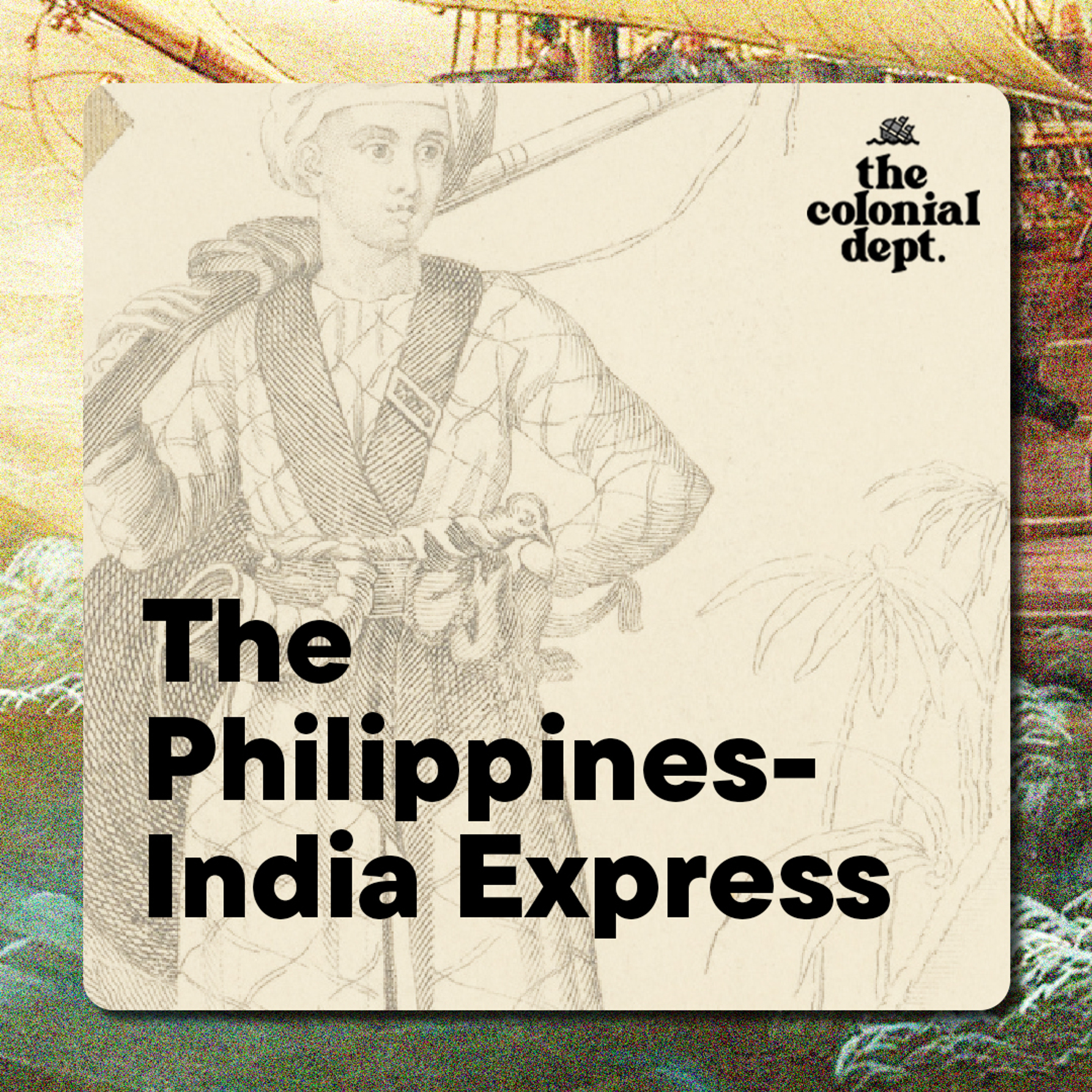
S8E13 The Philippines-India Express
The threads that connect the Indian subcontinent to the Philippine archipelago stretch back centuries. Some have been lost to time, survived only by goldwork and the testimonies of Spanish missions. Some survive as actual threads—as textiles that captured the fancy of Philippine residents. Some are remembered as painful history; an invasion engineered by empires, followed by a brutal and fruitless occupation. And some survive to the present day—in the words formed from our throats, and perhaps even the food that passes through our mouths. My book Silk, Silver, Spices, Slaves is now available on Shopee and Lazada for only P395. Support the podcast: patreon.com/thecolonialdept Follow us on IG: @thecolonialdept Follow us on TikTok: @thecolonialdept Email us: [email protected] Image Thumbnail: “Knave (Hyder Ali from Mysore).” Metropolitan Museum of Art. References: Rye, Ajit Singh (1981). “The Indian community in the Philippines: A Profile.” Asian Studies, 19, pp. 56-64. Quiason, Serafin (1966). English “Country Trade” with the Philippines: 1644-1765. University of the Philippines Press. Warren, James Francis (2021). The Sulu Zone, 1768-1898: The Dynamics of External Trade, Slavery, and Ethnicity in the Transformation of a Southeast Asian Maritime State (Fortieth Anniversary Edition). Ateneo de Manila University Press. Coo, Stephanie (2019). Clothing the Colony: Nineteenth Century Philippine Sartorial Culture, 1820-1896. Ateneo de Manila University Press. Sta. Maria, Felice Prudente (2025). What Recipes Don’t Tell: Philippine Food History in Fifty Words. Ateneo de Manila University Press. Legarda, Benito Jr. (1999). After the Galleons: Foreign Trade, Economic Change and Entrepreneurship in Nineteenth-Century Philippines. Ateneo de Manila University Press. “Paghinumdom: Retrospection of the Hindu-Buddhist Cultural Influences Based on Tangible Finds in the Caraga Region. (2022) National Museum of the Philippines. https://www.nationalmuseum.gov.ph/2022/09/30/paghinumdom-retrospection-of-the-hindu-buddhist-cultural-influences-based-on-tangible-finds-in-the-caraga-region/ Canta, Marilyn R. (2020) “[Golden Tara of Agusan].” In Encyclopedia of Philippine Art, Cultural Center of the Philippines https://epa.culturalcenter.gov.ph/3/82/2191/ Hontiveros, Greg (2017). “Beyond Gold: Hindu-Buddhist Cultural Influences Based on Tangible Finds in the Caraga Region.” Journal of History, 63(1). https://greghontiveros.wordpress.com/2020/09/19/beyond-gold/ La Follette, Cameron; Deur, Douglas; González, Esther (2018). “The Galleon’s Final Journey: Accounts of Ship, Crew, and Passengers in the Colonial Archives.” Oregon Historical Quarterly, 119(2), pp. 210-249. Angara, Edgardo; Madrid, Carlos (2017). The World of the Manila-Acapulco: The Global and Human Context. Vibal Foundation, Inc. “For All the Tea in China: The English East India Company.” (2023) Global History of Capitalism Project, Oxford University. https://globalcapitalism.history.ox.ac.uk/files/case33-englisheastindiacompanypdf Kehoe, Marsely (2026). "Gingham." The Dutch Textile Trade Project, edited by Carrie Anderson and Marsely Kehoe. https://dutchtextiletrade.org/textiles/gingham/
Embed this episode
No transcript yet.