
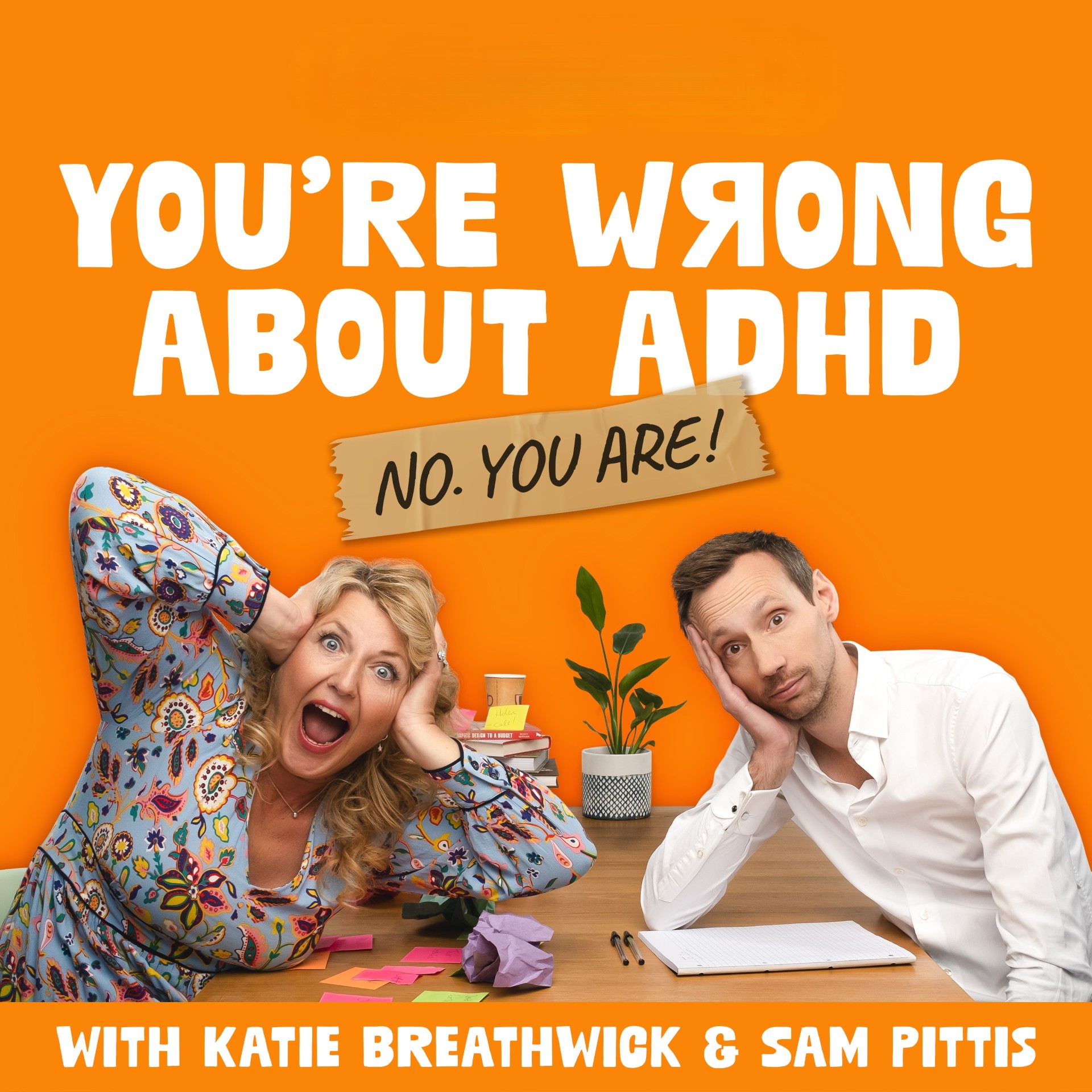
This is a global player original podcast. Hello, I'm Katie Brethwick. And I'm Sam Pritis. And welcome to our new podcast, You're Wrong About ADHD.
No, you are. No, you are. No, you are. This is stupid.
Stop it. Sam and I have been friends for nearly 20 years and a couple of years ago. We both found out we have ADHD. But I think it's fair to say we feel very differently about this.
Getting an ADHD diagnosis, answer lots of questions, but also raising new ones. Each week we're going to be talking about everything from our experiences, being diagnosed as adults, to relationships, coping strategies, and how we manage these very special brains. So we can learn more about ADHD and what it means to be neurodivergent. Well, hello, how are you?
I'm all right. How are you, Sam? Yeah, doing well. We've been talking so much about ADHD.
It's what we do here, after all. And we talk so much about how, yeah, hopefully it's useful to somebody else as well. It still really does feel like therapy, actually. It has felt like therapy.
At times. At times. I've learnt a lot. And I think one of the things we've been talking about is putting together a list of some of the things that we do, some of the things that suggested that maybe we could try of ways to manage ADHD, coping strategies, because there are loads out there, sometimes it could be a bit overwhelming, massive list of them.
And also I think there are probably things that we do where we don't even realise. Yeah, absolutely. And I think when I was first diagnosed, I met up with a young friend who had known that he'd had it for four, five years, and by this day, she was the expert in ADHD. And I took it out for dinner and basically said, tell me everything you know.
And it was a bit mind-blowing, because by the end of it, he had come up with a really long list for me to go home and think about. And actually, it was transformative. A lot of what he said to me was common sense, but was stuff I would never have got to on my own. I needed to be told, actually, you need to think about your organisation like this, this, and this.
So I found that really useful. I think it is a useful thing to share how you get stuff done. Definitely try things and see whether they work for you. On that note, we have a particular coping strategy that we suggested that the other should try.
I think we swear by. Yeah. What was the thing that you do that you suggested I do? I am an advocate and I'm an evangelist for this thing called the ADHD clock.
And if you go on to any search engine, Tapping ADHD clock, you will find this particular thing called an ADHD clock, which is essentially a timer. But it's sort of colour stuff in. It's very simple. It's made in a way that is really, really easy for ADHD people to use.
And it gives me volition. It gives me drive. So you set yourself five minutes and say, well, just start the job. I don't want to do the housework.
I could do five minutes. I'll just do five minutes of housework. And as soon as the along goes off, it'll beep. And then I can go back to doom scrolling like I was doing before.
And do you? Or do you actually find that? No, no. That's what's brilliant about it.
As soon as you're into it. The hyper focus hits and you don't stop. And so it's just been the most brilliant way of making me get up off my ass and get stuff done. And I give them to friends who are newly diagnosed.
And I've seen them as such a breakthrough piece of technology. And they're not technology. They're a kind of analog tool to help you get stuff done. Yeah.
So. Yeah. So. So I thought it would be a great idea for you to try one.
Yeah. And how was it, Sam? How did you get on with the ADHD clock? Well, I mean, technically I used it.
No, I mean, I bought one. I bought one. You didn't give me one. I bought it myself.
You bought the rainbow one, didn't you? I didn't. I didn't. Visually pleasing.
The problem was, yeah, right. After I'd done the work I needed to do. Oh, for God's sake. That is not the excuse.
I think I could see how I might use it. Well, that's great. So that's a no-user. Do you think you might?
Do you think it's like that? Honestly, it's annoying now because I pay for it. It's a six there. And it's got a rainbow one.
Why is she thinking my house? When can I put this in the bin? I'm not doing the thing I have to do. I do understand it because what he's actually doing is getting you over a psychological barrier.
So you can get them. Some people have them where you put five minutes of work, one minute of break time, or one minute of rest and ten minutes of work. You can almost pass it up your day like that. Yeah.
And I do totally understand the psychological barrier. It's almost like I don't want to do this massive task. It's too much. My head is swimming.
But if I tell myself I'm just going to do three or four minutes of it. Everyone can do two or four minutes. So I do use that technique, maybe without the clock. I probably am never going to use the clock.
I'm really honest. But thanks for the suggestion. My kids have it. It's got a rainbow on it.
Anyway, anyway. But I suggest you do something rather different. So let's see how you got on. Because I find I said this before, my ADHD often comes out in real bodily stress.
And exercise, I'm sure we'll talk about this good for that. But I do a thing called paired muscle relaxation. And you can find it online. You can find it in some exactly way.
But essentially, you breathe in and you clench your muscles, your pairs of muscles and work your way up your body. So you might clench your toes and then you might clench your legs. Generally, I tend to clench my fists and my upper body. And you breathe in and you hold it for a certain amount of time.
And then you let it go. And you work your way up your body. And what I find it does for me is, one it releases tension. It physically releases tension.
But it also focuses you on what you're doing. So that it's sort of mindfulness. I was about to say it's what people say mindfulness. And it is.
It is a form of mindfulness. It's bringing you into the present and the moment. So it's a physical release. But it also means that you're not suddenly getting distracted by anxieties or the hundreds of things you've got to do.
So I suggested that maybe you could try this in your own time. How'd you get on? I forgot. You forgot.
I forgot. And you know what? It was only when we were sitting here at that trick or podcast that I remembered you even asked me to do. And you were giving me grief at my ADHD clock.
At least I thought I'd remember to do it. Yeah. Anyway, I would love to try it other time. I'm like you.
It was already ruled out the ADHD clock. No. I was just thinking to go. I can totally see how the ADHD clock works.
What do you think about the muscle relaxation? Well, I don't have the same sorts of physical stresses that you do with ADHD. That sort of feeling, that kind of pent up feeling that you get. I don't get that.
And I wonder if what it's doing for you is something I don't necessarily have an issue with. But you know, I do think it's something that is probably a useful tool. I remember my mum used to do it. My mum who I think has ADHD.
When I was a kid, she used to do kick-fit and would involve me in those exercises. And we'd sort of lie on the floor and lift our legs up and things like that. And she used to do exactly what you described at the end of the exercise. And I wonder if that's the way she'd found her kind of doing with her ADHD.
I wonder whether actually mindfulness would be good for you. But let's save that. Let's talk about that. What other things you do?
Right. So I think this is a really, really important issue. I think the way that we cope the strategies that we find to mitigate our ADHD, that challenges our ADHD, is probably the most important question we can have. We find in positive ways to manage it so we don't do some of the negative stuff.
Everyone's brain is different as we discussed before. Everyone has different tools. Everyone's going to find different things useful. So I have made a list and I'm going to go through it.
And I got this list from my young friend who had ADHD. Some of those he gave to me, some of them I found along the way, some of them I've realized I've been doing for years without realizing that that's what they were giving me. But let's start with my meds because you don't take meds. I do.
Let's start with meds because for me they have been a key breakthrough. And I have found that if I wake up in the morning, I set an alarm, I have my meds on my bedside table. They have to be visible otherwise I'll forget to take them. The alarm goes off.
I take one and I go back to sleep and the meds help me wake up and help me put that crucial first foot on the bedroom carpet. So you use alarms? Do you use alarms to other things as well from this? Oh, I use alarms for everything.
So this was one of the tips I was given a really important issue. This was one of the tips I was given originally, which is smart phone, smart watch, smart everything. And if you can afford it, a good smart watch is the most amazing thing I have. My smart watch has a timer on it on the clock face and I use the timer all the time.
So if I put, say I put a wash in or I put the dishwasher on or I've hung out a wash to dry and I need to remember to bring it in before night. Or I need to get it off from school. Yeah, yeah, absolutely. Absolutely.
Picking the kids up from school. My God, that's three o'clock. The number of times I would only find it was three fifteen and I completely forgotten. Now I know I'd have alarms already set through the day and they'd be labeled.
I know they would call something specific. And more importantly, if I've just done a task and I need to come back to it, I will set an alarm. I've got a timer thing, a button that I press and it gives me options five, ten, fifteen, twenty minutes. And I will come back when I need to.
My watch and my phone are constantly talking to me all day reminding me about timekeeping. How else do you set reminders? What other things do you do? Because I found out email myself, which is really ineffective when I do it.
I need to find a much better, I need to just start using some sort of diary. What are you emailing yourself about? What are you emailing yourself about? What are you emailing yourself about?
I'm going to do this. Oh, I do that. I do that. Yeah.
So what's your system with lists and reminders? I have to. So one thing I've learned to my cost is keep all to-do's in one place. I know some things I think you don't need to do till Christmas.
Some things you don't need to think about till next year doesn't matter. It all has to go in the same place because otherwise I will put this on a to-do list and forget I've put them there and then I'll lose that list. And it's gone. All to-do's live in the same place.
They live on my phone, it's in a notes app and I have different sections on that list. There's a pending at the top, then there's a I need to do this now and then I have a line and under it is stuff to think about for the future. So I'll go down and look at that and then bring it up to the top. What about post-its?
I am completely obsessed with post-its. I have one of those like here draws to the right-hand side of my desk and the whole of the bottom drawer is filled with post-its because I'm so paranoid about running out of post-its. But when you've written on them, where do you put them? I screw them up and if you were sitting at my desk now and you look down at my keyboard, you would see post-its all around my keyboard.
But they are-it's like the brilliant thing about post-its is that you can move them. So I will write one thing on them like doctor's appointment. And if that's something I have to do today, it comes down to my right-hand side right down here where it's in my immediate visual space. If it's something that I need to do this week, it goes up at the top to above the keyboard.
And it's the fact that when I get up tomorrow and I sit down at my desk, I can look at those post-its. I can move them around and there is so much satisfaction. Having done a thing from picking up my post-its, screwing it up and it goes on the floor. And at the end of the day, I scoop up all those post-its and they go in the bin and it's just the most wonderful feeling.
I hate mess and I hate rubbish and I even hate just little pieces of paper. Could you not have a bin? I can't even have a post-it. I don't even like post-its.
Not being screwed up, I just don't even like them. I can't cope with them. It's too much mess for me. Listen to you and myself.
There are all sorts of diary planners out there. You can get AI assistant software to help you organise and plan diaries. You can get my mapping software when you've got a piece of work to do. It's a diagram, so rather than a list, it puts things into a diagram.
These are things which are designed to help people out. For some reason, I just find the idea of them. Some people consider it for listening to this. What we're describing is some system, but it's not, you know myself, you post it up.
It works for us and you've got to do what works for you. But I do wonder whether we should start using some of this technology to make things a bit more streamlined. To try, I remember the chat we had with Dr. Tony Lloyd from the ADHD Foundation.
I remember the subject of the white board came up. I was just stunned out around with my husband about my white board. It had become such an important part of my life and I wanted to put it up above my desk. He was my best friend to come to bed for midnight.
I had got to the stage where I was obsessed with it. My little bit of office, the bit of the house I've made into my office is right in the middle of the house. Sort of in the hallway. It's a bit of a room of one's own thing.
I don't have a room of my own. I'm sort of in a corridor essentially. My husband didn't like the fact that there was a white board there covered with all of our private life. But everyone to see.
That's a fair comment. That's a fair comment. The moment he suggested taking this thing away, when I said I had a meltdown, you have no idea. I absolutely.
I completely lost it. I now realize that that was emotional dysregulation, that I found a way of dealing with my ADHD. As Tony described it, Tony, Dr. Tony Lloyd says, the white board is the most brilliant visual representation and you can rub it out and move it around.
He took the white board away a day when I wasn't at home. I still don't know where it is. You can bet the day that we recorded that podcast I went home to him. That was a thing that was helping me with my ADHD.
That's why I have meltdown. You just took this thing and nicked it. This is why I went to the podcast. You can get one over on your husband, Brilliant.
I had a really good advice from an ADHD coach actually who said, sort of goes back to the ADHD clock, having different areas in the house. I think this will work for people without ADHD actually. For work, for looking at your phone, for eating, so that if you're working for home, for example, you're not saying, well, I'll just finish the team out in front of the telly, or you're sitting in your office eating your lunch and then suddenly you find yourself on your phone and then hours gone. So what he suggested was, if your office is only for work and nothing else, then that ability to start is that when you're in your office suddenly, it's a habit and your brain says, this is where I work.
And there's no option to look at your phone or to suddenly do the online shop or to do something else. So if you're just for work, I can see for me how that would work, I think. Has it worked for you? Have you given it?
I'm not tried it. You see that? And that's the thing, because I sit here listening to you and I actually feel itchy. Really?
Even considering it as an option. Why? Because I'm thinking about all the different places where I do stuff. So, for instance, when we watch telly, I also look at my phone and I have my laptop open.
My husband thinks it's hilarious. That's ADHD. I do. I do.
I tell the difference is boring. I love telly, but it's boring and it only entertains me so far. So I also have to have a sidoku up and I also have to be doing online shopping. I can get t-shirts and socks.
You can look at social media and stream on your phone at the same time. Oh! Oh, Channel 4! Channel 4!
You can see what I can watch on the phone and be on social media and have my laptop open and have it telly on at the same time. Same! Same! And that's when I feel fulfilled.
So the point about that is I think what we've just described is perhaps not the most healthy situation. I need to do all of those things in all of those spaces. I need to be doing all of them all at the same time. But we don't need to be looking at social media for ages and ages and ages.
No. So what do you do about that? Do you have limits on your social media? No, I'm really bad actually.
That is what I'll do. I'll think I just need to check something. And then, you know, I'm chilling at videos and watching these come by. Yeah.
Two hours. If I took away the option to do that, I think that really would help. You know all of these things are more easily said than done. You can see how it would work.
Do you know what, that's the thing for me. It's more easily said than done. It's all very well. But my husband has all these clever things where he switches off the internet between the hours of seven in the morning and one o'clock in the afternoon because he suddenly we realise that he was being distracted by the likes of Facebook and etc.
So he switches them off! I can't! I can't switch them off. I don't entirely agree with that.
I'm in the same place as you in that I feel like, but you can. I can't. I can't. I don't want to.
Yeah, but that's very different. That's very different. I don't want to. It's very different to I can't.
I don't mean to be the parental voice who suddenly crushing your childhood ADHD as I sounded like them, but if you were to say my phone doesn't come to the bedroom with me or my phone doesn't come into the office with me, you know, I'm going to take away the option. It's what I mean. The temptation is not there. No, please don't take away the option.
Why not? It's the thing that gives me entertainment and stimulation. You don't need that one. You don't need that one.
You try to work. I do. Maybe something to think about. No, no, I do.
I have a friend who is very calm and she and I walk our dogs together and she is one of these people who kind of advises people on insomnia, right? I'm struggling with insomnia and I said to her, I was at the time and I said to her, you know, this is this is what's happening and she said, so what you need to do is obviously you need to leave your phone downstairs. That's obviously going to be interrupting sleep and you're going to reach for it in the middle of the night when you wake up. Actually what happened was I woke up following morning at 2.30.
Late there feeling clenched like you talked about earlier. Maybe that's when I need to do the muscle. Well, I think I think my buddies would really help you with the work. And ended up going downstairs, finding my phone and then sitting on my computer and looking at social media on a massive screen rather than being in bed where I would have looked at social media for 20 minutes and then got back to sleep.
What I have done is switched off the blue light thing so that it's sort of yellow. It goes sort of urine, coloured yellow at night time. I think that has definitely made a difference. This is all about finding off from the simulation elsewhere.
So I do exercise and I do swim once a week. What I've realised is I need to do much more intense exercise. I need to do something else and I exercise is a big part of coping with ADHD because you are releasing that. So that desperate stimulation for entertainment on your phone at bed time is reduced if you are getting out of your system during the day.
And I find I'm really bad at that. Again, it's a similar psychological barrier. I will say to myself, I don't want to go swimming. And I say, well, you know what, pretty things in the car drive up there.
Just getting the pool and if you only do one length. I'll let you never have a bed. Get in and soon you don't want to leave. But it gets me there.
And it's taken me years to be convinced that I need to do exercise because to me it's always felt like I'm already bored. I agree. I'm the same. I'm the same.
But I think at the point where I was mentally not coping, I suddenly realised that this thing was a lifeline. But I need to find some new high intensity exercise. I've talked about doing squash. I mean, that just sounds like my life crisis.
Doesn't it go to police squash and carried out by some John's ambulance? What do you do? Well, so I this was not a surprise for you to learn, but I was allergic to exercise for most of my life. I mean, I was the kid who was messing around in Pee-Caht, my Pee-Tee-Tee-Tee.
I didn't blame her. I just don't know. I found it so boring. I found it so boring.
Now, today we're going to learn a throw ball for God's sake. So I was allergic and I found it boring. I've always found it boring. Actually, in my late twenties, when I could, for the first time before to join a gym, I remember that feeling of hang on a minute.
If you've got Telly to watch while you are walking or running, that changes everything. It changes everything. And actually, that's another tip is distraction. Distraction is huge for me to do it when it comes to exercise, doing the housework, doing anything boring, find a way to distract yourself.
Now, for me... Listen to that wonderful podcast, right? You're wrong about Haiti, too. Exactly.
Podcasts, audiobooks, I love. I will find I've spent two hours clearing out one of the boys' cupboards. And for exercise, it's exactly the same thing. I realized walking is what I love.
Yes, it's slow, but the stuff to look at as you go. And I can listen to an audiobook, I can have the dogs with me. And at the end of it, weirdly, walking is a good calorie burn. It's not surprising.
It's a good... For me, a good 8M mile walk. I love it. It just gets all the blood pumping.
If you go somewhere nice, you've got the exhilaration of what you're looking at. Yeah. Oh, if you go somewhere beautiful. There's nothing...
Absolutely reaches the intensity level for me. I can really agree on a beautiful sunny day and gorgeous, all some colours. Yeah. Do you ever set a time plan how you're going to do a job?
No. No. Do you? No.
I can't. It's another thing. I couldn't do that. It just feels like extra work to me.
I've got to do another work before I start. Yeah, it makes me feel itchy. But yeah, looking down my lips... I'm looking down at my lips.
I could work, though. Because it's all about the psychological barrier, as I said. So if you get yourself to a place where you say, I've got this thing I need to write or I've got this bit of work I need to, you know, suss out, if I break it down into pieces, take two minutes to plan doing this bit and then this bit and then this bit and then this bit, and maybe I'll do this bit today, this bit later, that would work the same way, wouldn't it? It would take a pressure off.
Yeah, but great. It will never happen. But thinking of other little tips, one thing I have discovered is how you store the things the important things you need. So if you were brave enough and you weren't too embarrassed to do it, I have a friend who does, you could wear a lanyard and on that, she has all of her bank cards and she has her house keys and her card keys.
And all of them are in place, she never takes it off, she puts it on in the morning, she lives with it on all day, she takes it off at night. I have found these brilliant, they look like sort of gun holsters, but they're for phones and I have two or three of them and they, I put my phone in it in the morning and I am at home with it on all the time. And it just means that I, because I'm constantly losing my phone. That's another thing about the brilliant watch that I have, it has a little button that you tap it and my phone will ring.
That's saved my life and saved me probably two hours a week. But you know, it's about having places for things and I mean, I go to the extreme, we've talked about this before on the podcast, I have at some point over my life developed a sort of obsessional, tidiness and organisation. Everything has its place. Yeah.
And I tend to say this to my children and say this to my wife, because I'm slightly obsessed about it. If I put something down in the place where it lives, then I'll always know where it is. If I put my phone down, randomly, I'll never find it again. So you don't put your phone down?
That is probably the only thing that I do that with and every time I do it, I think, this is why I'm so organised. Yeah, it's quite hard to live with that though, isn't it? Because there are other people who need to use those things. Yeah, I think you have to say do other people, you have your own rules, but for me, I need to get to know that.
That's definitely a learning experience. It's not imposing it on my family. Going back to planning, I think I actually ties in quite nicely with mindfulness, to go back to that as well. It's one of those things where someone said mindfulness to me, four or five years ago, I'd have been water you talking about.
Breathing, of course I breathe as I do. But again, having been through a diagnosis, having been through some relatively crisis moments, I'm totally convinced by it. If I'm getting really overwhelmed or confused, I do a breathing exercise. It could be just that suddenly there's loads of things to sort out, or suddenly there's a crisis with children, or suddenly I'm just really overwhelmed physically, and I'm ahead of time to go online.
What this does is essentially say, I'm not going to try and sort the problem out immediately. First thing I'm going to do is calm myself down. Now logically, it makes absolutely sense, because everybody does that. If you're faced with a panic situation, the first thing you try to do is take away the panic.
And essentially the one I use is that I do deep breathing. So you breathe through your nose, and then you breathe out deeply through the mouth. And the idea is just to focus on the breathing. Now your head obviously shoots off in different directions.
I can say, how do you concentrate on the breathing? You don't. Because what you do is you don't put pressure on yourself. You don't say, or you failed, or you haven't done it.
You just say. And it's okay to have thought in your mind. Well, what you say to yourself is, okay, I am worried about that still. I've just thought about that.
I'm going to bring myself back to the breath. And you just keep doing it. And even when your head says, yes, but that fire's still burning over there, you know, figuratively. You still say, okay, but I can't sort that out yet, because I am not in a situation where I can.
And what you're then doing is bringing your attention back to the breath. And all it does is calm the body down. Now, when someone first told me about that, I was like, this is just some sort of mumbo jumbo. What it's explained to me is actually being about the nervous system and about activating the parasympathetic nervous system.
So when you're stressed or in danger, your sympathetic nervous system kicks in. So it's like fight or flight, right? So your heart rate increases, blood flows to the body. You get ready, sort of on edge.
Meditation for some people, mindfulness certainly, it's the parasympathetic nervous system. And what that does is calm you down. And it changes your attitude from fight or flight to this is crisis to, I've calmed myself down. That makes perfect logical sense, doesn't it?
Because when you're panicked, when you're fight or flight, when you're heightened, you can't actually deal with things. And it may sound, in all of these things, you think, well, how do we do these? Because the whole point is going to be ADHD. I'll be honest with you, I'm almost feeling, I feel almost like a failure listening to you because, because I have tried to do, whenever anyone has sort of talked about breathing exercises in the past, they talk about emptying your mind, I can't, I don't know what that means.
So what, first, don't feel like a failure, because look, I don't do this as often as I should. The idea is that you do it regularly. With all of this stuff, the idea is it becomes habit, it has second nature. Has it?
Do you know what? When I'm at crisis point, it does. It would be better, I think, if I could do it more, so I could do it the rest of the time as well. Just gives you that beat, that moment, to pause before you react.
And I find it really, really helpful. That is really interesting. Yeah. The other thing I usually, if I'm really overwhelmed and over the top, I get a cold shower, and it does exactly the same thing.
Oh, well, yeah, cold water therapy. Something, yeah. That definitely works. And that is about kind of, you know, switching the brain on and invigorating the body.
It does wonders for the immune system and all sorts, doesn't it, cold water? I love cold showers. I don't love them, but they really, really work. Yeah.
So do you think, I mean, I don't think we're failures, but I think we're just being honest. We do seem to have talked far, far from now about stuff that we don't do. I suppose the point was I got to a crisis, and therefore I had to do this stuff, and found that it did work. So I'm totally convinced that it works, but it does take sometimes just trying different things until you find something works for you.
It does. And you prepare to go and try some of this. Oh my god. Well, I'll say yes now.
Let's see if I actually remember to do it. But actually what you just said was incredibly persuasive. And maybe I need a bit of the calm that you were describing in my life when things are getting a bit much for me. It's about remembering to do it.
So I have to make sure it goes on my to do list, and maybe set an alarm for it. But that's the thing. The more you do it, the more it does become second nature. And the other thing is not to beat yourself up when you don't do it, or when you forget to do it.
So the ADHD clock's on. So I, having been convinced of how it may work, will have a go at using the ADHD clock. And you try some pet muscle relaxation. And we'll report back how about that.
Yeah. All right. Let's go for it. It's a deal.
Well, I was going to say that's everything from us today, but it's not. No, because obviously I forgot to mention a couple of key things. First thing really quickly, write everything down, write everything down, write everything down. The moment you think of it, don't think, oh, I'll remember that when I get home.
No. Get your phone out, make a note there and then. That's the first thing. Another one, say things out loud.
So when I'm, it's always the washing. I want to talk about the laundry so much. When I'm putting the washing in, I say to myself, take this out in one hour. And for some reason, the vocalization really helps me.
My final tip. And this is a really important one. If yourself a break, you will fail. You will, for short, you will make mistakes.
It's OK. And there will be days when you will wind up in bed, feeling like rubbish and knowing that you're letting everyone down. That's OK too, because tomorrow your energy will be back and you'll be back on the treadmill being great. I totally agree.
Is that everything? That's everything. You can listen for your wrong about ADHD for free on Global Player. Download it from the app store or go to Global Player.com.
See you next time. This is a Global Player Original Podcast.