
EPISODE · Jun 8, 2026 · 1H 48M
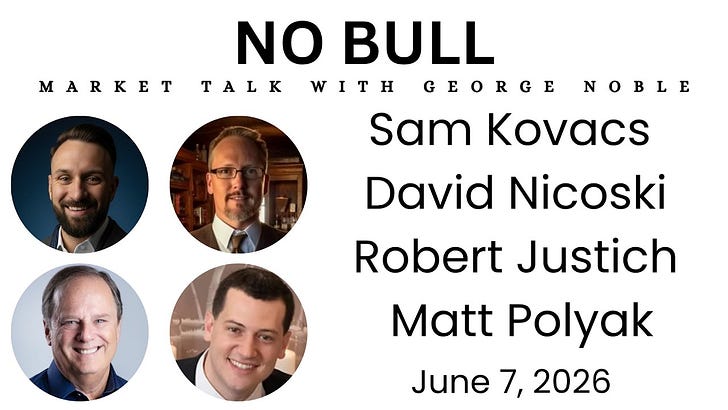
Sam Kovacs | David Nicoski | Robert Justich | Matt Polyak.
from The Noble Update Podcast · host George Noble
1. Strategic Actions and Decisions* Monitor Cushing Inventories as a Leading Indicator: The most immediate catalyst for an oil price spike is not headlines, but the physical drawdown of Cushing, Oklahoma storage tanks toward their 20-million-barrel operational floor. This mechanical squeeze will force a price spike regardless of geopolitical headlines. [00:03:23]* Re-evaluate Portfolio Concentration Risk: The market’s narrow leadership (Mag 7, AI trade) represents a risk management failure. Shift focus to sectors showing basing patterns and relative strength, such as industrials (steel, aluminum, truckers), which have demonstrated significant alpha outside the dominant tech narrative. [00:35:12]* Reduce Exposure to Speculative Tech and Photonics: The recent parabolic moves in AI-adjacent and photonics stocks are showing classic exhaustion signals. Executives should avoid these narratives and consider reducing holdings given extreme valuations and the disconnect from underlying revenue generation. [01:05:33]* Prepare for Energy Exposure via Refiners and Heavy Crude Assets: Capital should be positioned in assets that benefit from the current dislocation, including U.S. refiners (MPC, VLO) with Gulf access and Canadian heavy crude producers (Suncor, Imperial) that gain as the WTI-Canadian differential compresses. [01:30:35]* Plan for a Delayed and Expensive Supply Response: Even if a deal is struck imminently, the physical reopening of the Strait of Hormuz will take months, while restoring global strategic reserves will take years. Energy prices will likely find a permanently higher floor post-crisis, forcing a rethink of cost structures. [01:40:18]2. Executive SummaryThe energy market is facing a critical, underpriced supply shock driven by collapsing storage at Cushing, Oklahoma. Refiners are running at 95%+ capacity to capture record crack spreads, creating a mechanical floor that will force oil prices higher within 30-50 days. A reopening of the Strait of Hormuz appears unlikely due to divergent strategic incentives between the US, Israel, and Iran. Simultaneously, the AI trade shows classic exhaustion signals including parabolic moves, extreme volume spikes, and 50%+ of the S&P trading at greater than ten times sales, presenting a significant risk of violent mean reversion. The strategic action is to overweight energy (refiners, heavy crude) while aggressively underweighting the concentrated tech narrative.3. Key Takeaways and Practical Lessons1. Market Narratives Often Ignore Physical Mechanics: The market remains sanguine despite Cushing inventories heading toward zero because the narrative fixates on headlines rather than the physical impossibility of moving new barrels in time.* Practical Lesson: When physical buffers including storage and refining capacity are exhausted, price must clear the market. Monitor Cushing weekly data, not just Brent futures.2. Don’t Fight the Last War’s Incentives: Attempting to predict a peace deal based on economic pressure fails because Iran prioritizes ideological survival via conflict over economic relief, while Israel views peacetime merely as preparation for the next war.* Practical Lesson: When assessing geopolitical risk, analyze each nation’s written national security strategy. If survival requires conflict, price will not respond to sanctions relief.3. Parabolic Moves Resolve Violently, Not Sideways: The AI and semiconductor trade has experienced a 40% move in ten weeks on low volume, followed by an outside reversal day on record volume. This technical profile signals an exhaustion move, not a consolidation.* Practical Lesson: If a stock is trading at thirty times sales and up 100% in twelve months while its peers show relative weakness, the correct action is to de-risk, not to debate long-term fundamentals.4. Free Cash Flow is the Ultimate Truth Teller: Energy constitutes only 3.2% of the S&P 500 but generates over 12% of the index’s free cash flow. This dislocation is historically unsustainable.* Practical Lesson: When a sector’s weight in the index is a fraction of its cash generation, capital will eventually rotate. Screen for sectors where the free cash flow yield is severely disconnected from the index weight.5. Supply Chain Restoration Follows a Different Timeline: Politicians promise immediate relief, but physical supply chains require six to eight months post-agreement to return to pre-crisis flows, and years to rebuild depleted strategic reserves.* Practical Lesson: For any commodity crisis, subtract three months from the political timeline. If a peace deal is announced in June, the physical supply shortage will likely persist until the fourth quarter or first quarter of next year.Follow Sam Kovacs on X here - @SamKovXFollow David Nicoski on X here - @davevermilionFollow Robert Justich on X here - @ReswotFollow Matt Polyak on X here - @hmnbdmntcrstWatch on Youtube Below - This is a public episode. If you'd like to discuss this with other subscribers or get access to bonus episodes, visit georgenoble.substack.com/subscribe
Embed this episode
Ready to play
Sam Kovacs | David Nicoski | Robert Justich | Matt Polyak.
No transcript for this episode yet
Similar Episodes
No similar episodes found.
Similar Podcasts
No similar podcasts found.