
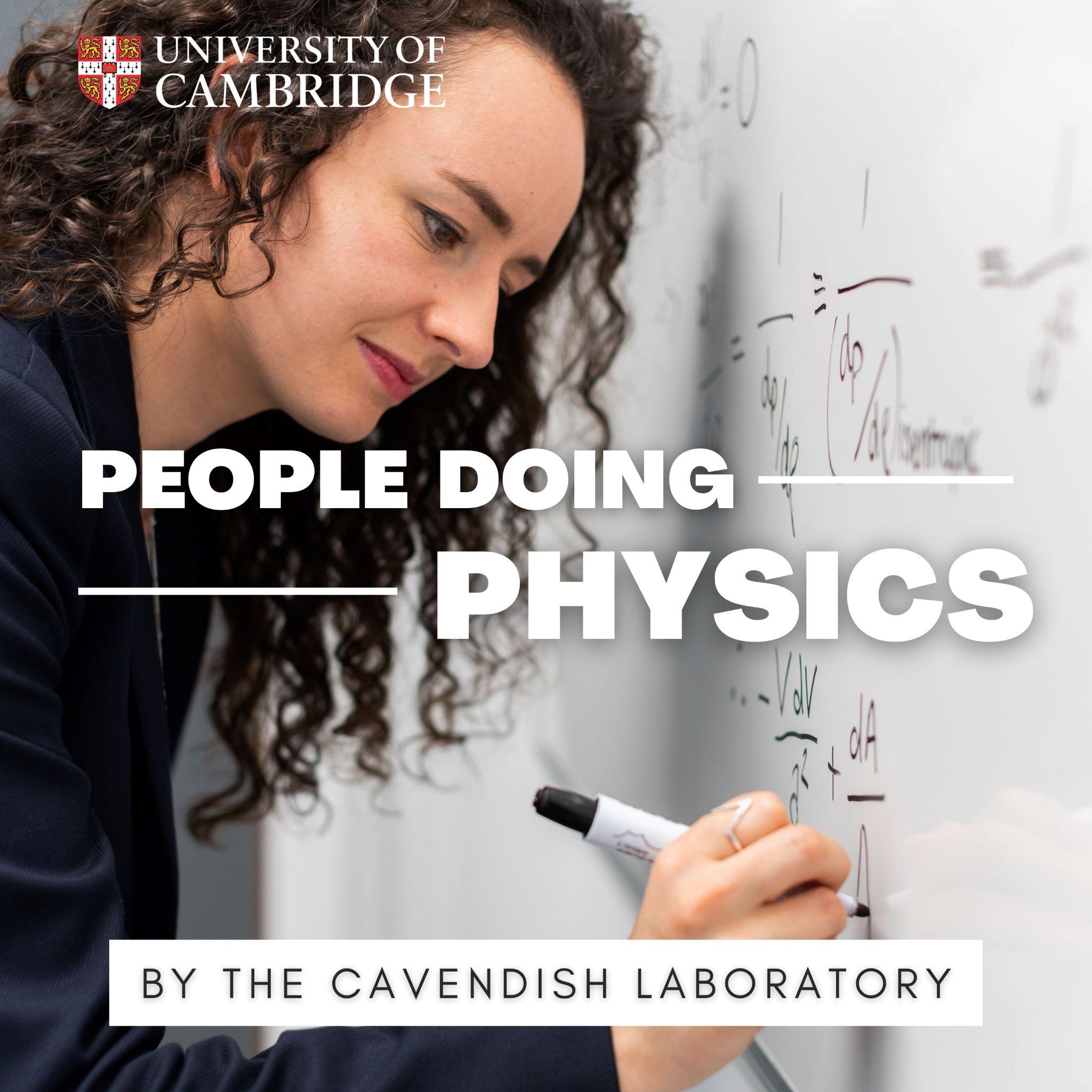
EPISODE · Jan 5, 2023 · 39 MIN
Sarah Bohndiek
from People doing Physics
Intro We’re joined today by Prof. Sarah Bohndiek, Professor of Biomedical Physics at the Cavendish Laboratory, Group Leader at the Cancer Research UK Cambridge Institute, and Fellow of Corpus Christi College. Born in Greenwich, Sarah found an early enthusiasm for science and went on to study Natural Sciences as an undergraduate student at Cambridge University. Drawn to interdisciplinary research, she completed a PhD in Radiation Physics at UCL’s Department of Medical Physics, looking at x-ray imaging techniques for cancer detection and working alongside biologists and chemists. Following this, Sarah moved towards optics, in order to become involved in clinical trials and took up postdoctoral positions in Cambridge and Stanford.Currently, her research group, the Vision Lab, looks to understand tumours using new medical imaging techniques, and Sarah is also particularly interested in the incredibly important process of standardising complex methods and datasets between laboratories. Alongside her research, she has championed public engagement and interdisciplinary research training, and pushes for open access, practical solutions to serious medical issues. Stay with us… Please help us get better by taking our quick survey! Your feedback will help us understand how we can improve in the future. Thank you for your time.[00:34] – Guest’s intro[02:03] – Growing up in Greenwich, fascination with Astrophysics and interest in physics[03:36] – Interest in using physics for medical application [08:35] – X-ray tomography techniques and working as part of the UK-wide consortium during PhD [12:05] – Inter-disciplinary aspect of work[13:27] – Importance of Physics of medicine building and holistic medical research approach [20:01] – In the news this month we talk about how reshaping RNA to an origami identifier opens new avenues for understanding and advancing disease diagnostics. RNA or ribonucleic acid is one of the key biological molecules that bridges our genetic information (DNA) and molecular factories (proteins). RNA has a single strand in comparison to double-stranded DNA helix. Labour-intensive approach of RNA sequencing suffers enzyme biases that causes the loss of native RNA information including RNA identity and quantity. Up until now, we could not detect RNA ‘makeup’, including its chemical modifications and overall shape. The mere order of bases in RNA could not tell us how that RNA looked. Researchers have recently developed a new method - Amplification-free RNA TargEt Multiplex Isoform Sensing (ARTEMIS) that has made possible the identification of multiple RNAs in parallel.[25:15] – Shift from imaging to NMR[29:16] – Current Research while leading the Vision Lab at the Cavendish[31:00] – Making improvement in the existing medical technologies(devices)[32:47] – Working with humongous datasets, open access and standardisation [36:12] – Future exciting development in medical imaging [38:59] – OutroUseful linksKnow more about Physics of Medicine research here. Read the article on this month’s news - Reshaping RNA to an origami identifier opens new avenues for understanding and advancing disease diagnosticsLink of the Research Paper for this month’s news release - Nanopore microscope identifies RNA isoforms with structural coloursTo learn more about the Cavendish Laboratory, or if you are interested in joining us or studying with us, go to www.phy.cam.ac.uk Share and join the conversationIf you like this episode, don’t forget to rate it and leave a review on your favourite podcast. Any comment about the podcast or question you would like to ask our physicists, email us at [email protected] or join the conversation on Twitter using the hashtag #PeopleDoingPhysics. Episode creditsHosts: Jacob Butler and Simone Eizagirre Barker News presenter: Paolo MoligniniProducer: Chris BrockThis podcast uses the following third-party services for analysis: OP3 - https://op3.dev/privacy
Embed this episode
What this episode covers
Our guest this month is Prof. Sarah Bohndiek, Professor of Biomedical Physics at the Cavendish Laboratory, Group Leader at the Cancer Research UK Cambridge Institute, and Fellow of Corpus Christi College. Currently, her research group, the Vision Lab, looks to understand tumours using new medical imaging techniques, and Sarah is also particularly interested in the incredibly important process of standardising complex methods and datasets between laboratories. Alongside her research, she has championed public engagement and interdisciplinary research training, and pushes for open access, practical solutions to serious medical issues. During the episode, we talk about her experiences growing up in Greenwich, her early interest in Astrophysics and subsequent movement into Biomedical physics, her research and future exciting developments in medical imaging.
NOW PLAYING
Sarah Bohndiek
No transcript for this episode yet
Similar Episodes
No similar episodes found.
Similar Podcasts
No similar podcasts found.