Saronic Technologies Autonomous Surface Vessels
from The Innovation Attorney Podcast Hosted by The Innovation Attorney
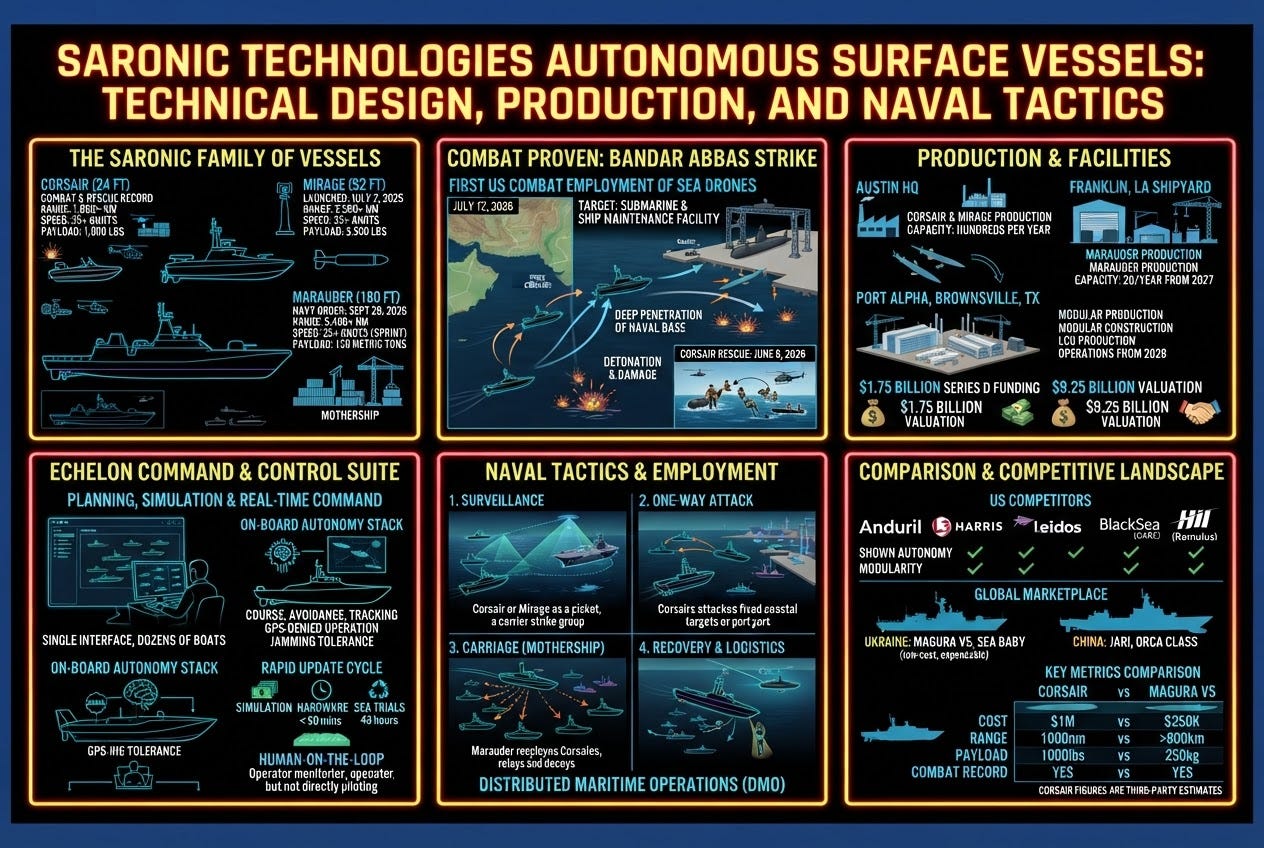
Saronic Technologies fields autonomous surface vessels in three production sizes, from the 24 foot Corsair that struck Bandar Abbas on July 12, 2026 to the 180 foot Marauder. Only the Corsair has a combat and rescue record, and its warhead, guidance mode, and damage results remain undisclosed. The 52 foot Mirage launched on July 2, 2026, and the Marauder received a Navy production order on September 29, 2026, as one of three suppliers in a 30 vessel purchase. Every range, speed, and payload figure comes from Saronic and has not been measured by an outside party. A fleet planner should read each hull as a delivery vehicle whose value depends on the targeting network behind it and the defenses it meets. Executive Summary Saronic Technologies of Austin, Texas builds the autonomous surface vessels that U.S. forces employed in combat for the first time on July 12, 2026. Three Corsair boats, each 24 feet long, struck a submarine and ship maintenance facility at the Bandar Abbas Naval Base, according to U.S. Central Command. On June 8, 2026, a Corsair operated by Task Force 59 had recovered two Army aviators from the water off Oman after their AH 64 Apache went down. Those two events moved the company from prototype supplier to wartime supplier in five weeks. The technical record comes from the company. Saronic lists the Corsair at 24 feet, above 35 knots, 1,000 nautical miles, and 1,000 pounds of payload. The Mirage is listed at 52 feet, above 35 knots, 2,500 nautical miles, and 3,500 pounds. The Marauder is listed at 180 feet, above 25 knots sprint and 12 knots cruise, 5,400 nautical miles, and 150 metric tons of containerized payload. The Echelon software suite plans, simulates, and commands these vessels from a single interface, and the company states that a single operator can supervise dozens of boats. Saronic closed a $1.75 billion Series D on March 31, 2026 at a $9.25 billion valuation. It operates a shipyard in Franklin, Louisiana, with a stated target of 20 Marauders per year beginning January 1, 2027, and it broke ground on a Brownsville, Texas shipyard named Port Alpha on September 30, 2026. The Navy order of 30 medium unmanned surface vessels averages $40 million per hull, with ten Marauders implied for Saronic. What Is the History of Saronic Technologies? Saronic Technologies was founded in 2022 in Austin, Texas, by Dino Mavrookas, a former Navy SEAL who served eleven years including time with SEAL Team Six, and Vibhav Altekar, an engineer formerly at Anduril. Doug Lambert, previously at Liquid Robotics and Terradepth, and Rob Lehman, a Marine veteran with 21 years of service, joined as chief operating and chief commercial officers. The company entered the 8VC Build Program and reports putting prototypes on the water within 180 days. The first public test came in April 2024 at Integrated Battle Problem 24.1, where the 6 foot Spyglass and the 14 foot Cutlass were integrated with Anduril’s Lattice command software and the Cutlass launched an Altius loitering munition. By October 2024 Saronic had five Corsair prototypes. The company raised a $600 million Series C in 2025 at a $4 billion valuation, acquired a 4.4 million square foot shipyard in Franklin, Louisiana, in April 2025, and unveiled the Echelon command suite on July 30, 2025. The Navy program around Saronic went through turbulence in 2025. A Navy test off California in mid 2025 ended with one autonomous boat stalling and a second boat riding over its deck. The vessels came from Saronic and BlackSea Technologies, and an anonymous source attributed the event to software failure and human error. The Defense Innovation Unit paused a contract worth nearly $20 million for autonomy software supplied by L3Harris, and the Navy removed the head of its unmanned and small combatants program office. The Navy then replaced its Modular Attack Surface Craft effort with the Medium Unmanned Surface Vessel Marketplace. Saronic’s production commitment followed. A $392 million Navy production award for Corsair was announced in 2025, and other reports place the Corsair production agreement above $400 million. Task Force 59, the 5th Fleet unit created in September 2021 to field unmanned and artificial intelligence systems, began receiving Corsairs in March 2026. The Series D closed on March 31, 2026, led by Kleiner Perkins. Combat followed within weeks. The Corsair rescue on June 8, 2026 became the first publicly reported personnel recovery by an unmanned surface vessel. The Bandar Abbas strike on July 12, 2026 became the first American combat employment of sea drones, in the words of the Central Command announcement. The Mirage launched on July 2, 2026, the Marauder hull entered the water at Franklin in late May 2026, and the Navy announced its 30 vessel medium unmanned surface vessel order on September 29, 2026. Port Alpha broke ground the next day, with the Vice President and the Governor of Texas in attendance. In late 2025 the company listed the Mirage at 40 feet, 2,000 nautical miles, and 2,000 pounds, and the Marauder at 150 feet, 3,500 nautical miles, and about 36 to 40 metric tons. The current figures are 52 feet, 2,500 nautical miles, and 3,500 pounds for the Mirage, and 180 feet, 5,400 nautical miles, and 150 metric tons for the Marauder. The Mirage gained 12 feet of published length between concept and launch, and the Marauder gained 30, so the published tables describe design intent that is still moving. The Navy’s unmanned surface program has a longer lineage than Saronic. DARPA and the Navy built the 132 foot Sea Hunter and Sea Hawk trimarans through Leidos, and the Navy tested a medium vessel prototype from L3Harris under a $34.9 million award in 2020. The Pentagon launched Replicator in 2023 with about $1 billion to buy thousands of aerial and maritime drones, and a reconciliation bill passed in July 2025 included almost $5 billion for maritime autonomous systems. The Navy created Surface Development Group One to carry its small and medium vessels into the fleet, and it established a Robotic and Autonomous Systems Warfighting Development Center. Military Sealift Command conducted astern refueling of the experimental medium vessel Seahawk from the oiler USNS Guadalupe off Southern California on April 15, 2026, which addressed one of the logistics gaps for large uncrewed ships. Saronic entered that program as a company with money and a pace of delivery that the earlier programs lacked. It carried a risk those programs also had: the first boats the Navy bought in large numbers had not yet fought. The Gulf became the proving ground because Task Force 59 had worked there since September 2021, running unmanned vessels across the Persian Gulf, the Gulf of Oman, the Red Sea, the Gulf of Aden, and the Arabian Sea. The Houthis had used explosive surface boats against ships in the Red Sea, and Iran had experimented with explosive boats for years, so the region already held both the threat and the Navy’s operators. Saronic states that a Corsair endured conditions in a January 2026 test that no human operator could have withstood. The Corsair reached the Middle East in March 2026, and Task Force 59 used it for surveillance in the Gulf of Oman in late March. Eleven weeks later it was recovering aviators. What Are the Technical Specifications of the Saronic Corsair? The Corsair is a 24 foot, diesel powered autonomous surface vessel that Saronic rates above 35 knots, beyond 1,000 nautical miles, and at 1,000 pounds of payload capacity. The Navy bought it under a production agreement announced in 2025 at $392 million, and Task Force 59 began fielding it in the Gulf region in March 2026. It is the only Saronic hull with documented operational use. Mechanism The hull carries a low profile and shallow draft, which reduces its radar and visual return and lets it close shorelines and piers that deeper craft avoid. Passive sensors give 360 degree coverage day and night, and an electro optical sensor supports observation of the tar… This is a public episode. If you'd like to discuss this with other subscribers or get access to bonus episodes, visit theinnovationattorney.substack.com/subscribe
Embed this episode
No transcript yet.